Major Banks Shift from Risk Containment to Active Engagement in Cryptocurrency Historically, leading banks regarded cryptocurrencies as high-risk assets, often Major Banks Shift from Risk Containment to Active Engagement in Cryptocurrency Historically, leading banks regarded cryptocurrencies as high-risk assets, often

Wall Street Embraces Digital Assets as Banks Go Onchain
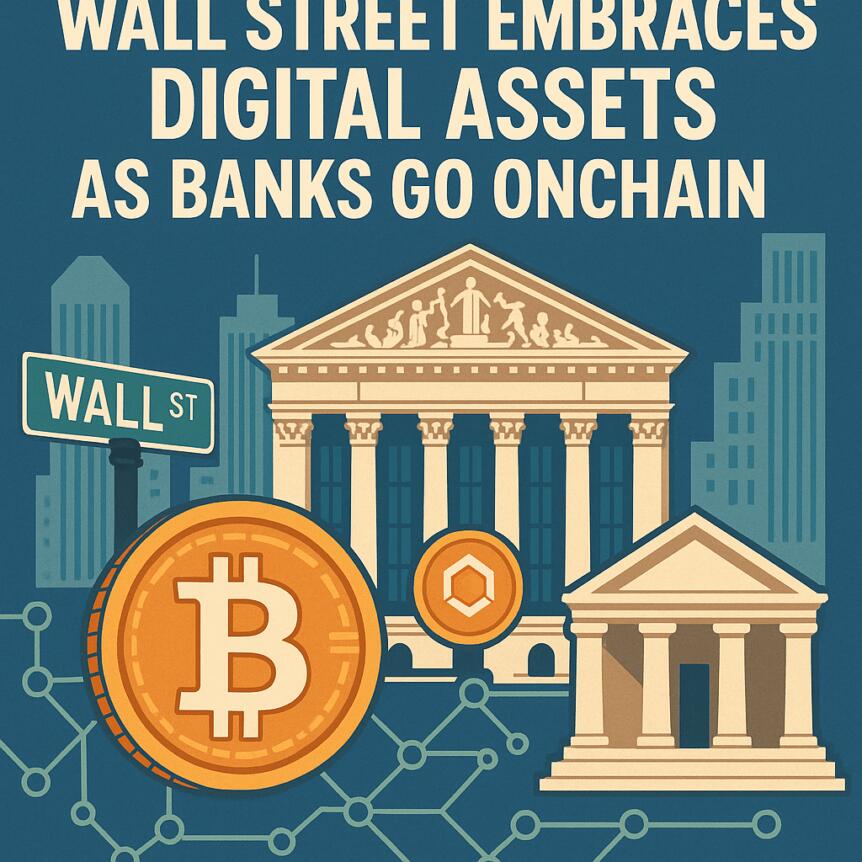
Wall Street Embraces Digital Assets As Banks Go Onchain

Major Banks Shift from Risk Containment to Active Engagement in Cryptocurrency

Historically, leading banks regarded cryptocurrencies as high-risk assets, often seeking to limit their exposure. However, recent developments reveal a decisive move toward integrating digital assets into mainstream financial services. This transition encompasses a broad range of initiatives, from blockchain-based payment channels to tokenized digital cash, indicating a more sophisticated approach to digital currency adoption by traditional banking institutions.

This evolving stance is exemplified by several key moves in the industry. JPMorgan is expanding its US dollar deposit token, JPM Coin, onto the Canton Network, signaling a significant step toward infrastructure that supports real-world application of tokenized fiat currency. Morgan Stanley is preparing to introduce ETFs that provide exposure to Bitcoin and Solana, making these assets accessible to a broader client base. Meanwhile, Barclays has invested in Ubyx, a stablecoin settlement infrastructure company, marking its foray into digital dollar settlement solutions. Additionally, Bank of America has authorized its advisers to recommend spot Bitcoin ETFs to clients, further blurring the line between traditional finance and the crypto ecosystem.

JPMorgan Advances Digital Cash Infrastructure

JPMorgan announced plans to deploy JPM Coin, its US dollar-denominated deposit token, onto the Canton Network—a highly secure, privacy-focused layer-1 blockchain developed by Digital Asset and Kinexys. This move reflects a strategic push to facilitate cross-border and inter-institutional settlement through regulated digital cash, reducing settlement times and enhancing security for institutional clients.

JPM Coin is designed as a digital claim on JPMorgan’s dollar deposits, providing a faster, secure means of transferring funds across interoperable blockchain networks. According to Yuval Rooz, CEO of Digital Asset, this collaboration operationalizes the long-held industry vision of regulated digital cash capable of operating seamlessly at market speed.

Morgan Stanley Ventures into Crypto ETFs

Following the success of spot Bitcoin ETFs in the United States, Morgan Stanley has filed with the SEC to launch the Morgan Stanley Bitcoin Trust and the Morgan Stanley Solana Trust. These funds aim to offer passive exposure to Bitcoin and Solana, respectively, potentially broadening investment access to millions of wealth management clients.

If approved, these ETFs could stand among the most successful in the industry, attracting significant inflows given the strong investor appetite for crypto-related investment vehicles. The ongoing momentum in Bitcoin ETF launches continues to underscore institutional recognition of cryptocurrencies as core assets.

Barclays Invests in Stablecoin Infrastructure

London-based Barclays has made its first strategic investment in Ubyx, a platform facilitating stablecoin settlement within regulated environments. This aligns with Barclays’ interest in exploring digital money infrastructure, despite previous cautionary stances on digital assets. Ubyx, supported by notable investors like Coinbase and Galaxy, aims to enable interoperability between stablecoin issuers and financial institutions, underscoring the sector’s push toward foundational digital dollar work.

Bank of America Endorses Bitcoin ETF Recommendations

Bank of America has begun permitting its wealth advisers to recommend Bitcoin ETFs from providers like BlackRock, Fidelity, and Grayscale. This development indicates a growing institutional acceptance of digital assets and signals that traditional investors could soon receive targeted investment advice in the crypto space. The move follows reports that the bank’s private wealth division has suggested a modest 1-4% allocation of digital assets, reflecting increasing confidence in cryptocurrencies’ role within diversified portfolios.

This article was originally published as Wall Street Embraces Digital Assets as Banks Go Onchain on Crypto Breaking News – your trusted source for crypto news, Bitcoin news, and blockchain updates.


Market Opportunity
Major Logo
Major Price(MAJOR)
$0.12778
$0.12778$0.12778
-0.54%
USD
Major (MAJOR) Live Price Chart
Disclaimer: The articles reposted on this site are sourced from public platforms and are provided for informational purposes only. They do not necessarily reflect the views of MEXC. All rights remain with the original authors. If you believe any content infringes on third-party rights, please contact service@support.mexc.com for removal. MEXC makes no guarantees regarding the accuracy, completeness, or timeliness of the content and is not responsible for any actions taken based on the information provided. The content does not constitute financial, legal, or other professional advice, nor should it be considered a recommendation or endorsement by MEXC.

You May Also Like

The Channel Factories We’ve Been Waiting For

The Channel Factories We’ve Been Waiting For

The post The Channel Factories We’ve Been Waiting For appeared on BitcoinEthereumNews.com. Visions of future technology are often prescient about the broad strokes while flubbing the details. The tablets in “2001: A Space Odyssey” do indeed look like iPads, but you never see the astronauts paying for subscriptions or wasting hours on Candy Crush.  Channel factories are one vision that arose early in the history of the Lightning Network to address some challenges that Lightning has faced from the beginning. Despite having grown to become Bitcoin’s most successful layer-2 scaling solution, with instant and low-fee payments, Lightning’s scale is limited by its reliance on payment channels. Although Lightning shifts most transactions off-chain, each payment channel still requires an on-chain transaction to open and (usually) another to close. As adoption grows, pressure on the blockchain grows with it. The need for a more scalable approach to managing channels is clear. Channel factories were supposed to meet this need, but where are they? In 2025, subnetworks are emerging that revive the impetus of channel factories with some new details that vastly increase their potential. They are natively interoperable with Lightning and achieve greater scale by allowing a group of participants to open a shared multisig UTXO and create multiple bilateral channels, which reduces the number of on-chain transactions and improves capital efficiency. Achieving greater scale by reducing complexity, Ark and Spark perform the same function as traditional channel factories with new designs and additional capabilities based on shared UTXOs.  Channel Factories 101 Channel factories have been around since the inception of Lightning. A factory is a multiparty contract where multiple users (not just two, as in a Dryja-Poon channel) cooperatively lock funds in a single multisig UTXO. They can open, close and update channels off-chain without updating the blockchain for each operation. Only when participants leave or the factory dissolves is an on-chain transaction…
Share
BitcoinEthereumNews2025/09/18 00:09
Onyxcoin Price Breakout Coming — Is a 38% Move Next?

Onyxcoin Price Breakout Coming — Is a 38% Move Next?

The post Onyxcoin Price Breakout Coming — Is a 38% Move Next? appeared on BitcoinEthereumNews.com. Onyxcoin price action has entered a tense standoff between bulls
Share
BitcoinEthereumNews2026/01/14 00:33
CEO Sandeep Nailwal Shared Highlights About RWA on Polygon

CEO Sandeep Nailwal Shared Highlights About RWA on Polygon

The post CEO Sandeep Nailwal Shared Highlights About RWA on Polygon appeared on BitcoinEthereumNews.com. Polygon CEO Sandeep Nailwal highlighted Polygon’s lead in global bonds, Spiko US T-Bill, and Spiko Euro T-Bill. Polygon published an X post to share that its roadmap to GigaGas was still scaling. Sentiments around POL price were last seen to be bearish. Polygon CEO Sandeep Nailwal shared key pointers from the Dune and RWA.xyz report. These pertain to highlights about RWA on Polygon. Simultaneously, Polygon underlined its roadmap towards GigaGas. Sentiments around POL price were last seen fumbling under bearish emotions. Polygon CEO Sandeep Nailwal on Polygon RWA CEO Sandeep Nailwal highlighted three key points from the Dune and RWA.xyz report. The Chief Executive of Polygon maintained that Polygon PoS was hosting RWA TVL worth $1.13 billion across 269 assets plus 2,900 holders. Nailwal confirmed from the report that RWA was happening on Polygon. The Dune and https://t.co/W6WSFlHoQF report on RWA is out and it shows that RWA is happening on Polygon. Here are a few highlights: – Leading in Global Bonds: Polygon holds 62% share of tokenized global bonds (driven by Spiko’s euro MMF and Cashlink euro issues) – Spiko U.S.… — Sandeep | CEO, Polygon Foundation (※,※) (@sandeepnailwal) September 17, 2025 The X post published by Polygon CEO Sandeep Nailwal underlined that the ecosystem was leading in global bonds by holding a 62% share of tokenized global bonds. He further highlighted that Polygon was leading with Spiko US T-Bill at approximately 29% share of TVL along with Ethereum, adding that the ecosystem had more than 50% share in the number of holders. Finally, Sandeep highlighted from the report that there was a strong adoption for Spiko Euro T-Bill with 38% share of TVL. He added that 68% of returns were on Polygon across all the chains. Polygon Roadmap to GigaGas In a different update from Polygon, the community…
Share
BitcoinEthereumNews2025/09/18 01:10