This article presents a non-convex approach to learning in hyperbolic spaces. We apply semidefinite relaxation and sparse moment-sum-of-squares relaxation to effectivelyThis article presents a non-convex approach to learning in hyperbolic spaces. We apply semidefinite relaxation and sparse moment-sum-of-squares relaxation to effectively

Beyond Euclidean Space: Optimizing Hierarchical Data in Hyperbolic HSVMs

Abstract and 1. Introduction

  1. Related Works

  2. Convex Relaxation Techniques for Hyperbolic SVMs

    3.1 Preliminaries

    3.2 Original Formulation of the HSVM

    3.3 Semidefinite Formulation

    3.4 Moment-Sum-of-Squares Relaxation

  3. Experiments

    4.1 Synthetic Dataset

    4.2 Real Dataset

  4. Discussions, Acknowledgements, and References

    \

A. Proofs

B. Solution Extraction in Relaxed Formulation

C. On Moment Sum-of-Squares Relaxation Hierarchy

D. Platt Scaling [31]

E. Detailed Experimental Results

F. Robust Hyperbolic Support Vector Machine

Abstract

Hyperbolic spaces have increasingly been recognized for their outstanding performance in handling data with inherent hierarchical structures compared to their Euclidean counterparts. However, learning in hyperbolic spaces poses significant challenges. In particular, extending support vector machines to hyperbolic spaces is in general a constrained non-convex optimization problem. Previous and popular attempts to solve hyperbolic SVMs, primarily using projected gradient descent, are generally sensitive to hyperparameters and initializations, often leading to suboptimal solutions. In this work, by first rewriting the problem into a polynomial optimization, we apply semidefinite relaxation and sparse moment-sum-of-squares relaxation to effectively approximate the optima. From extensive empirical experiments, these methods are shown to perform better than the projected gradient descent approach.

1 Introduction

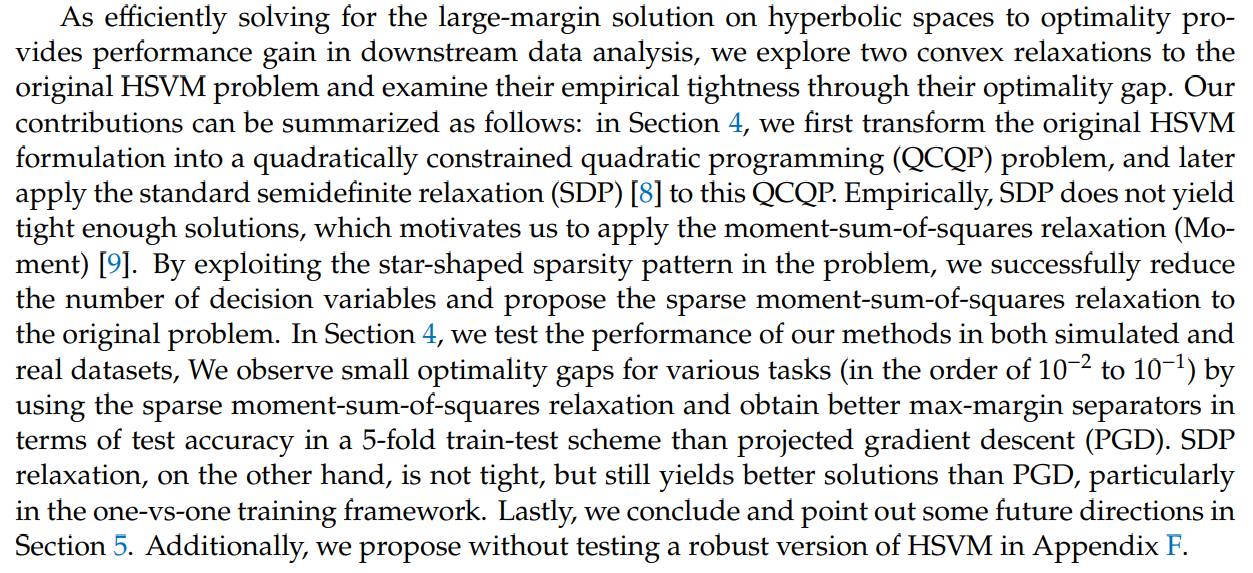
\ On the other hand, learning and optimization on hyperbolic spaces are typically more involved than that on Euclidean spaces. Problems that are convex in Euclidean spaces become constrained non-convex problems in hyperbolic spaces. The hyperbolic Support Vector Machine (HSVM), as explored in recent studies [4, 5], exemplifies such challenges by presenting as a non-convex constrained programming problem that has been solved predominantly based on projected gradient descent. Attempts have been made to alleviate its non-convex nature through reparametrization [6] or developing a hyperbolic perceptron algorithm that converges to a separator with finetuning using adversarial samples to approximate the large-margin solution [7]. To our best knowledge, these attempts are grounded in the gradient descent dynamics, which is highly sensitive to initialization and hyperparameters and cannot certify optimality.

\
\

:::info This paper is available on arxiv under CC by-SA 4.0 Deed (Attribution-Sharealike 4.0 International) license.

:::

\

:::info Authors:

(1) Sheng Yang, John A. Paulson School of Engineering and Applied Sciences, Harvard University, Cambridge, MA (shengyang@g.harvard.edu);

(2) Peihan Liu, John A. Paulson School of Engineering and Applied Sciences, Harvard University, Cambridge, MA (peihanliu@fas.harvard.edu);

(3) Cengiz Pehlevan, John A. Paulson School of Engineering and Applied Sciences, Harvard University, Cambridge, MA, Center for Brain Science, Harvard University, Cambridge, MA, and Kempner Institute for the Study of Natural and Artificial Intelligence, Harvard University, Cambridge, MA (cpehlevan@seas.harvard.edu).

:::

\

Disclaimer: The articles reposted on this site are sourced from public platforms and are provided for informational purposes only. They do not necessarily reflect the views of MEXC. All rights remain with the original authors. If you believe any content infringes on third-party rights, please contact service@support.mexc.com for removal. MEXC makes no guarantees regarding the accuracy, completeness, or timeliness of the content and is not responsible for any actions taken based on the information provided. The content does not constitute financial, legal, or other professional advice, nor should it be considered a recommendation or endorsement by MEXC.

You May Also Like

South Korea Launches Innovative Stablecoin Initiative

South Korea Launches Innovative Stablecoin Initiative

The post South Korea Launches Innovative Stablecoin Initiative appeared on BitcoinEthereumNews.com. South Korea has witnessed a pivotal development in its cryptocurrency landscape with BDACS introducing the nation’s first won-backed stablecoin, KRW1, built on the Avalanche network. This stablecoin is anchored by won assets stored at Woori Bank in a 1:1 ratio, ensuring high security. Continue Reading:South Korea Launches Innovative Stablecoin Initiative Source: https://en.bitcoinhaber.net/south-korea-launches-innovative-stablecoin-initiative
Share
BitcoinEthereumNews2025/09/18 17:54
Hong Kong Backs Commercial Bank Tokenized Deposits in 2025

Hong Kong Backs Commercial Bank Tokenized Deposits in 2025

The post Hong Kong Backs Commercial Bank Tokenized Deposits in 2025 appeared on BitcoinEthereumNews.com. HKMA to support tokenized deposits and regular issuance of digital bonds. SFC drafting licensing framework for trading, custody, and stablecoin issuers. New rules will cover stablecoin issuers, digital asset trading, and custody services. Hong Kong is stepping up its digital finance ambitions with a policy blueprint that places tokenization at the core of banking innovation.  In the 2025 Policy Address, Chief Executive John Lee outlined measures that will see the Hong Kong Monetary Authority (HKMA) encourage commercial banks to roll out tokenized deposits and expand the city’s live tokenized-asset transactions. Hong Kong’s Project Ensemble to Drive Tokenized Deposits Lee confirmed that the HKMA will “continue to take forward Project Ensemble, including encouraging commercial banks to introduce tokenised deposits, and promoting live transactions of tokenised assets, such as the settlement of tokenised money market funds with tokenised deposits.” The initiative aims to embed tokenized deposits, bank liabilities represented as blockchain-based tokens, into mainstream financial operations. These deposits could facilitate the settlement of money-market funds and other financial instruments more quickly and efficiently. To ensure a controlled rollout, the HKMA will utilize its regulatory sandbox to enable banks to test tokenized products while enhancing risk management. Tokenized Bonds to Become a Regular Feature Beyond deposits, the government intends to make tokenized bond issuance a permanent element of Hong Kong’s financial markets. After successful pilots, including green bonds, the HKMA will help regularize the issuance process to build deep and liquid markets for digital bonds accessible to both local and international investors. Related: Beijing Blocks State-Owned Firms From Stablecoin Businesses in Hong Kong Hong Kong’s Global Financial Role The policy address also set out a comprehensive regulatory framework for digital assets. Hong Kong is implementing a regime for stablecoin issuers and drafting licensing rules for digital asset trading and custody services. The Securities…
Share
BitcoinEthereumNews2025/09/18 07:10
Jerome Powell & A Hard Money Moment

Jerome Powell & A Hard Money Moment

With Trump teeing up a personally controlled Federal Reserve, hard money seems like an easy bet, but Bitcoin and gold aren't behaving the same.
Share
Coinstats2026/01/15 06:30




