Meet Saaniya Chugh - HackerNoon Writing Course Guest Speaker
\
Tell Us A Bit About Yourself
I’m Saaniya Chugh, a Senior Technical Consultant at ServiceNow with a background in IT service management, digital transformation, and AI-driven automation. Over the last decade, I’ve worked across consulting, strategy, and leadership roles, helping organizations harness technology in meaningful ways.
Alongside my professional journey, I’m passionate about writing and storytelling especially making complex ideas in ITSM and AI accessible to everyone. I’ve published thought pieces, contributed to HackerNoon, and recently authored a book exploring how enterprises can integrate AI into their IT ecosystems.
At the heart of everything I do is a simple goal: to empower people, whether they’re readers, learners, or fellow professionals - to see technology not just as a tool, but as a collaborator in creativity and growth.
\
What Sparked Your Interest in the World of Writing or Storytelling?
For me, writing started as a way of making sense of things. I’ve always been surrounded by complex ideas in technology and business, and I realized early on that if I couldn’t explain something simply, I probably didn’t understand it deeply enough myself. Writing became my way of breaking things down - first for me, and then for others.
On a more personal note, I’ve always loved stories. Growing up, I would hear my grandmother tell the same bedtime story over and over again, and yet every time, it felt new because of the way she told it. That taught me something powerful: stories aren’t just about information, they’re about connection.
So when I started publishing articles, and later my book, it wasn’t just about documenting knowledge. It was about creating a bridge, between technical and non-technical, between machines and people, between ideas and emotions. That’s what keeps me hooked: the ability of words to connect us in ways no algorithm ever fully can.
\
\
What Areas or Topics Are You Most Passionate About, and Why?
I’m most passionate about the space where IT Service Management, AI, and consulting intersect. ITSM has been the foundation of my career - it’s the discipline that taught me how structure, governance, and processes can enable organizations to scale responsibly. Over the years, I’ve seen ITSM evolve from being perceived as “just the plumbing of tech” into a strategic enabler of digital transformation.
What really excites me now is how AI is reshaping this space. Intelligent automation, predictive insights, and generative models are no longer buzzwords, they’re becoming part of everyday IT operations. For me, writing about this isn’t just about documenting technology, it’s about helping people understand how these tools can make their work more meaningful, reduce repetitive toil, and open up creative possibilities.
As a consultant, I get to work directly with enterprises that are figuring out how to bring these technologies into their environments. Writing about ITSM and AI lets me share those lessons more widely, taking what I’ve learned in boardrooms, client workshops, and transformation projects, and making it accessible to readers everywhere. It’s a way of bridging worlds: between technical and business, between curiosity and clarity, and between today’s challenges and tomorrow’s opportunities.
\
Can You Share a Defining Moment in Your Career?
I’ve had two defining moments that shaped my career in very different but connected ways.
The first came during a major ITSM transformation project early in my consulting career. I was focused on the “how” - how to configure systems, how to automate workflows. But a client once asked me, “Saaniya, we know you can make the technology work. But what we really need is your perspective: how should we change as an organization?” That shifted everything for me. It made me realize that technology is only half the story - the real value comes when you can guide people, build trust, and align systems with culture and business outcomes. That question pushed me to step into strategic thinking, which later led me into AI-driven ITSM, where the conversations aren’t just about tools but about reshaping how work itself is done.
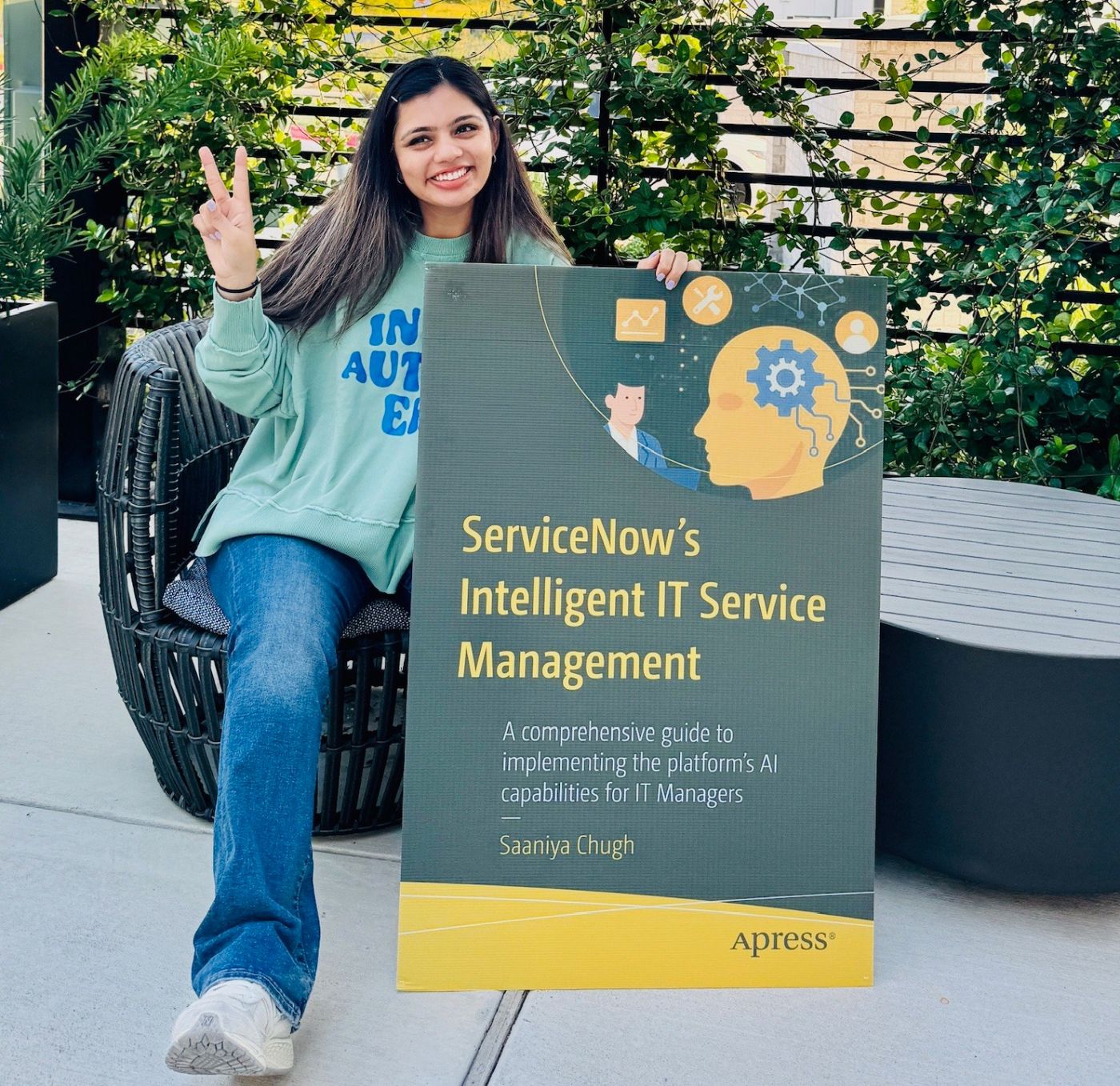
The second moment came when I published my first article on LinkedIn. Until then, writing felt personal, notes to myself, occasional blogs. But when that article went live, people across the world started engaging with it. That was the moment I realized writing wasn’t just about sharing knowledge; it was about joining a global conversation, simplifying complex ideas, and giving people the confidence to approach technology differently. That led me to keep writing, eventually publishing my book, ServiceNow’s Intelligent IT Service Management.
Together, these two moments taught me that my role isn’t just about implementing systems or writing words, it’s about creating connection. Whether it’s guiding an enterprise through change or helping a reader understand AI through a story, the lesson is the same: expertise matters, but empathy and perspective matter more.
\
How Do You See the Role of Content and Storytelling Evolving in the Digital Age?
I think the biggest shift is that content is no longer just about information - it’s about connection and context. In the past, storytelling was mostly one-way: you wrote, and readers consumed. Today, with AI, social platforms, and interactive formats, content has become a dialogue. Readers don’t just want facts, they want narratives they can relate to, voices they can trust, and stories that reflect both technology and human experience.
We’re also entering an age where discoverability is changing. With AI engines summarizing and surfacing content, it’s not enough to simply optimize for search engines anymore. Writers need to think about clarity, authority, and voice, because that’s what ensures your work gets cited, shared, and remembered.
Looking ahead, I believe storytelling will become even more important as technology advances. AI can generate words, but it can’t generate meaning. The role of the writer will be to weave together facts, insights, and emotions in a way that machines can’t replicate. For me, that’s the exciting part: the digital age doesn’t diminish the value of human storytelling, it magnifies it. Writers who embrace tools like AI as collaborators, while holding on to their authentic voice, will shape the narratives of the future.
\
Why Did You Decide to Support the HackerNoon Writing Course as a Guest Speaker?
I chose to support the HackerNoon Writing Course because I truly believe in the power of community-driven learning. HackerNoon has always been a place where diverse voices come together to share ideas, challenge norms, and simplify complex technology for everyone. Being invited as a guest speaker felt like a natural extension of what I already love doing, making AI and IT concepts accessible, and inspiring others to find their own voice in the process.
I genuinely love HackerNoon both as a writer and as a reader. As a writer, it has given me the opportunity to share my perspective with a global audience; as a reader, it has exposed me to bold, curious voices that keep me learning every day. It has provided opportunities to grow in both spaces, and I’m deeply grateful for that.
For me, writing has been more than a skill - it’s been a way to connect across cultures, industries, and generations. I know how intimidating it can feel to put your words out into the world for the first time, and I want to help new writers see AI not as a threat, but as a collaborator that can amplify their reach and creativity.
My hope is to add value by sharing both the technical insights I’ve gained from consulting and the storytelling lessons I’ve learned from my own journey and if even one aspiring writer walks away with the confidence to hit “publish,” I’ll consider my role a success.
\
What Advice Would You Give to New Writers?
My first piece of advice is: just start writing. Don’t wait for the “perfect” topic, the “perfect” draft, or the “perfect” timing, because they never come. The act of putting words on the page is where the real clarity emerges.
Second, write for connection, not perfection. Whether you’re explaining a technical concept or sharing a personal story, your job as a writer isn’t to sound flawless, it’s to make someone feel understood. That’s where your voice matters more than polished grammar or trendy buzzwords.
Third, don’t be afraid to use AI as a collaborator. It can help you brainstorm, outline, or simplify your drafts, but remember: it’s scaffolding, not the house. The real power comes from your perspective, your experiences, your stories.
Finally, be consistent. Writing is like building a muscle; the more you practice, the stronger your voice becomes. Celebrate the small wins: publishing that first blog, getting your first comment, hitting “send” on a newsletter. Each step builds confidence.
Above all, remember this: your words have the power to create connection. Somewhere out there, someone needs to hear your story told in your way.
\ If you’d like to continue the conversation or share your own journey, I’d be happy to connect. You can find my work here:
📖 HackerNoon : https://hackernoon.com/u/saaniyachugh
💼 LinkedIn: https://www.linkedin.com/in/saaniyachugh/
🌐 Know more about my 1st book: https://link.springer.com/book/10.1007/979-8-8688-1706-9
I’m always open to hearing new ideas, stories, or perspectives. So if something I’ve said resonates with you, or if you’re just starting out and want a little encouragement, please feel free to reach out anytime. I’d love to connect, listen, and learn alongside you.
\ 
\
\


You May Also Like

XRP Price: One Analyst Says 530% Rally Is Coming — Here’s the Chart Behind It

What Are Malicious LLM Routers and How Can They Steal Your Crypto?