Crypto phishing losses plunged 83% to $83.85 million in 2025 from $494 million the previous year, according to a Scam Sniffer report. Victims fell 68% to 106,106Crypto phishing losses plunged 83% to $83.85 million in 2025 from $494 million the previous year, according to a Scam Sniffer report. Victims fell 68% to 106,106

Crypto phishing losses plunge 83% to $84M, report finds

Crypto phishing losses plunged 83% to $83.85 million in 2025 from $494 million the previous year, according to a Scam Sniffer report.

Summary
  • Signature phishing losses fell to $83.9M in 2025, down sharply from $494M in 2024.
  • Victim count dropped 68% as large phishing cases over $1M became far less common.
  • Losses peaked during Q3 market rallies, then fell sharply as trading activity cooled.

Victims fell 68% to 106,106 from 332,000 in 2024, with the largest single theft dropping 88.3% to $6.5 million from $55.48 million.

Large cases exceeding $1 million declined 63.3% to 11 incidents from 30 in 2024. The data covers wallet drainer attacks via phishing websites on EVM-compatible chains, excluding direct hacks, exchange compromises, and smart contract exploits.

Q3 peak correlates with market rally

Third quarter crypto phishing losses totaled $31.04 million across 39,886 victims, coinciding with Ethereum’s strongest rally period. The quarter accounted for 37% of annual losses while representing one-quarter of the calendar year.

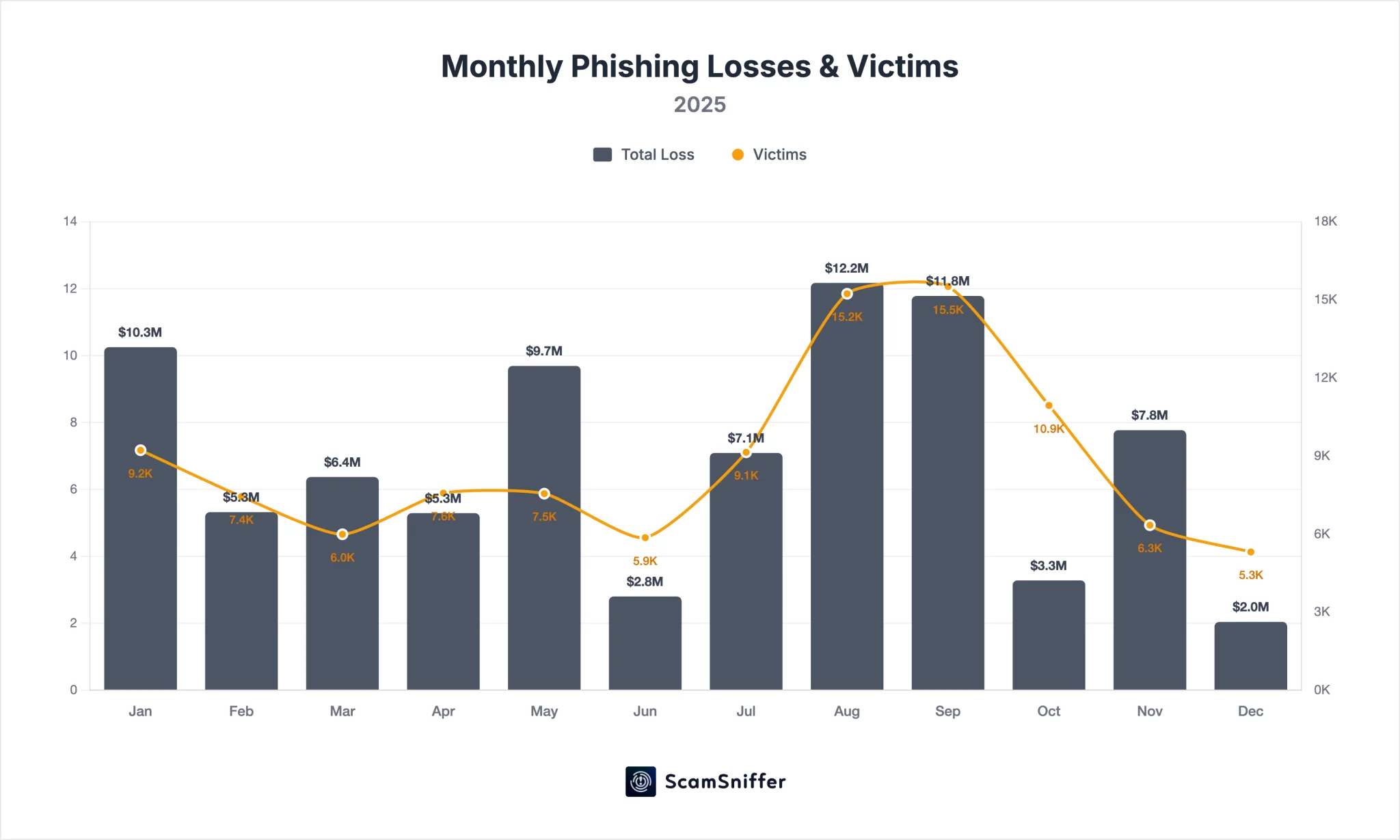
August and September combined for $23.95 million in losses, representing 29% of yearly totals during the market’s most active trading period. Average loss per victim stood at $778 in Q3, down from $969 in Q1.
Crypto phishing losses plunge 83% to $84M, report finds - 1

Fourth quarter saw the sharpest decline with just $13.09 million in losses across 22,592 victims as markets cooled. December posted the lowest monthly total at $2.04 million with 5,313 victims.

“Market-Loss Correlation: Q3’s highest losses ($31M) coincided with ETH’s strongest rally. More market activity = more potential victims,” the report stated. “Phishing operates as a probability function of user activity.”

November presented an anomaly with losses surging 137% while victim count dropped 42%. Average loss per victim jumped to $1,225 from $580 in October, though the report characterized this as monthly fluctuation rather than confirmed trend.

EIP-7702 exploitation surfaces post-Pectra

Crypto phishing attackers exploited EIP-7702 account abstraction features shortly after the Pectra upgrade, bundling multiple malicious operations into single signatures.

August saw the largest EIP-7702 cases totaling $2.54 million across two incidents.

Permit and Permit2 signatures accounted for $8.72 million across three cases, representing 38% of large-case losses.

Transfer-based attacks totaled $4.87 million across two incidents, while Approve and increaseApproval signatures combined for $5.62 million across three cases.

The largest 2025 theft involved $6.5 million in stETH and aEthWBTC stolen via Permit signature in September.

A May attack extracted $3.13 million in WBTC through increaseApproval, while August saw $3.05 million in aEthUSDT stolen via Transfer signature.

Six of the 11 cases exceeding $1 million occurred during July through September, aligning with peak market activity. Total large-case losses reached $22.98 million, representing 27% of the yearly total.


Market Opportunity
Scamcoin Logo
Scamcoin Price(SCAM)
$0,00109
$0,00109$0,00109
+1,58%
USD
Scamcoin (SCAM) Live Price Chart
Disclaimer: The articles reposted on this site are sourced from public platforms and are provided for informational purposes only. They do not necessarily reflect the views of MEXC. All rights remain with the original authors. If you believe any content infringes on third-party rights, please contact service@support.mexc.com for removal. MEXC makes no guarantees regarding the accuracy, completeness, or timeliness of the content and is not responsible for any actions taken based on the information provided. The content does not constitute financial, legal, or other professional advice, nor should it be considered a recommendation or endorsement by MEXC.

You May Also Like

Shocking OpenVPP Partnership Claim Draws Urgent Scrutiny

Shocking OpenVPP Partnership Claim Draws Urgent Scrutiny

The post Shocking OpenVPP Partnership Claim Draws Urgent Scrutiny appeared on BitcoinEthereumNews.com. The cryptocurrency world is buzzing with a recent controversy surrounding a bold OpenVPP partnership claim. This week, OpenVPP (OVPP) announced what it presented as a significant collaboration with the U.S. government in the innovative field of energy tokenization. However, this claim quickly drew the sharp eye of on-chain analyst ZachXBT, who highlighted a swift and official rebuttal that has sent ripples through the digital asset community. What Sparked the OpenVPP Partnership Claim Controversy? The core of the issue revolves around OpenVPP’s assertion of a U.S. government partnership. This kind of collaboration would typically be a monumental endorsement for any private cryptocurrency project, especially given the current regulatory climate. Such a partnership could signify a new era of mainstream adoption and legitimacy for energy tokenization initiatives. OpenVPP initially claimed cooperation with the U.S. government. This alleged partnership was said to be in the domain of energy tokenization. The announcement generated considerable interest and discussion online. ZachXBT, known for his diligent on-chain investigations, was quick to flag the development. He brought attention to the fact that U.S. Securities and Exchange Commission (SEC) Commissioner Hester Peirce had directly addressed the OpenVPP partnership claim. Her response, delivered within hours, was unequivocal and starkly contradicted OpenVPP’s narrative. How Did Regulatory Authorities Respond to the OpenVPP Partnership Claim? Commissioner Hester Peirce’s statement was a crucial turning point in this unfolding story. She clearly stated that the SEC, as an agency, does not engage in partnerships with private cryptocurrency projects. This response effectively dismantled the credibility of OpenVPP’s initial announcement regarding their supposed government collaboration. Peirce’s swift clarification underscores a fundamental principle of regulatory bodies: maintaining impartiality and avoiding endorsements of private entities. Her statement serves as a vital reminder to the crypto community about the official stance of government agencies concerning private ventures. Moreover, ZachXBT’s analysis…
Share
BitcoinEthereumNews2025/09/18 02:13
XRP Holds $1.88 Fibonacci Support as 3-Day Chart Signals Bullish Continuation

XRP Holds $1.88 Fibonacci Support as 3-Day Chart Signals Bullish Continuation

XRP is once again drawing attention on higher timeframes as its 3-day chart begins to mirror past bullish phases. Market observers are closely watching how the
Share
Tronweekly2026/01/11 21:30
Russians ask government hotlines whether pensions are paid in crypto

Russians ask government hotlines whether pensions are paid in crypto

                                                                               Crypto-related questions about pension payments are reaching Russia’s Social 
Share
Coinstats2026/01/11 20:13