The post PerpDEX Platforms Enter Selection Phase as Hybrid Models Gain Traction appeared on BitcoinEthereumNews.com. TLDR: PerpDEX platforms move from experimentationThe post PerpDEX Platforms Enter Selection Phase as Hybrid Models Gain Traction appeared on BitcoinEthereumNews.com. TLDR: PerpDEX platforms move from experimentation

PerpDEX Platforms Enter Selection Phase as Hybrid Models Gain Traction

TLDR:

  • PerpDEX platforms move from experimentation to selection based on speed and security.
  • Hybrid models merge off-chain execution with on-chain settlement for better trading performance.
  • Rails by Kraken delivers near-zero MEV, minimal slippage, and fast execution.
  • Incentive programs and Kraken ecosystem liquidity support Rails’ growth in hybrid trading.

PerpDEX platforms have entered a new competitive stage as perpetual decentralized exchanges move beyond experimentation. 

The market has largely validated demand for on-chain perpetual trading, shifting attention toward execution quality, reliability, and user experience. Industry observers note that this phase emphasizes differentiation rather than discovery. 

Design efficiency, liquidity depth, and operational resilience are now central evaluation factors. As capital and traders consolidate, only platforms meeting professional trading standards are expected to endure this selection process.

Market Enters the Selection Phase for Perp DEXs

Recent commentary from Jonasoeth describes the current period as a selection phase for PerpDEX platforms, rather than a proof stage. 

According to the post, the market no longer questions whether decentralized perpetual trading works. Instead, traders and liquidity providers are choosing platforms that combine speed, stability, and security with intuitive interfaces.

The post explains that earlier market cycles produced several architectural approaches. Some teams opted to build proprietary blockchains to achieve fully on-chain order books and higher throughput. 

This path offers performance control but introduces higher operational costs and engineering complexity, limiting accessibility for newer entrants.

Other platforms relied on shared Layer 2 networks using automated market makers or simplified order books. These designs lowered development barriers but often faced slower execution, slippage, and exposure to shared blockspace constraints. As trading volumes increased, these limitations became more visible to active participants.

Hybrid Models and the Emergence of Rails

Jonasoeth’s commentary points to hybrid designs as a growing middle ground within the PerpDEX landscape. 

Hybrid platforms combine on-chain settlement with off-chain matching or pre-confirmation systems. This structure seeks to preserve decentralization while reducing latency and execution uncertainty.

The post cites growing adoption of this model among exchanges supported by centralized trading firms. Examples mentioned include Bybit-backed Apex and Binance-affiliated Aster. 

These platforms aim to deliver experiences comparable to centralized exchanges while maintaining self-custody protections.

A newer case study referenced in the post is Rails, developed by Kraken under the handle @rails_xyz. Rails extends the hybrid approach by prioritizing execution speed, fairness, and reduced maximal extractable value exposure. The post notes that near-zero MEV and minimal slippage address long-standing trader concerns.

Jonasoeth further states that Rails is designed with compliance readiness and institutional alignment, supported by Kraken’s infrastructure. 

Community engagement through incentive programs such as Rails Play and a points system has also been introduced. The post suggests that liquidity migration from Kraken’s ecosystem could support Rails’ growth during this selection phase.

As competition intensifies, PerpDEX platforms are being evaluated on measurable performance and trust standards. 

Market participants appear increasingly selective, favoring designs that balance decentralization with professional trading requirements.

The post PerpDEX Platforms Enter Selection Phase as Hybrid Models Gain Traction appeared first on Blockonomi.

Source: https://blockonomi.com/perpdex-platforms-enter-selection-phase-as-hybrid-models-gain-traction/

Market Opportunity
Griffin AI Logo
Griffin AI Price(GAIN)
$0.00435
$0.00435$0.00435
+9.57%
USD
Griffin AI (GAIN) Live Price Chart
Disclaimer: The articles reposted on this site are sourced from public platforms and are provided for informational purposes only. They do not necessarily reflect the views of MEXC. All rights remain with the original authors. If you believe any content infringes on third-party rights, please contact service@support.mexc.com for removal. MEXC makes no guarantees regarding the accuracy, completeness, or timeliness of the content and is not responsible for any actions taken based on the information provided. The content does not constitute financial, legal, or other professional advice, nor should it be considered a recommendation or endorsement by MEXC.

You May Also Like

Building a DEXScreener Clone: A Step-by-Step Guide

Building a DEXScreener Clone: A Step-by-Step Guide

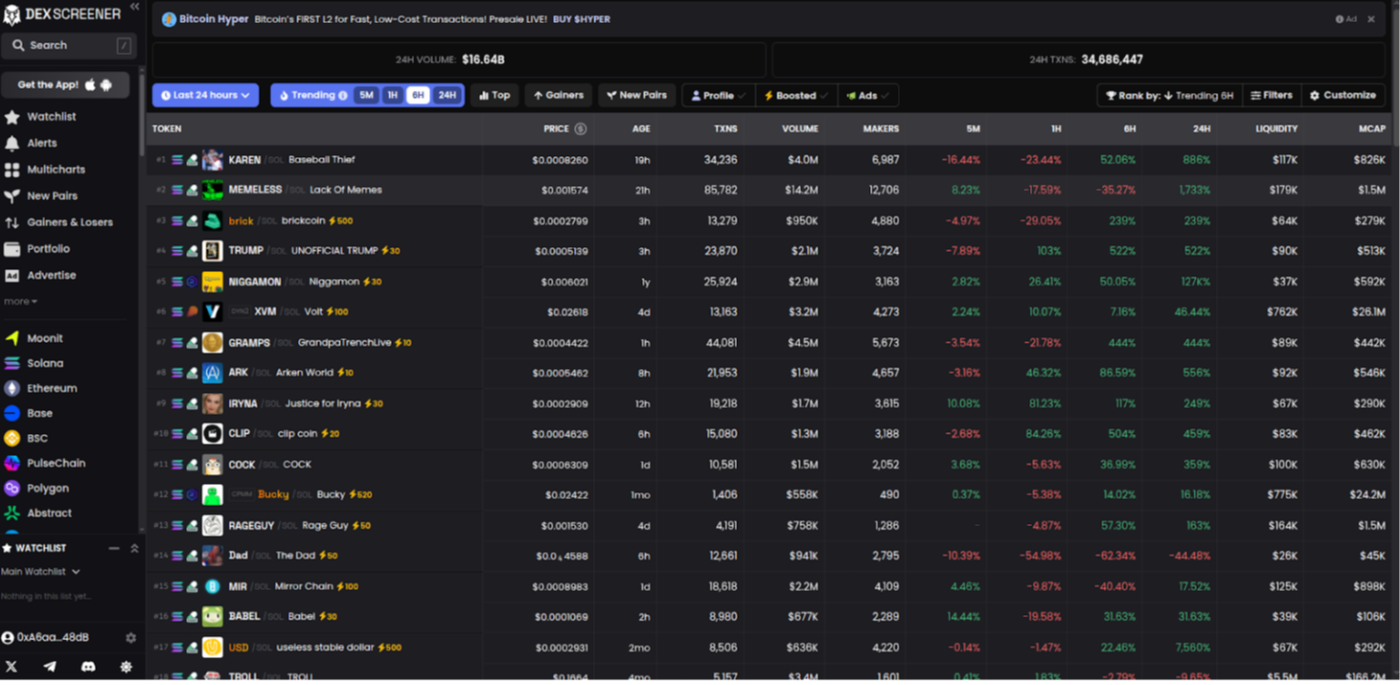
DEX Screener is used by crypto traders who need access to on-chain data like trading volumes, liquidity, and token prices. This information allows them to analyze trends, monitor new listings, and make informed investment decisions. In this tutorial, I will build a DEXScreener clone from scratch, covering everything from the initial design to a functional app. We will use Streamlit, a Python framework for building full-stack apps.
Share
Hackernoon2025/09/18 15:05
Sensura to Showcase Non-Invasive Health Monitoring Platform, Starting with Glucose, at CES 2026

Sensura to Showcase Non-Invasive Health Monitoring Platform, Starting with Glucose, at CES 2026

LAS VEGAS, Jan. 6, 2026 /PRNewswire/ — Sensura, a Singapore-based deep-tech company focused on next-generation health and wellness monitoring, today announced that
Share
AI Journal2026/01/07 11:30
Franklin Templeton CEO Dismisses 50bps Rate Cut Ahead FOMC

Franklin Templeton CEO Dismisses 50bps Rate Cut Ahead FOMC

The post Franklin Templeton CEO Dismisses 50bps Rate Cut Ahead FOMC appeared on BitcoinEthereumNews.com. Franklin Templeton CEO Jenny Johnson has weighed in on whether the Federal Reserve should make a 25 basis points (bps) Fed rate cut or 50 bps cut. This comes ahead of the Fed decision today at today’s FOMC meeting, with the market pricing in a 25 bps cut. Bitcoin and the broader crypto market are currently trading flat ahead of the rate cut decision. Franklin Templeton CEO Weighs In On Potential FOMC Decision In a CNBC interview, Jenny Johnson said that she expects the Fed to make a 25 bps cut today instead of a 50 bps cut. She acknowledged the jobs data, which suggested that the labor market is weakening. However, she noted that this data is backward-looking, indicating that it doesn’t show the current state of the economy. She alluded to the wage growth, which she remarked is an indication of a robust labor market. She added that retail sales are up and that consumers are still spending, despite inflation being sticky at 3%, which makes a case for why the FOMC should opt against a 50-basis-point Fed rate cut. In line with this, the Franklin Templeton CEO said that she would go with a 25 bps rate cut if she were Jerome Powell. She remarked that the Fed still has the October and December FOMC meetings to make further cuts if the incoming data warrants it. Johnson also asserted that the data show a robust economy. However, she noted that there can’t be an argument for no Fed rate cut since Powell already signaled at Jackson Hole that they were likely to lower interest rates at this meeting due to concerns over a weakening labor market. Notably, her comment comes as experts argue for both sides on why the Fed should make a 25 bps cut or…
Share
BitcoinEthereumNews2025/09/18 00:36
