Despite their reputation for volatility, crypto markets spend most of their time ranging, as liquidity cycles, leverage resets, and value discovery limit sustainedDespite their reputation for volatility, crypto markets spend most of their time ranging, as liquidity cycles, leverage resets, and value discovery limit sustained

Why crypto markets spend more time ranging than trending

Despite their reputation for volatility, crypto markets spend most of their time ranging, as liquidity cycles, leverage resets, and value discovery limit sustained trends.

Summary
  • Market auction theory favors value discovery over constant trends.
  • Leverage cycles repeatedly halt sustained directional moves.
  • Institutional activity reinforces range-bound market behavior.

Crypto markets are often associated with explosive rallies and sharp crashes, but these headline-grabbing moments make up only a small portion of overall price behavior. In reality, cryptocurrencies spend far more time consolidating within ranges than trending in one direction.

This tendency is not a flaw in the market, it is a structural feature driven by liquidity dynamics, leverage mechanics, and the process of value discovery.

Understanding why crypto markets range more than they trend can help traders and investors align expectations, avoid frustration during sideways periods, and better interpret what price action is signaling beneath the surface.

Market auction theory and value discovery
Why crypto markets spend more time ranging than trending - 1

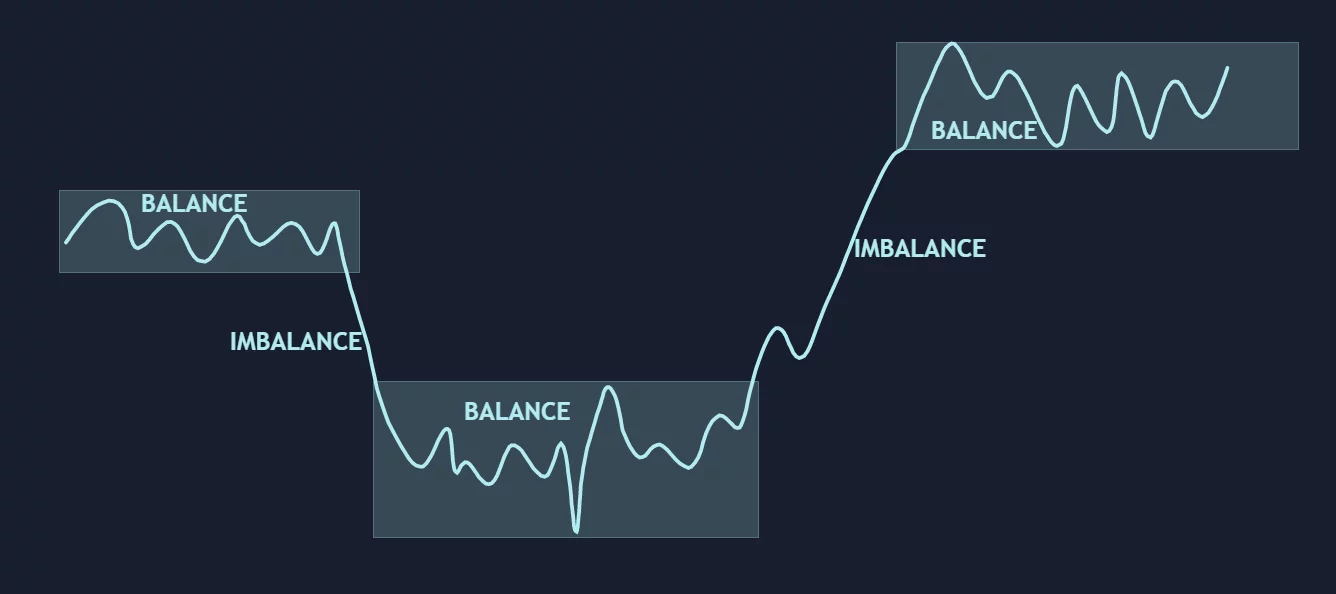
At the core of range-bound behavior lies market auction theory. Markets exist to facilitate trade and discover fair value, not to move endlessly higher or lower. When buyers and sellers reach a temporary agreement on price, trading activity compresses, forming a value area.

In crypto markets, price frequently oscillates between a Value Area High and a Value Area Low, testing the point at which supply and demand are balanced. Once a value is established, price naturally rotates within that range until a new catalyst forces a reassessment. Trending phases typically occur only when the value is rejected, not when it is accepted.

Because cryptocurrency trades globally, without centralized market hours, this value-discovery process occurs continuously. As a result, consolidation becomes the dominant state, with trends emerging only when the imbalance is strong enough to overwhelm the equilibrium.

Leverage cycles and trend exhaustion

Another major reason crypto markets range more than they trend is the heavy use of leverage. Perpetual futures and options allow traders to amplify exposure, thereby accelerating price movements during trends. However, leverage is a double-edged sword.

As trends develop, leveraged positions build rapidly. Eventually, this leverage becomes unstable, triggering liquidations that abruptly halt directional movement. Once these liquidations occur, the market often lacks the fuel required to continue trending, forcing price into consolidation.

These leverage resets are not anomalies; they are recurring structural events. Ranging conditions allow leverage to reset, risk normalizing, and liquidity to rebuild before another trend can emerge.

Institutional behavior favors ranges

As institutional participation grows, range-bound conditions become even more pronounced. Large participants prefer stable environments where they can accumulate or distribute positions without causing excessive slippage.

Institutions rarely chase price. Instead, they operate within ranges, building exposure gradually while liquidity is abundant. This behavior reinforces consolidation phases and delays breakout attempts until positioning is complete.

When breakouts do occur, they are often sharp and decisive, precisely because liquidity has already been absorbed during the range. In this sense, ranges function as preparatory zones for future trends rather than as signs of indecision.

Trends stand out because they are compressed in time. While ranges can last weeks or months, trends often unfold quickly, driven by cascading liquidations, sudden inflows, or macro catalysts. This creates the illusion that trends dominate market behavior, even though they are statistically rare.

Once a trend exhausts, price typically returns to balance, resuming its range-bound behavior. This cycle repeats across all time frames, from intraday charts to multi-year market structures.

What to expect in the market

Crypto markets will continue to spend most of their time ranging, punctuated by brief but aggressive trending phases. Understanding this reality allows market participants to adapt strategies, manage expectations, and recognize that consolidation is not stagnation; it is the market doing its job.


Market Opportunity
Moonveil Logo
Moonveil Price(MORE)
$0,002532
$0,002532$0,002532
+0,31%
USD
Moonveil (MORE) Live Price Chart
Disclaimer: The articles reposted on this site are sourced from public platforms and are provided for informational purposes only. They do not necessarily reflect the views of MEXC. All rights remain with the original authors. If you believe any content infringes on third-party rights, please contact service@support.mexc.com for removal. MEXC makes no guarantees regarding the accuracy, completeness, or timeliness of the content and is not responsible for any actions taken based on the information provided. The content does not constitute financial, legal, or other professional advice, nor should it be considered a recommendation or endorsement by MEXC.

You May Also Like

Shocking OpenVPP Partnership Claim Draws Urgent Scrutiny

Shocking OpenVPP Partnership Claim Draws Urgent Scrutiny

The post Shocking OpenVPP Partnership Claim Draws Urgent Scrutiny appeared on BitcoinEthereumNews.com. The cryptocurrency world is buzzing with a recent controversy surrounding a bold OpenVPP partnership claim. This week, OpenVPP (OVPP) announced what it presented as a significant collaboration with the U.S. government in the innovative field of energy tokenization. However, this claim quickly drew the sharp eye of on-chain analyst ZachXBT, who highlighted a swift and official rebuttal that has sent ripples through the digital asset community. What Sparked the OpenVPP Partnership Claim Controversy? The core of the issue revolves around OpenVPP’s assertion of a U.S. government partnership. This kind of collaboration would typically be a monumental endorsement for any private cryptocurrency project, especially given the current regulatory climate. Such a partnership could signify a new era of mainstream adoption and legitimacy for energy tokenization initiatives. OpenVPP initially claimed cooperation with the U.S. government. This alleged partnership was said to be in the domain of energy tokenization. The announcement generated considerable interest and discussion online. ZachXBT, known for his diligent on-chain investigations, was quick to flag the development. He brought attention to the fact that U.S. Securities and Exchange Commission (SEC) Commissioner Hester Peirce had directly addressed the OpenVPP partnership claim. Her response, delivered within hours, was unequivocal and starkly contradicted OpenVPP’s narrative. How Did Regulatory Authorities Respond to the OpenVPP Partnership Claim? Commissioner Hester Peirce’s statement was a crucial turning point in this unfolding story. She clearly stated that the SEC, as an agency, does not engage in partnerships with private cryptocurrency projects. This response effectively dismantled the credibility of OpenVPP’s initial announcement regarding their supposed government collaboration. Peirce’s swift clarification underscores a fundamental principle of regulatory bodies: maintaining impartiality and avoiding endorsements of private entities. Her statement serves as a vital reminder to the crypto community about the official stance of government agencies concerning private ventures. Moreover, ZachXBT’s analysis…
Share
BitcoinEthereumNews2025/09/18 02:13
Bitcoin Has Taken Gold’s Role In Today’s World, Eric Trump Says

Bitcoin Has Taken Gold’s Role In Today’s World, Eric Trump Says

Eric Trump on Tuesday described Bitcoin as a “modern-day gold,” calling it a liquid store of value that can act as a hedge to real estate and other assets. Related Reading: XRP’s Biggest Rally Yet? Analyst Projects $20+ In October 2025 According to reports, the remark came during a TV appearance on CNBC’s Squawk Box, tied to the launch of American Bitcoin, the mining and treasury firm he helped start. Company Holdings And Strategy Based on public filings and company summaries, American Bitcoin has accumulated 2,443 BTC on its balance sheet. That stash has been valued in the low hundreds of millions of dollars at recent spot prices. The firm mixes large-scale mining with the goal of holding Bitcoin as a strategic reserve, which it says will help it grow both production and asset holdings over time. Eric Trump’s comments were direct. He told viewers that institutions are treating Bitcoin more like a store of value than a fringe idea, and he warned firms that resist blockchain adoption. The tone was strong at times, and the line about Bitcoin being a modern equivalent of gold was used to frame American Bitcoin’s role as both miner and holder.   Eric Trump has said: bitcoin is modern-day gold — unusual_whales (@unusual_whales) September 16, 2025 How The Company Went Public American Bitcoin moved toward a public listing via an all-stock merger with Gryphon Digital Mining earlier this year, a deal that kept most of the original shareholders in control and positioned the new entity for a Nasdaq debut. Reports show that mining partner Hut 8 holds a large ownership stake, leaving the Trump family and other backers with a minority share. The listing brought fresh attention and capital to the firm as it began trading under the ticker ABTC. Market watchers say the firm’s public debut highlights two trends: mining companies are trying to grow by both producing and holding Bitcoin, and political ties are bringing more headlines to crypto firms. Some analysts point out that holding large amounts of Bitcoin on the balance sheet exposes a company to price swings, while supporters argue it aligns incentives between miners and investors. Related Reading: Ethereum Bulls Target $8,500 With Big Money Backing The Move – Details Reaction And Possible Risks Based on coverage of the launch, investors have reacted with both enthusiasm and caution. Supporters praise the prospect of a US-based miner that aims to be transparent and aggressive about building a reserve. Critics point to governance questions, possible conflicts tied to high-profile backers, and the usual risks of a volatile asset being held on corporate balance sheets. Eric Trump’s remark that Bitcoin has taken gold’s role in today’s world reflects both his belief in its value and American Bitcoin’s strategy of mining and holding. Whether that view sticks will depend on how investors and institutions respond in the months ahead. Featured image from Meta, chart from TradingView
Share
NewsBTC2025/09/18 06:00
XRP Holds $1.88 Fibonacci Support as 3-Day Chart Signals Bullish Continuation

XRP Holds $1.88 Fibonacci Support as 3-Day Chart Signals Bullish Continuation

XRP is once again drawing attention on higher timeframes as its 3-day chart begins to mirror past bullish phases. Market observers are closely watching how the
Share
Tronweekly2026/01/11 21:30