Bitcoin started 2026 stuck near $88,000, extending weeks of sideways trading. While price action looks stagnant, on-chain data suggests the market may be quietlyBitcoin started 2026 stuck near $88,000, extending weeks of sideways trading. While price action looks stagnant, on-chain data suggests the market may be quietly

Will Bitcoin Price Reclaim $100,000 in January? 3 Charts Hold the Answer

Bitcoin started 2026 stuck near $88,000, extending weeks of sideways trading. While price action looks stagnant, on-chain data suggests the market may be quietly shifting beneath the surface.

Three indicators from CryptoQuant point to easing sell pressure, even as macro uncertainty continues to cap upside momentum.

Long-Term Holders Show Signs of Accumulation

Bitcoin’s price has struggled to reclaim key resistance after a sharp pullback in late 2025. The lack of follow-through buying has kept sentiment fragile, with traders waiting for confirmation that the correction has run its course.

The first signal comes from long-term holder (LTH) supply data. After months of negative readings, the 30-day net change in LTH supply has turned positive by roughly 10,700 BTC.
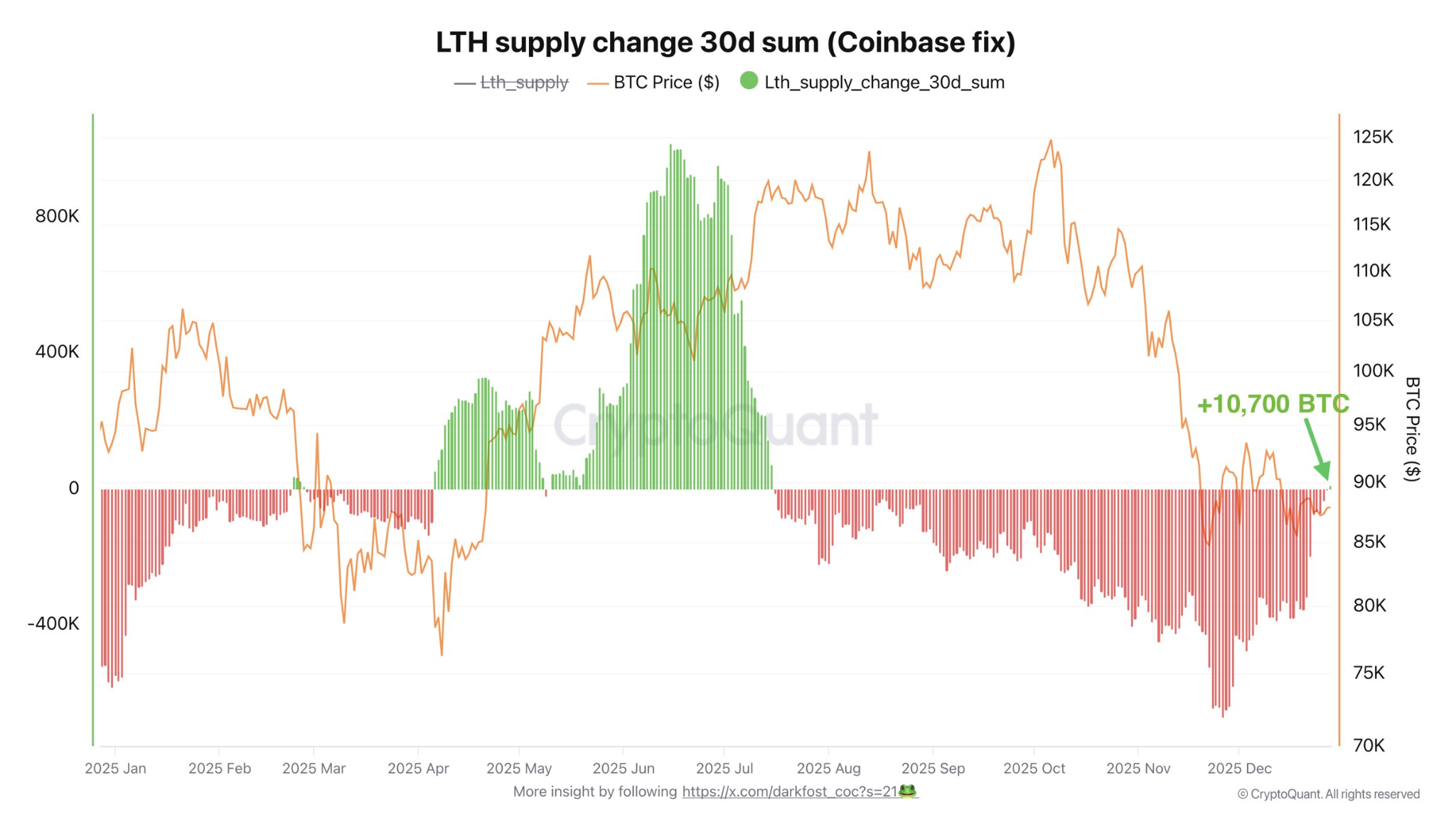
Bitcoin Long-Term Holder’s Supply. Source: X/Darkfost

This shift suggests that long-term investors are no longer distributing coins at scale. 

Instead, supply is gradually moving back into stronger hands, a pattern often seen during consolidation phases rather than market tops.

LTH SOPR Signals Balance, not Capitulation

A second chart tracks the long-term holder spent output profit ratio (SOPR). This metric shows whether long-term holders are selling at a profit or a loss.

Currently, LTH SOPR is hovering around the neutral 1.0 level. That indicates long-term holders are not capitulating or rushing to exit at losses. 

Historically, this behavior aligns with markets finding equilibrium after a correction, rather than entering a deeper breakdown.

Exchange outflows reduce immediate sell pressure

The third indicator looks at Bitcoin exchange netflows. Recent data shows continued net outflows, with more BTC leaving exchanges than entering them.

This trend reduces immediate sell-side supply on spot markets. 

However, the lack of a price rebound suggests demand remains cautious, likely constrained by tighter liquidity and delayed expectations for US rate cuts.
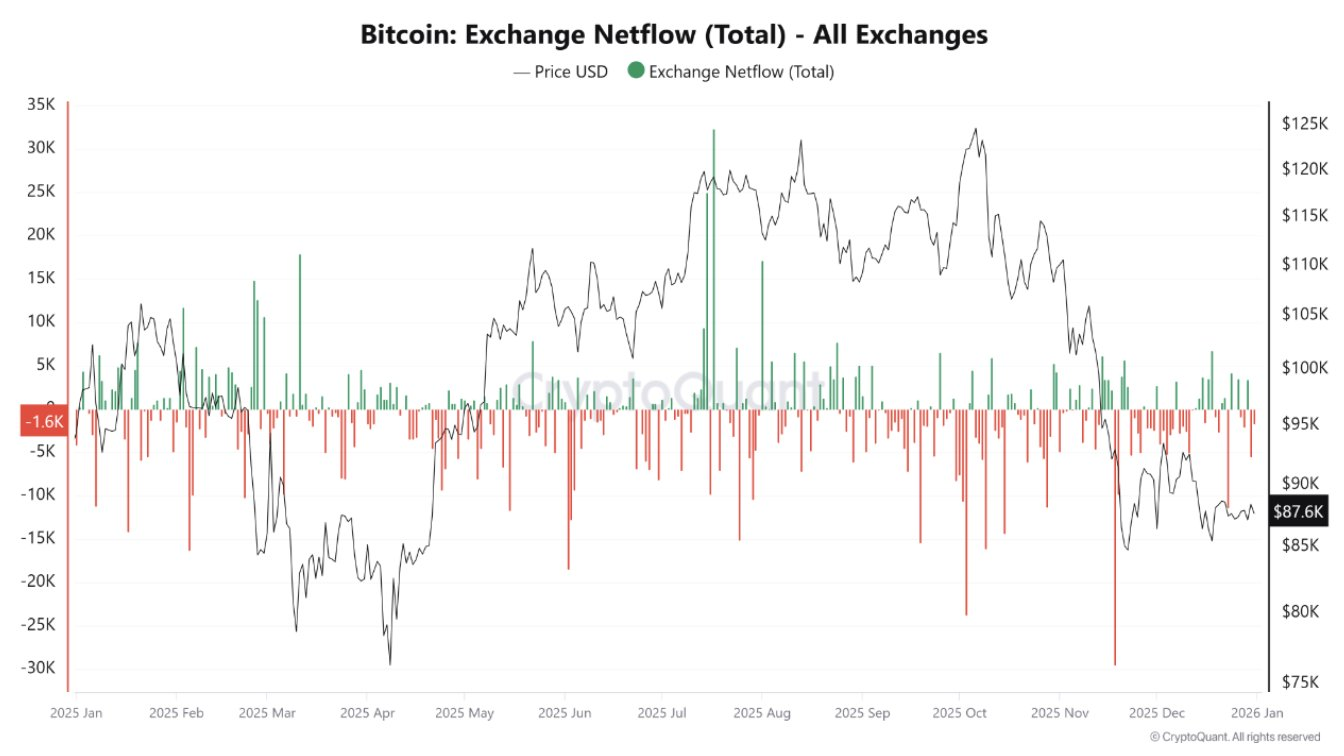
Bitcoin Exchange Netflow. Source: X/CryptoQuant

Will Bitcoin Price Recover in January?

Taken together, the charts paint a mixed but improving picture. Supply-side pressure appears to be easing, and long-term holders remain confident. 

Still, price remains range-bound due to weak demand and macro headwinds. A rapid move to $100,000 in January would likely require a fresh catalyst. 

Without it, Bitcoin may continue consolidating, building a base that could support a stronger recovery later in 2026 rather than an immediate breakout.


Market Opportunity
NEAR Logo
NEAR Price(NEAR)
$1.687
$1.687$1.687
+3.11%
USD
NEAR (NEAR) Live Price Chart
Disclaimer: The articles reposted on this site are sourced from public platforms and are provided for informational purposes only. They do not necessarily reflect the views of MEXC. All rights remain with the original authors. If you believe any content infringes on third-party rights, please contact service@support.mexc.com for removal. MEXC makes no guarantees regarding the accuracy, completeness, or timeliness of the content and is not responsible for any actions taken based on the information provided. The content does not constitute financial, legal, or other professional advice, nor should it be considered a recommendation or endorsement by MEXC.

You May Also Like

The Channel Factories We’ve Been Waiting For

The Channel Factories We’ve Been Waiting For

The post The Channel Factories We’ve Been Waiting For appeared on BitcoinEthereumNews.com. Visions of future technology are often prescient about the broad strokes while flubbing the details. The tablets in “2001: A Space Odyssey” do indeed look like iPads, but you never see the astronauts paying for subscriptions or wasting hours on Candy Crush.  Channel factories are one vision that arose early in the history of the Lightning Network to address some challenges that Lightning has faced from the beginning. Despite having grown to become Bitcoin’s most successful layer-2 scaling solution, with instant and low-fee payments, Lightning’s scale is limited by its reliance on payment channels. Although Lightning shifts most transactions off-chain, each payment channel still requires an on-chain transaction to open and (usually) another to close. As adoption grows, pressure on the blockchain grows with it. The need for a more scalable approach to managing channels is clear. Channel factories were supposed to meet this need, but where are they? In 2025, subnetworks are emerging that revive the impetus of channel factories with some new details that vastly increase their potential. They are natively interoperable with Lightning and achieve greater scale by allowing a group of participants to open a shared multisig UTXO and create multiple bilateral channels, which reduces the number of on-chain transactions and improves capital efficiency. Achieving greater scale by reducing complexity, Ark and Spark perform the same function as traditional channel factories with new designs and additional capabilities based on shared UTXOs.  Channel Factories 101 Channel factories have been around since the inception of Lightning. A factory is a multiparty contract where multiple users (not just two, as in a Dryja-Poon channel) cooperatively lock funds in a single multisig UTXO. They can open, close and update channels off-chain without updating the blockchain for each operation. Only when participants leave or the factory dissolves is an on-chain transaction…
Share
BitcoinEthereumNews2025/09/18 00:09
PEPE leads memecoin gains amid post-holiday crypto market altcoin rally

PEPE leads memecoin gains amid post-holiday crypto market altcoin rally

Memecoins like FLOKI, Dogwifhat, and fartcoin are up double digits amid an early-year crypto market rally on Friday.
Share
Coinstats2026/01/03 03:19
Vitalik Buterin: Ethereum Progressed in 2025, Must Decentralize in 2026

Vitalik Buterin: Ethereum Progressed in 2025, Must Decentralize in 2026

Vitalik Buterin stressed that Ethereum’s next phase depends as much on decentralization as on technical upgrades.
Share
CryptoPotato2026/01/03 04:04