The post Solana Quietly Dominates as Network Usage Surges While SOL Price Stalls Below $130 appeared first on Coinpedia Fintech News Crypto markets started 2026The post Solana Quietly Dominates as Network Usage Surges While SOL Price Stalls Below $130 appeared first on Coinpedia Fintech News Crypto markets started 2026

Solana Quietly Dominates as Network Usage Surges While SOL Price Stalls Below $130

Solana Sell-Off Cools as SOL Price Defends Support—A Recovery Depends on This Level

The post Solana Quietly Dominates as Network Usage Surges While SOL Price Stalls Below $130 appeared first on Coinpedia Fintech News

Crypto markets started 2026 with a strong attention on Solana, even though the SOL price has been consolidating below $130 for weeks. According to recent on-chain data, whales accumulating Solana-related tokens was the most discussed trend in the market. Additionally, SOL’s network usage and transaction volume dominate despite low price action. This suggests smart money is taking positions, which might soon result in a breakout in Solana price chart.

Solana’s DEX Trading Volume Touches $1.6 Trillion

Solana became one of the top altcoins by performance in 2025 and it outpaced several CEXs by trading volume. According to the Solana vs CEX chart, the altcoin recorded $1.6 trillion in DEX trading volume. This figure ranks Solana just behind Binance which showed $7.2 trillion in trading volume. 

According to an on-chain analyst, CryptosRus, Solana’s rising trading volume hints at increasing usage and transaction among investors. This rise in on-chain indicators amid a price stagnation suggests continuous accumulation among large investors. As a result, it might soon trigger a breakout for SOL price. 

However, any breakout might trigger profit-taking sentiment among short-term holders, as revealed by the NVT data. Solana’s Network Value to Transactions (NVT) ratio has been rising and it is now at the highest level in seven months.
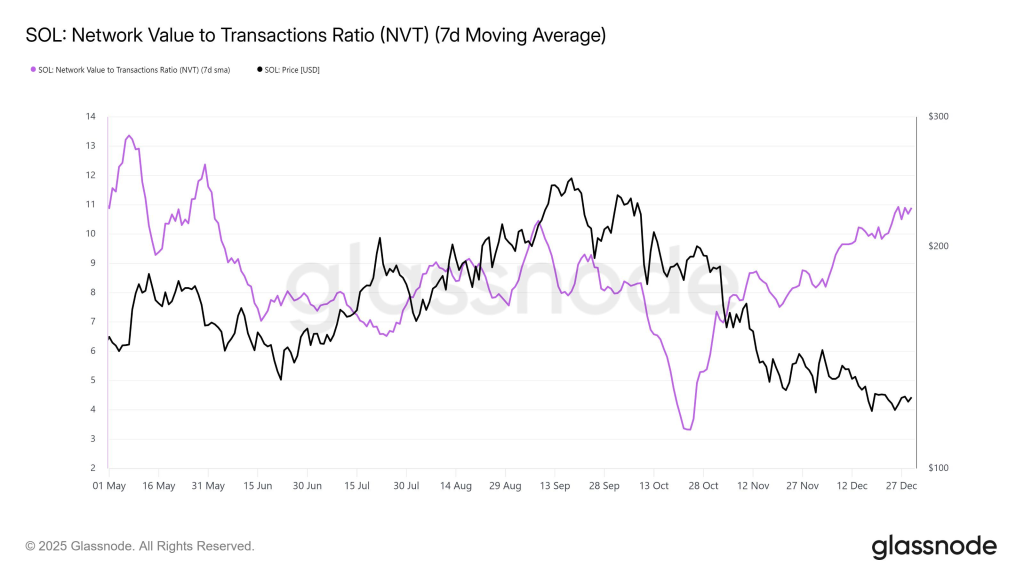
SOL NVT RatioSOL NVT Ratio

In the past, an increasing NVT ratio has often pointed to bearish threats, as SOL’s market value surges faster than ongoing transaction activity. This gap means Solana price is surging amid low transaction activity, making the altcoin overvalued. This often leads to short-term price pressure for SOL.

Also read: Ethereum and Solana Could Hit New All-Time Highs If US Crypto Law Passes

Additionally, the open interest of Solana slowed down from September 2025. Data from Coinglass reveals that the metric dropped from the high of $17 billion to $7.5 billion, as of January 2026.

These bearish metrics might keep Solana trapped within a selling region below $130 unless strong accumulation takes place.  

What’s Next for SOL Price?

Solana has been holding near its 20-day EMA around $125 for several days, showing that buyers are still active and defending this level. However, sellers are strongly defending a push above $130, keeping SOL price trapped below the declining trend line on the 1-hour chart. As of writing, Solana trades at $124, declining over 1% in the last 24 hours.
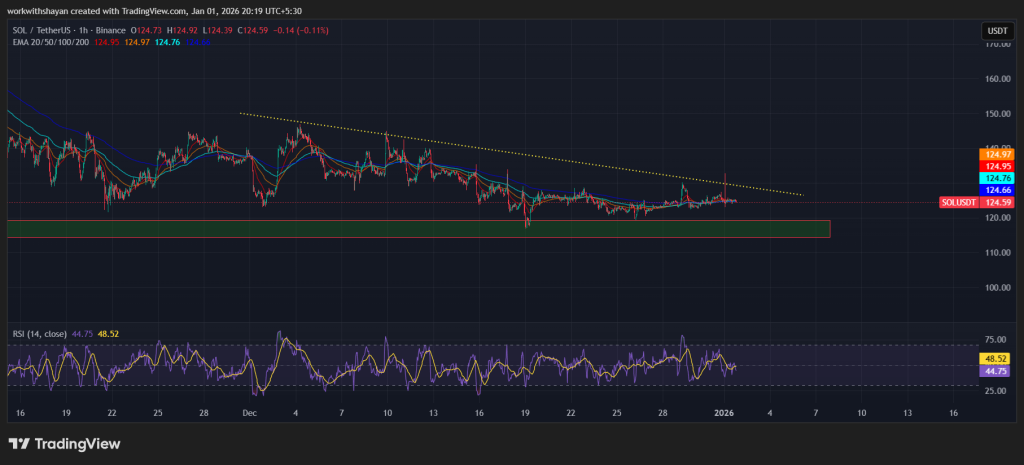
SOL/USDT Chart: TradingViewSOL/USDT Chart: TradingView

If the price manages to close above the 20-day EMA, the SOL/USDT pair could move higher toward the descending resistance line. A break above $130 might force sellers to exit. However, there may be some selling pressure around the 50-day SMA at $133, but a breakout above it appears likely.

On the other hand, if the price falls away from these moving averages, it would suggest sellers are still in control, increasing the risk of a decline toward the support zone below $110 and possibly down to the key psychological level of $100.

Market Opportunity
Solana Logo
Solana Price(SOL)
$131.55
$131.55$131.55
+1.98%
USD
Solana (SOL) Live Price Chart
Disclaimer: The articles reposted on this site are sourced from public platforms and are provided for informational purposes only. They do not necessarily reflect the views of MEXC. All rights remain with the original authors. If you believe any content infringes on third-party rights, please contact service@support.mexc.com for removal. MEXC makes no guarantees regarding the accuracy, completeness, or timeliness of the content and is not responsible for any actions taken based on the information provided. The content does not constitute financial, legal, or other professional advice, nor should it be considered a recommendation or endorsement by MEXC.

You May Also Like

The Channel Factories We’ve Been Waiting For

The Channel Factories We’ve Been Waiting For

The post The Channel Factories We’ve Been Waiting For appeared on BitcoinEthereumNews.com. Visions of future technology are often prescient about the broad strokes while flubbing the details. The tablets in “2001: A Space Odyssey” do indeed look like iPads, but you never see the astronauts paying for subscriptions or wasting hours on Candy Crush.  Channel factories are one vision that arose early in the history of the Lightning Network to address some challenges that Lightning has faced from the beginning. Despite having grown to become Bitcoin’s most successful layer-2 scaling solution, with instant and low-fee payments, Lightning’s scale is limited by its reliance on payment channels. Although Lightning shifts most transactions off-chain, each payment channel still requires an on-chain transaction to open and (usually) another to close. As adoption grows, pressure on the blockchain grows with it. The need for a more scalable approach to managing channels is clear. Channel factories were supposed to meet this need, but where are they? In 2025, subnetworks are emerging that revive the impetus of channel factories with some new details that vastly increase their potential. They are natively interoperable with Lightning and achieve greater scale by allowing a group of participants to open a shared multisig UTXO and create multiple bilateral channels, which reduces the number of on-chain transactions and improves capital efficiency. Achieving greater scale by reducing complexity, Ark and Spark perform the same function as traditional channel factories with new designs and additional capabilities based on shared UTXOs.  Channel Factories 101 Channel factories have been around since the inception of Lightning. A factory is a multiparty contract where multiple users (not just two, as in a Dryja-Poon channel) cooperatively lock funds in a single multisig UTXO. They can open, close and update channels off-chain without updating the blockchain for each operation. Only when participants leave or the factory dissolves is an on-chain transaction…
Share
BitcoinEthereumNews2025/09/18 00:09
Sui Ecosystem Gains Spotlight as Taipei Builders Demo Day Highlights New DeFi Ideas

Sui Ecosystem Gains Spotlight as Taipei Builders Demo Day Highlights New DeFi Ideas

Sui Taipei Builders’ Demo Day brings developers, investors, and enthusiasts together to present blockchain projects. The Sui ecosystem will host the Taipei Builders
Share
LiveBitcoinNews2026/01/03 00:00
Stability World AI Makes AI Accessible and Ownable for People

Stability World AI Makes AI Accessible and Ownable for People

Stability World AI blends AI agents with blockchain incentives to promoting trust, accessibility, shared ownership of AI through user-driven governance.
Share
Blockchainreporter2026/01/03 00:00