Bitmine Expands Ethereum Holdings: Adds 32,938 ETH And Stakes Nearly 119K ETH
Ethereum continues to struggle to regain bullish momentum as apathy and persistent selling pressure dominate the broader crypto market. Price action remains subdued, with ETH failing to sustain moves above key resistance levels, reinforcing the perception that investors are still cautious.
Many analysts argue that the market has yet to fully reset, pointing to weak risk appetite, declining liquidity, and a lack of strong spot demand. As a result, Ethereum, like most major assets, remains trapped in a consolidation phase marked by hesitation rather than conviction.
Despite this gloomy backdrop, a growing group of optimists believes Ethereum could be approaching a cyclical bottom. Their view is based less on short-term price action and more on structural and behavioral signals that tend to emerge during late-stage bearish phases. One of the most notable developments comes from on-chain data.
According to data from Arkham shared by Lookonchain, Bitmine acquired another 32,938 ETH worth approximately $97.6 million just a few hours ago. Bitmine is a large institutional Ethereum-focused entity known for accumulating ETH at scale and deploying it across staking and long-term strategies rather than short-term trading. With this latest purchase, Bitmine now holds roughly 3.357 million ETH, valued at around $10 billion, making it one of the largest known Ethereum holders.
Bitmine Deepens Long-Term Commitment
Ethereum’s near-term price action remains fragile, but institutional behavior continues to diverge from market sentiment. Over the past few hours, Bitmine staked an additional 118,944 ETH, worth approximately $352.16 million, according to data from Arkham reported by Lookonchain. This move follows Bitmine’s recent spot accumulation and reinforces its long-term positioning strategy rather than a short-term speculative approach.

Staking at this scale effectively removes a significant amount of ETH from liquid circulation, tightening available supply on exchanges. Unlike transfers to centralized platforms, staking reflects a high-conviction view that prioritizes yield generation and long-term network participation over immediate liquidity.
For analysts tracking structural supply dynamics, this behavior contrasts sharply with the current price trend, which continues to show limited bullish follow-through.
Despite these developments, the broader market remains unconvinced. Ethereum has struggled to reclaim key resistance levels, and momentum indicators still point to weakness. As a result, analysts are increasingly divided when assessing the outlook for 2026.
Some interpret ongoing institutional accumulation and staking as early positioning ahead of a longer-term recovery cycle. Others caution that macro uncertainty, muted demand, and persistent risk aversion could keep ETH range-bound or under pressure for longer than expected.
In this context, Bitmine’s actions stand out as a signal of long-term confidence, but not necessarily an immediate catalyst. For now, Ethereum’s price remains weak, while the strategic behavior beneath the surface continues to quietly reshape the supply landscape.
Ethereum Remains Range-Bound Below Key Resistance
Ethereum continues to trade in a consolidation range after failing to reclaim higher levels, with price hovering around the $3,000 zone. The chart shows ETH capped below the declining 100-day and 200-day moving averages, which now act as dynamic resistance around the $3,400–$3,600 area. This alignment reinforces the broader bearish structure that has been in place since the November breakdown.
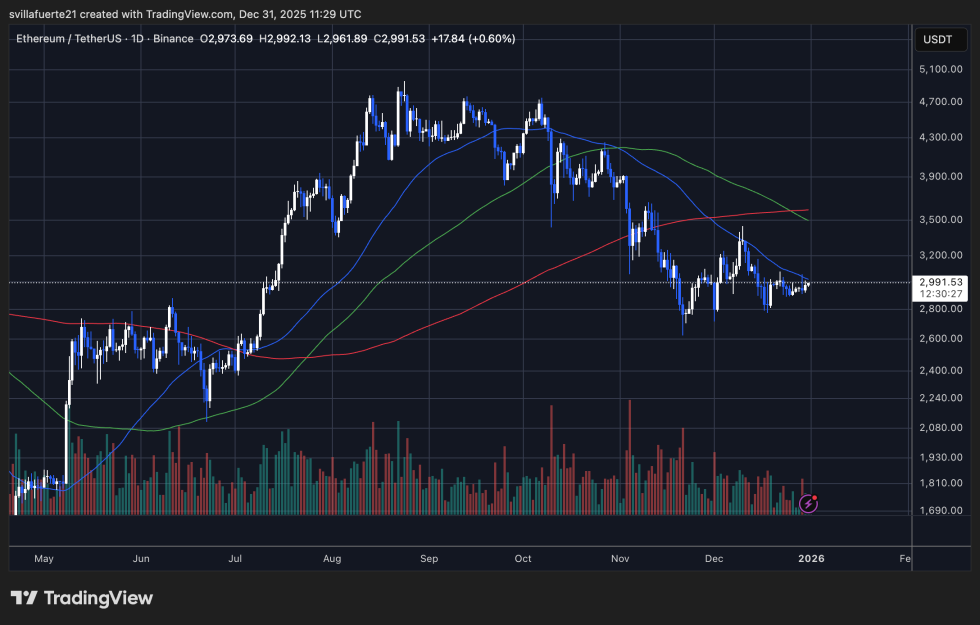
After peaking near the $4,800 region earlier in the cycle, ETH entered a clear downtrend, marked by lower highs and expanding sell-side volume during corrective phases. The sharp sell-off into late November pushed the price toward the $2,800 area, where buyers stepped in to defend support. Since then, Ethereum has stabilized but failed to generate sustained upside momentum, suggesting demand remains cautious rather than aggressive.
Volume has declined noticeably during recent rebounds, indicating a lack of strong conviction from buyers. This behavior is typical of late-stage corrective phases, where price compresses while market participants wait for clearer signals. As long as ETH remains below the 200-day moving average, upside attempts are likely to face selling pressure.
On the downside, the $2,800–$2,900 zone stands out as a key support area. A clean break below this range would increase the risk of a deeper retracement. Conversely, reclaiming $3,300 with strong volume would be the first sign that Ethereum is transitioning out of its current corrective structure.
Featured image from ChatGPT, chart from TradingView.com
You May Also Like

The Channel Factories We’ve Been Waiting For

Sui Ecosystem Gains Spotlight as Taipei Builders Demo Day Highlights New DeFi Ideas