Blockchain investigator ZachXBT has exposed a Canada-based scammer who allegedly stole more than $2 million in cryptocurrency by impersonating Coinbase customerBlockchain investigator ZachXBT has exposed a Canada-based scammer who allegedly stole more than $2 million in cryptocurrency by impersonating Coinbase customer

ZachXBT Exposes “Canadian” Scammer Who Stole $2M Via Fake Coinbase Support

Blockchain investigator ZachXBT has exposed a Canada-based scammer who allegedly stole more than $2 million in cryptocurrency by impersonating Coinbase customer support, adding to a growing list of social engineering cases targeting users of major exchanges.

In a series of posts on X, ZachXBT said the alleged scammer, identified by the alias “Haby” or “Havard,” spent more than a year posing as a Coinbase help desk worker and tricking users into handing over funds.

ZachXBT Tracks Coinbase Scammer Through Screenshots and Wallet Data

According to the investigator, the suspect relied on classic social engineering tactics rather than technical exploits, manipulating victims into believing their accounts were under threat and needed immediate intervention.

ZachXBT said he was able to trace the activity by cross-referencing screenshots shared in Telegram group chats, social media posts, and on-chain transaction data.

In an instance, dated Dec. 30, 2024, the alleged scammer posted a screenshot boasting of a 21,000 XRP theft, worth about $44,000 at the time, taken from a Coinbase user.

Further analysis linked that XRP address to additional Coinbase-related thefts totaling roughly $500,000.

The investigator said the suspect routinely converted stolen XRP into bitcoin using instant exchange services, a move intended to obscure transaction trails.
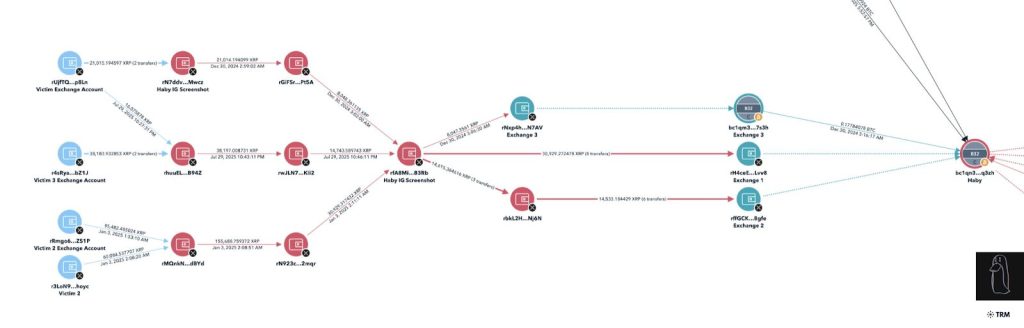
Source: ZachXBT

By analyzing transaction timing and wallet balances, ZachXBT said he identified a bitcoin address that later displayed a balance of about $237,000 in February 2025, matching screenshots the suspect had shared while showing off his funds in private chats.

Tracing backward from that address revealed three more Coinbase impersonation thefts worth more than $560,000.

ZachXBT also shared a leaked screen recording that allegedly shows the suspect on a call with a victim, impersonating Coinbase support.

In the video, the caller is heard guiding the target through what appeared to be fake security steps while inadvertently revealing an email address and Telegram account tied to the operation.

The suspect reportedly bought expensive Telegram usernames and deleted older accounts in an attempt to evade detection, though repeated online bragging made attribution easier.

Crypto Users Face Rising Losses as Social Engineering Attacks Spread

The case surfaced as authorities in India recently arrested a former Coinbase customer support agent in Hyderabad over a separate data breach affecting nearly 70,000 users.

Coinbase CEO Brian Armstrong said the breach stemmed from a bribery scheme targeting offshore support staff and resulted in about $307 million in remediation and reimbursement costs.

Coinbase refused to pay a $20 million ransom linked to the incident and instead launched a bounty program to aid investigations.

Social engineering scams like the one described by ZachXBT typically begin with unsolicited calls, texts, or emails that appear to come from a legitimate company.

Scammers often create urgency by claiming there has been suspicious activity or an imminent account compromise, then pressure victims into revealing login credentials or two-factor authentication codes or transferring funds to wallets controlled by the attacker.

The exposure of the alleged Canadian scammer follows other recent enforcement actions. In the United States, prosecutors charged a 23-year-old Brooklyn resident with stealing about $16 million from roughly 100 Coinbase users through a similar impersonation scheme.

That investigation also relied on blockchain analysis and resulted in the seizure of cash and digital assets, with recovery efforts ongoing.

Source: Chainalysis

Industry data show crypto theft remains widespread, with more than $3.4 billion stolen across the sector between January and early December 2025.

Security experts continue to urge users to avoid responding to unsolicited messages, never share passwords or recovery phrases, and only contact support through official websites or apps.


Market Opportunity
Octavia Logo
Octavia Price(VIA)
$0.0066
$0.0066$0.0066
-4.34%
USD
Octavia (VIA) Live Price Chart
Disclaimer: The articles reposted on this site are sourced from public platforms and are provided for informational purposes only. They do not necessarily reflect the views of MEXC. All rights remain with the original authors. If you believe any content infringes on third-party rights, please contact service@support.mexc.com for removal. MEXC makes no guarantees regarding the accuracy, completeness, or timeliness of the content and is not responsible for any actions taken based on the information provided. The content does not constitute financial, legal, or other professional advice, nor should it be considered a recommendation or endorsement by MEXC.

You May Also Like

UK Lowest in G7 Investments for 2025 Amid Expert Warnings on Frameworks

UK Lowest in G7 Investments for 2025 Amid Expert Warnings on Frameworks

The post UK Lowest in G7 Investments for 2025 Amid Expert Warnings on Frameworks appeared on BitcoinEthereumNews.com. The UK recorded the lowest investment among
Share
BitcoinEthereumNews2025/12/31 06:58
Chinese Bitcoin Hardware Titans Control 95% of Market, Now Coming to America to Dodge Trump Tariff War

Chinese Bitcoin Hardware Titans Control 95% of Market, Now Coming to America to Dodge Trump Tariff War

Three of China’s largest Bitcoin hardware manufacturers are establishing production facilities in the United States as President Donald Trump’s tariff policies reshape the cryptocurrency industry. The three industry leaders, Bitmain, Canaan, and MicroBT, collectively control over 90% of the global mining rig market. These companies are the architects of Bitcoin’s physical infrastructure, manufacturing the specialized ASIC (Application-Specific Integrated Circuit) machines that form the backbone of the world’s most valuable cryptocurrency network. Every Bitcoin mined globally likely passes through hardware bearing Chinese engineering fingerprints. 95% Market Control Sparks “Digital Dependency Trap” and Security Risks According to a June 18 Reuters report, these Bitcoin mining giants are establishing U.S. operations to circumvent potential tariffs. However, critics have raised security concerns about Chinese involvement in sectors spanning semiconductor manufacturing and energy infrastructure. Guang Yang, chief technology officer at crypto technology provider Conflux Network, described the situation as extending beyond trade policy. “The U.S.-China trade war goes beyond tariffs,” Yang stated. “It’s a strategic pivot toward ‘politically acceptable’ hardware sources.” Bitmain, the largest of the three companies by revenue, initiated U.S. production of mining equipment in December , one month after Trump’s presidential election victory. Canaan began trial production in the United States on April 2 to avoid tariffs following Trump’s announcement of new trade levies. One of the largest manufacturers of #bitcoin mining machines, Canaan, has set up a base of operations outside of China. CEO Zhang says, Kazakhstan is essential to "expanding after-sales geographical coverage and providing […] support growing international customer base" pic.twitter.com/7D5Xh2ici5 — Documenting ₿itcoin 📄 (@DocumentingBTC) June 23, 2021 Third-ranked MicroBT announced in a statement that it is “actively implementing a localization strategy in the U.S.” to “avoid the impact of tariffs.” $11.9B by 2028: The Market These Giants Are Fighting for According to Frost & Sullivan’s “2024 Global Blockchain Hardware Industry White Paper,” the ASIC-based Bitcoin mining hardware market demonstrates substantial consolidation. When measured by computing power sold, these three Chinese companies command 95.4% of the global market share. The Bitcoin ecosystem encompasses five primary segments: hardware supply, mining farm operations, mining pool management, trading platforms, and payment processing services. Hardware manufacturers like Canaan, the first Bitcoin mining company to go public and the second-largest by computing power , focus exclusively on integrated circuit (IC) design, manufacturing, and equipment sales. Industry analysts project continued sector expansion, with the market expected to reach $11.9 billion by 2028, representing a compound annual growth rate of 15.3%, contingent on Bitcoin’s continued price appreciation driven by supply scarcity. Source: Frost & Sullivan China’s Historical Bitcoin Mining Advantage Understanding today’s migration requires examining how China achieved such overwhelming market control in the first place. The foundation was laid during the historic 2017 Bitcoin boom, when three key factors aligned to create Chinese mining supremacy. During the early expansion phase, Chinese officials recognized cryptocurrency mining as a profitable venture that attracted substantial foreign investment. Consequently, authorities initially overlooked the mining sector while simultaneously restricting Bitcoin trading and initial coin offerings. Hydro-power plants go on sale in China since #Bitcoin mining crackdown has reduced demand for electricity. – South China Morning Post pic.twitter.com/QKEbUzWN4g — Bitcoin Archive (@BTC_Archive) June 30, 2021 China’s extensive hydroelectric infrastructure further strengthened the country’s mining operations, providing the cheap energy essential for profitable Bitcoin production. Does Chinese Hardware Control America’s Bitcoin Network? While the United States leads global Bitcoin mining operations with over 38% of total network activity , American miners depend almost entirely on Chinese-manufactured equipment. America Leads Bitcoin Mining Operation/ Source: Bitbo This creates what security analysts describe as a “digital dependency trap,” a scenario where America’s cryptocurrency infrastructure relies fundamentally on hardware produced by its primary economic rival. Guang Yang, Conflux Network’s chief technology officer, frames this dependency in geopolitical terms that extend far beyond trade economics . “The U.S.-China trade war goes beyond tariffs,” Yang explains. “It’s a strategic pivot toward ‘politically acceptable’ hardware sources.” His assessment reflects growing concerns within the cryptocurrency community about supply chain vulnerabilities that could impact national economic security.
Share
CryptoNews2025/06/19 04:26
XRP Enters The Same Zone That Preceded Its Last Historic Breakout

XRP Enters The Same Zone That Preceded Its Last Historic Breakout

The post XRP Enters The Same Zone That Preceded Its Last Historic Breakout appeared on BitcoinEthereumNews.com. My name is Godspower Owie, and I was born and brought
Share
BitcoinEthereumNews2025/12/31 07:03