Representative Maxine Waters has formally requested House Financial Services Committee Chairman French Hill schedule an oversight hearing with SEC Chairman PaulRepresentative Maxine Waters has formally requested House Financial Services Committee Chairman French Hill schedule an oversight hearing with SEC Chairman Paul

Maxine Waters Demands SEC Hearing Over Dropped Crypto Cases

Representative Maxine Waters has formally requested House Financial Services Committee Chairman French Hill schedule an oversight hearing with SEC Chairman Paul Atkins, citing the agency’s dismissal of major crypto enforcement actions and what she describes as unprecedented politicization under the Trump administration.

Waters sent the detailed letter on Sunday, marking her most forceful push yet for congressional scrutiny of the SEC’s dramatic policy reversal since Atkins assumed leadership.

The ranking Democrat noted the Committee has held no hearings with Atkins despite “rapid, significant, and questionable policy shifts,” contrasting this with former Chair Gary Gensler’s two appearances during his first year.
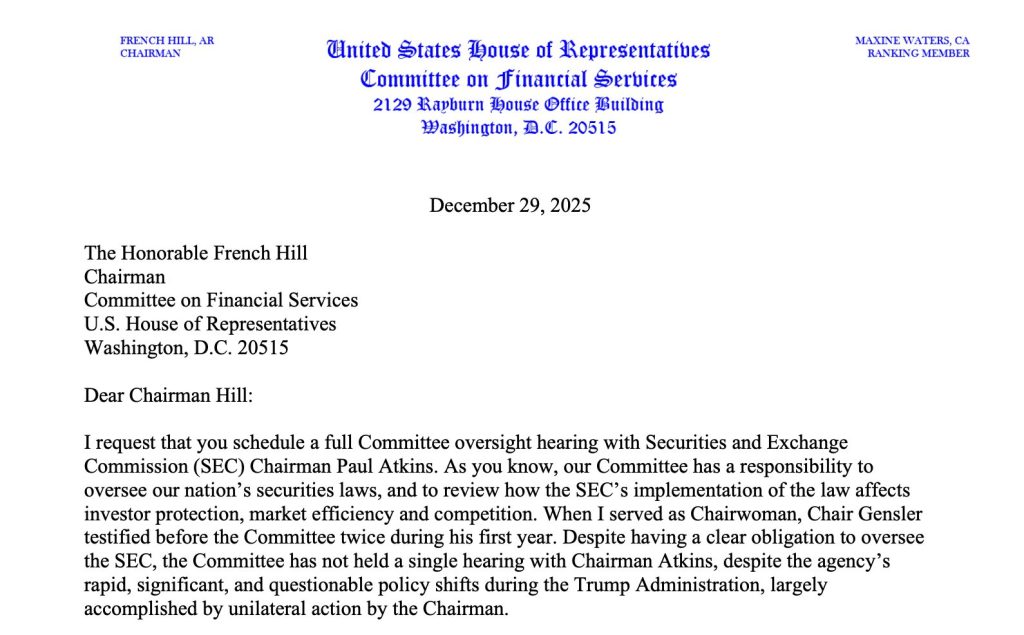
Maxine Waters SEC Hearing - Letter ScreenshotSource: Waters Letter

Crypto Enforcement Retreat Draws Fire

The lawmaker’s central concern is the SEC’s termination of enforcement actions against Coinbase, Binance, and Justin Sun, among others, who were previously accused of securities violations.

The SEC has terminated or stayed major enforcement actions against multiple crypto companies and individuals that had been credibly accused of major violations of our securities laws,” Waters wrote, adding that defendants sometimes announced case dismissals before the Commission voted.

Waters questioned whether Chairman Atkins’ office took “an unusually active role in negotiating an end to these cases,” demanding the Committee examine the SEC’s rationale for abandoning matters affecting millions of retail investors.

The agency has dropped or paused nearly sixty percent of crypto cases since Trump’s January inauguration, according to recent reports, while no new crypto enforcement actions have been filed in 2025.

The SEC dismissed cases against Coinbase in February 2025 and against Kraken in March, both resolved without fines or admissions of wrongdoing.

Binance’s case ended in May following a February pause request, while the Ripple lawsuit concluded in August with a reduced $125 million penalty, but appeals were withdrawn.

Waters has consistently opposed Trump’s crypto connections, previously slamming his October pardon of Binance founder Changpeng Zhao as legitimizing “crypto crime” and enabling operations “with virtually no guardrails.

Independence and Transparency Concerns Mount

Beyond crypto enforcement, Waters outlined ten areas requiring immediate oversight, starting with SEC independence.

Congress designed the SEC to be independent of the White House. Yet, Chairman Atkins repeatedly frames the agency’s agenda as an instrument of the Administration,” she stated, warning that this “politicization threatens market integrity” amid suspicious trading patterns around tariff announcements.

The ranking member criticized the SEC’s approach to policymaking, which “eschews notice-and-comment rulemaking in favor of staff statements,” calling it a violation of the Administrative Procedure Act.

Waters highlighted withdrawn investor-protection rules covering artificial intelligence, cybersecurity, and market structure reforms, stemming from GameStop-era concerns, and questioned what “empirical analysis the SEC relied upon in reversing course.

Meanwhile, the SEC has delayed hedge fund transparency requirements and extended securities-lending reporting deadlines into 2028, moves Waters says effectively kill manipulation-detection reforms.

The agency also announced it will largely cease issuing no-action responses for shareholder proposal exclusions following Atkins’ instructions, potentially emboldening executives to ignore investor concerns.

Deregulation Agenda Under Scrutiny

Waters compared Atkins’ regulatory rollbacks to conditions preceding the 1929 stock market crash, echoing concerns raised by SEC Commissioner Caroline Crenshaw.

The agency’s Spring 2025 agenda outlines potential reductions in registration requirements and disclosure obligations, as well as expanded access to private assets for retirement accounts.

We have not had the opportunity to examine Chairman Atkins’s deregulatory agenda,” Waters noted.

The letter also addressed the SEC’s decision to abandon climate-risk disclosure rules despite investor demand for standardized information, as well as concerns about weakening market surveillance under a “notice-first enforcement approach.

Waters questioned restructuring plans for the Consolidated Audit Trail, essential for detecting insider trading.

Staffing emerged as another flashpoint, with Reuters data showing the SEC lost fifteen to nineteen percent of full-time staff in Enforcement, Trading and Markets, and Corporation Finance divisions over several weeks in May.

We must assess the operational impact of the recent mass exodus of senior career staff,” Waters wrote, questioning whether the agency maintains “human capital necessary to accomplish its mission.

Waters concluded by urging Hill to convene the hearing “as soon as practicable when Congress returns,” asserting that “investors, retirees, and working families deserve transparency and accountability” from the nation’s primary securities regulator.

Disclaimer: The articles reposted on this site are sourced from public platforms and are provided for informational purposes only. They do not necessarily reflect the views of MEXC. All rights remain with the original authors. If you believe any content infringes on third-party rights, please contact service@support.mexc.com for removal. MEXC makes no guarantees regarding the accuracy, completeness, or timeliness of the content and is not responsible for any actions taken based on the information provided. The content does not constitute financial, legal, or other professional advice, nor should it be considered a recommendation or endorsement by MEXC.

You May Also Like

UK Lowest in G7 Investments for 2025 Amid Expert Warnings on Frameworks

UK Lowest in G7 Investments for 2025 Amid Expert Warnings on Frameworks

The post UK Lowest in G7 Investments for 2025 Amid Expert Warnings on Frameworks appeared on BitcoinEthereumNews.com. The UK recorded the lowest investment among
Share
BitcoinEthereumNews2025/12/31 06:58
Chinese Bitcoin Hardware Titans Control 95% of Market, Now Coming to America to Dodge Trump Tariff War

Chinese Bitcoin Hardware Titans Control 95% of Market, Now Coming to America to Dodge Trump Tariff War

Three of China’s largest Bitcoin hardware manufacturers are establishing production facilities in the United States as President Donald Trump’s tariff policies reshape the cryptocurrency industry. The three industry leaders, Bitmain, Canaan, and MicroBT, collectively control over 90% of the global mining rig market. These companies are the architects of Bitcoin’s physical infrastructure, manufacturing the specialized ASIC (Application-Specific Integrated Circuit) machines that form the backbone of the world’s most valuable cryptocurrency network. Every Bitcoin mined globally likely passes through hardware bearing Chinese engineering fingerprints. 95% Market Control Sparks “Digital Dependency Trap” and Security Risks According to a June 18 Reuters report, these Bitcoin mining giants are establishing U.S. operations to circumvent potential tariffs. However, critics have raised security concerns about Chinese involvement in sectors spanning semiconductor manufacturing and energy infrastructure. Guang Yang, chief technology officer at crypto technology provider Conflux Network, described the situation as extending beyond trade policy. “The U.S.-China trade war goes beyond tariffs,” Yang stated. “It’s a strategic pivot toward ‘politically acceptable’ hardware sources.” Bitmain, the largest of the three companies by revenue, initiated U.S. production of mining equipment in December , one month after Trump’s presidential election victory. Canaan began trial production in the United States on April 2 to avoid tariffs following Trump’s announcement of new trade levies. One of the largest manufacturers of #bitcoin mining machines, Canaan, has set up a base of operations outside of China. CEO Zhang says, Kazakhstan is essential to "expanding after-sales geographical coverage and providing […] support growing international customer base" pic.twitter.com/7D5Xh2ici5 — Documenting ₿itcoin 📄 (@DocumentingBTC) June 23, 2021 Third-ranked MicroBT announced in a statement that it is “actively implementing a localization strategy in the U.S.” to “avoid the impact of tariffs.” $11.9B by 2028: The Market These Giants Are Fighting for According to Frost & Sullivan’s “2024 Global Blockchain Hardware Industry White Paper,” the ASIC-based Bitcoin mining hardware market demonstrates substantial consolidation. When measured by computing power sold, these three Chinese companies command 95.4% of the global market share. The Bitcoin ecosystem encompasses five primary segments: hardware supply, mining farm operations, mining pool management, trading platforms, and payment processing services. Hardware manufacturers like Canaan, the first Bitcoin mining company to go public and the second-largest by computing power , focus exclusively on integrated circuit (IC) design, manufacturing, and equipment sales. Industry analysts project continued sector expansion, with the market expected to reach $11.9 billion by 2028, representing a compound annual growth rate of 15.3%, contingent on Bitcoin’s continued price appreciation driven by supply scarcity. Source: Frost & Sullivan China’s Historical Bitcoin Mining Advantage Understanding today’s migration requires examining how China achieved such overwhelming market control in the first place. The foundation was laid during the historic 2017 Bitcoin boom, when three key factors aligned to create Chinese mining supremacy. During the early expansion phase, Chinese officials recognized cryptocurrency mining as a profitable venture that attracted substantial foreign investment. Consequently, authorities initially overlooked the mining sector while simultaneously restricting Bitcoin trading and initial coin offerings. Hydro-power plants go on sale in China since #Bitcoin mining crackdown has reduced demand for electricity. – South China Morning Post pic.twitter.com/QKEbUzWN4g — Bitcoin Archive (@BTC_Archive) June 30, 2021 China’s extensive hydroelectric infrastructure further strengthened the country’s mining operations, providing the cheap energy essential for profitable Bitcoin production. Does Chinese Hardware Control America’s Bitcoin Network? While the United States leads global Bitcoin mining operations with over 38% of total network activity , American miners depend almost entirely on Chinese-manufactured equipment. America Leads Bitcoin Mining Operation/ Source: Bitbo This creates what security analysts describe as a “digital dependency trap,” a scenario where America’s cryptocurrency infrastructure relies fundamentally on hardware produced by its primary economic rival. Guang Yang, Conflux Network’s chief technology officer, frames this dependency in geopolitical terms that extend far beyond trade economics . “The U.S.-China trade war goes beyond tariffs,” Yang explains. “It’s a strategic pivot toward ‘politically acceptable’ hardware sources.” His assessment reflects growing concerns within the cryptocurrency community about supply chain vulnerabilities that could impact national economic security.
Share
CryptoNews2025/06/19 04:26
XRP Enters The Same Zone That Preceded Its Last Historic Breakout

XRP Enters The Same Zone That Preceded Its Last Historic Breakout

The post XRP Enters The Same Zone That Preceded Its Last Historic Breakout appeared on BitcoinEthereumNews.com. My name is Godspower Owie, and I was born and brought
Share
BitcoinEthereumNews2025/12/31 07:03