Introduction As the U.S. national debt approaches $38 trillion amidst economic uncertainties, Bitcoin’s role as a competitive force to the dollar gains attentionIntroduction As the U.S. national debt approaches $38 trillion amidst economic uncertainties, Bitcoin’s role as a competitive force to the dollar gains attention

Coinbase CEO Explains How Bitcoin Boosts USD’s Reserve Power
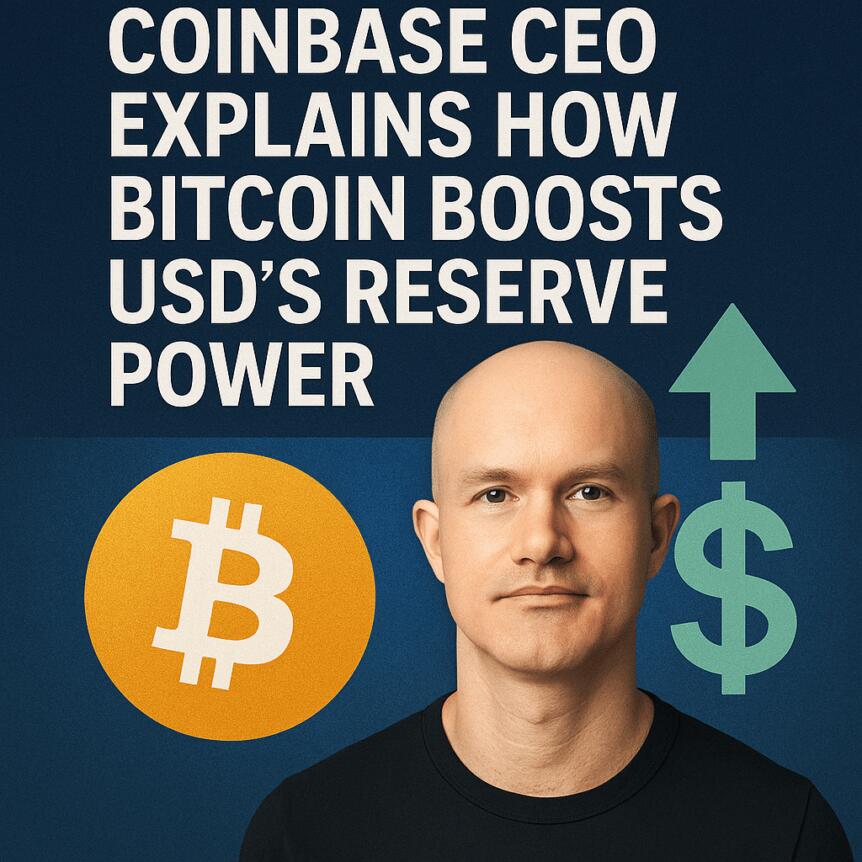
Coinbase Ceo Explains How Bitcoin Boosts Usd's Reserve Power

Introduction

As the U.S. national debt approaches $38 trillion amidst economic uncertainties, Bitcoin’s role as a competitive force to the dollar gains attention. Industry leaders highlight its potential in regulating fiscal discipline and sustaining dollar dominance while debates around stablecoins’ future continue.

Key Takeaways

  • Coinbase CEO Brian Armstrong views Bitcoin as a check on the U.S. dollar, helping to curb inflation and deficit spending.
  • U.S. national debt surges at approximately $70,843 per second, nearing $38 trillion, driven by ongoing fiscal deficits.
  • Bitcoin experienced significant volatility, reaching a peak of $126,080 before retracing to around $88,210, while gold continues its upward trend.
  • Stablecoins are increasingly considered vital for maintaining the dollar’s global reserve status, with the US enacting comprehensive regulatory frameworks.

Tickers mentioned: None.

Sentiment: Mixed – cautious optimism about Bitcoin’s influence, with ongoing regulatory developments.

Price impact: Neutral – Bitcoin’s recent volatility reflects broader market uncertainties.

Trading idea (Not Financial Advice): Hold — Given current fluctuations, maintaining positions is prudent amid ongoing macroeconomic shifts.

Market context: The escalating U.S. debt and inflationary pressures are fueling increased interest in alternative assets like Bitcoin and stablecoins, shaping the future landscape of global financial systems.

Bitcoin and the U.S. Dollar

Coinbase CEO Brian Armstrong emphasized Bitcoin’s role as a competitive force against the U.S. dollar, asserting that it provides a vital check on American monetary policy. In an interview with Rick Rubin on Tetragrammation, Armstrong argued that Bitcoin offers a safeguard during times of economic uncertainty, especially when deficit spending and inflation rise uncontrollably.

“Bitcoin supplies a balance to the dollar. If the U.S. engages in excessive deficit spending or inflation surpasses economic growth, people tend to migrate toward Bitcoin,” he stated. Armstrong further warned that sustained inflation exceeding growth could threaten the dollar’s prestige as the world’s reserve currency, a scenario that would significantly impact U.S. economic standing.

He also believes Bitcoin indirectly supports the stability of the U.S. economy by prompting regulators and policymakers to avoid actions that could damage confidence. “In a strange way, Bitcoin is helping to extend the American experiment,” he concluded.

US Debt Continues Rapid Growth

The United States’ national debt has surged to approximately $37.65 trillion, increasing by nearly $4.25 million per minute, according to data from the US Congress Joint Economic Committee. This relentless growth underscores the mounting fiscal challenges facing the nation.

In response to economic uncertainty, some experts, including JPMorgan, have pointed to Bitcoin and gold as hedges against currency debasement. Bitcoin notably peaked at $126,080 in October before retracing by about 30%. Conversely, gold has continued its upward trajectory, reaching $4,545 per ounce recently.

The Trump administration’s March move to establish a Strategic Bitcoin Reserve—though currently holding seized assets and not yet purchasing new ones—indicates a strategic interest in crypto assets as a buffer against mounting debt. Nevertheless, legislative efforts, such as the proposed Bitcoin Act of 2025, remain in early stages.

Role of Stablecoins in Dollar Dominance

Industry analysts argue that stablecoins may play a more significant role than Bitcoin in reinforcing the dollar’s position as the global reserve currency. Sandeep Nailwal, CEO of the Polygon Foundation, noted recent trends of dollarization in regions like Latin America and Africa, driven by digital dollar adoption. This process, termed “Dollarisation 2.0,” is fundamentally reconfiguring economic relationships worldwide.

The U.S. recent passage of the GENIUS Act—a comprehensive framework regulating stablecoins—illustrates the government’s recognition of their importance. Currently valued at over $312 billion, stablecoins are projected to reach $2 trillion by 2028, further embedding the dollar into everyday financial transactions globally.

This article was originally published as Coinbase CEO Explains How Bitcoin Boosts USD’s Reserve Power on Crypto Breaking News – your trusted source for crypto news, Bitcoin news, and blockchain updates.


Market Opportunity
Power Protocol Logo
Power Protocol Price(POWER)
$0.15994
$0.15994$0.15994
+2.70%
USD
Power Protocol (POWER) Live Price Chart
Disclaimer: The articles reposted on this site are sourced from public platforms and are provided for informational purposes only. They do not necessarily reflect the views of MEXC. All rights remain with the original authors. If you believe any content infringes on third-party rights, please contact service@support.mexc.com for removal. MEXC makes no guarantees regarding the accuracy, completeness, or timeliness of the content and is not responsible for any actions taken based on the information provided. The content does not constitute financial, legal, or other professional advice, nor should it be considered a recommendation or endorsement by MEXC.

You May Also Like

The Channel Factories We’ve Been Waiting For

The Channel Factories We’ve Been Waiting For

The post The Channel Factories We’ve Been Waiting For appeared on BitcoinEthereumNews.com. Visions of future technology are often prescient about the broad strokes while flubbing the details. The tablets in “2001: A Space Odyssey” do indeed look like iPads, but you never see the astronauts paying for subscriptions or wasting hours on Candy Crush.  Channel factories are one vision that arose early in the history of the Lightning Network to address some challenges that Lightning has faced from the beginning. Despite having grown to become Bitcoin’s most successful layer-2 scaling solution, with instant and low-fee payments, Lightning’s scale is limited by its reliance on payment channels. Although Lightning shifts most transactions off-chain, each payment channel still requires an on-chain transaction to open and (usually) another to close. As adoption grows, pressure on the blockchain grows with it. The need for a more scalable approach to managing channels is clear. Channel factories were supposed to meet this need, but where are they? In 2025, subnetworks are emerging that revive the impetus of channel factories with some new details that vastly increase their potential. They are natively interoperable with Lightning and achieve greater scale by allowing a group of participants to open a shared multisig UTXO and create multiple bilateral channels, which reduces the number of on-chain transactions and improves capital efficiency. Achieving greater scale by reducing complexity, Ark and Spark perform the same function as traditional channel factories with new designs and additional capabilities based on shared UTXOs.  Channel Factories 101 Channel factories have been around since the inception of Lightning. A factory is a multiparty contract where multiple users (not just two, as in a Dryja-Poon channel) cooperatively lock funds in a single multisig UTXO. They can open, close and update channels off-chain without updating the blockchain for each operation. Only when participants leave or the factory dissolves is an on-chain transaction…
Share
BitcoinEthereumNews2025/09/18 00:09
Fed Decides On Interest Rates Today—Here’s What To Watch For

Fed Decides On Interest Rates Today—Here’s What To Watch For

The post Fed Decides On Interest Rates Today—Here’s What To Watch For appeared on BitcoinEthereumNews.com. Topline The Federal Reserve on Wednesday will conclude a two-day policymaking meeting and release a decision on whether to lower interest rates—following months of pressure and criticism from President Donald Trump—and potentially signal whether additional cuts are on the way. President Donald Trump has urged the central bank to “CUT INTEREST RATES, NOW, AND BIGGER” than they might plan to. Getty Images Key Facts The central bank is poised to cut interest rates by at least a quarter-point, down from the 4.25% to 4.5% range where they have been held since December to between 4% and 4.25%, as Wall Street has placed 100% odds of a rate cut, according to CME’s FedWatch, with higher odds (94%) on a quarter-point cut than a half-point (6%) reduction. Fed governors Christopher Waller and Michelle Bowman, both Trump appointees, voted in July for a quarter-point reduction to rates, and they may dissent again in favor of a large cut alongside Stephen Miran, Trump’s Council of Economic Advisers’ chair, who was sworn in at the meeting’s start on Tuesday. It’s unclear whether other policymakers, including Kansas City Fed President Jeffrey Schmid and St. Louis Fed President Alberto Musalem, will favor larger cuts or opt for no reduction. Fed Chair Jerome Powell said in his Jackson Hole, Wyoming, address last month the central bank would likely consider a looser monetary policy, noting the “shifting balance of risks” on the U.S. economy “may warrant adjusting our policy stance.” David Mericle, an economist for Goldman Sachs, wrote in a note the “key question” for the Fed’s meeting is whether policymakers signal “this is likely the first in a series of consecutive cuts” as the central bank is anticipated to “acknowledge the softening in the labor market,” though they may not “nod to an October cut.” Mericle said he…
Share
BitcoinEthereumNews2025/09/18 00:23
One Of Frank Sinatra’s Most Famous Albums Is Back In The Spotlight

One Of Frank Sinatra’s Most Famous Albums Is Back In The Spotlight

The post One Of Frank Sinatra’s Most Famous Albums Is Back In The Spotlight appeared on BitcoinEthereumNews.com. Frank Sinatra’s The World We Knew returns to the Jazz Albums and Traditional Jazz Albums charts, showing continued demand for his timeless music. Frank Sinatra performs on his TV special Frank Sinatra: A Man and his Music Bettmann Archive These days on the Billboard charts, Frank Sinatra’s music can always be found on the jazz-specific rankings. While the art he created when he was still working was pop at the time, and later classified as traditional pop, there is no such list for the latter format in America, and so his throwback projects and cuts appear on jazz lists instead. It’s on those charts where Sinatra rebounds this week, and one of his popular projects returns not to one, but two tallies at the same time, helping him increase the total amount of real estate he owns at the moment. Frank Sinatra’s The World We Knew Returns Sinatra’s The World We Knew is a top performer again, if only on the jazz lists. That set rebounds to No. 15 on the Traditional Jazz Albums chart and comes in at No. 20 on the all-encompassing Jazz Albums ranking after not appearing on either roster just last frame. The World We Knew’s All-Time Highs The World We Knew returns close to its all-time peak on both of those rosters. Sinatra’s classic has peaked at No. 11 on the Traditional Jazz Albums chart, just missing out on becoming another top 10 for the crooner. The set climbed all the way to No. 15 on the Jazz Albums tally and has now spent just under two months on the rosters. Frank Sinatra’s Album With Classic Hits Sinatra released The World We Knew in the summer of 1967. The title track, which on the album is actually known as “The World We Knew (Over and…
Share
BitcoinEthereumNews2025/09/18 00:02