The post Chainlink Price at a Crossroads: Why LINK Is Struggling Near $12 appeared first on Coinpedia Fintech News The crypto markets are becoming choppy nowadaysThe post Chainlink Price at a Crossroads: Why LINK Is Struggling Near $12 appeared first on Coinpedia Fintech News The crypto markets are becoming choppy nowadays

Chainlink Price at a Crossroads: Why LINK Is Struggling Near $12

2025/12/24 19:33
3 min read
For feedback or concerns regarding this content, please contact us at crypto.news@mexc.com
“Infinitely Better” LINK Could Beat XRP Over the Next 10 Years, Says Lark Davis

The post Chainlink Price at a Crossroads: Why LINK Is Struggling Near $12 appeared first on Coinpedia Fintech News

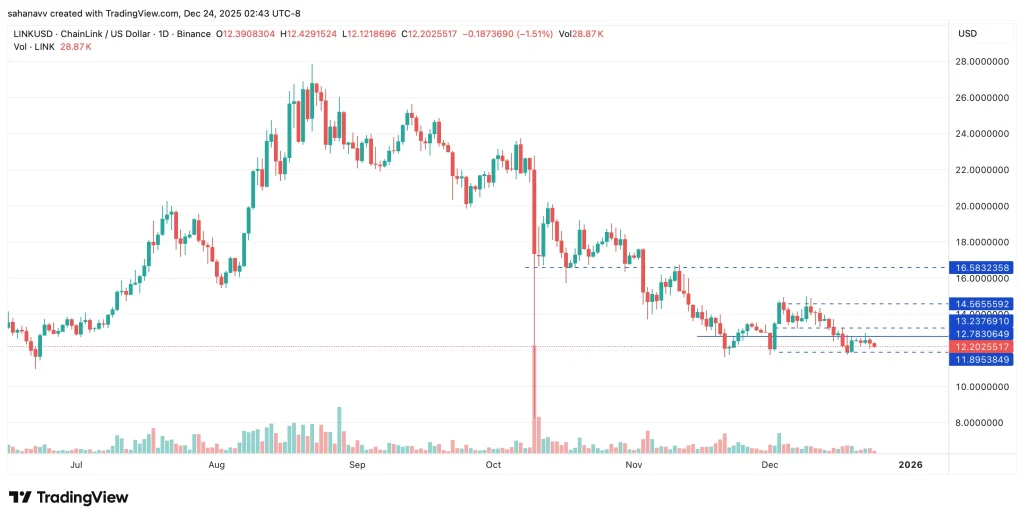
The crypto markets are becoming choppy nowadays as the prices of most of the tokens are heading towards their local support range. Meanwhile, the Chainlink (LINK) price is trading near the $12 zone, extending a broader downtrend that has been in place since October. While volatility has cooled, the chart shows that LINK is not stabilising yet. Instead, price action suggests sellers remain in control, with rallies failing to reclaim key resistance levels. The market is now approaching a critical decision point that could define LINK’s next move.

On the daily chart, LINK continues to print lower highs and lower lows, a classic bearish structure. Every rebound attempt over the past two months has stalled below prior support zones, which have now turned into resistance. This behaviour signals distribution rather than accumulation.

The sharp breakdown in October was followed by weak recovery attempts, showing that buyers have not stepped in aggressively. Until this structure changes, the broader trend remains tilted to the downside.
link price

The $12–$12.20 area is the most important level on the chart right now. Volume has remained relatively low, suggesting a lack of strong demand. If buyers were in control, the chart would show stronger bounces and follow-through. Instead, price is compressing near the level, increasing the risk of a breakdown. 

What happens next?

A clean daily close below $12 would likely trigger another leg lower rather than a temporary dip. Below this level, the next demand zone sits near $11.90–$11.50, where buyers previously stepped in. Such a move would not indicate panic but a continuation of the existing trend. In weak market conditions, altcoins like LINK tend to follow momentum rather than reverse abruptly.

Besides, to invalidate the bearish setup, the price must reclaim $12.80–$13.30 and hold above it. This zone marks previous support that repeatedly capped recent rallies. A breakout above it, supported by rising volume, would signal that sellers are losing control.

Without this reclaim, upside moves are likely to be sold into rather than extended.

LINK’s weakness also reflects broader market conditions. With Bitcoin and Ethereum consolidating and liquidity thinning, capital is rotating away from higher-beta altcoins. In such phases, tokens with weaker structure tend to underperform until market confidence returns. This makes patience critical for traders, as early dip-buying often leads to poor risk-reward setups.

Collectively, Chainlink is not collapsing, but it is clearly failing to reclaim structure. The $12 level is acting as a pressure point, and the lack of strong buying interest keeps downside risks elevated. Until the LINK price reclaims key resistance at $15 with volume growth, the trend may remain sideways to lower.


Disclaimer: The articles reposted on this site are sourced from public platforms and are provided for informational purposes only. They do not necessarily reflect the views of MEXC. All rights remain with the original authors. If you believe any content infringes on third-party rights, please contact crypto.news@mexc.com for removal. MEXC makes no guarantees regarding the accuracy, completeness, or timeliness of the content and is not responsible for any actions taken based on the information provided. The content does not constitute financial, legal, or other professional advice, nor should it be considered a recommendation or endorsement by MEXC.
Tags:

You May Also Like

Cashing In On University Patents Means Giving Up On Our Innovation Future

Cashing In On University Patents Means Giving Up On Our Innovation Future

The post Cashing In On University Patents Means Giving Up On Our Innovation Future appeared on BitcoinEthereumNews.com. “It’s a raid on American innovation that would deliver pennies to the Treasury while kneecapping the very engine of our economic and medical progress,” writes Pipes. Getty Images Washington is addicted to taxing success. Now, Commerce Secretary Howard Lutnick is floating a plan to skim half the patent earnings from inventions developed at universities with federal funding. It’s being sold as a way to shore up programs like Social Security. In reality, it’s a raid on American innovation that would deliver pennies to the Treasury while kneecapping the very engine of our economic and medical progress. Yes, taxpayer dollars support early-stage research. But the real payoff comes later—in the jobs created, cures discovered, and industries launched when universities and private industry turn those discoveries into real products. By comparison, the sums at stake in patent licensing are trivial. Universities collectively earn only about $3.6 billion annually in patent income—less than the federal government spends on Social Security in a single day. Even confiscating half would barely register against a $6 trillion federal budget. And yet the damage from such a policy would be anything but trivial. The true return on taxpayer investment isn’t in licensing checks sent to Washington, but in the downstream economic activity that federally supported research unleashes. Thanks to the bipartisan Bayh-Dole Act of 1980, universities and private industry have powerful incentives to translate early-stage discoveries into real-world products. Before Bayh-Dole, the government hoarded patents from federally funded research, and fewer than 5% were ever licensed. Once universities could own and license their own inventions, innovation exploded. The result has been one of the best returns on investment in government history. Since 1996, university research has added nearly $2 trillion to U.S. industrial output, supported 6.5 million jobs, and launched more than 19,000 startups. Those companies pay…
Share
BitcoinEthereumNews2025/09/18 03:26
Subaru Motors Finance Reviews 2026

Subaru Motors Finance Reviews 2026

If you’re at a Subaru dealership, your heart is set on the perfect Outback or Forester. The salesperson asks, “Would you like to finance it today?” That’s where
Share
Fintechzoom2026/03/08 10:55
Shiba Inu Price Prediction: Dubai Cracks Down on KuCoin as Pepeto Outpaces DOGE and SHIB With $7.4M Raised

Shiba Inu Price Prediction: Dubai Cracks Down on KuCoin as Pepeto Outpaces DOGE and SHIB With $7.4M Raised

SHIB trades near cycle lows, but Pepeto is outpacing every Shiba Inu price prediction with $7.4M raised and a full exchange ecosystem approaching launch as Dubai
Share
Techbullion2026/03/08 10:54





