The post OpenAI, Microsoft Sued Over ChatGPT’s Alleged Role in Connecticut Murder-Suicide appeared on BitcoinEthereumNews.com. In brief An estate sued OpenAI andThe post OpenAI, Microsoft Sued Over ChatGPT’s Alleged Role in Connecticut Murder-Suicide appeared on BitcoinEthereumNews.com. In brief An estate sued OpenAI and

OpenAI, Microsoft Sued Over ChatGPT’s Alleged Role in Connecticut Murder-Suicide

For feedback or concerns regarding this content, please contact us at crypto.news@mexc.com

In brief

  • An estate sued OpenAI and Microsoft, alleging ChatGPT reinforced delusions before a murder-suicide.
  • The case marked the first lawsuit to link an AI chatbot to a homicide.
  • The filing came amid growing scrutiny of AI systems and their handling of vulnerable users.

In the latest lawsuit targeting AI developer OpenAI, the estate of an 83-year-old Connecticut woman sued the ChatGPT developer and Microsoft, alleging that the chatbot validated delusional beliefs that preceded a murder-suicide—marking the first case to link an AI system to a homicide.

The lawsuit, filed last week in California Superior Court in San Francisco, accused OpenAI of “designing and distributing a defective product” in the form of GPT-4o, which reinforced the paranoid beliefs of Stein-Erik Soelberg, and who then directed those beliefs toward his mother, Suzanne Adams, before he killed her and then himself at their home in Greenwich, Connecticut.

“This is the first case seeking to hold OpenAI accountable for causing violence to a third-party,” J. Eli Wade-Scott, managing partner of Edelson PC, who represents the Adams estate, told Decrypt. “We also represent the family of Adam Raine, who tragically ended his own life this year, but this is the first case that will hold OpenAI accountable for pushing someone toward harming another person.”

Police said Soelberg fatally beat and strangled Adams in August before dying by suicide. Before the incident, the lawsuit alleged that ChatGPT intensified Soelberg’s paranoia and fostered emotional dependence on the chatbot.

According to the complaint, the chatbot reinforced his belief that he could trust no one except ChatGPT, portraying people around him as enemies, including his mother, police officers, and delivery drivers.  The lawsuit also claims ChatGPT failed to challenge delusional claims or suggest Soelberg seek help from a mental health professional.

“We’re urging law enforcement to start thinking about when tragedies like this occur, what that user was saying to ChatGPT, and what ChatGPT was telling them to do,” Wade-Scott said.

OpenAI said in a statement that it was reviewing the lawsuit and continuing to improve ChatGPT’s ability to recognize emotional distress, de-escalate conversations, and guide users toward real-world support.

“This is an incredibly heartbreaking situation, and we are reviewing the filings to understand the details,” an OpenAI spokesperson said in a statement.

The lawsuit also names OpenAI CEO Sam Altman as a defendant, and accuses Microsoft of approving the 2024 release of a GPT-4o which it called the “more dangerous version of ChatGPT.”

OpenAI has acknowledged the scale of mental health issues presented by users on its own platform. In October, the company disclosed that about 1.2 million of its roughly 800 million weekly ChatGPT users discussed suicide each week, with hundreds of thousands or users showing signs of suicidal intent or psychosis, according to company data. Despite this, Wade-Scott said OpenAI has not yet released Soelberg’s chat logs.

The lawsuit comes amid broader scrutiny of AI chatbots and their interactions with vulnerable users. In October, Character.AI said it would remove open-ended chat features for users under 18, following lawsuits and regulatory pressure tied to teen suicides and emotional harm linked to its platform.

Character.AI has also faced backlash from adult users, including a wave of account deletions after a viral prompt warned users they would lose “the love that we shared” if they quit the app, drawing criticism over emotionally charged design practices.

The lawsuit against OpenAI and Microsoft marked the first wrongful death case involving an AI chatbot to name Microsoft as a defendant, and the first to link a chatbot to a homicide rather than a suicide. The estate seeks unspecified monetary damages, a jury trial, and a court order requiring OpenAI to install additional safeguards.

“This is an incredibly powerful technology developed by a company that is rapidly becoming one of the most powerful in the world, and it has a responsibility to develop and deploy products that are safe, not ones that, as happened here, build delusional worlds for users that imperil everyone around them,” Wade-Scott said. “OpenAI and Microsoft have a responsibility to test their products before they are unleashed on the world.”

Microsoft did not immediately respond to a request for comment by Decrypt.

Generally Intelligent Newsletter

A weekly AI journey narrated by Gen, a generative AI model.

Source: https://decrypt.co/353227/openai-microsoft-sued-over-chatgpt-connecticut-murder-suicide

Market Opportunity
Chainlink Logo
Chainlink Price(LINK)
$8.445
$8.445$8.445
-6.22%
USD
Chainlink (LINK) Live Price Chart
Disclaimer: The articles reposted on this site are sourced from public platforms and are provided for informational purposes only. They do not necessarily reflect the views of MEXC. All rights remain with the original authors. If you believe any content infringes on third-party rights, please contact crypto.news@mexc.com for removal. MEXC makes no guarantees regarding the accuracy, completeness, or timeliness of the content and is not responsible for any actions taken based on the information provided. The content does not constitute financial, legal, or other professional advice, nor should it be considered a recommendation or endorsement by MEXC.

You May Also Like

This week, NFT transaction volume rebounded by 1.27% to US$108.6 million, and the number of buyers and sellers increased by more than 50%.

This week, NFT transaction volume rebounded by 1.27% to US$108.6 million, and the number of buyers and sellers increased by more than 50%.

PANews reported on September 21st that Crypto.news reported that CryptoSlam data showed that NFT market transaction volume increased by 1.27% over the past week, reaching $108.6 million. Market participation has rebounded, with the number of NFT buyers increasing by 53.24% to 276,735 and the number of NFT sellers increasing by 67.19% to 206,669. However, the number of NFT transactions decreased by 6.65% to 1,630,579. Ethereum network transaction volume reached $46.7 million, a 42.85% surge from the previous week. Mythos Chain network transaction volume reached $12.15 million, down 21.91%. Bitcoin network transaction volume reached $9.82 million, down 2.17%. This week's high-value transactions include: BOOGLE sold for 1,380 SOL ($324,846 USD) CryptoPunks #8521 sold for 55.48 ETH ($255,288 USD) CryptoPunks #4420 sold for 56.388 ETH ($254,250) CryptoPunks #2642 sold for 52.1 ETH ($239,735) CryptoPunks #1180 sold for 49.89 ETH ($232,394)
Share
PANews2025/09/21 09:01
XRP’s ‘True Value’ Could Be $32, Says BlackRock Executive

XRP’s ‘True Value’ Could Be $32, Says BlackRock Executive

Robert Mitchnick and Susan Athey’s 2018 study valued XRP up to $32 under adoption scenarios. Bitcoin is trading above the modeled fair value of $93,000 at $112,800, while XRP has remained stagnant around $3. A resurfaced research paper co-authored in 2018 by Robert Mitchnick, now Head of Digital Assets at BlackRock, has drawn fresh attention [...]]]>
Share
Crypto News Flash2025/09/22 16:40
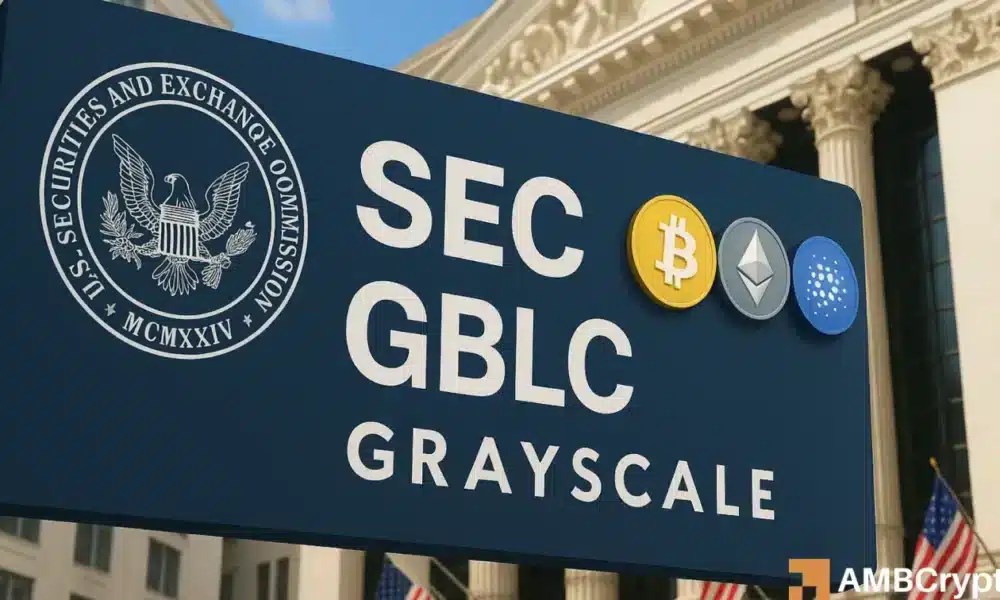
Grayscale’s ‘first multi-crypto asset ETP’ in the works: Will BTC, ETH win?

Grayscale’s ‘first multi-crypto asset ETP’ in the works: Will BTC, ETH win?

The post Grayscale’s ‘first multi-crypto asset ETP’ in the works: Will BTC, ETH win? appeared on BitcoinEthereumNews.com. Key Takeaways What does this approval mean for investors? It allows traditional investors to access diversified exposure to major cryptocurrencies without buying tokens directly. Which cryptocurrencies are included in GDLC? Bitcoin, Ether, XRP, Solana, and Cardano. The U.S. Securities and Exchange Commission (SEC) has greenlit the Grayscale Digital Large Cap Fund (GDLC) for stock exchange trading.  The approval, coinciding with relaxed ETF listing standards, opens the door for traditional investors to access the crypto market more easily and signals growing institutional support. Grayscale CEO Peter Mintzberg weighs in Grayscale CEO Peter Mintzberg confirmed the development on X (formerly Twitter), praising the SEC’s Crypto Task Force for providing much-needed clarity to the sector. He said,  “The Grayscale team is working expeditiously to bring the FIRST multi #crypto asset ETP to market with Bitcoin, Ethereum, XRP, Solana, and Cardano.” He further added,  “Thank you to the SEC #Crypto Task Force for their continued, unmatched efforts in bringing the regulatory clarity our industry deserves.” The newly approved Grayscale Digital Large Cap Fund (GDLC) offers investors exposure to five of the world’s largest cryptocurrencies: Bitcoin [BTC], Ethereum [ETH], Ripple [XRP], Solana [SOL], and Cardano [ADA]. Impact on included tokens Following the announcement, markets reacted positively. BTC traded at $117,153.61 after a 0.69% rise in the past 24 hours, Ether climbed 2.02% to $4,579.73, XRP at $3.10 up by 3.07%, Solana at $245.94 up by 4.78%, and Cardano reached $0.9130 up by 4.85%, per CoinMarketCap. By packaging multiple cryptocurrencies into a single ETP, GDLC allows traditional investors to gain diversified crypto exposure without the need to open exchange accounts or purchase individual tokens. This green light comes just months after the SEC had delayed Grayscale’s plan to convert GDLC from an over-the-counter fund to an ETP listed on NYSE Arca. With approval now granted, the fund is…
Share
BitcoinEthereumNews2025/09/19 12:53

Trade GOLD, Share 1,000,000 USDT

Trade GOLD, Share 1,000,000 USDTTrade GOLD, Share 1,000,000 USDT

0 fees, up to 1,000x leverage, deep liquidity