The accommodation industry has undergone a dramatic transformation in how it handles financial transactions, with payment management emerging as a critical componentThe accommodation industry has undergone a dramatic transformation in how it handles financial transactions, with payment management emerging as a critical component

Streamlining Payment Management in the Modern Accommodation Industry

2025/12/21 23:14
3 min read
For feedback or concerns regarding this content, please contact us at crypto.news@mexc.com

The accommodation industry has undergone a dramatic transformation in how it handles financial transactions, with payment management emerging as a critical component of operational success. From boutique hotels to large resort chains, efficient payment processing systems have become essential for maintaining competitiveness and ensuring guest satisfaction in an increasingly digital marketplace.

Modern accommodation Industry Payment Management providers face unique payment challenges that distinguish them from traditional retail businesses. Guests expect seamless transactions across multiple touchpoints—from initial booking deposits and advance payments to on-property charges for dining, spa services, and room upgrades. Managing these diverse payment streams while maintaining security and compliance requires sophisticated systems that can handle complexity without sacrificing user experience.

Digital Payment Integration

Today’s accommodation industry relies heavily on integrated payment platforms that connect reservation systems, property management software, and accounting tools. These integrated solutions eliminate manual data entry, reduce errors, and provide real-time financial visibility. Guests can now complete transactions through various channels including online booking portals, mobile applications, self-service kiosks, and traditional front desk terminals, all while ensuring data consistency across platforms.

Security and Compliance

Payment security represents a paramount concern for accommodation providers handling sensitive financial information. Compliance with Payment Card Industry Data Security Standard (PCI DSS) requirements protects both businesses and guests from fraud and data breaches. Modern payment management systems employ tokenization and encryption technologies that safeguard card information while streamlining the payment process. Additionally, implementing secure payment gateways helps properties avoid costly security incidents that could damage reputation and result in substantial financial penalties.

Global Payment Processing

With international tourism continuing to expand, accommodation providers must accommodate diverse payment preferences and currencies. Multi-currency processing capabilities enable guests to pay in their preferred currency while properties receive funds in their local currency, with transparent exchange rate information provided upfront. Supporting various payment methods—including credit cards, debit cards, digital wallets, bank transfers, and regional payment options—ensures properties don’t lose bookings due to payment limitations.

Revenue Optimization

Strategic payment management extends beyond processing transactions to optimizing revenue collection. Flexible deposit policies, dynamic pricing integration, and automated payment scheduling help properties maximize cash flow while minimizing cancellations. Pre-authorization capabilities allow businesses to secure funds for incidental charges without immediate capture, improving guest experience while protecting against revenue loss.

Reconciliation and Reporting

Automated reconciliation features save countless hours previously spent matching payments with reservations and identifying discrepancies. Comprehensive reporting capabilities provide insights into payment trends, processing costs, and revenue patterns that inform business decisions. Real-time financial dashboards enable managers to monitor performance metrics and quickly identify issues requiring attention.

Future Trends

The accommodation industry continues evolving toward contactless payments, biometric authentication, and blockchain-based solutions. Artificial intelligence and machine learning enhance fraud detection while predictive analytics help optimize payment timing and reduce failed transactions. As guest expectations continue rising, properties investing in robust payment management infrastructure position themselves for sustained success in an increasingly competitive marketplace.

Effective payment management has transformed from a back-office function into a strategic differentiator that directly impacts guest satisfaction, operational efficiency, and financial performance throughout the accommodation industry.


Comments
Disclaimer: The articles reposted on this site are sourced from public platforms and are provided for informational purposes only. They do not necessarily reflect the views of MEXC. All rights remain with the original authors. If you believe any content infringes on third-party rights, please contact crypto.news@mexc.com for removal. MEXC makes no guarantees regarding the accuracy, completeness, or timeliness of the content and is not responsible for any actions taken based on the information provided. The content does not constitute financial, legal, or other professional advice, nor should it be considered a recommendation or endorsement by MEXC.

You May Also Like

This week, NFT transaction volume rebounded by 1.27% to US$108.6 million, and the number of buyers and sellers increased by more than 50%.

This week, NFT transaction volume rebounded by 1.27% to US$108.6 million, and the number of buyers and sellers increased by more than 50%.

PANews reported on September 21st that Crypto.news reported that CryptoSlam data showed that NFT market transaction volume increased by 1.27% over the past week, reaching $108.6 million. Market participation has rebounded, with the number of NFT buyers increasing by 53.24% to 276,735 and the number of NFT sellers increasing by 67.19% to 206,669. However, the number of NFT transactions decreased by 6.65% to 1,630,579. Ethereum network transaction volume reached $46.7 million, a 42.85% surge from the previous week. Mythos Chain network transaction volume reached $12.15 million, down 21.91%. Bitcoin network transaction volume reached $9.82 million, down 2.17%. This week's high-value transactions include: BOOGLE sold for 1,380 SOL ($324,846 USD) CryptoPunks #8521 sold for 55.48 ETH ($255,288 USD) CryptoPunks #4420 sold for 56.388 ETH ($254,250) CryptoPunks #2642 sold for 52.1 ETH ($239,735) CryptoPunks #1180 sold for 49.89 ETH ($232,394)
Share
PANews2025/09/21 09:01
XRP’s ‘True Value’ Could Be $32, Says BlackRock Executive

XRP’s ‘True Value’ Could Be $32, Says BlackRock Executive

Robert Mitchnick and Susan Athey’s 2018 study valued XRP up to $32 under adoption scenarios. Bitcoin is trading above the modeled fair value of $93,000 at $112,800, while XRP has remained stagnant around $3. A resurfaced research paper co-authored in 2018 by Robert Mitchnick, now Head of Digital Assets at BlackRock, has drawn fresh attention [...]]]>
Share
Crypto News Flash2025/09/22 16:40
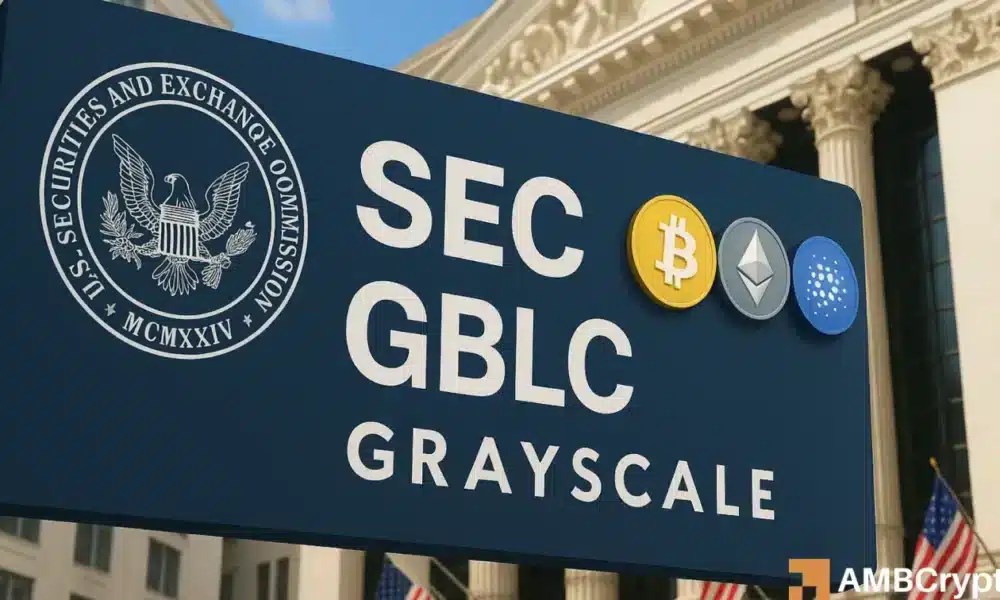
Grayscale’s ‘first multi-crypto asset ETP’ in the works: Will BTC, ETH win?

Grayscale’s ‘first multi-crypto asset ETP’ in the works: Will BTC, ETH win?

The post Grayscale’s ‘first multi-crypto asset ETP’ in the works: Will BTC, ETH win? appeared on BitcoinEthereumNews.com. Key Takeaways What does this approval mean for investors? It allows traditional investors to access diversified exposure to major cryptocurrencies without buying tokens directly. Which cryptocurrencies are included in GDLC? Bitcoin, Ether, XRP, Solana, and Cardano. The U.S. Securities and Exchange Commission (SEC) has greenlit the Grayscale Digital Large Cap Fund (GDLC) for stock exchange trading.  The approval, coinciding with relaxed ETF listing standards, opens the door for traditional investors to access the crypto market more easily and signals growing institutional support. Grayscale CEO Peter Mintzberg weighs in Grayscale CEO Peter Mintzberg confirmed the development on X (formerly Twitter), praising the SEC’s Crypto Task Force for providing much-needed clarity to the sector. He said,  “The Grayscale team is working expeditiously to bring the FIRST multi #crypto asset ETP to market with Bitcoin, Ethereum, XRP, Solana, and Cardano.” He further added,  “Thank you to the SEC #Crypto Task Force for their continued, unmatched efforts in bringing the regulatory clarity our industry deserves.” The newly approved Grayscale Digital Large Cap Fund (GDLC) offers investors exposure to five of the world’s largest cryptocurrencies: Bitcoin [BTC], Ethereum [ETH], Ripple [XRP], Solana [SOL], and Cardano [ADA]. Impact on included tokens Following the announcement, markets reacted positively. BTC traded at $117,153.61 after a 0.69% rise in the past 24 hours, Ether climbed 2.02% to $4,579.73, XRP at $3.10 up by 3.07%, Solana at $245.94 up by 4.78%, and Cardano reached $0.9130 up by 4.85%, per CoinMarketCap. By packaging multiple cryptocurrencies into a single ETP, GDLC allows traditional investors to gain diversified crypto exposure without the need to open exchange accounts or purchase individual tokens. This green light comes just months after the SEC had delayed Grayscale’s plan to convert GDLC from an over-the-counter fund to an ETP listed on NYSE Arca. With approval now granted, the fund is…
Share
BitcoinEthereumNews2025/09/19 12:53

Trade GOLD, Share 1,000,000 USDT

Trade GOLD, Share 1,000,000 USDTTrade GOLD, Share 1,000,000 USDT

0 fees, up to 1,000x leverage, deep liquidity