The post Why Washington now eyes BTC miners appeared on BitcoinEthereumNews.com. Homepage > News > Business > The shadow over Bitmain: Why Washington now eyes BTC miners For years, most BTC holders didn’t think twice about where their mining equipment came from. Bitmain—this massive Beijing-based manufacturer—just kept shipping Antminers to warehouses in Texas, Kazakhstan, Paraguay, wherever. As long as the rigs worked and the hash rate kept climbing, nobody really cared. That casual attitude died this month when the U.S. government launched a national-security investigation into Bitmain and its stranglehold on global mining hardware. They’re calling it Operation Red Sunset, which should tell you how seriously they’re taking this. Here’s what has Washington spooked: Bitmain controls approximately 80% of the world’s Bitcoin mining equipment. And basically every modern Antminer can be accessed remotely through firmware updates. Theoretically, one command pushed from their headquarters in China could throttle, redirect, or completely brick a huge chunk of the BTC network’s processing power. Intelligence officials worry that Beijing could exploit that access directly, or force Bitmain to do it during some future crisis—Taiwan keeps coming up in these conversations. Making things messier, one of Bitmain’s biggest recent customers is American Bitcoin, a mining operation backed by Donald Trump Jr. and Eric Trump. So yeah, that’s added some urgency to the whole thing. American Bitcoin ordered 16,000 high-end rigs earlier this year for a new facility somewhere in the Midwest. The irony isn’t subtle: a company connected to the incoming first family is now at the center of an investigation designed to reduce foreign control over critical U.S. infrastructure. From what I’m hearing, investigators are especially interested in whether those machines have hidden backdoors or telemetry channels that Beijing could flip on without anyone knowing. Bitmain claims that its remote-management tools are solely for customer support and monitoring efficiency. They insist that no government has… The post Why Washington now eyes BTC miners appeared on BitcoinEthereumNews.com. Homepage > News > Business > The shadow over Bitmain: Why Washington now eyes BTC miners For years, most BTC holders didn’t think twice about where their mining equipment came from. Bitmain—this massive Beijing-based manufacturer—just kept shipping Antminers to warehouses in Texas, Kazakhstan, Paraguay, wherever. As long as the rigs worked and the hash rate kept climbing, nobody really cared. That casual attitude died this month when the U.S. government launched a national-security investigation into Bitmain and its stranglehold on global mining hardware. They’re calling it Operation Red Sunset, which should tell you how seriously they’re taking this. Here’s what has Washington spooked: Bitmain controls approximately 80% of the world’s Bitcoin mining equipment. And basically every modern Antminer can be accessed remotely through firmware updates. Theoretically, one command pushed from their headquarters in China could throttle, redirect, or completely brick a huge chunk of the BTC network’s processing power. Intelligence officials worry that Beijing could exploit that access directly, or force Bitmain to do it during some future crisis—Taiwan keeps coming up in these conversations. Making things messier, one of Bitmain’s biggest recent customers is American Bitcoin, a mining operation backed by Donald Trump Jr. and Eric Trump. So yeah, that’s added some urgency to the whole thing. American Bitcoin ordered 16,000 high-end rigs earlier this year for a new facility somewhere in the Midwest. The irony isn’t subtle: a company connected to the incoming first family is now at the center of an investigation designed to reduce foreign control over critical U.S. infrastructure. From what I’m hearing, investigators are especially interested in whether those machines have hidden backdoors or telemetry channels that Beijing could flip on without anyone knowing. Bitmain claims that its remote-management tools are solely for customer support and monitoring efficiency. They insist that no government has…

Why Washington now eyes BTC miners

For feedback or concerns regarding this content, please contact us at crypto.news@mexc.com

For years, most BTC holders didn’t think twice about where their mining equipment came from. Bitmain—this massive Beijing-based manufacturer—just kept shipping Antminers to warehouses in Texas, Kazakhstan, Paraguay, wherever. As long as the rigs worked and the hash rate kept climbing, nobody really cared. That casual attitude died this month when the U.S. government launched a national-security investigation into Bitmain and its stranglehold on global mining hardware. They’re calling it Operation Red Sunset, which should tell you how seriously they’re taking this.

Here’s what has Washington spooked: Bitmain controls approximately 80% of the world’s Bitcoin mining equipment. And basically every modern Antminer can be accessed remotely through firmware updates. Theoretically, one command pushed from their headquarters in China could throttle, redirect, or completely brick a huge chunk of the BTC network’s processing power. Intelligence officials worry that Beijing could exploit that access directly, or force Bitmain to do it during some future crisis—Taiwan keeps coming up in these conversations. Making things messier, one of Bitmain’s biggest recent customers is American Bitcoin, a mining operation backed by Donald Trump Jr. and Eric Trump. So yeah, that’s added some urgency to the whole thing.

American Bitcoin ordered 16,000 high-end rigs earlier this year for a new facility somewhere in the Midwest. The irony isn’t subtle: a company connected to the incoming first family is now at the center of an investigation designed to reduce foreign control over critical U.S. infrastructure. From what I’m hearing, investigators are especially interested in whether those machines have hidden backdoors or telemetry channels that Beijing could flip on without anyone knowing.

Bitmain claims that its remote-management tools are solely for customer support and monitoring efficiency. They insist that no government has ever made them insert malicious code. But those reassurances don’t mean much to people who remember what happened with Huawei and ZTE. Once Washington decides a tech vendor is too risky, the commercial arguments quickly lose their significance.

This investigation goes way beyond Bitmain, though. The Commerce Department apparently set an internal deadline—December 2025—to shift at least 50% of new BTC mining capacity onto American or allied hardware. Lawmakers from both parties are already drafting bills that would slap steep tariffs on Chinese-made miners and offer accelerated depreciation for operators who switch to domestic brands. We’re talking about Auradine, Marathon’s (NASDAQ: MARA) upcoming MARA Miner, and Intel’s (NASDAQ: INTC) Blockscale line, which they previously killed but are now apparently reviving.

Miners are stuck in a really awkward spot right now. The newest Bitmain S21 XP Hydros still have the best joules-per-terahash efficiency on the planet, and it’s not even close. Switching to less efficient machines right now means hemorrhaging money at a time when BTC is sitting below $84,000, and electricity costs keep going up. Many public mining companies have informed their investors that they’ll operate their existing Chinese fleets until the hardware literally fails, then determine what to do next. But privately? Executives admit the political risk is getting impossible to ignore.

Inside China, Bitmain’s already adapting. They opened a small assembly plant in Malaysia, and they’re negotiating for a second one in Vietnam—pretty obvious moves to keep shipping containers flowing even if direct U.S. exports get banned. Long-term, though, nobody really believes China’s going to give up its lead in semiconductor fab and mining-chip design without pushing back hard.

For BTC itself, the timing is genuinely terrible. Hash rate is near all-time highs, but profitability has tanked to levels we haven’t seen since the 2022 bear market. Forcing a rapid hardware transition risks a nasty drop in total hash rate right when the ecosystem can’t afford it. Some veterans I’ve talked to are quietly worried that a botched migration could temporarily hand a 51% advantage to whichever pools keep their Bitmain rigs running the longest.

This doesn’t mean everything will fall apart tomorrow. The network’s survived way worse. But Operation Red Sunset marks the point where BTC mining stopped being just another industry and turned into a piece of great-power competition. Those machines that used to feel like neutral tools? They carry geopolitical weight now. Miners who’ve spent years obsessing over watts and uptime suddenly have to think about sovereignty too.

Whether Washington’s freaking out for good reason or overreacting, one thing seems pretty clear: the days when the average BTC user could ignore who actually manufactures the hardware are done.

Watch: Untangling Bitcoin mining at the CoinGeek Weekly Livestream

title=”YouTube video player” frameborder=”0″ allow=”accelerometer; autoplay; clipboard-write; encrypted-media; gyroscope; picture-in-picture; web-share” referrerpolicy=”strict-origin-when-cross-origin” allowfullscreen=””>

Source: https://coingeek.com/the-shadow-over-bitmain-why-washington-now-eyes-btc-miners/

Market Opportunity
Bitcoin Logo
Bitcoin Price(BTC)
$65,974.33
$65,974.33$65,974.33
-4.27%
USD
Bitcoin (BTC) Live Price Chart
Disclaimer: The articles reposted on this site are sourced from public platforms and are provided for informational purposes only. They do not necessarily reflect the views of MEXC. All rights remain with the original authors. If you believe any content infringes on third-party rights, please contact crypto.news@mexc.com for removal. MEXC makes no guarantees regarding the accuracy, completeness, or timeliness of the content and is not responsible for any actions taken based on the information provided. The content does not constitute financial, legal, or other professional advice, nor should it be considered a recommendation or endorsement by MEXC.

You May Also Like

This week, NFT transaction volume rebounded by 1.27% to US$108.6 million, and the number of buyers and sellers increased by more than 50%.

This week, NFT transaction volume rebounded by 1.27% to US$108.6 million, and the number of buyers and sellers increased by more than 50%.

PANews reported on September 21st that Crypto.news reported that CryptoSlam data showed that NFT market transaction volume increased by 1.27% over the past week, reaching $108.6 million. Market participation has rebounded, with the number of NFT buyers increasing by 53.24% to 276,735 and the number of NFT sellers increasing by 67.19% to 206,669. However, the number of NFT transactions decreased by 6.65% to 1,630,579. Ethereum network transaction volume reached $46.7 million, a 42.85% surge from the previous week. Mythos Chain network transaction volume reached $12.15 million, down 21.91%. Bitcoin network transaction volume reached $9.82 million, down 2.17%. This week's high-value transactions include: BOOGLE sold for 1,380 SOL ($324,846 USD) CryptoPunks #8521 sold for 55.48 ETH ($255,288 USD) CryptoPunks #4420 sold for 56.388 ETH ($254,250) CryptoPunks #2642 sold for 52.1 ETH ($239,735) CryptoPunks #1180 sold for 49.89 ETH ($232,394)
Share
PANews2025/09/21 09:01
XRP’s ‘True Value’ Could Be $32, Says BlackRock Executive

XRP’s ‘True Value’ Could Be $32, Says BlackRock Executive

Robert Mitchnick and Susan Athey’s 2018 study valued XRP up to $32 under adoption scenarios. Bitcoin is trading above the modeled fair value of $93,000 at $112,800, while XRP has remained stagnant around $3. A resurfaced research paper co-authored in 2018 by Robert Mitchnick, now Head of Digital Assets at BlackRock, has drawn fresh attention [...]]]>
Share
Crypto News Flash2025/09/22 16:40
Grayscale’s ‘first multi-crypto asset ETP’ in the works: Will BTC, ETH win?

Grayscale’s ‘first multi-crypto asset ETP’ in the works: Will BTC, ETH win?

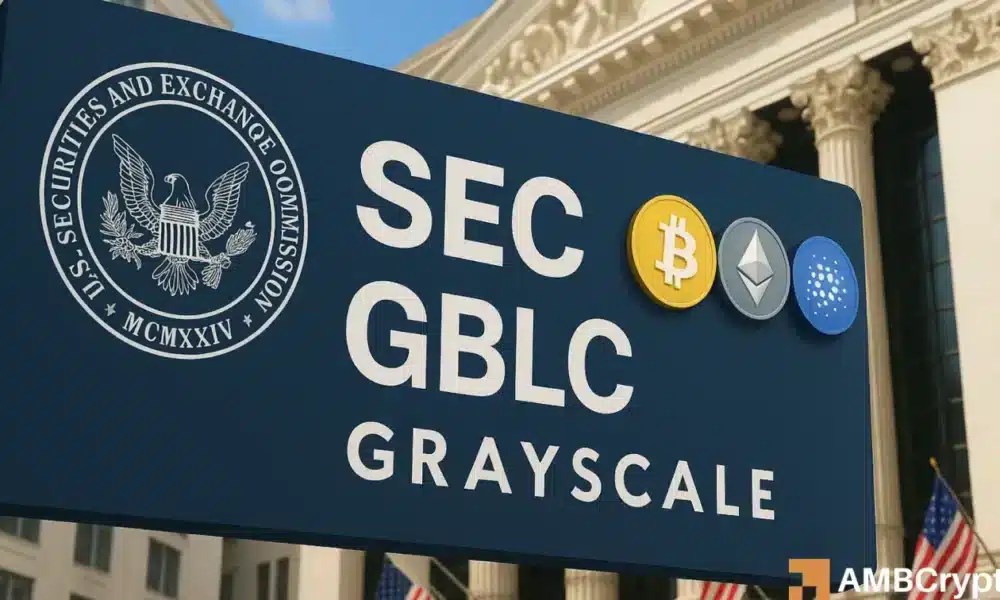
The post Grayscale’s ‘first multi-crypto asset ETP’ in the works: Will BTC, ETH win? appeared on BitcoinEthereumNews.com. Key Takeaways What does this approval mean for investors? It allows traditional investors to access diversified exposure to major cryptocurrencies without buying tokens directly. Which cryptocurrencies are included in GDLC? Bitcoin, Ether, XRP, Solana, and Cardano. The U.S. Securities and Exchange Commission (SEC) has greenlit the Grayscale Digital Large Cap Fund (GDLC) for stock exchange trading.  The approval, coinciding with relaxed ETF listing standards, opens the door for traditional investors to access the crypto market more easily and signals growing institutional support. Grayscale CEO Peter Mintzberg weighs in Grayscale CEO Peter Mintzberg confirmed the development on X (formerly Twitter), praising the SEC’s Crypto Task Force for providing much-needed clarity to the sector. He said,  “The Grayscale team is working expeditiously to bring the FIRST multi #crypto asset ETP to market with Bitcoin, Ethereum, XRP, Solana, and Cardano.” He further added,  “Thank you to the SEC #Crypto Task Force for their continued, unmatched efforts in bringing the regulatory clarity our industry deserves.” The newly approved Grayscale Digital Large Cap Fund (GDLC) offers investors exposure to five of the world’s largest cryptocurrencies: Bitcoin [BTC], Ethereum [ETH], Ripple [XRP], Solana [SOL], and Cardano [ADA]. Impact on included tokens Following the announcement, markets reacted positively. BTC traded at $117,153.61 after a 0.69% rise in the past 24 hours, Ether climbed 2.02% to $4,579.73, XRP at $3.10 up by 3.07%, Solana at $245.94 up by 4.78%, and Cardano reached $0.9130 up by 4.85%, per CoinMarketCap. By packaging multiple cryptocurrencies into a single ETP, GDLC allows traditional investors to gain diversified crypto exposure without the need to open exchange accounts or purchase individual tokens. This green light comes just months after the SEC had delayed Grayscale’s plan to convert GDLC from an over-the-counter fund to an ETP listed on NYSE Arca. With approval now granted, the fund is…
Share
BitcoinEthereumNews2025/09/19 12:53

Trade GOLD, Share 1,000,000 USDT

Trade GOLD, Share 1,000,000 USDTTrade GOLD, Share 1,000,000 USDT

0 fees, up to 1,000x leverage, deep liquidity