Argentina Considers Loosening Crypto Regulations to Enable Bank Participation Argentina is exploring a significant policy shift that could allow local financial institutions to engage more directly with cryptocurrencies. This proposed move signals a departure from the country’s historically restrictive stance on digital assets and could pave the way for broader adoption within the banking sector. [...]Argentina Considers Loosening Crypto Regulations to Enable Bank Participation Argentina is exploring a significant policy shift that could allow local financial institutions to engage more directly with cryptocurrencies. This proposed move signals a departure from the country’s historically restrictive stance on digital assets and could pave the way for broader adoption within the banking sector. [...]

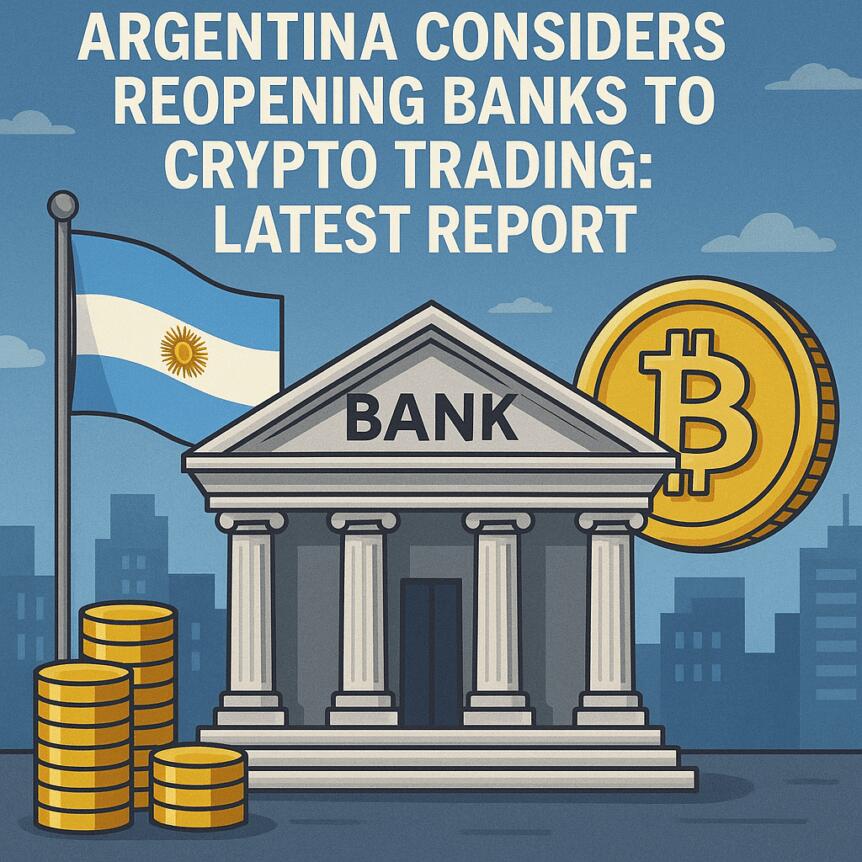
Argentina Considers Reopening Banks to Crypto Trading: Latest Report
For feedback or concerns regarding this content, please contact us at crypto.news@mexc.com
Argentina Considers Reopening Banks To Crypto Trading: Latest Report

Argentina Considers Loosening Crypto Regulations to Enable Bank Participation

Argentina is exploring a significant policy shift that could allow local financial institutions to engage more directly with cryptocurrencies. This proposed move signals a departure from the country’s historically restrictive stance on digital assets and could pave the way for broader adoption within the banking sector.

Key Takeaways

  • Argentina’s central bank is reportedly evaluating measures to permit traditional banks to trade cryptocurrencies.
  • This potential change follows years of regulatory uncertainty and previous bans on crypto services by the central bank.
  • Draft regulations are expected, with possible approval as soon as April 2026, according to local industry sources.
  • The move aligns with broader government efforts to clarify industry rules and foster a more open financial ecosystem.

Tickers mentioned: None

Sentiment: Neutral

Price impact: Neutral, as regulatory developments could eventually facilitate market growth but are currently in early discussion phases.

Market context: The Argentine government is gradually shifting towards accommodating digital assets amid escalating inflation and currency devaluation concerns.

Detailed Developments in Argentina’s Crypto Policy

According to a report by local news outlet La Nacion, the Central Bank of Argentina (Banco Central de la República Argentina) is considering new regulations that would allow banks to trade cryptocurrencies directly. The report, citing unnamed sources, suggests that these measures could significantly alter the country’s financial landscape, but specific timelines remain unspecified. Industry insiders suggest that the measures could be approved as early as April 2026, marking a notable strategic shift.

This potential move comes after the central bank’s abrupt intervention in May 2022, when it banned financial institutions from offering crypto trading, citing risks to users and the stability of the financial system. Since then, however, regulatory attitudes have appeared to soften. Argentina’s government recently finalized clearer rules for virtual asset service providers, requiring registration since April 2024. Major players like Coinbase and Binance have expanded their operations in Argentina, reflecting increased integration of crypto services into the formal economy.

Argentina’s crypto industry has experienced rapid growth, often surpassing neighboring countries in inflows. In October 2024, data indicated that the country had become the leading market for crypto inflows in Latin America, driven by high inflation—around 276%—and peso devaluation. These economic pressures have accelerated adoption, despite existing regulatory hostility.

The potential move to enable banks to trade cryptocurrencies would be a significant step toward mainstream acceptance. Industry representatives, including local exchanges like Lemon, believe that a more open financial ecosystem could be instrumental in boosting mass adoption of digital assets in the country.

This article was originally published as Argentina Considers Reopening Banks to Crypto Trading: Latest Report on Crypto Breaking News – your trusted source for crypto news, Bitcoin news, and blockchain updates.


Disclaimer: The articles reposted on this site are sourced from public platforms and are provided for informational purposes only. They do not necessarily reflect the views of MEXC. All rights remain with the original authors. If you believe any content infringes on third-party rights, please contact crypto.news@mexc.com for removal. MEXC makes no guarantees regarding the accuracy, completeness, or timeliness of the content and is not responsible for any actions taken based on the information provided. The content does not constitute financial, legal, or other professional advice, nor should it be considered a recommendation or endorsement by MEXC.

You May Also Like

Two companies account for 97% of the market, and transaction volume surges by 1100%: Predicting the reshaping of the market landscape and the next wave of entrepreneurial opportunities.

Two companies account for 97% of the market, and transaction volume surges by 1100%: Predicting the reshaping of the market landscape and the next wave of entrepreneurial opportunities.

Author: MetaHub Research Introduction: Redefining the Boundaries of Prediction Markets Prediction markets are markets that allow participants to trade on the outcomes
Share
PANews2026/03/06 08:30
The U.S. Securities and Exchange Commission (SEC) dismissed charges against Justin Sun and the Tron Foundation; Rainberry agreed to pay a $10 million fine.

The U.S. Securities and Exchange Commission (SEC) dismissed charges against Justin Sun and the Tron Foundation; Rainberry agreed to pay a $10 million fine.

PANews reported on March 6th that, according to The Block, the U.S. Securities and Exchange Commission (SEC) has dropped its 2023 charges against TRON founder Justin
Share
PANews2026/03/06 08:05
UK crypto holders brace for FCA’s expanded regulatory reach

UK crypto holders brace for FCA’s expanded regulatory reach

The post UK crypto holders brace for FCA’s expanded regulatory reach appeared on BitcoinEthereumNews.com. British crypto holders may soon face a very different landscape as the Financial Conduct Authority (FCA) moves to expand its regulatory reach in the industry. A new consultation paper outlines how the watchdog intends to apply its rulebook to crypto firms, shaping everything from asset safeguarding to trading platform operation. According to the financial regulator, these proposals would translate into clearer protections for retail investors and stricter oversight of crypto firms. UK FCA plans Until now, UK crypto users mostly encountered the FCA through rules on promotions and anti-money laundering checks. The consultation paper goes much further. It proposes direct oversight of stablecoin issuers, custodians, and crypto-asset trading platforms (CATPs). For investors, that means the wallets, exchanges, and coins they rely on could soon be subject to the same governance and resilience standards as traditional financial institutions. The regulator has also clarified that firms need official authorization before serving customers. This condition should, in theory, reduce the risk of sudden platform failures or unclear accountability. David Geale, the FCA’s executive director of payments and digital finance, said the proposals are designed to strike a balance between innovation and protection. He explained: “We want to develop a sustainable and competitive crypto sector – balancing innovation, market integrity and trust.” Geale noted that while the rules will not eliminate investment risks, they will create consistent standards, helping consumers understand what to expect from registered firms. Why does this matter for crypto holders? The UK regulatory framework shift would provide safer custody of assets, better disclosure of risks, and clearer recourse if something goes wrong. However, the regulator was also frank in its submission, arguing that no rulebook can eliminate the volatility or inherent risks of holding digital assets. Instead, the focus is on ensuring that when consumers choose to invest, they do…
Share
BitcoinEthereumNews2025/09/17 23:52





