According to the “State of Stablecoins in 2025” report jointly released by Dune and Artemis, the stablecoin market has seen significant growth in the past year, with accelerated institutional adoption, the rise of decentralized stablecoins, and continued increase in on-chain transaction activity.According to the “State of Stablecoins in 2025” report jointly released by Dune and Artemis, the stablecoin market has seen significant growth in the past year, with accelerated institutional adoption, the rise of decentralized stablecoins, and continued increase in on-chain transaction activity.

Stablecoin market changes: USDC market share doubles, newcomer USDe emerges
2025/03/20 12:50

Stablecoin market changes: USDC market share doubles, newcomer USDe emerges

Original: Artemis, Dune

Compiled by: Yuliya, PANews

Stablecoins are reshaping the global financial system at an unprecedented pace. According to the "2025 State of Stablecoins" report jointly released by Dune and Artemis, the stablecoin market has seen significant growth in the past year, with accelerated institutional adoption, the rise of decentralized stablecoins, and continued growth in on-chain transaction activity.

Market size and growth trends

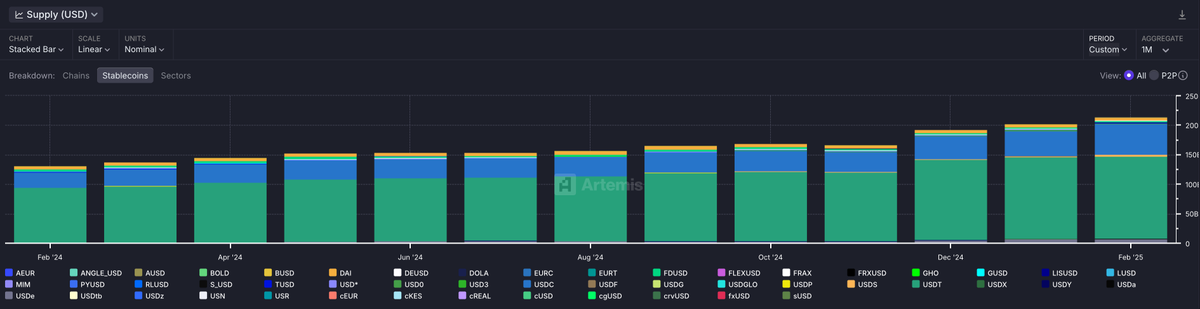
As of February 2025, the supply of stablecoins has reached $214 billion, with an annual transaction volume of $35 trillion, twice the size of Visa's annual transaction volume. Market activity has also increased, with the number of active addresses on the chain increasing by 53% to over 30 million. Institutional funds are flowing in on a large scale, driving the deep integration of traditional finance (TradFi) and the crypto market.
Stablecoin market changes: USDC market share doubles, newcomer USDe emerges

Changes in USDC and USDT dominance

Driven by the compliance process and market strategies, USDC and USDT still dominate, but there are subtle changes in market share.

  • USDC's market value doubled to US$56 billion, mainly due to MiCA and DIFC regulatory approvals, the addition of important strategic partners such as Stripe and MoneyGram, and rapid expansion in the global market.
  • USDT's total market value has grown to $146 billion, and it is still the largest stablecoin by market value, but its market share has declined, institutional adoption has declined, and its focus has gradually shifted to the P2P remittance market, consolidating its position in the global payment field.

Stablecoin market changes: USDC market share doubles, newcomer USDe emerges

The rise of decentralized stablecoins

In the decentralized finance (DeFi) ecosystem, the influence of decentralized stablecoins has increased significantly, and many emerging projects have achieved breakthrough growth.

  • USDe (Ethena Labs) : The market value has skyrocketed from US$146 million to US$6.2 billion, becoming the third largest stablecoin in the market. The key to its growth lies in its innovative yield strategy and Delta-neutral hedging mechanism.
  • USDS (MakerDAO) : MakerDAO rebranded as Sky and launched the compliance-friendly USDS, with a market value of $2.6 billion in February 2025. This adjustment enhanced its competitiveness in the decentralized stablecoin market.

Stablecoin market changes: USDC market share doubles, newcomer USDe emerges

Capital Flow and Industry Distribution

The flow trend of stablecoins reflects the positioning and competitiveness of different public chains in the market:

  • Ethereum remains the leading stablecoin issuance platform, accounting for 55% of the supply share.
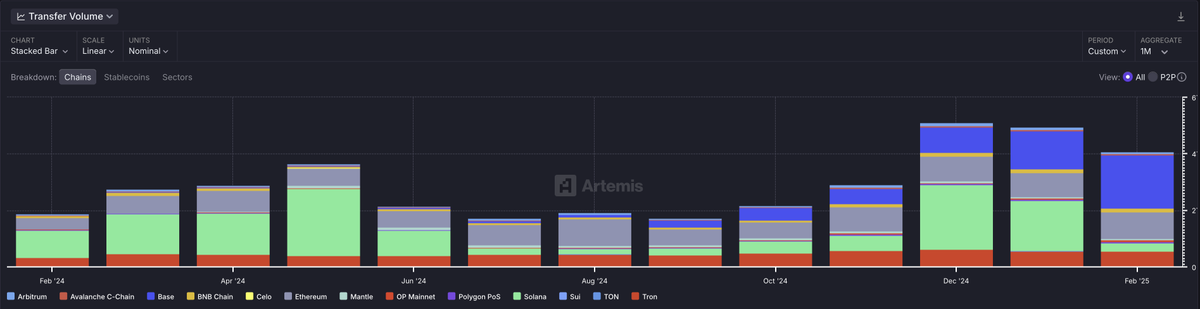
  • Base and Solana have grown rapidly in transaction volume. Driven by the DeFi and Meme coin markets, they have become important on-chain ecosystems for the circulation of stablecoin funds.
  • TRON continues to occupy a core position in the global P2P payment and cross-border remittance markets, especially in emerging markets where stablecoins are widely used for payments and savings.
Stablecoin market changes: USDC market share doubles, newcomer USDe emerges

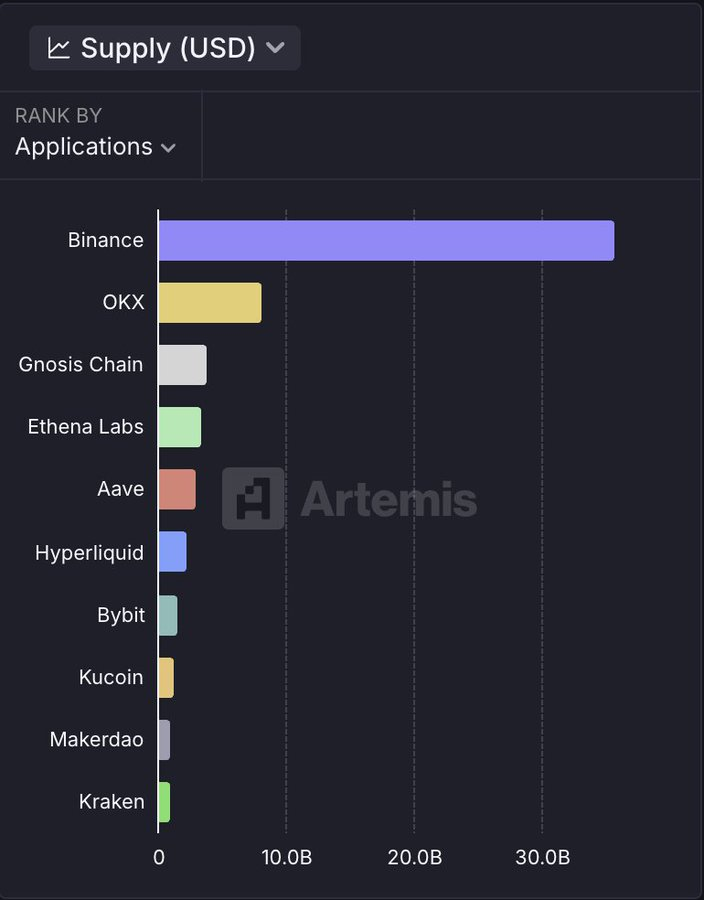
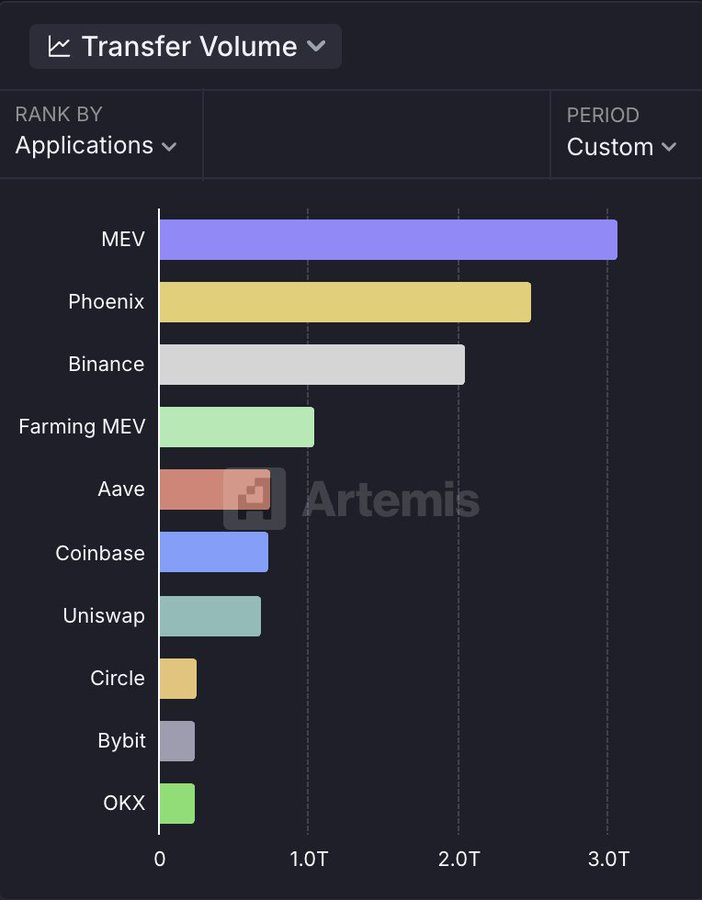
Most stablecoin liquidity is concentrated in centralized exchanges (CEX), and trading volume is mainly driven by DeFi (DEX, lending, and yield mining), reflecting the efficient circulation and innovation of funds.
Stablecoin market changes: USDC market share doubles, newcomer USDe emerges

Stablecoin market changes: USDC market share doubles, newcomer USDe emerges

Core role and future development

Stablecoins have become a key infrastructure in the crypto market, while also driving innovation in the traditional financial sector. Industry experts are optimistic about the future development of stablecoins:

“Stablecoins are the lifeblood of the crypto market and a super conductor for the financial system. They open up new markets and financial opportunities, driving innovation that would otherwise be out of reach.”

— Rob Hadick, General Partner, Dragonfly

“Stablecoins have significant advantages in cross-border payments. We hope that Base will support more local currency stablecoins, so that global users can use familiar currencies to trade on the chain and increase the popularity of blockchain technology.”

—— Neodaoist, Product Manager of Base

“The new generation of stablecoins must have market resilience. At its core, USDe is a yield-backed stability mechanism that ensures users have access to a reliable alternative to the U.S. dollar.”

— Conor Ryder, Head of Research at Ethena Labs

“The flow of stablecoins depends on the quality of infrastructure - low cost, fast transactions, and market demand. On Solana, Meme coin transactions have extremely high demand for liquidity and instant settlement, making stablecoins an indispensable part.”

—— Andrew Hong, Herd founder and data analysis expert

“TRON has become the blockchain of choice for stablecoin transactions, with billions of dollars in daily transactions. USDT drives real economic activity on TRON, especially in emerging markets, where it has become a key tool for payments and savings.”

——Sam Elfarra, TRON DAO community spokesperson

Disclaimer: The articles reposted on this site are sourced from public platforms and are provided for informational purposes only. They do not necessarily reflect the views of MEXC. All rights remain with the original authors. If you believe any content infringes on third-party rights, please contact service@support.mexc.com for removal. MEXC makes no guarantees regarding the accuracy, completeness, or timeliness of the content and is not responsible for any actions taken based on the information provided. The content does not constitute financial, legal, or other professional advice, nor should it be considered a recommendation or endorsement by MEXC.

You May Also Like

“I Wasted 8 Years in Crypto”: A Builder’s Exit Note Goes Viral Across Asia

“I Wasted 8 Years in Crypto”: A Builder’s Exit Note Goes Viral Across Asia

The post “I Wasted 8 Years in Crypto”: A Builder’s Exit Note Goes Viral Across Asia appeared on BitcoinEthereumNews.com. “I am NOT building a new financial system. I built a casino.”This stark admission from Ken Chan, former co-founder of derivatives protocol Aevo, has been reverberating across Asian crypto communities this week. What began as a post on X has now crossed linguistic borders, been introduced to Chinese communities by local news media, and been widely shared among Korean traders, accumulating millions of views along the way. Sponsored Sponsored From Ayn Rand to Disillusionment: A Libertarian’s Journey Through Crypto Chan’s confession is not merely a critique—it is the unraveling of a personal ideology. He describes himself as a “starry-eyed libertarian” who donated to Gary Johnson’s 2016 presidential campaign after being radicalized by Ayn Rand’s novels. The cypherpunk ethos of Bitcoin spoke directly to this worldview. “Being able to walk across the border with a billion dollars in your head is and always will be a powerful idea to me,” he writes. Yet eight years of industry experience eroded that idealism. Chan recounts how the Layer 1 wars—the flood of capital into Aptos, Sui, Sei, ICP, and countless others—produced no meaningful progress toward a new financial system. Instead, it “literally torched everyone’s money” in pursuit of becoming the next Solana. His verdict is unsparing: “We do not need to build the Casino on Mars.” According to his LinkedIn profile, Chan departed Aevo in May this year. His personal website indicates he is now working on KENSAT, a personal satellite project. It is scheduled to launch aboard a Falcon 9 in June 2026. His confession arrives six months after his departure. It comes as AEVO token trades at roughly $45 million in fully diluted market cap—down approximately 99% from its peak. Chan’s central metaphor—that crypto has become “the biggest, online, multi-player 24/7 casino our generation has ever concocted”—cuts through technical complexity with…
Share
BitcoinEthereumNews2025/12/10 11:04
Bitcoin faces quantum risk: Solana co-founder issues warning

Bitcoin faces quantum risk: Solana co-founder issues warning

The post Bitcoin faces quantum risk: Solana co-founder issues warning appeared on BitcoinEthereumNews.com. Solana co-founder Anatoly Yakovenko has warned that Bitcoin developers must prepare for a potential quantum computing breakthrough that could render the network’s current security measures outdated. Summary At the All-In Summit, Solana co-founder Anatoly Yakovenko reignited debate over Bitcoin’s long-term security. There’s a “50/50” chance that quantum computers could break its cryptographic defenses within five years. Rapid advances in AI show how quickly theory can become reality. The question is not just if Bitcoin must migrate to quantum-safe cryptography—but when. According to Yakovenko, who was speaking at the All-In Summit 2025, there is a “50/50” probability that within five years, quantum computers will be strong enough to crack the cryptographic safeguards protecting Bitcoin wallets. The concern centers on quantum machines running algorithms like Shor’s, which could crack the Elliptic Curve Digital Signature Algorithm currently protecting Bitcoin (BTC) private keys. This would allow attackers to forge transactions and compromise wallets, creating an existential risk for the network. Yakovenko argued that “we should migrate Bitcoin to a quantum-resistant signature scheme” before such technology becomes viable. Skeptics like Blockstream’s Adam Back downplay immediacy of threat The Bitcoin community remains divided on the urgency of quantum threats. Adam Back, CEO of Blockstream, estimated that the technology is still relatively far away and argued that making Bitcoin quantum-ready is “relatively simple.” Bitcoin Core contributor Peter Todd dismissed current quantum computers as non-existent, stating that “demos running toy problems do not count.” Luke Dashjr, another Bitcoin Core contributor, suggested quantum threats pose less immediate danger than spam transactions and developer corruption issues the community currently faces. Bitcoin’s design complicates any quantum upgrade. A migration to post-quantum cryptography would require a hard fork, a highly contentious and technically complex process needing widespread network support. Yakovenko countered skepticism by pointing to quick AI advances as evidence of how…
Share
BitcoinEthereumNews2025/09/22 01:33




