Shares of Kakaopay dropped sharply after volatile trading as regulators warn of risks tied to widespread stablecoin adoption. Shares of South Korean digital payments firm Kakaopay tumbled as much as 17% on June 27 after trading resumed Thursday, following a…Shares of Kakaopay dropped sharply after volatile trading as regulators warn of risks tied to widespread stablecoin adoption. Shares of South Korean digital payments firm Kakaopay tumbled as much as 17% on June 27 after trading resumed Thursday, following a…

South Korean payments firm Kakaopay tumbles 17% as regulators sound alarm on stablecoins

Shares of Kakaopay dropped sharply after volatile trading as regulators warn of risks tied to widespread stablecoin adoption.

Shares of South Korean digital payments firm Kakaopay tumbled as much as 17% on June 27 after trading resumed Thursday, following a one-day suspension by the Korea Exchange, Bloomberg reported.

The halt came just days after an earlier suspension on Tuesday, triggered by a sharp rally that saw the stock surge around 50% in two sessions. Moreover, the stock has tripled in value over the past month, fueled by investor excitement over the company’s potential move into stablecoins.
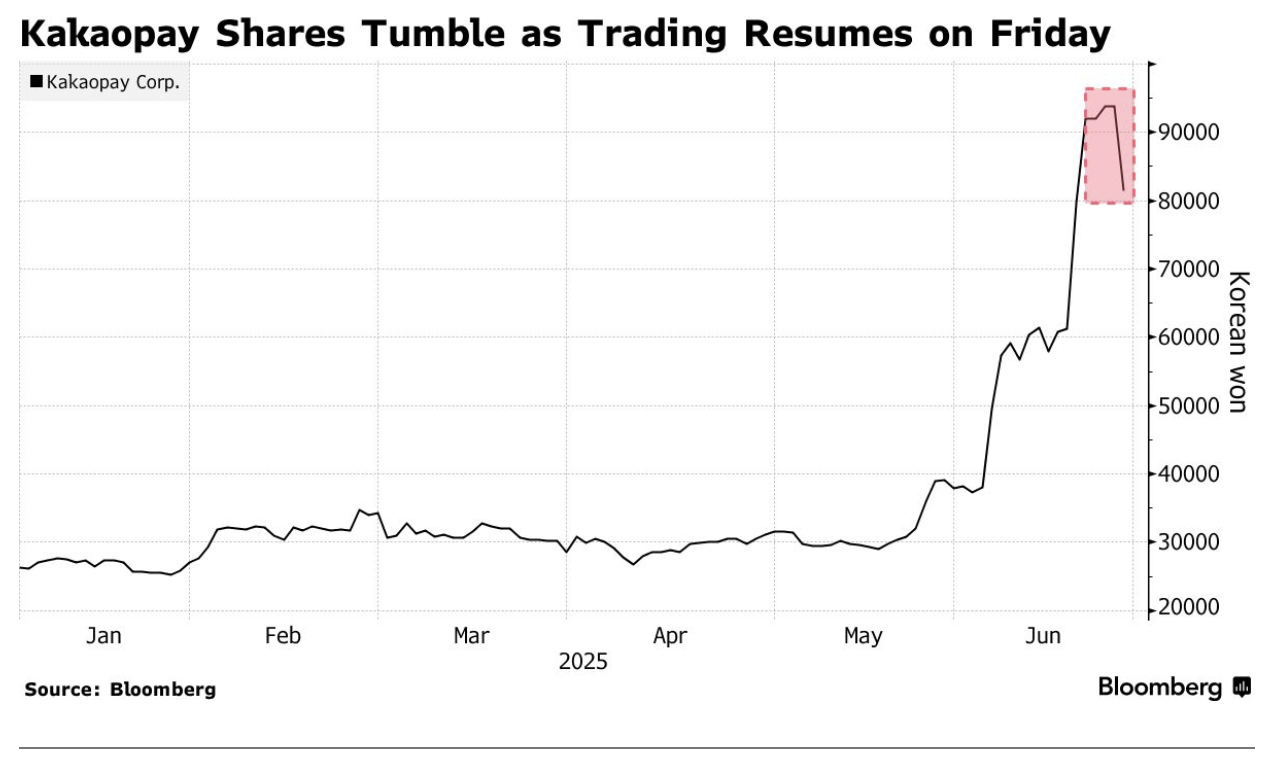
South Korean payments firm Kakaopay tumbles 17% as regulators sound alarm on stablecoins - 1

The exchange suspended the stock twice due to its extreme price volatility, ultimately designating Kakaopay as an “investment risk.”

“Kakaopay was definitely overheated and went ahead of its fundamentals,” said Shawn Oh, an equities trader at NH Investment & Securities Co. in Seoul. “Going forward, the stock will face a reality check.”

As previously reported by the Korea Times, Kakao Pay recently filed 18 trademark applications. KakaoBank, another major Kakao Group affiliate, has also submitted multiple trademark applications related to its stablecoin business, covering cryptocurrency software, financial transaction services, and mining under brand names such as BKRW and KRWB.

“We submitted the trademark applications to proactively respond to developments in the stablecoin market,” a KakaoBank official said. “We will continue to carefully monitor relevant legal frameworks and market dynamics.”

These moves coincide with accelerated legislative discussions in South Korea’s National Assembly on the Digital Asset Framework Act, which, once enacted, would permit issuance of won-pegged stablecoins and open the market to major financial and fintech firms like KakaoBank and Kakao Pay.

However, the Bank of Korea recently cautioned that the widespread adoption of stablecoins could lead to risks including market instability caused by mass withdrawals (coin runs) and disturbances in the foreign exchange market.

Similarly, the Bank for International Settlements noted that stablecoins are not a substitute for traditional money, and their future role remains “unclear.”


Disclaimer: The articles reposted on this site are sourced from public platforms and are provided for informational purposes only. They do not necessarily reflect the views of MEXC. All rights remain with the original authors. If you believe any content infringes on third-party rights, please contact service@support.mexc.com for removal. MEXC makes no guarantees regarding the accuracy, completeness, or timeliness of the content and is not responsible for any actions taken based on the information provided. The content does not constitute financial, legal, or other professional advice, nor should it be considered a recommendation or endorsement by MEXC.

You May Also Like

X to cut off InfoFi crypto projects from accessing its API

X to cut off InfoFi crypto projects from accessing its API

X, the most widely used app for crypto projects, is changing its API access policy. InfoFi projects, which proliferated non-organic bot content, will be cut off
Share
Cryptopolitan2026/01/16 02:50
X Just Killed Kaito and InfoFi Crypto, Several Tokens Crash

X Just Killed Kaito and InfoFi Crypto, Several Tokens Crash

The post X Just Killed Kaito and InfoFi Crypto, Several Tokens Crash appeared on BitcoinEthereumNews.com. X has revoked API access for apps that reward users for
Share
BitcoinEthereumNews2026/01/16 03:42
China Blocks Nvidia’s RTX Pro 6000D as Local Chips Rise

China Blocks Nvidia’s RTX Pro 6000D as Local Chips Rise

The post China Blocks Nvidia’s RTX Pro 6000D as Local Chips Rise appeared on BitcoinEthereumNews.com. China Blocks Nvidia’s RTX Pro 6000D as Local Chips Rise China’s internet regulator has ordered the country’s biggest technology firms, including Alibaba and ByteDance, to stop purchasing Nvidia’s RTX Pro 6000D GPUs. According to the Financial Times, the move shuts down the last major channel for mass supplies of American chips to the Chinese market. Why Beijing Halted Nvidia Purchases Chinese companies had planned to buy tens of thousands of RTX Pro 6000D accelerators and had already begun testing them in servers. But regulators intervened, halting the purchases and signaling stricter controls than earlier measures placed on Nvidia’s H20 chip. Image: Nvidia An audit compared Huawei and Cambricon processors, along with chips developed by Alibaba and Baidu, against Nvidia’s export-approved products. Regulators concluded that Chinese chips had reached performance levels comparable to the restricted U.S. models. This assessment pushed authorities to advise firms to rely more heavily on domestic processors, further tightening Nvidia’s already limited position in China. China’s Drive Toward Tech Independence The decision highlights Beijing’s focus on import substitution — developing self-sufficient chip production to reduce reliance on U.S. supplies. “The signal is now clear: all attention is focused on building a domestic ecosystem,” said a representative of a leading Chinese tech company. Nvidia had unveiled the RTX Pro 6000D in July 2025 during CEO Jensen Huang’s visit to Beijing, in an attempt to keep a foothold in China after Washington restricted exports of its most advanced chips. But momentum is shifting. Industry sources told the Financial Times that Chinese manufacturers plan to triple AI chip production next year to meet growing demand. They believe “domestic supply will now be sufficient without Nvidia.” What It Means for the Future With Huawei, Cambricon, Alibaba, and Baidu stepping up, China is positioning itself for long-term technological independence. Nvidia, meanwhile, faces…
Share
BitcoinEthereumNews2025/09/18 01:37



