The International Monetary Fund on Thursday released a new global assessment of the stablecoin market, warning that fragmented regulatory frameworks acrossThe International Monetary Fund on Thursday released a new global assessment of the stablecoin market, warning that fragmented regulatory frameworks across

IMF Warns: Fragmented Stablecoin Rules Create “Roadblocks” – New Guidelines Released

2025/12/05 06:53

The International Monetary Fund on Thursday released a new global assessment of the stablecoin market, warning that fragmented regulatory frameworks across countries are now creating structural “roadblocks” that threaten financial stability, weaken oversight, and slow the development of cross-border payments.

In its report titled “Understanding Stablecoins,” the IMF reviewed how major economies, including the United States, the United Kingdom, the European Union, and Japan, regulate stablecoins and found that national approaches remain widely inconsistent.

While some countries treat stablecoins as securities, others regulate them as payment instruments, permit only bank-issued tokens, or leave large parts of the market unregulated.

Stablecoins Are Moving Faster Than Regulators Can Track, IMF Warns

The IMF said this regulatory patchwork allows stablecoins to move across borders faster than oversight can follow.

Issuers can operate from lightly regulated jurisdictions while serving users in stricter markets, limiting authorities’ ability to monitor reserves, redemptions, liquidity management, and anti-money laundering controls.

The fund warned that this creates regulatory arbitrage and weakens global supervision.

The report also pointed to technical fragmentation. Stablecoins increasingly operate across different blockchains and exchanges that are not always interoperable.

According to the IMF, this lack of coordination raises transaction costs, slows market development, and creates barriers to efficient global payments.

Differences in national regulatory treatment further complicate cross-border usage and settlement.
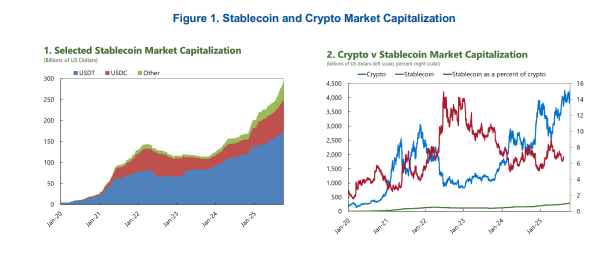
Source: IMF

Stablecoins remain dominated by U.S. dollar-denominated tokens. The IMF said the global stablecoin market is now worth more than $300 billion. Tether’s USDT and Circle’s USDC make up the majority of that supply. About 40% of USDC’s reserves are held in short-term U.S. treasuries, while roughly 75% of USDT’s reserves are in short-term treasuries, with another 5% held in Bitcoin.

The concentration of reserves in government debt markets links stablecoins directly to traditional financial systems

Widespread use of foreign-currency stablecoins can weaken domestic monetary control, lower demand for local currency, and accelerate digital dollarization. Stablecoins also make it easier to bypass capital controls through unhosted wallets and offshore platforms.

In addition to monetary concerns, the fund cited broader financial stability concerns. Large-scale redemptions could force rapid sales of Treasury bills and repo assets, potentially disrupting short-term funding markets that are critical for monetary policy transmission.

The IMF also noted that the increasing interconnection between stablecoin issuers, banks, custodians, crypto exchanges, and funds also increases the risk of contagion spreading from digital markets into the wider financial system.

IMF Urges Unified Stablecoin Regulation as Cross-Border Risks Grow

To address these risks, the IMF released new global policy guidelines intended to reduce fragmentation. It called for harmonized definitions of stablecoins, consistent rules for reserve assets, and shared cross-border monitoring frameworks.

The fund said issuers should be subject to the principle of “same activity, same risk, same regulation,” regardless of whether the issuer is a bank, fintech company, or crypto platform.

The IMF also said stablecoins should be backed only by high-quality liquid assets such as short-term government securities, with strict limits on risky holdings. Issuers must guarantee full one-to-one redemption at par, on demand, at all times.

Strong international coordination on anti-money laundering enforcement, licensing, and supervision of large global stablecoin arrangements was also included in the new guidance.

The IMF’s warning comes as regulatory pressure is rising worldwide. In Europe, the European Central Bank recently warned that stablecoins, despite their small footprint in the euro area, now pose spillover risks due to their growing ties to U.S. Treasury markets.

The European Systemic Risk Board has also called for urgent safeguards against cross-border stablecoin structures operating under the EU’s MiCA framework.

In China, the central bank has described stablecoins as a threat to financial stability and monetary sovereignty, while the Bank of England and Basel regulators are reassessing how banks should hold capital against stablecoin exposure as usage expands.

The IMF concluded that without consistent global regulation, stablecoins could bypass national safeguards, destabilize vulnerable economies, and transmit financial shocks across borders at high speed.


Disclaimer: The articles reposted on this site are sourced from public platforms and are provided for informational purposes only. They do not necessarily reflect the views of MEXC. All rights remain with the original authors. If you believe any content infringes on third-party rights, please contact service@support.mexc.com for removal. MEXC makes no guarantees regarding the accuracy, completeness, or timeliness of the content and is not responsible for any actions taken based on the information provided. The content does not constitute financial, legal, or other professional advice, nor should it be considered a recommendation or endorsement by MEXC.

You May Also Like

Peter Schiff challenges President Trump to debate, moves on Binance’s CZ

Peter Schiff challenges President Trump to debate, moves on Binance’s CZ

The post Peter Schiff challenges President Trump to debate, moves on Binance’s CZ appeared on BitcoinEthereumNews.com. Peter Schiff has challenged President Trump to a debate about the U.S. economy after the president verbally attacked him for speaking on the affordability crisis.  Despite the growing concern among Americans regarding inflation, President Trump continues to claim that prices are falling and the economy is recovering.  President Donald Trump’s verbal attacks continue  Financial commentator Peter Schiff publicly challenged President Donald Trump on Saturday after the president attacked him on Truth Social for appearing on Fox & Friends Weekend.  The president’s attack on Schiff was in response to his discussing the affordability crisis facing Americans during his morning television appearance on December 6, 2025. Trump posted on Truth Social, questioning why Fox & Friends would host Schiff. The president described Schiff as a “Trump hating loser who has already proven to be wrong.”  Trump insisted that prices are substantially reducing and blamed former President Joe Biden for creating the affordability crisis. He claimed gasoline hit $1.99 per gallon in certain states and that other prices are almost all down. Hours later, Schiff responded on X, challenging Trump or his designee to a debate on the U.S. economy and the effectiveness of his policies. In a separate post, Schiff suggested Trump should change the name of his social media platform to “Lie Social,” considering his dislike for the truth. During his Fox & Friends appearance, Schiff explained that the inflation rate is going to accelerate as Trump’s term progresses and that the policies continue to impact pricing. He told the show’s host, Griff Jenkins, that Biden had a lot of help in causing the affordability crisis, including from Trump during his first term.  Schiff stated that Trump is not fixing the problem but making it worse. The President has continued to dismiss concerns about affordability as a Democrat con job. During…
Share
BitcoinEthereumNews2025/12/07 04:51
Solana Treasury Firm Holdings Could Double as Forward Industries Unveils $4 Billion Raise

Solana Treasury Firm Holdings Could Double as Forward Industries Unveils $4 Billion Raise

The post Solana Treasury Firm Holdings Could Double as Forward Industries Unveils $4 Billion Raise appeared on BitcoinEthereumNews.com. In brief Forward Industries, the largest publicly traded Solana treasury company, filed to raise $4 billion through an at-the-market equity offering to expand its SOL holdings. The company’s stock (FORD) fell 8.2% following the announcement, while the proceeds could more than double the $3.1 billion currently held in Solana treasuries. DeFi Development Corp. also registered a preferred stock offering with the SEC, following similar funding tactics used by Bitcoin treasury companies like MicroStrategy. Forward Industries, the newest and largest publicly traded Solana treasury company, has filed to raise $4 billion through an at-the-market equity offering. For the sake of comparison, this $4 billion raise is nearly the same size as Bitcoin treasury Strategy’s Stride preferred stock raise in July. And it’s double the size of the Strife preferred stock offering the company did in May. The proceeds would be used for working capital; pursuit of its Solana token strategy, and “the purchase of income-generating assets to grow its business,” the company said in a press release. Forward Industries declined to comment to Decrypt on what other income-generating assets it’s considering adding to its balance sheet.  As markets opened Wednesday morning, Forward saw its stock price take a dive. The shares, which trade under the FORD ticker on the Nasdaq, dipped to $31.29 before rebounding to $34.28 at the time of writing—marking a 8.2% fall for the session. If the company sells all the shares and spends the bulk of the proceeds on buying Solana, it could more than double the amount of SOL being held in treasuries. At the time of writing, there’s already $3.1 billion in Solana treasuries, according to crypto price aggregator CoinGecko. Users on Myriad, a prediction market owned by Decrypt parent company DASTAN, have been growing more confident that SOL will reach $250 sooner than…
Share
BitcoinEthereumNews2025/09/18 12:43





