What to Know: Rising U.S. debt and heavy Treasury issuance are killing the charm of long-duration bonds, so institutions are looking toward Bitcoin and other digital assets as hedges.  As Bitcoin adoption grows, demand is shifting away from simple price bets toward real infrastructure for fast payments, DeFi, NFTs, and gaming.  Bitcoin Hyper ($HYPER) introduces a Bitcoin-anchored Layer 2 that uses the Solana Virtual Machine to fix Bitcoin’s slow transactions, high fees, and lack of smart contracts. Competition among Bitcoin Layer 2 networks will heat up as macro pressures and institutional inflows reward projects that mix Bitcoin’s trust with real performance. Surging US debt and sticky deficits are no longer a quiet background issue. They are starting to feel like the entire plot. BlackRock’s recent AI-driven research makes it clear: nonstop Treasury issuance and rising interest costs put pressure on long-term bonds. When the concept of a risk-free asset starts wobbling, investors begin asking the classic question: where do we turn next? Bitcoin keeps showing up in those conversations. After the spot ETF wave, $BTC turned into a boardroom-friendly hedge. If US debt continues to climb, a supply-capped and rules-based asset starts looking pretty good. That is the broad idea BlackRock is pointing toward. But once institutions agree Bitcoin belongs in the hedge bucket, the next question hits fast: how do you actually use $BTC inside today’s high-speed markets? On-chain Bitcoin is slow, block space is tight, and fees can spike into tens of dollars when the network gets busy. Great for cold storage. Not great for anything that needs to move quickly. This is the gap Bitcoin Hyper ($HYPER) aims to front-run. It markets itself as a high-performance Bitcoin Layer 2 built on the Solana Virtual Machine (SVM), offering sub-second settlement and smart contracts while anchoring its security to Bitcoin. If BlackRock’s macro outlook drives more capital into $BTC, Bitcoin Hyper aims to be the platform where that capital actually generates results. Think payments, DeFi, gaming, NFTs, and more. Why Debt Risks And Institutional Flows Favor High-Throughput Bitcoin Infrastructure If the U.S. is heading toward chronic deficits, higher rates, and nonstop Treasury issuance, then long-duration bonds stop looking like a safe parking spot and start acting like a stress test. That is why large asset managers talk about needing new hedges. Bitcoin fits that role, as do gold and tokenized assets backed by real collateral. As institutions add Bitcoin exposure, the pressure builds to make $BTC usable, not just something you lock in a vault. Lightning facilitates payments, but it does not support complex smart contracts or high-performance DeFi applications. Ethereum rollups and Solana solve those problems, but they are not secured by Bitcoin, which matters to investors who want their hedge and their infrastructure to be based on the same monetary foundation. That is why the race among Bitcoin-aligned Layer 2s and sidechains is speeding up. Stacks, Rootstock, and others are trying to push programmability closer to Bitcoin, each making different trade-offs. Bitcoin Hyper is one of the new crypto projects taking a more ambitious approach: instead of building a new system, it uses the Solana VM and anchors it to Bitcoin. It is like taking a sports car engine and dropping it into a truck known for reliability. Inside Bitcoin Hyper’s SVM Layer 2 And The Ongoing Presale Bitcoin Hyper ($HYPER) focuses heavily on speed. The design is modular: Bitcoin Layer 1 handles settlement and data availability, while an SVM-powered Layer 2 handles execution. Developers can use Rust and Solana-style tools, but the chain ultimately settles back to $BTC instead of $SOL. The goal is simple: push beyond Solana speeds while inheriting Bitcoin’s trust and brand power. Bitcoin Hyper currently relies on a single trusted sequencer. It batches transactions and anchors its state to the Bitcoin blockchain. This setup allows extremely low-latency confirmations, which works well for order-book DEXs, gaming loops, and NFT mints. Fees aim to stay at fractions of a cent, not the usual on-chain $BTC spikes. A decentralized canonical bridge moves $BTC into wrapped assets for fast swaps, payments, lending, and staking. The presale is already large. Bitcoin Hyper has raised over $28.9M and you can buy $HYPER now for just $0.013375. For Bitcoin holders and DeFi users, the pitch is straightforward. If institutional money continues to flow into $BTC due to macroeconomic risks, the next stage of the trade may manifest in the infrastructure that makes Bitcoin actually useful. Bitcoin Hyper wants to be that high-throughput SVM Layer 2 built for payments, gaming, and composable DeFi. Join the $HYPER presale now. This article is for informational purposes only and doesn’t offer financial, investment, or trading advice. Always do your own research (DYOR) before investing in crypto. Authored by Aaron Walker, NewsBTC – https://www.newsbtc.com/news/blackrock-warns-on-us-debt-bitcoin-hyper-presale-acceleratesWhat to Know: Rising U.S. debt and heavy Treasury issuance are killing the charm of long-duration bonds, so institutions are looking toward Bitcoin and other digital assets as hedges.  As Bitcoin adoption grows, demand is shifting away from simple price bets toward real infrastructure for fast payments, DeFi, NFTs, and gaming.  Bitcoin Hyper ($HYPER) introduces a Bitcoin-anchored Layer 2 that uses the Solana Virtual Machine to fix Bitcoin’s slow transactions, high fees, and lack of smart contracts. Competition among Bitcoin Layer 2 networks will heat up as macro pressures and institutional inflows reward projects that mix Bitcoin’s trust with real performance. Surging US debt and sticky deficits are no longer a quiet background issue. They are starting to feel like the entire plot. BlackRock’s recent AI-driven research makes it clear: nonstop Treasury issuance and rising interest costs put pressure on long-term bonds. When the concept of a risk-free asset starts wobbling, investors begin asking the classic question: where do we turn next? Bitcoin keeps showing up in those conversations. After the spot ETF wave, $BTC turned into a boardroom-friendly hedge. If US debt continues to climb, a supply-capped and rules-based asset starts looking pretty good. That is the broad idea BlackRock is pointing toward. But once institutions agree Bitcoin belongs in the hedge bucket, the next question hits fast: how do you actually use $BTC inside today’s high-speed markets? On-chain Bitcoin is slow, block space is tight, and fees can spike into tens of dollars when the network gets busy. Great for cold storage. Not great for anything that needs to move quickly. This is the gap Bitcoin Hyper ($HYPER) aims to front-run. It markets itself as a high-performance Bitcoin Layer 2 built on the Solana Virtual Machine (SVM), offering sub-second settlement and smart contracts while anchoring its security to Bitcoin. If BlackRock’s macro outlook drives more capital into $BTC, Bitcoin Hyper aims to be the platform where that capital actually generates results. Think payments, DeFi, gaming, NFTs, and more. Why Debt Risks And Institutional Flows Favor High-Throughput Bitcoin Infrastructure If the U.S. is heading toward chronic deficits, higher rates, and nonstop Treasury issuance, then long-duration bonds stop looking like a safe parking spot and start acting like a stress test. That is why large asset managers talk about needing new hedges. Bitcoin fits that role, as do gold and tokenized assets backed by real collateral. As institutions add Bitcoin exposure, the pressure builds to make $BTC usable, not just something you lock in a vault. Lightning facilitates payments, but it does not support complex smart contracts or high-performance DeFi applications. Ethereum rollups and Solana solve those problems, but they are not secured by Bitcoin, which matters to investors who want their hedge and their infrastructure to be based on the same monetary foundation. That is why the race among Bitcoin-aligned Layer 2s and sidechains is speeding up. Stacks, Rootstock, and others are trying to push programmability closer to Bitcoin, each making different trade-offs. Bitcoin Hyper is one of the new crypto projects taking a more ambitious approach: instead of building a new system, it uses the Solana VM and anchors it to Bitcoin. It is like taking a sports car engine and dropping it into a truck known for reliability. Inside Bitcoin Hyper’s SVM Layer 2 And The Ongoing Presale Bitcoin Hyper ($HYPER) focuses heavily on speed. The design is modular: Bitcoin Layer 1 handles settlement and data availability, while an SVM-powered Layer 2 handles execution. Developers can use Rust and Solana-style tools, but the chain ultimately settles back to $BTC instead of $SOL. The goal is simple: push beyond Solana speeds while inheriting Bitcoin’s trust and brand power. Bitcoin Hyper currently relies on a single trusted sequencer. It batches transactions and anchors its state to the Bitcoin blockchain. This setup allows extremely low-latency confirmations, which works well for order-book DEXs, gaming loops, and NFT mints. Fees aim to stay at fractions of a cent, not the usual on-chain $BTC spikes. A decentralized canonical bridge moves $BTC into wrapped assets for fast swaps, payments, lending, and staking. The presale is already large. Bitcoin Hyper has raised over $28.9M and you can buy $HYPER now for just $0.013375. For Bitcoin holders and DeFi users, the pitch is straightforward. If institutional money continues to flow into $BTC due to macroeconomic risks, the next stage of the trade may manifest in the infrastructure that makes Bitcoin actually useful. Bitcoin Hyper wants to be that high-throughput SVM Layer 2 built for payments, gaming, and composable DeFi. Join the $HYPER presale now. This article is for informational purposes only and doesn’t offer financial, investment, or trading advice. Always do your own research (DYOR) before investing in crypto. Authored by Aaron Walker, NewsBTC – https://www.newsbtc.com/news/blackrock-warns-on-us-debt-bitcoin-hyper-presale-accelerates

BlackRock Warns on US Debt While Bitcoin Hyper Presale Accelerates

2025/12/05 00:15

What to Know:

  • Rising U.S. debt and heavy Treasury issuance are killing the charm of long-duration bonds, so institutions are looking toward Bitcoin and other digital assets as hedges. 
  • As Bitcoin adoption grows, demand is shifting away from simple price bets toward real infrastructure for fast payments, DeFi, NFTs, and gaming. 
  • Bitcoin Hyper ($HYPER) introduces a Bitcoin-anchored Layer 2 that uses the Solana Virtual Machine to fix Bitcoin’s slow transactions, high fees, and lack of smart contracts.
  • Competition among Bitcoin Layer 2 networks will heat up as macro pressures and institutional inflows reward projects that mix Bitcoin’s trust with real performance.

Surging US debt and sticky deficits are no longer a quiet background issue. They are starting to feel like the entire plot.

BlackRock’s recent AI-driven research makes it clear: nonstop Treasury issuance and rising interest costs put pressure on long-term bonds.

When the concept of a risk-free asset starts wobbling, investors begin asking the classic question: where do we turn next?

Bitcoin keeps showing up in those conversations. After the spot ETF wave, $BTC turned into a boardroom-friendly hedge.

If US debt continues to climb, a supply-capped and rules-based asset starts looking pretty good. That is the broad idea BlackRock is pointing toward.
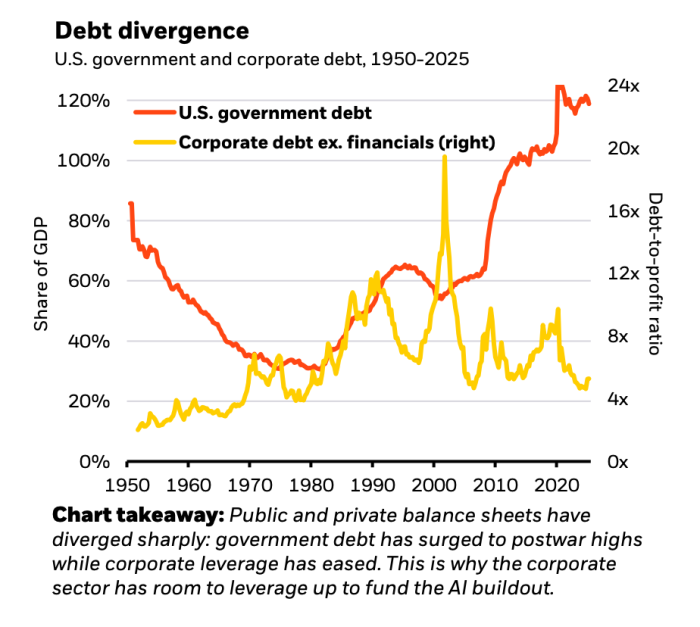
Debt divergence from Blackrock global outlook research.

But once institutions agree Bitcoin belongs in the hedge bucket, the next question hits fast: how do you actually use $BTC inside today’s high-speed markets?

On-chain Bitcoin is slow, block space is tight, and fees can spike into tens of dollars when the network gets busy. Great for cold storage. Not great for anything that needs to move quickly.

This is the gap Bitcoin Hyper ($HYPER) aims to front-run.

It markets itself as a high-performance Bitcoin Layer 2 built on the Solana Virtual Machine (SVM), offering sub-second settlement and smart contracts while anchoring its security to Bitcoin.

If BlackRock’s macro outlook drives more capital into $BTC, Bitcoin Hyper aims to be the platform where that capital actually generates results. Think payments, DeFi, gaming, NFTs, and more.

Why Debt Risks And Institutional Flows Favor High-Throughput Bitcoin Infrastructure

If the U.S. is heading toward chronic deficits, higher rates, and nonstop Treasury issuance, then long-duration bonds stop looking like a safe parking spot and start acting like a stress test.

That is why large asset managers talk about needing new hedges. Bitcoin fits that role, as do gold and tokenized assets backed by real collateral.

As institutions add Bitcoin exposure, the pressure builds to make $BTC usable, not just something you lock in a vault.

Lightning facilitates payments, but it does not support complex smart contracts or high-performance DeFi applications.

Ethereum rollups and Solana solve those problems, but they are not secured by Bitcoin, which matters to investors who want their hedge and their infrastructure to be based on the same monetary foundation.

That is why the race among Bitcoin-aligned Layer 2s and sidechains is speeding up. Stacks, Rootstock, and others are trying to push programmability closer to Bitcoin, each making different trade-offs.

Bitcoin Hyper is one of the new crypto projects taking a more ambitious approach: instead of building a new system, it uses the Solana VM and anchors it to Bitcoin. It is like taking a sports car engine and dropping it into a truck known for reliability.

Inside Bitcoin Hyper’s SVM Layer 2 And The Ongoing Presale

Bitcoin Hyper ($HYPER) focuses heavily on speed.

The design is modular: Bitcoin Layer 1 handles settlement and data availability, while an SVM-powered Layer 2 handles execution. Developers can use Rust and Solana-style tools, but the chain ultimately settles back to $BTC instead of $SOL.

The goal is simple: push beyond Solana speeds while inheriting Bitcoin’s trust and brand power.

Bitcoin Hyper currently relies on a single trusted sequencer. It batches transactions and anchors its state to the Bitcoin blockchain.

This setup allows extremely low-latency confirmations, which works well for order-book DEXs, gaming loops, and NFT mints.

Fees aim to stay at fractions of a cent, not the usual on-chain $BTC spikes. A decentralized canonical bridge moves $BTC into wrapped assets for fast swaps, payments, lending, and staking.

The presale is already large. Bitcoin Hyper has raised over $28.9M and you can buy $HYPER now for just $0.013375.

For Bitcoin holders and DeFi users, the pitch is straightforward. If institutional money continues to flow into $BTC due to macroeconomic risks, the next stage of the trade may manifest in the infrastructure that makes Bitcoin actually useful.

Bitcoin Hyper wants to be that high-throughput SVM Layer 2 built for payments, gaming, and composable DeFi.

Join the $HYPER presale now.

This article is for informational purposes only and doesn’t offer financial, investment, or trading advice. Always do your own research (DYOR) before investing in crypto.

Authored by Aaron Walker, NewsBTC – https://www.newsbtc.com/news/blackrock-warns-on-us-debt-bitcoin-hyper-presale-accelerates

Market Opportunity
Hyperlane Logo
Hyperlane Price(HYPER)
$0.13498
$0.13498$0.13498
-1.15%
USD
Hyperlane (HYPER) Live Price Chart
Disclaimer: The articles reposted on this site are sourced from public platforms and are provided for informational purposes only. They do not necessarily reflect the views of MEXC. All rights remain with the original authors. If you believe any content infringes on third-party rights, please contact service@support.mexc.com for removal. MEXC makes no guarantees regarding the accuracy, completeness, or timeliness of the content and is not responsible for any actions taken based on the information provided. The content does not constitute financial, legal, or other professional advice, nor should it be considered a recommendation or endorsement by MEXC.

You May Also Like

Tom Lee, 2026’yı “Ethereum Yılı” İlan Etti: Fiyat Tahminini Paylaştı!

Tom Lee, 2026’yı “Ethereum Yılı” İlan Etti: Fiyat Tahminini Paylaştı!

BitMine Yönetim Kurulu Başkanı ve Fundstrat kurucu ortağı Tom Lee, Ethereum’un 2026 yılında “öne çıkan anını” yaşayabileceğini ve ETH fiyatının 12.000 dolara kadar
Share
Coinstats2026/01/17 22:47
How to earn from cloud mining: IeByte’s upgraded auto-cloud mining platform unlocks genuine passive earnings

How to earn from cloud mining: IeByte’s upgraded auto-cloud mining platform unlocks genuine passive earnings

The post How to earn from cloud mining: IeByte’s upgraded auto-cloud mining platform unlocks genuine passive earnings appeared on BitcoinEthereumNews.com. contributor Posted: September 17, 2025 As digital assets continue to reshape global finance, cloud mining has become one of the most effective ways for investors to generate stable passive income. Addressing the growing demand for simplicity, security, and profitability, IeByte has officially upgraded its fully automated cloud mining platform, empowering both beginners and experienced investors to earn Bitcoin, Dogecoin, and other mainstream cryptocurrencies without the need for hardware or technical expertise. Why cloud mining in 2025? Traditional crypto mining requires expensive hardware, high electricity costs, and constant maintenance. In 2025, with blockchain networks becoming more competitive, these barriers have grown even higher. Cloud mining solves this by allowing users to lease professional mining power remotely, eliminating the upfront costs and complexity. IeByte stands at the forefront of this transformation, offering investors a transparent and seamless path to daily earnings. IeByte’s upgraded auto-cloud mining platform With its latest upgrade, IeByte introduces: Full Automation: Mining contracts can be activated in just one click, with all processes handled by IeByte’s servers. Enhanced Security: Bank-grade encryption, cold wallets, and real-time monitoring protect every transaction. Scalable Options: From starter packages to high-level investment contracts, investors can choose the plan that matches their goals. Global Reach: Already trusted by users in over 100 countries. Mining contracts for 2025 IeByte offers a wide range of contracts tailored for every investor level. From entry-level plans with daily returns to premium high-yield packages, the platform ensures maximum accessibility. Contract Type Duration Price Daily Reward Total Earnings (Principal + Profit) Starter Contract 1 Day $200 $6 $200 + $6 + $10 bonus Bronze Basic Contract 2 Days $500 $13.5 $500 + $27 Bronze Basic Contract 3 Days $1,200 $36 $1,200 + $108 Silver Advanced Contract 1 Day $5,000 $175 $5,000 + $175 Silver Advanced Contract 2 Days $8,000 $320 $8,000 + $640 Silver…
Share
BitcoinEthereumNews2025/09/17 23:48
UK crypto holders brace for FCA’s expanded regulatory reach

UK crypto holders brace for FCA’s expanded regulatory reach

The post UK crypto holders brace for FCA’s expanded regulatory reach appeared on BitcoinEthereumNews.com. British crypto holders may soon face a very different landscape as the Financial Conduct Authority (FCA) moves to expand its regulatory reach in the industry. A new consultation paper outlines how the watchdog intends to apply its rulebook to crypto firms, shaping everything from asset safeguarding to trading platform operation. According to the financial regulator, these proposals would translate into clearer protections for retail investors and stricter oversight of crypto firms. UK FCA plans Until now, UK crypto users mostly encountered the FCA through rules on promotions and anti-money laundering checks. The consultation paper goes much further. It proposes direct oversight of stablecoin issuers, custodians, and crypto-asset trading platforms (CATPs). For investors, that means the wallets, exchanges, and coins they rely on could soon be subject to the same governance and resilience standards as traditional financial institutions. The regulator has also clarified that firms need official authorization before serving customers. This condition should, in theory, reduce the risk of sudden platform failures or unclear accountability. David Geale, the FCA’s executive director of payments and digital finance, said the proposals are designed to strike a balance between innovation and protection. He explained: “We want to develop a sustainable and competitive crypto sector – balancing innovation, market integrity and trust.” Geale noted that while the rules will not eliminate investment risks, they will create consistent standards, helping consumers understand what to expect from registered firms. Why does this matter for crypto holders? The UK regulatory framework shift would provide safer custody of assets, better disclosure of risks, and clearer recourse if something goes wrong. However, the regulator was also frank in its submission, arguing that no rulebook can eliminate the volatility or inherent risks of holding digital assets. Instead, the focus is on ensuring that when consumers choose to invest, they do…
Share
BitcoinEthereumNews2025/09/17 23:52