Kalshi has switched on tokenized versions of its event contracts on Solana, making its first explicit play to court the same crypto-native traders who have funneled billions of dollars into rival prediction platform Polymarket. Instead of holding positions solely as traditional off-chain contracts on Kalshi’s regulated venue, users can now buy and sell tokenized representations […]Kalshi has switched on tokenized versions of its event contracts on Solana, making its first explicit play to court the same crypto-native traders who have funneled billions of dollars into rival prediction platform Polymarket. Instead of holding positions solely as traditional off-chain contracts on Kalshi’s regulated venue, users can now buy and sell tokenized representations […]

Kalshi Picks Solana To Ignite Tokenized Event Trading

2025/12/02 22:30
3 min read
For feedback or concerns regarding this content, please contact us at crypto.news@mexc.com

Kalshi has switched on tokenized versions of its event contracts on Solana, making its first explicit play to court the same crypto-native traders who have funneled billions of dollars into rival prediction platform Polymarket.

Instead of holding positions solely as traditional off-chain contracts on Kalshi’s regulated venue, users can now buy and sell tokenized representations of those wagers on Solana. The economic exposure is identical, but the wrapper is crypto-native: the bet becomes a transferable token on a public blockchain.

Solana Lands Kalshi’s First Fully Tokenized Event Markets

“The tokenized versions of the contracts work the same way as the regular ones found previously on Kalshi’s platform,” the company told CNBC. The key difference is market structure. By trading the tokens rather than the contracts themselves, users can operate with greater pseudonymity and more flexibility in how they custody and move positions, putting Kalshi “on par with Polymarket, which allows users to trade directly on-chain.”

Support for these tokenized wagers is already live on Solana. Decentralized finance protocols DFlow and Jupiter are onboarding as institutional conduits, effectively bridging Kalshi’s off-chain orderbook into Solana’s liquidity. That link is designed to let crypto-native traders discover, route and size positions through the DeFi stack while Kalshi continues to run its core matching and settlement infrastructure in a regulated environment.

The timing coincides with a sharp upswing in prediction market activity. Combined trading volume in prediction markets reached almost $28 billion through October 2025, with a weekly record of $2.3 billion in the week of October 20, according to data cited from Crypto.com’s research arm. Kalshi’s thesis is that the next leg of growth will be driven by the digital asset market, which it pegs at roughly $3 trillion and heavily populated by traders already comfortable with on-chain risk.

“There’s a lot of power users in crypto,” said John Wang, Kalshi’s head of crypto. “This is about tapping into the billions of dollars of liquidity that crypto has, and then also enabling developers to build third party front ends that utilize Kalshi’s liquidity.”

Founded in 2018, Kalshi was the first exchange to roll out federally regulated event contracts on US congressional races for American traders in late 2024, following a years-long legal battle with the Commodity Futures Trading Commission. Since then, it has expanded to roughly 3,500 markets, raised more than $300 million at a $5 billion valuation, and grown its footprint to over 140 countries, according to the company.

That regulatory and capital advantage is being tested as Polymarket moves to relaunch in the US and other competitors scale. Kalshi’s leadership is effectively betting that deeper liquidity is the decisive differentiator — and that crypto traders are the marginal source of that liquidity.

Digital asset holders tend to trade prediction markets at higher volumes than non-crypto users, Wang said, arguing that their funds can meaningfully thicken orderbooks and sharpen pricing across Kalshi’s markets. “If you have a market with no liquidity, then you don’t really have a market,” he said. “People can’t really trade size or get the prices that they want.”

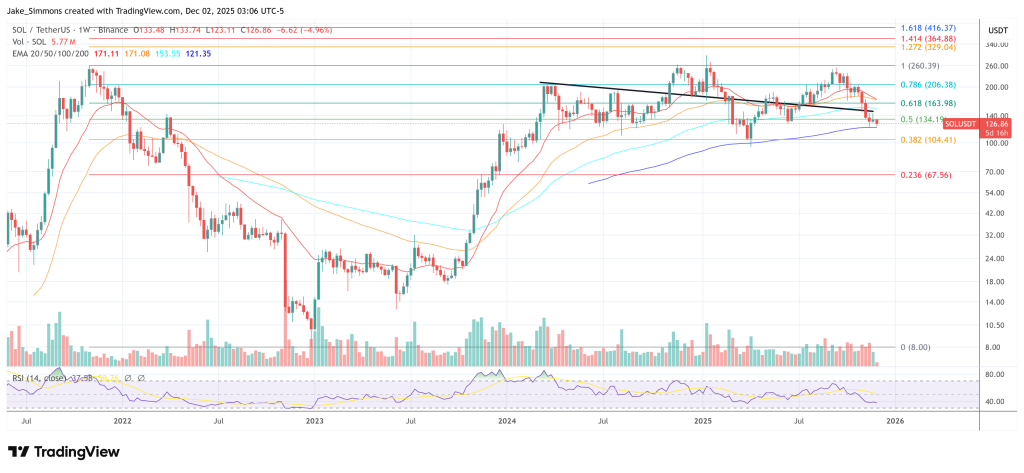
At press time, Solana (SOL) traded at $126.86.
Solana price
Market Opportunity
PlaysOut Logo
PlaysOut Price(PLAY)
$0,04609
$0,04609$0,04609
+4,67%
USD
PlaysOut (PLAY) Live Price Chart
Disclaimer: The articles reposted on this site are sourced from public platforms and are provided for informational purposes only. They do not necessarily reflect the views of MEXC. All rights remain with the original authors. If you believe any content infringes on third-party rights, please contact crypto.news@mexc.com for removal. MEXC makes no guarantees regarding the accuracy, completeness, or timeliness of the content and is not responsible for any actions taken based on the information provided. The content does not constitute financial, legal, or other professional advice, nor should it be considered a recommendation or endorsement by MEXC.

You May Also Like

Why Localization Services Matter for Software Companies

Why Localization Services Matter for Software Companies

Rarely does software designed for one market translate smoothly to another. The most obvious obstacle is language, but it’s not the only one. Before a product feels
Share
Techbullion2026/03/25 19:10
₹71L CoinDCX Fraud Case Turns, Court Finds No Link to Founders

₹71L CoinDCX Fraud Case Turns, Court Finds No Link to Founders

Court grants bail to CoinDCX founders after ₹71L scam traced to fake site; no link found, funds recovered, platform secure. The court granted bail to CoinDCX founders
Share
LiveBitcoinNews2026/03/25 19:43
UK crypto holders brace for FCA’s expanded regulatory reach

UK crypto holders brace for FCA’s expanded regulatory reach

The post UK crypto holders brace for FCA’s expanded regulatory reach appeared on BitcoinEthereumNews.com. British crypto holders may soon face a very different landscape as the Financial Conduct Authority (FCA) moves to expand its regulatory reach in the industry. A new consultation paper outlines how the watchdog intends to apply its rulebook to crypto firms, shaping everything from asset safeguarding to trading platform operation. According to the financial regulator, these proposals would translate into clearer protections for retail investors and stricter oversight of crypto firms. UK FCA plans Until now, UK crypto users mostly encountered the FCA through rules on promotions and anti-money laundering checks. The consultation paper goes much further. It proposes direct oversight of stablecoin issuers, custodians, and crypto-asset trading platforms (CATPs). For investors, that means the wallets, exchanges, and coins they rely on could soon be subject to the same governance and resilience standards as traditional financial institutions. The regulator has also clarified that firms need official authorization before serving customers. This condition should, in theory, reduce the risk of sudden platform failures or unclear accountability. David Geale, the FCA’s executive director of payments and digital finance, said the proposals are designed to strike a balance between innovation and protection. He explained: “We want to develop a sustainable and competitive crypto sector – balancing innovation, market integrity and trust.” Geale noted that while the rules will not eliminate investment risks, they will create consistent standards, helping consumers understand what to expect from registered firms. Why does this matter for crypto holders? The UK regulatory framework shift would provide safer custody of assets, better disclosure of risks, and clearer recourse if something goes wrong. However, the regulator was also frank in its submission, arguing that no rulebook can eliminate the volatility or inherent risks of holding digital assets. Instead, the focus is on ensuring that when consumers choose to invest, they do…
Share
BitcoinEthereumNews2025/09/17 23:52