Ether ETFs saw $79 million in outflows while open interest fell sharply across major exchanges, even as institutions continued to buy quietly. The post ETH ETFs Start Bleeding Again, but BlackRock Quietly Buys Dip appeared first on Coinspeaker.Ether ETFs saw $79 million in outflows while open interest fell sharply across major exchanges, even as institutions continued to buy quietly. The post ETH ETFs Start Bleeding Again, but BlackRock Quietly Buys Dip appeared first on Coinspeaker.

ETH ETFs Start Bleeding Again, but BlackRock Quietly Buys Dip

Ether ETH $2 809 24h volatility: 1.1% Market cap: $339.02 B Vol. 24h: $27.56 B is back under pressure with the recent sharp pullback from the $3,000 zone. The US spot ETFs recorded $79 million in outflows on Dec. 1 as the price briefly lost the $2,800-$2,850 support level.

At the time of writing, ETH is trading around $2,800 with a market cap of $337.7 billion.

According to popular crypto analyst Ted, if the leading altcoin loses this key level, it could drop towards the $2,500 level. However, he added that a reclaim of the $2,800 level will send ETH above $3,000.

Open Interest Crash Signals a Wide Reset

Ethereum’s open interest (OI) on Binance has seen a major drop after peaking at $12.6 billion in August. In just three months, roughly $6.4 billion in derivative positions disappeared, bringing the OI 51% down to $6.2 billion.
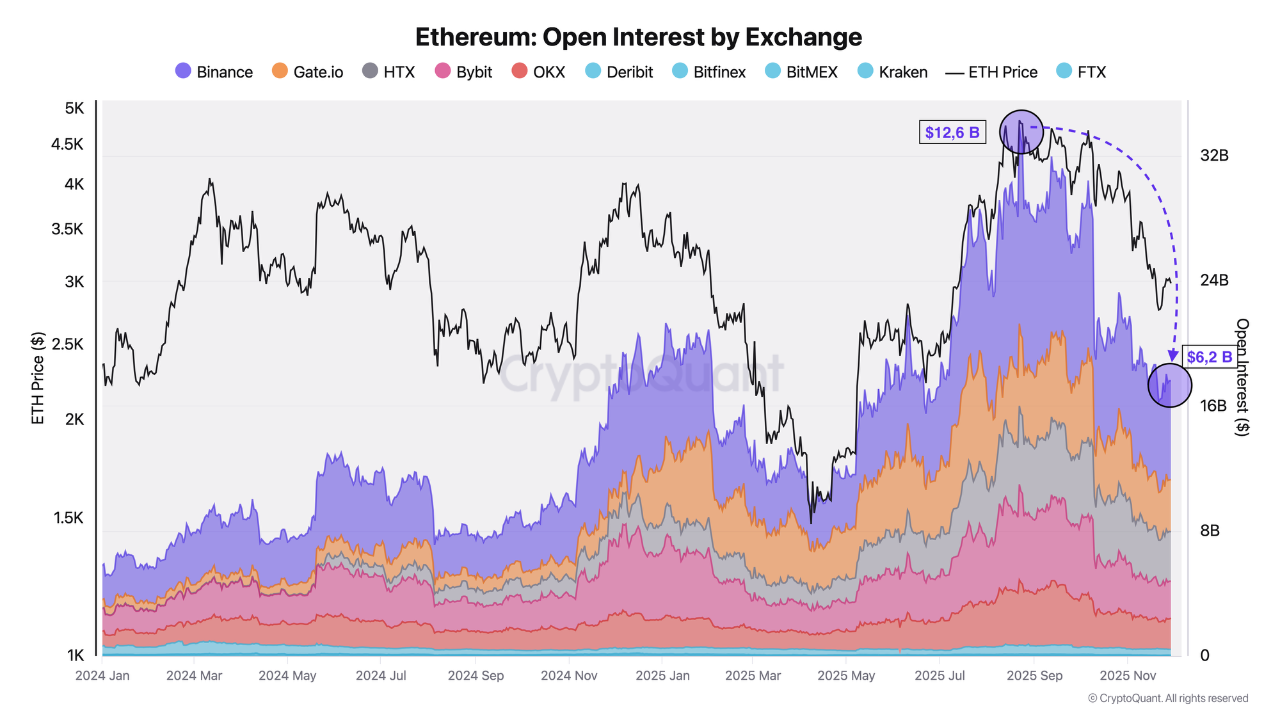
Ethereum open interest by exchange | Source: CryptoQuant

Ethereum open interest by exchange | Source: CryptoQuant

ETH itself has dropped from its $4,830 peak to about $2,800, a decline of around 43%. While this drop in OI looks dramatic, it has only dropped below the previous peak of $7.7 billion.

Traders seem hesitant to jump back in with liquidations stacking up. According to CryptoQuant analyst Darkfost, the scale of this reduction could help clear excess leverage and form a strong price bottom once the dust settles.

Big Buyers Step In to Buy the ETH Dip

While Ether ETFs saw an outflow with fear among retail traders, institutions are buying the ETH price dip. BlackRock recently purchased about $26.7 million worth of ETH, which suggests that long-term buyers are not backing away.

Moreover, on-chain data from Lookonchain shows that the trader pension-usdt.eth shifted long after the latest dip, opening a 2x position on 20,000 ETH (around $56 million).

This came shortly after the trader earned roughly $1 million in one hour by taking a 2x short on 6,358 ETH right before prices dropped on Dec. 1.

This optimism comes as Ethereum awaits its Fusaka upgrade, scheduled for Dec. 3. The upgrade aims to increase the network’s blob space capacity and reduce transaction costs across Ethereum Layer 2 networks.

next

The post ETH ETFs Start Bleeding Again, but BlackRock Quietly Buys Dip appeared first on Coinspeaker.

Market Opportunity
Ethereum Logo
Ethereum Price(ETH)
$3,302.52
$3,302.52$3,302.52
-0.87%
USD
Ethereum (ETH) Live Price Chart
Disclaimer: The articles reposted on this site are sourced from public platforms and are provided for informational purposes only. They do not necessarily reflect the views of MEXC. All rights remain with the original authors. If you believe any content infringes on third-party rights, please contact service@support.mexc.com for removal. MEXC makes no guarantees regarding the accuracy, completeness, or timeliness of the content and is not responsible for any actions taken based on the information provided. The content does not constitute financial, legal, or other professional advice, nor should it be considered a recommendation or endorsement by MEXC.

You May Also Like

Which Altcoins Stand to Gain from the SEC’s New ETF Listing Standards?

Which Altcoins Stand to Gain from the SEC’s New ETF Listing Standards?

On Wednesday, the US SEC (Securities and Exchange Commission) took a landmark step in crypto regulation, approving generic listing standards for spot crypto ETFs (exchange-traded funds). This new framework eliminates the case-by-case 19b-4 approval process, streamlining the path for multiple digital asset ETFs to enter the market in the coming weeks. Grayscale’s Multi-Crypto Milestone Grayscale secured a first-mover advantage as its Digital Large Cap Fund (GDLC) received approval under the new listing standards. Products that will be traded under the ticker GDLC include Bitcoin, Ethereum, XRP, Solana, and Cardano. “Grayscale Digital Large Cap Fund $GDLC was just approved for trading along with the Generic Listing Standards. The Grayscale team is working expeditiously to bring the FIRST multi-crypto asset ETP to market with Bitcoin, Ethereum, XRP, Solana, and Cardano,” wrote Grayscale CEO Peter Mintzberg. The approval marks the US’s first diversified, multi-crypto ETP, signaling a shift toward broader portfolio products rather than single-asset ETFs. Bloomberg’s Eric Balchunas explained that around 12–15 cryptocurrencies now qualify for spot ETF consideration. However, this is contingent on the altcoins having established futures trading on Coinbase Derivatives for at least six months. This includes well-known altcoins like Dogecoin (DOGE), Litecoin (LTC), and Chainlink (LINK), alongside the majors already included in Grayscale’s GDLC. Altcoins in the Spotlight Amid New Era of ETF Eligibility Several assets have already met the key condition, regulated futures trading on Coinbase. For example, Solana futures launched in February 2024, making the token eligible as of August 19. “The SEC approved generic ETF listing standards. Assets with a regulated futures contract trading for 6 months qualify for a spot ETF. Solana met this criterion on Aug 19, 6 months after SOL futures launched on Coinbase Derivatives,” SolanaFloor indicated. Crypto investors and communities also identified which tokens stand to gain. Chainlink community liaison Zach Rynes highlighted that LINK could soon see its own ETF. He noted that both Bitwise and Grayscale have already filed applications. Meanwhile, the Litecoin Foundation indicated that the new standards provide the regulatory framework for LTC to be listed on US exchanges. Hedera is also in the spotlight, with digital asset investor Mark anticipating an HBAR ETF. Market observers see the decision as a potential turning point for broader adoption, bringing the much-needed clarity and accessibility for investors. At the same time, it boosts confidence in the market’s maturity. The general sentiment is that with the SEC’s approval, the next phase of crypto ETFs is no longer a question of ‘if,’ but ‘when.’ The shift to generic listing standards could expand the US-listed digital asset ETFs roster beyond Bitcoin and Ethereum. Such a move would usher in new investment vehicles covering a dozen or more altcoins. This represents the clearest path yet toward mainstream, regulated access to diversified crypto exposure. More importantly, it comes without the friction of direct custody. “We’re gonna be off to the races in a matter of weeks,” ETF analyst James Seyffart quipped.
Share
Coinstats2025/09/18 12:57
XRP Crowned South Korea’s Most-Traded Crypto of 2025

XRP Crowned South Korea’s Most-Traded Crypto of 2025

XRP Surpasses Bitcoin and Ethereum as South Korea’s Most Traded Crypto in 2025According to renowned market analyst X Finance Bull, XRP dominated South Korea’s crypto
Share
Coinstats2026/01/16 16:54
Fintech Is Leveling the Playing Field in Trading, Says Zak Westphal

Fintech Is Leveling the Playing Field in Trading, Says Zak Westphal

The post Fintech Is Leveling the Playing Field in Trading, Says Zak Westphal appeared on BitcoinEthereumNews.com. The trading world was once divided into two groups: those with access to high-powered data and those without.  As you might have guessed, it was the major institutions (like Wall Street) that had a monopoly on the tools, data access, and speed. This left retail traders fighting to keep up. This gap is closing rapidly, and the main reason is the introduction of new technology and platforms entering the fold. Zak Westphal has been at the forefront of this transformation. While Co-Founding StocksToTrade, he has been a big part of empowering everyday traders to gain access to the real-time information and algorithmic systems that have long provided Wall Street with its edge. We spoke with him about how fintech is reshaping the landscape and what it really means for retail traders today. Fintech has changed everything from banking to payments. In your opinion, what has been its greatest impact on the world of trading? For me, it’s all about access. When I began my trading career, institutions had a significant advantage, even more pronounced than it is now. They had direct feeds of data, algorithmic systems, and research teams monitoring information right around the clock. Retail traders, on the other hand, had slower information and pretty basic tools in comparison.  Fintech has substantially changed the game. Today, a retail trader from home can access real-time market data, scan thousands of stocks in mere seconds, and utilize algorithmic tools that were once only available to hedge funds. I can’t think of a time when the access for everyday traders has been as accessible as it is today. That doesn’t mean the advantages are gone, because Wall Street still has resources that individuals simply can’t have. However, there is now an opportunity for everyday traders actually to compete. And that is a…
Share
BitcoinEthereumNews2025/09/18 17:14