BitcoinWorld Alarming Surge: Crypto Hack Losses Skyrocket to $194M in November November delivered a stark and alarming reminder of the persistent dangers in the digital asset space. According to a shocking report from blockchain security firm PeckShield, crypto hack losses exploded to a staggering $194.27 million. This figure represents a devastating tenfold increase from the $18.18 million lost in October, highlighting a severe and sudden escalation […] This post Alarming Surge: Crypto Hack Losses Skyrocket to $194M in November first appeared on BitcoinWorld.BitcoinWorld Alarming Surge: Crypto Hack Losses Skyrocket to $194M in November November delivered a stark and alarming reminder of the persistent dangers in the digital asset space. According to a shocking report from blockchain security firm PeckShield, crypto hack losses exploded to a staggering $194.27 million. This figure represents a devastating tenfold increase from the $18.18 million lost in October, highlighting a severe and sudden escalation […] This post Alarming Surge: Crypto Hack Losses Skyrocket to $194M in November first appeared on BitcoinWorld.

Alarming Surge: Crypto Hack Losses Skyrocket to $194M in November

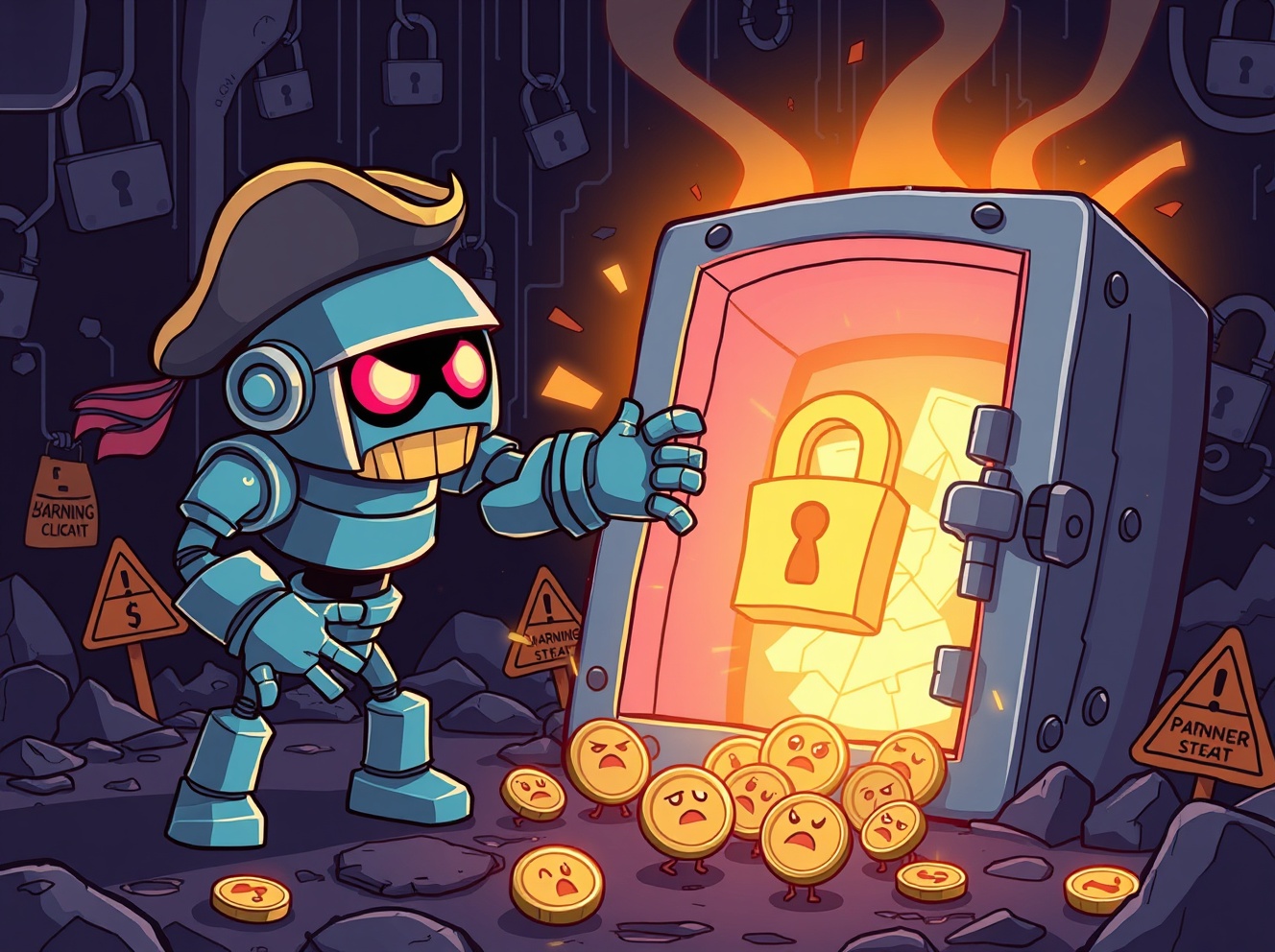
Cartoon illustration of a crypto hack with a robot attacking a digital vault, showing alarming cryptocurrency losses.

BitcoinWorld

Alarming Surge: Crypto Hack Losses Skyrocket to $194M in November

November delivered a stark and alarming reminder of the persistent dangers in the digital asset space. According to a shocking report from blockchain security firm PeckShield, crypto hack losses exploded to a staggering $194.27 million. This figure represents a devastating tenfold increase from the $18.18 million lost in October, highlighting a severe and sudden escalation in security breaches.

Why Did Crypto Hack Losses Spike So Dramatically?

The dramatic rise in crypto hack losses wasn’t due to a higher number of incidents, but rather the sheer scale of a few major exploits. In total, there were approximately 15 security breaches. However, three attacks alone accounted for the overwhelming majority of the stolen funds, turning November into one of the most damaging months of the year for the industry.

This surge underscores a critical challenge: as the total value locked in decentralized finance (DeFi) protocols and exchanges grows, they become more attractive targets for sophisticated attackers. The concentration of value in certain platforms means a single successful exploit can lead to catastrophic crypto hack losses.

Breaking Down the Major November Exploits

To understand where the $194 million vanished, we need to look at the primary targets. The scale of these individual incidents explains the monthly total.

  • Balancer ($137.4 million): This decentralized finance (DeFi) protocol suffered the single largest blow. An attacker exploited a vulnerability in its liquidity pools, leading to massive crypto hack losses for the protocol and its users.
  • Upbit ($36 million): The South Korean cryptocurrency exchange confirmed a significant loss, though it assured users that no customer funds were affected, covering the shortfall with its own reserves.
  • Yearn.finance ($9 million): Another major DeFi player, Yearn.finance, was hit by an exploit related to a legacy vault, demonstrating that even established protocols with robust audits are not immune.

What Can You Do to Mitigate Your Risk?

While institutional platforms bear the brunt of responsibility, users are not powerless. The alarming November data on crypto hack losses is a call to action for every investor to review their security practices.

First, consider using a hardware wallet for storing significant amounts of cryptocurrency. This keeps your private keys offline and away from internet-based threats. Second, be extremely cautious with DeFi interactions. Always research a protocol’s audit history and community reputation before depositing funds. Finally, enable all available security features on your exchange accounts, such as two-factor authentication (2FA) using an authenticator app, not SMS.

Remember, the goal is not to instill fear but to promote vigilance. The blockchain’s transparency allows us to track these crypto hack losses precisely, which in turn helps the entire ecosystem learn and build stronger defenses.

The Path Forward: Security as a Priority

The tenfold spike in November’s crypto hack losses is a sobering data point for the industry. It serves as a powerful reminder that technological innovation must be matched by an equal commitment to security. For mainstream adoption to continue, trust must be earned and protected.

Therefore, the response from developers, auditors, and platform operators will be crucial. We can expect increased investment in security audits, bug bounty programs, and more sophisticated monitoring tools. The fight against these exploits is ongoing, and November’s losses will likely catalyze a new wave of defensive innovation.

Frequently Asked Questions (FAQs)

Q: Were any user funds lost in the Upbit hack?
A: According to Upbit, no customer funds were lost. The exchange stated it would cover the $36 million loss from its own reserves.

Q: What is the most common cause of these crypto hacks?
A: Many exploits stem from smart contract vulnerabilities—flaws in the code that governs DeFi protocols—which attackers can manipulate to drain funds.

Q: Does this mean DeFi is unsafe?
A: Not inherently, but it carries different risks than traditional finance. The open-source and permissionless nature of DeFi requires users to be more diligent about where they place their trust and funds.

Q: How can I check if a protocol has been audited?
A: Reputable DeFi projects will usually publish their audit reports on their official websites or documentation. Look for audits from well-known security firms.

Q: Has the stolen money from these November hacks been recovered?
A: Recovery is often very difficult. Some funds may be frozen or traced, but a significant portion is typically lost permanently, highlighting the importance of prevention.

Help spread awareness about crypto security! If you found this breakdown of November’s alarming hack losses useful, share this article with your network on Twitter or LinkedIn. Educating others is one of the best ways to strengthen the entire cryptocurrency community against future threats.

To learn more about the latest trends in blockchain security, explore our article on key developments shaping the future of cryptocurrency safety and institutional adoption.

This post Alarming Surge: Crypto Hack Losses Skyrocket to $194M in November first appeared on BitcoinWorld.

Market Opportunity
SURGE Logo
SURGE Price(SURGE)
$0.03925
$0.03925$0.03925
+4.08%
USD
SURGE (SURGE) Live Price Chart
Disclaimer: The articles reposted on this site are sourced from public platforms and are provided for informational purposes only. They do not necessarily reflect the views of MEXC. All rights remain with the original authors. If you believe any content infringes on third-party rights, please contact service@support.mexc.com for removal. MEXC makes no guarantees regarding the accuracy, completeness, or timeliness of the content and is not responsible for any actions taken based on the information provided. The content does not constitute financial, legal, or other professional advice, nor should it be considered a recommendation or endorsement by MEXC.

You May Also Like

X to cut off InfoFi crypto projects from accessing its API

X to cut off InfoFi crypto projects from accessing its API

X, the most widely used app for crypto projects, is changing its API access policy. InfoFi projects, which proliferated non-organic bot content, will be cut off
Share
Cryptopolitan2026/01/16 02:50
X Just Killed Kaito and InfoFi Crypto, Several Tokens Crash

X Just Killed Kaito and InfoFi Crypto, Several Tokens Crash

The post X Just Killed Kaito and InfoFi Crypto, Several Tokens Crash appeared on BitcoinEthereumNews.com. X has revoked API access for apps that reward users for
Share
BitcoinEthereumNews2026/01/16 03:42
Google's AP2 protocol has been released. Does encrypted AI still have a chance?

Google's AP2 protocol has been released. Does encrypted AI still have a chance?

Following the MCP and A2A protocols, the AI Agent market has seen another blockbuster arrival: the Agent Payments Protocol (AP2), developed by Google. This will clearly further enhance AI Agents' autonomous multi-tasking capabilities, but the unfortunate reality is that it has little to do with web3AI. Let's take a closer look: What problem does AP2 solve? Simply put, the MCP protocol is like a universal hook, enabling AI agents to connect to various external tools and data sources; A2A is a team collaboration communication protocol that allows multiple AI agents to cooperate with each other to complete complex tasks; AP2 completes the last piece of the puzzle - payment capability. In other words, MCP opens up connectivity, A2A promotes collaboration efficiency, and AP2 achieves value exchange. The arrival of AP2 truly injects "soul" into the autonomous collaboration and task execution of Multi-Agents. Imagine AI Agents connecting Qunar, Meituan, and Didi to complete the booking of flights, hotels, and car rentals, but then getting stuck at the point of "self-payment." What's the point of all that multitasking? So, remember this: AP2 is an extension of MCP+A2A, solving the last mile problem of AI Agent automated execution. What are the technical highlights of AP2? The core innovation of AP2 is the Mandates mechanism, which is divided into real-time authorization mode and delegated authorization mode. Real-time authorization is easy to understand. The AI Agent finds the product and shows it to you. The operation can only be performed after the user signs. Delegated authorization requires the user to set rules in advance, such as only buying the iPhone 17 when the price drops to 5,000. The AI Agent monitors the trigger conditions and executes automatically. The implementation logic is cryptographically signed using Verifiable Credentials (VCs). Users can set complex commission conditions, including price ranges, time limits, and payment method priorities, forming a tamper-proof digital contract. Once signed, the AI Agent executes according to the conditions, with VCs ensuring auditability and security at every step. Of particular note is the "A2A x402" extension, a technical component developed by Google specifically for crypto payments, developed in collaboration with Coinbase and the Ethereum Foundation. This extension enables AI Agents to seamlessly process stablecoins, ETH, and other blockchain assets, supporting native payment scenarios within the Web3 ecosystem. What kind of imagination space can AP2 bring? After analyzing the technical principles, do you think that's it? Yes, in fact, the AP2 is boring when it is disassembled alone. Its real charm lies in connecting and opening up the "MCP+A2A+AP2" technology stack, completely opening up the complete link of AI Agent's autonomous analysis+execution+payment. From now on, AI Agents can open up many application scenarios. For example, AI Agents for stock investment and financial management can help us monitor the market 24/7 and conduct independent transactions. Enterprise procurement AI Agents can automatically replenish and renew without human intervention. AP2's complementary payment capabilities will further expand the penetration of the Agent-to-Agent economy into more scenarios. Google obviously understands that after the technical framework is established, the ecological implementation must be relied upon, so it has brought in more than 60 partners to develop it, almost covering the entire payment and business ecosystem. Interestingly, it also involves major Crypto players such as Ethereum, Coinbase, MetaMask, and Sui. Combined with the current trend of currency and stock integration, the imagination space has been doubled. Is web3 AI really dead? Not entirely. Google's AP2 looks complete, but it only achieves technical compatibility with Crypto payments. It can only be regarded as an extension of the traditional authorization framework and belongs to the category of automated execution. There is a "paradigm" difference between it and the autonomous asset management pursued by pure Crypto native solutions. The Crypto-native solutions under exploration are taking the "decentralized custody + on-chain verification" route, including AI Agent autonomous asset management, AI Agent autonomous transactions (DeFAI), AI Agent digital identity and on-chain reputation system (ERC-8004...), AI Agent on-chain governance DAO framework, AI Agent NPC and digital avatars, and many other interesting and fun directions. Ultimately, once users get used to AI Agent payments in traditional fields, their acceptance of AI Agents autonomously owning digital assets will also increase. And for those scenarios that AP2 cannot reach, such as anonymous transactions, censorship-resistant payments, and decentralized asset management, there will always be a time for crypto-native solutions to show their strength? The two are more likely to be complementary rather than competitive, but to be honest, the key technological advancements behind AI Agents currently all come from web2AI, and web3AI still needs to keep up the good work!
Share
PANews2025/09/18 07:00