BitcoinWorld Shocking Revelation: James Cameron Declares Generative AI ‘Horrifying’ Despite Avatar’s Tech Innovation In a stunning declaration that’s sending shockwaves through the entertainment industry, legendary filmmaker James Cameron has labeled generative AI technology as ‘horrifying’ despite his reputation as a technological pioneer. The Avatar director’s strong stance against AI-generated content comes as he prepares to release the latest installment in his groundbreaking franchise, creating a fascinating contradiction between […] This post Shocking Revelation: James Cameron Declares Generative AI ‘Horrifying’ Despite Avatar’s Tech Innovation first appeared on BitcoinWorld.BitcoinWorld Shocking Revelation: James Cameron Declares Generative AI ‘Horrifying’ Despite Avatar’s Tech Innovation In a stunning declaration that’s sending shockwaves through the entertainment industry, legendary filmmaker James Cameron has labeled generative AI technology as ‘horrifying’ despite his reputation as a technological pioneer. The Avatar director’s strong stance against AI-generated content comes as he prepares to release the latest installment in his groundbreaking franchise, creating a fascinating contradiction between […] This post Shocking Revelation: James Cameron Declares Generative AI ‘Horrifying’ Despite Avatar’s Tech Innovation first appeared on BitcoinWorld.

Shocking Revelation: James Cameron Declares Generative AI ‘Horrifying’ Despite Avatar’s Tech Innovation

Shocking Revelation: James Cameron Declares Generative AI 'Horrifying' Despite Avatar's Tech Innovation

BitcoinWorld

Shocking Revelation: James Cameron Declares Generative AI ‘Horrifying’ Despite Avatar’s Tech Innovation

In a stunning declaration that’s sending shockwaves through the entertainment industry, legendary filmmaker James Cameron has labeled generative AI technology as ‘horrifying’ despite his reputation as a technological pioneer. The Avatar director’s strong stance against AI-generated content comes as he prepares to release the latest installment in his groundbreaking franchise, creating a fascinating contradiction between his embrace of cutting-edge visual effects and his rejection of artificial intelligence in creative processes.

Why James Cameron Fears Generative AI Technology

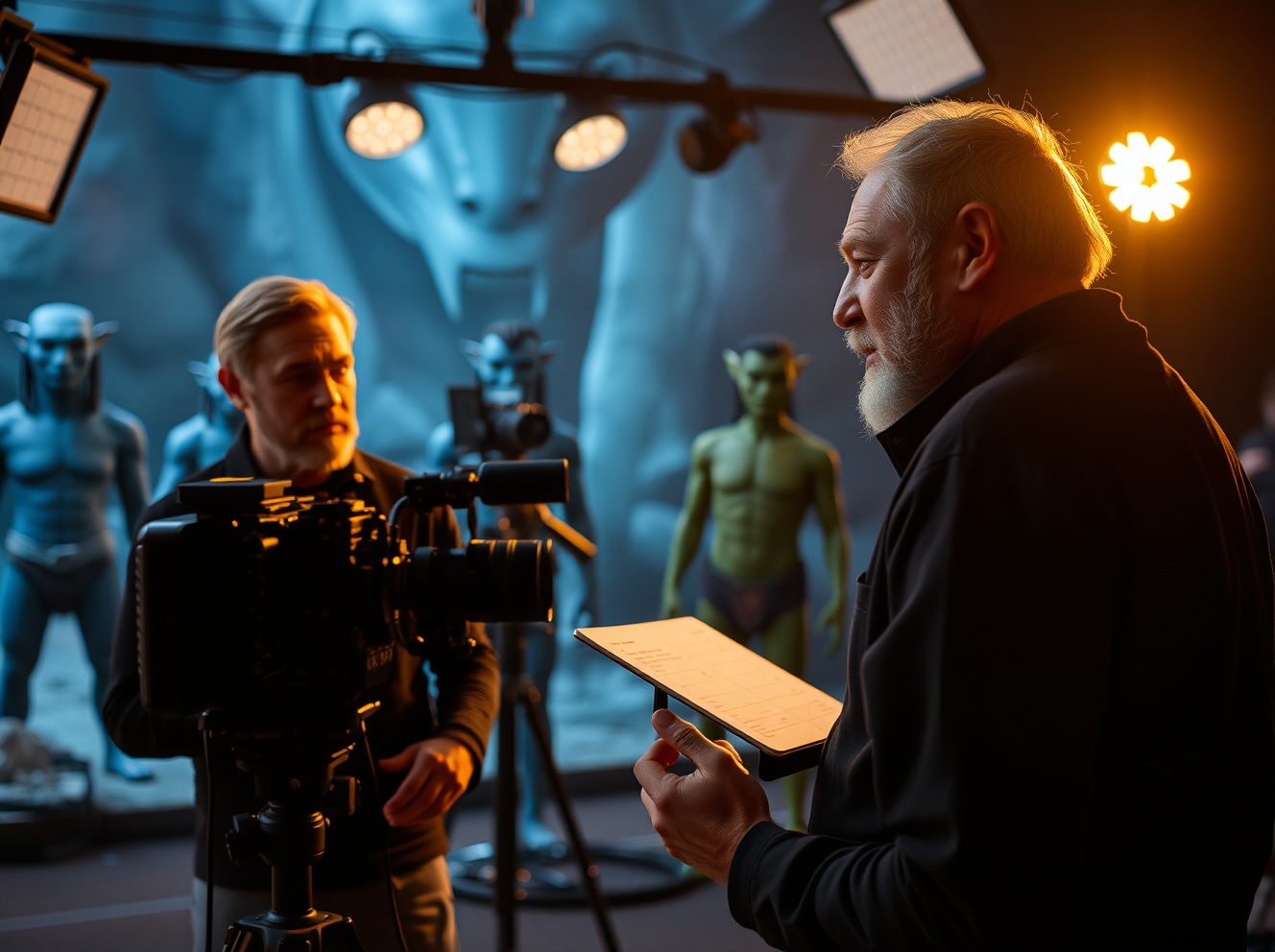
During a recent CBS Sunday Morning interview promoting ‘Avatar: Fire and Ash,’ James Cameron drew a clear line between his use of performance capture and what he considers the dangerous territory of generative AI. While both involve digital creation, Cameron emphasized they represent fundamentally different approaches to storytelling. ‘For years, there was this sense that, ‘Oh they’re doing something strange with computers, and they’re replacing actors,” Cameron revealed. ‘When in fact, once you really drill down and you see what we’re doing, it’s a celebration of the actor-director moment.’

The Critical Difference: Performance Capture vs Generative AI

James Cameron passionately explained why his Avatar technology represents the opposite of generative AI approaches. Performance capture, as used in the Avatar films, records real human performances that digital artists then use as templates. The CBS segment showcased cast members performing their underwater scenes in a massive 250,000-gallon water tank, demonstrating the human element at the core of the process.

Performance CaptureGenerative AI
Based on real actor performancesCreates from text prompts
Human-driven creative processAlgorithm-generated content
Director-actor collaborationNo human performance required
Celebrates human artistryReplaces human creativity

Avatar Director’s Warning About AI Technology

James Cameron’s concerns about generative AI extend beyond artistic integrity. ‘Go to the other end of the spectrum and you’ve got generative AI, where they can make up a character, they can make up an actor, they can make up a performance from scratch with a text prompt,’ Cameron stated. ‘No, that’s horrifying … That’s exactly what we’re not doing.’ His warning highlights the ethical and creative implications of AI technology that can generate complete performances without human input.

The Future of Film Technology According to Cameron

Despite his criticism of generative AI, James Cameron continues to push boundaries with film technology in the Avatar franchise. His approach demonstrates that technological advancement doesn’t require sacrificing human creativity. The key distinctions Cameron emphasizes include:

  • Human performance as the foundation
  • Director-led creative vision
  • Collaboration between artists and technicians
  • Technology enhancing rather than replacing

Frequently Asked Questions About James Cameron and AI

What is James Cameron’s background in film technology?
James Cameron is known for pushing technological boundaries in films like Avatar, The Terminator, and Titanic.

How does performance capture work in Avatar?
Performance capture involves recording actors’ movements and expressions, which digital artists at companies like Weta Digital use to create the final Na’vi characters.

What companies are leading in generative AI?
Companies like OpenAI, Midjourney, and Stability AI are at the forefront of generative AI development.

Where was the CBS interview conducted?
The interview was part of CBS Sunday Morning programming tied to the Avatar: Fire and Ash release from Disney.

James Cameron’s stark warning about generative AI serves as a crucial reminder that technological advancement must serve human creativity rather than replace it. As the entertainment industry grapples with AI’s rapid development, Cameron’s perspective offers valuable insight into maintaining artistic integrity while embracing innovation. His distinction between performance capture and generative AI highlights the importance of preserving human expression in an increasingly digital world.

To learn more about the latest AI technology trends, explore our article on key developments shaping artificial intelligence features and institutional adoption.

This post Shocking Revelation: James Cameron Declares Generative AI ‘Horrifying’ Despite Avatar’s Tech Innovation first appeared on BitcoinWorld.

Market Opportunity
null Logo
null Price(null)
--
----
USD
null (null) Live Price Chart
Disclaimer: The articles reposted on this site are sourced from public platforms and are provided for informational purposes only. They do not necessarily reflect the views of MEXC. All rights remain with the original authors. If you believe any content infringes on third-party rights, please contact service@support.mexc.com for removal. MEXC makes no guarantees regarding the accuracy, completeness, or timeliness of the content and is not responsible for any actions taken based on the information provided. The content does not constitute financial, legal, or other professional advice, nor should it be considered a recommendation or endorsement by MEXC.

You May Also Like

X to cut off InfoFi crypto projects from accessing its API

X to cut off InfoFi crypto projects from accessing its API

X, the most widely used app for crypto projects, is changing its API access policy. InfoFi projects, which proliferated non-organic bot content, will be cut off
Share
Cryptopolitan2026/01/16 02:50
X Just Killed Kaito and InfoFi Crypto, Several Tokens Crash

X Just Killed Kaito and InfoFi Crypto, Several Tokens Crash

The post X Just Killed Kaito and InfoFi Crypto, Several Tokens Crash appeared on BitcoinEthereumNews.com. X has revoked API access for apps that reward users for
Share
BitcoinEthereumNews2026/01/16 03:42
Google's AP2 protocol has been released. Does encrypted AI still have a chance?

Google's AP2 protocol has been released. Does encrypted AI still have a chance?

Following the MCP and A2A protocols, the AI Agent market has seen another blockbuster arrival: the Agent Payments Protocol (AP2), developed by Google. This will clearly further enhance AI Agents' autonomous multi-tasking capabilities, but the unfortunate reality is that it has little to do with web3AI. Let's take a closer look: What problem does AP2 solve? Simply put, the MCP protocol is like a universal hook, enabling AI agents to connect to various external tools and data sources; A2A is a team collaboration communication protocol that allows multiple AI agents to cooperate with each other to complete complex tasks; AP2 completes the last piece of the puzzle - payment capability. In other words, MCP opens up connectivity, A2A promotes collaboration efficiency, and AP2 achieves value exchange. The arrival of AP2 truly injects "soul" into the autonomous collaboration and task execution of Multi-Agents. Imagine AI Agents connecting Qunar, Meituan, and Didi to complete the booking of flights, hotels, and car rentals, but then getting stuck at the point of "self-payment." What's the point of all that multitasking? So, remember this: AP2 is an extension of MCP+A2A, solving the last mile problem of AI Agent automated execution. What are the technical highlights of AP2? The core innovation of AP2 is the Mandates mechanism, which is divided into real-time authorization mode and delegated authorization mode. Real-time authorization is easy to understand. The AI Agent finds the product and shows it to you. The operation can only be performed after the user signs. Delegated authorization requires the user to set rules in advance, such as only buying the iPhone 17 when the price drops to 5,000. The AI Agent monitors the trigger conditions and executes automatically. The implementation logic is cryptographically signed using Verifiable Credentials (VCs). Users can set complex commission conditions, including price ranges, time limits, and payment method priorities, forming a tamper-proof digital contract. Once signed, the AI Agent executes according to the conditions, with VCs ensuring auditability and security at every step. Of particular note is the "A2A x402" extension, a technical component developed by Google specifically for crypto payments, developed in collaboration with Coinbase and the Ethereum Foundation. This extension enables AI Agents to seamlessly process stablecoins, ETH, and other blockchain assets, supporting native payment scenarios within the Web3 ecosystem. What kind of imagination space can AP2 bring? After analyzing the technical principles, do you think that's it? Yes, in fact, the AP2 is boring when it is disassembled alone. Its real charm lies in connecting and opening up the "MCP+A2A+AP2" technology stack, completely opening up the complete link of AI Agent's autonomous analysis+execution+payment. From now on, AI Agents can open up many application scenarios. For example, AI Agents for stock investment and financial management can help us monitor the market 24/7 and conduct independent transactions. Enterprise procurement AI Agents can automatically replenish and renew without human intervention. AP2's complementary payment capabilities will further expand the penetration of the Agent-to-Agent economy into more scenarios. Google obviously understands that after the technical framework is established, the ecological implementation must be relied upon, so it has brought in more than 60 partners to develop it, almost covering the entire payment and business ecosystem. Interestingly, it also involves major Crypto players such as Ethereum, Coinbase, MetaMask, and Sui. Combined with the current trend of currency and stock integration, the imagination space has been doubled. Is web3 AI really dead? Not entirely. Google's AP2 looks complete, but it only achieves technical compatibility with Crypto payments. It can only be regarded as an extension of the traditional authorization framework and belongs to the category of automated execution. There is a "paradigm" difference between it and the autonomous asset management pursued by pure Crypto native solutions. The Crypto-native solutions under exploration are taking the "decentralized custody + on-chain verification" route, including AI Agent autonomous asset management, AI Agent autonomous transactions (DeFAI), AI Agent digital identity and on-chain reputation system (ERC-8004...), AI Agent on-chain governance DAO framework, AI Agent NPC and digital avatars, and many other interesting and fun directions. Ultimately, once users get used to AI Agent payments in traditional fields, their acceptance of AI Agents autonomously owning digital assets will also increase. And for those scenarios that AP2 cannot reach, such as anonymous transactions, censorship-resistant payments, and decentralized asset management, there will always be a time for crypto-native solutions to show their strength? The two are more likely to be complementary rather than competitive, but to be honest, the key technological advancements behind AI Agents currently all come from web2AI, and web3AI still needs to keep up the good work!
Share
PANews2025/09/18 07:00