Upbit replaced all stolen user funds while investigators track a Lazarus-style laundering trail. South Korea’s FIU targets Korbit, Gopax, Bithumb, and Coinone with penalties after compliance failures. South Korean authorities say a North Korean state-backed hacking group likely stole about 44.5 billion won, roughly 30 million dollars, from the country’s largest crypto exchange, Upbit. The [...]]]>Upbit replaced all stolen user funds while investigators track a Lazarus-style laundering trail. South Korea’s FIU targets Korbit, Gopax, Bithumb, and Coinone with penalties after compliance failures. South Korean authorities say a North Korean state-backed hacking group likely stole about 44.5 billion won, roughly 30 million dollars, from the country’s largest crypto exchange, Upbit. The [...]]]>

Report Claims North Korean Group Orchestrated $30M Crypto Hack in South Korea

For feedback or concerns regarding this content, please contact us at crypto.news@mexc.com
  • Upbit replaced all stolen user funds while investigators track a Lazarus-style laundering trail.
  • South Korea’s FIU targets Korbit, Gopax, Bithumb, and Coinone with penalties after compliance failures.

South Korean authorities say a North Korean state-backed hacking group likely stole about 44.5 billion won, roughly 30 million dollars, from the country’s largest crypto exchange, Upbit. The breach hit a Solana hot wallet on Nov. 27, according to Upbit’s operator Dunamu.

Around 4:42 a.m. local time, the exchange detected abnormal withdrawals of Solana-based tokens and quickly suspended deposits and withdrawals on the network. The stolen assets included SOL, USDC, and a basket of other Solana ecosystem tokens that were sent to an external wallet not controlled by the exchange.
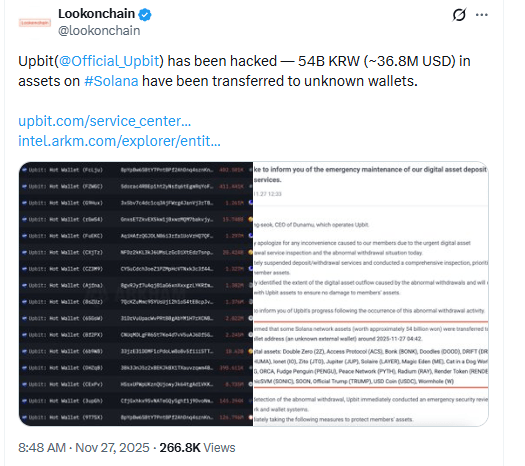
Source: LookonchainSource: Lookonchain on X

Soon after the incident, Yonhap and other local outlets reported that investigators see “North Korean fingerprints” on the attack. Officials said the operation bears similarities to the 2019 Upbit hack, as featured in our coverage, when 58 billion won worth of Ethereum disappeared in a case later tied to North Korea’s Lazarus Group.

South Korea’s police cyber unit, financial regulators, and intelligence agencies are conducting on-site inspections at Dunamu. They are tracing flows linked to about 44.5 billion won in stolen crypto and reviewing whether compromised or impersonated administrator credentials opened the door, rather than a direct break of Upbit’s core servers.

Upbit Pays Back $30M Losses as Suspected North Korean Trail Appears

Upbit said it has already reimbursed all affected member assets from its own reserves and absorbed a corporate loss of about 5.9 billion won. It also reported freezing a portion of the stolen funds with help from project teams and blockchain analytics firms, while shifting remaining Solana holdings into cold storage.

As the investigation unfolds, blockchain traces show the attacker quickly swapped multiple Solana tokens into wrapped Solana and SOL, then moved the proceeds across roughly 185 wallets before bridging into Ethereum. That pattern, according to analysts, matches earlier Lazarus-linked laundering routes.

South Korea Targets Four More Exchanges After Upbit Case

Meanwhile, South Korea’s Financial Intelligence Unit is now turning to Korbit, Gopax, Bithumb, and Coinone after the Upbit incident. Regulators plan penalties for these four platforms following a 35.2 billion won fine against Dunamu, as previously mentioned in our report, the operator of Upbit, for weak anti–money laundering and customer checks.

Inspectors ran on-site reviews across the exchanges from 2024 into early 2025 and kept finding similar problems. They flagged poor ID verification, slow reports of suspicious activity, and large transfers that slipped past AML controls. As a result, authorities expect further sanctions to land in the first half of next year.

]]>
Disclaimer: The articles reposted on this site are sourced from public platforms and are provided for informational purposes only. They do not necessarily reflect the views of MEXC. All rights remain with the original authors. If you believe any content infringes on third-party rights, please contact crypto.news@mexc.com for removal. MEXC makes no guarantees regarding the accuracy, completeness, or timeliness of the content and is not responsible for any actions taken based on the information provided. The content does not constitute financial, legal, or other professional advice, nor should it be considered a recommendation or endorsement by MEXC.

You May Also Like

What Is Jawboning? Jimmy Kimmel Suspension Sparks Legal Concerns About Trump Administration

What Is Jawboning? Jimmy Kimmel Suspension Sparks Legal Concerns About Trump Administration

The post What Is Jawboning? Jimmy Kimmel Suspension Sparks Legal Concerns About Trump Administration appeared on BitcoinEthereumNews.com. Topline Legal experts have raised concerns that ABC’s decision to pull “Jimmy Kimmel Live” from its airwaves following the host’s controversial comments about the death of Charlie Kirk, could be because the Trump administration violated free speech protections through a practice known as “jawboning.” Jimmy Kimmel speaks at Disney’s Advertising Upfront on May 13 in New York City. Disney via Getty Images Key Facts Disney-owned ABC announced Wednesday Kimmel’s show will be taken off the air “indefinitely,” which came after ABC affiliate owner Nexstar—which needs Federal Communications Commission approval to complete a planned acquisition of competitor Tegna Inc.—said it would not air the program due to Kimmel’s comments Monday regarding Kirk’s death and the reaction to it. The sudden move drew particular concern because it came only hours after FCC head Brendan Carr called for ABC to “take action” against Kimmel, and cryptically suggested his agency could take action saying, “We can do this the easy way or the hard way.” While ABC and Nexstar have not given any indication their decisions were influenced by Carr’s comments, the timing raised concerns among legal experts that the Trump administration’s threats may have unlawfully coerced ABC and Nexstar to punish Kimmel, which could constitute jawboning. Jawboning refers to “the use of official speech to inappropriately compel private action,” as defined by the Cato Institute, as governments or public officials—who cannot directly punish private actors for speech they don’t like—can use strongman tactics to try and indirectly silence critics or influence private companies’ actions. The practice is fairly loosely defined and there aren’t many legal safeguards dictating how violations of it are enforced, the Knight First Amendment Institute notes, but the Supreme Court has repeatedly ruled it can be unlawful and an impermissible First Amendment violation when it involves specific threats. The White…
Share
BitcoinEthereumNews2025/09/19 07:17
Why Fintech Platforms Are Growing Faster Than Traditional Banks

Why Fintech Platforms Are Growing Faster Than Traditional Banks

Fintech platforms are outpacing traditional banks in growth across nearly every measurable dimension. Customer acquisition rates, revenue growth, geographic expansion
Share
Techbullion2026/03/24 07:58
Japan’s CPI Reveals Critical 1.3% Inflation Rise in February as Core Pressure Eases Unexpectedly

Japan’s CPI Reveals Critical 1.3% Inflation Rise in February as Core Pressure Eases Unexpectedly

BitcoinWorld Japan’s CPI Reveals Critical 1.3% Inflation Rise in February as Core Pressure Eases Unexpectedly TOKYO, Japan — March 2025: Japan’s National Consumer
Share
bitcoinworld2026/03/24 08:10