Galaxy Digital CEO Mike Novogratz says the October 10th crash in crypto was far more than a routine shakeout, claiming that roughly a third of market makers in parts of the ecosystem were effectively wiped out. “We had a flash crash and it did a lot of damage to the fabric of the market,” Novogratz told Anthony Scaramucci on the first-ever episode of “All Things Markets,” recorded November 26. “Even on Hyperliquid, the market makers, you know, 30 percent of them went out of business. Got zeroed.” Scaramucci framed the last 20 trading days as another brutal reminder of crypto’s structural volatility. “I know I have a trap door on my portfolio,” he said. “Once in a while I’ll be walking across the living room feeling beautiful about myself. And then, boom, a trap door opens and I have fallen into the basement of the house.” Related Reading: Will Crypto Explode If Kevin Hassett Takes Over The Fed In 2026? According to Novogratz, this particular trap door opened at Binance. “It started really by, you know, at Binance, they had an oracle which set price misfunction,” he said. That error hit a synthetic stablecoin and “created a cascade where people were getting stopped out because there was the wrong price.” The dislocation then bled into levered perpetual markets “like Hyperliquid, like Uniswap,” where “as prices went down, people started getting liquidated.” He argued that the way crypto participants use leverage turned a technical glitch into a systemic event. “What people don’t understand about crypto is that the crypto investor doesn’t play for 10, 11, 12 percent returns,” he said. “Crypto investor call themselves degens with pride. They want to turn one into 15. And so they trade a very volatile asset with a lot of leverage.” Perpetual futures make that leverage particularly dangerous for liquidity providers. “Perpetual futures are not normal futures,” Novogratz said, crediting “the genius that Arthur Hayes and his group of people” for a design where “as longs get liquidated, they’re paired off against shorts.” In a fast collapse, “you could be short and you lose your short position. Well, if you’re long on another exchange against that short position, you’re shit out of luck. And that happened to a lot of market makers.” Will The Crypto Market Recover? The result, he said, was a sharp loss of liquidity and retail capital. “We lost a lot of liquidity in the market. We lost a lot of retail punters who lost their stack,” he noted, adding that after such a wipeout “it takes a while for Humpty Dumpty to get put back together again.” Novogratz said he initially expected higher levels to hold. “I actually, to be fair, thought we were going to hold at higher levels at $90,000,” he admitted. “And we went all the way to $80,000. $80,000 was a maximum pain point… Got to $1.80 on XRP. We got to $125 on Solana. Real pain points.” He links the subsequent rebound to macro tailwinds, not healed sentiment. “Now we bounce up. We bounce because of the Fed. But we’re not out of the woods,” he said. “I do think Bitcoin will climb back towards $100,000 by the end of the year, but there’ll be sellers waiting there. We’ve done some medium-term damage to the psychology of the market.” Related Reading: Crypto Has Entered Late-Cycle Territory, Says Global Liquidity Veteran On the spot side, he highlighted massive profit-taking by early holders against ETF-driven inflows. “We had one $9 billion seller,” he said. “That’s one-third of all of IBIT’s flows of the year.” As US wealth channels move “from a zero weighting to a 3 to 4 percent weighting” in Bitcoin, that “was met with OG sellers.” “In the long run, that’s healthy,” he said. “In the short run, that’s painful.” Novogratz also argued that crypto is being repriced as a real business ecosystem rather than a pure story. “It’s a transition from just being a story — ‘we’re the most important industry… we’re going to decentralize the world’ — to ‘show me what crypto actually does,’” he said. “Some businesses are making money. Some businesses aren’t. There are some token ecosystems that make common sense to an investor and there’s some that all feel like they’re just an association.” Overlaying it all is a macro backdrop he views as increasingly supportive. He called the Fed’s recent signals and plans to ease bank cash requirements in repo “a monstrous liquidity boom that’s coming,” adding that “they’re going to bring rates down to 2 percent in the next 16 months” and that inflation will “creep higher,” implying negative real rates. For crypto, the message is double-edged: structurally de-levered, with fewer market makers and wounded sentiment, but still tied to a global liquidity cycle that Novogratz believes is turning in its favor — once Humpty Dumpty gets put back together again. At press time, Bitcoin traded at $91,115. Featured image from YouTube, chart from TradingView.comGalaxy Digital CEO Mike Novogratz says the October 10th crash in crypto was far more than a routine shakeout, claiming that roughly a third of market makers in parts of the ecosystem were effectively wiped out. “We had a flash crash and it did a lot of damage to the fabric of the market,” Novogratz told Anthony Scaramucci on the first-ever episode of “All Things Markets,” recorded November 26. “Even on Hyperliquid, the market makers, you know, 30 percent of them went out of business. Got zeroed.” Scaramucci framed the last 20 trading days as another brutal reminder of crypto’s structural volatility. “I know I have a trap door on my portfolio,” he said. “Once in a while I’ll be walking across the living room feeling beautiful about myself. And then, boom, a trap door opens and I have fallen into the basement of the house.” Related Reading: Will Crypto Explode If Kevin Hassett Takes Over The Fed In 2026? According to Novogratz, this particular trap door opened at Binance. “It started really by, you know, at Binance, they had an oracle which set price misfunction,” he said. That error hit a synthetic stablecoin and “created a cascade where people were getting stopped out because there was the wrong price.” The dislocation then bled into levered perpetual markets “like Hyperliquid, like Uniswap,” where “as prices went down, people started getting liquidated.” He argued that the way crypto participants use leverage turned a technical glitch into a systemic event. “What people don’t understand about crypto is that the crypto investor doesn’t play for 10, 11, 12 percent returns,” he said. “Crypto investor call themselves degens with pride. They want to turn one into 15. And so they trade a very volatile asset with a lot of leverage.” Perpetual futures make that leverage particularly dangerous for liquidity providers. “Perpetual futures are not normal futures,” Novogratz said, crediting “the genius that Arthur Hayes and his group of people” for a design where “as longs get liquidated, they’re paired off against shorts.” In a fast collapse, “you could be short and you lose your short position. Well, if you’re long on another exchange against that short position, you’re shit out of luck. And that happened to a lot of market makers.” Will The Crypto Market Recover? The result, he said, was a sharp loss of liquidity and retail capital. “We lost a lot of liquidity in the market. We lost a lot of retail punters who lost their stack,” he noted, adding that after such a wipeout “it takes a while for Humpty Dumpty to get put back together again.” Novogratz said he initially expected higher levels to hold. “I actually, to be fair, thought we were going to hold at higher levels at $90,000,” he admitted. “And we went all the way to $80,000. $80,000 was a maximum pain point… Got to $1.80 on XRP. We got to $125 on Solana. Real pain points.” He links the subsequent rebound to macro tailwinds, not healed sentiment. “Now we bounce up. We bounce because of the Fed. But we’re not out of the woods,” he said. “I do think Bitcoin will climb back towards $100,000 by the end of the year, but there’ll be sellers waiting there. We’ve done some medium-term damage to the psychology of the market.” Related Reading: Crypto Has Entered Late-Cycle Territory, Says Global Liquidity Veteran On the spot side, he highlighted massive profit-taking by early holders against ETF-driven inflows. “We had one $9 billion seller,” he said. “That’s one-third of all of IBIT’s flows of the year.” As US wealth channels move “from a zero weighting to a 3 to 4 percent weighting” in Bitcoin, that “was met with OG sellers.” “In the long run, that’s healthy,” he said. “In the short run, that’s painful.” Novogratz also argued that crypto is being repriced as a real business ecosystem rather than a pure story. “It’s a transition from just being a story — ‘we’re the most important industry… we’re going to decentralize the world’ — to ‘show me what crypto actually does,’” he said. “Some businesses are making money. Some businesses aren’t. There are some token ecosystems that make common sense to an investor and there’s some that all feel like they’re just an association.” Overlaying it all is a macro backdrop he views as increasingly supportive. He called the Fed’s recent signals and plans to ease bank cash requirements in repo “a monstrous liquidity boom that’s coming,” adding that “they’re going to bring rates down to 2 percent in the next 16 months” and that inflation will “creep higher,” implying negative real rates. For crypto, the message is double-edged: structurally de-levered, with fewer market makers and wounded sentiment, but still tied to a global liquidity cycle that Novogratz believes is turning in its favor — once Humpty Dumpty gets put back together again. At press time, Bitcoin traded at $91,115. Featured image from YouTube, chart from TradingView.com
30% Of Crypto Market Makers Got Wiped, Mike Novogratz Says

2025/11/28 09:00

Galaxy Digital CEO Mike Novogratz says the October 10th crash in crypto was far more than a routine shakeout, claiming that roughly a third of market makers in parts of the ecosystem were effectively wiped out.

“We had a flash crash and it did a lot of damage to the fabric of the market,” Novogratz told Anthony Scaramucci on the first-ever episode of “All Things Markets,” recorded November 26. “Even on Hyperliquid, the market makers, you know, 30 percent of them went out of business. Got zeroed.”

Scaramucci framed the last 20 trading days as another brutal reminder of crypto’s structural volatility. “I know I have a trap door on my portfolio,” he said. “Once in a while I’ll be walking across the living room feeling beautiful about myself. And then, boom, a trap door opens and I have fallen into the basement of the house.”

According to Novogratz, this particular trap door opened at Binance. “It started really by, you know, at Binance, they had an oracle which set price misfunction,” he said. That error hit a synthetic stablecoin and “created a cascade where people were getting stopped out because there was the wrong price.” The dislocation then bled into levered perpetual markets “like Hyperliquid, like Uniswap,” where “as prices went down, people started getting liquidated.”

He argued that the way crypto participants use leverage turned a technical glitch into a systemic event. “What people don’t understand about crypto is that the crypto investor doesn’t play for 10, 11, 12 percent returns,” he said. “Crypto investor call themselves degens with pride. They want to turn one into 15. And so they trade a very volatile asset with a lot of leverage.”

Perpetual futures make that leverage particularly dangerous for liquidity providers. “Perpetual futures are not normal futures,” Novogratz said, crediting “the genius that Arthur Hayes and his group of people” for a design where “as longs get liquidated, they’re paired off against shorts.” In a fast collapse, “you could be short and you lose your short position. Well, if you’re long on another exchange against that short position, you’re shit out of luck. And that happened to a lot of market makers.”

Will The Crypto Market Recover?

The result, he said, was a sharp loss of liquidity and retail capital. “We lost a lot of liquidity in the market. We lost a lot of retail punters who lost their stack,” he noted, adding that after such a wipeout “it takes a while for Humpty Dumpty to get put back together again.”

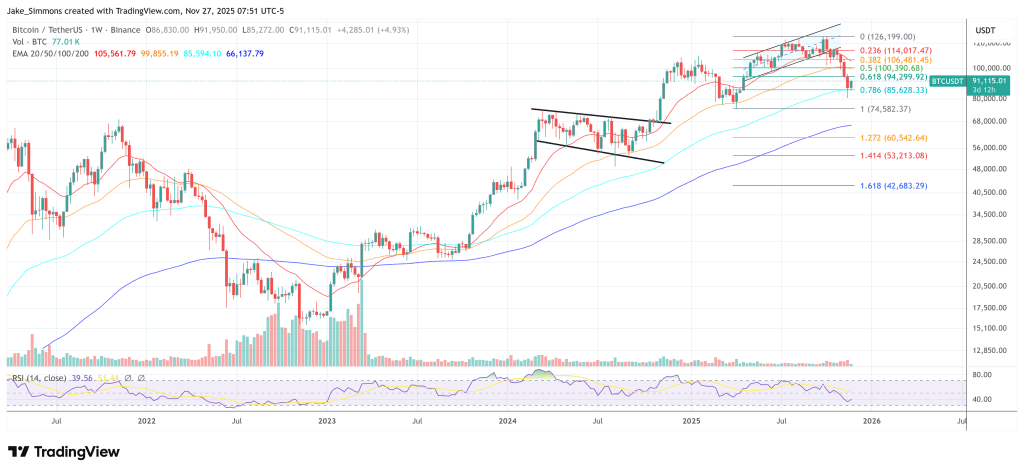
Novogratz said he initially expected higher levels to hold. “I actually, to be fair, thought we were going to hold at higher levels at $90,000,” he admitted. “And we went all the way to $80,000. $80,000 was a maximum pain point… Got to $1.80 on XRP. We got to $125 on Solana. Real pain points.”

He links the subsequent rebound to macro tailwinds, not healed sentiment. “Now we bounce up. We bounce because of the Fed. But we’re not out of the woods,” he said. “I do think Bitcoin will climb back towards $100,000 by the end of the year, but there’ll be sellers waiting there. We’ve done some medium-term damage to the psychology of the market.”

On the spot side, he highlighted massive profit-taking by early holders against ETF-driven inflows. “We had one $9 billion seller,” he said. “That’s one-third of all of IBIT’s flows of the year.” As US wealth channels move “from a zero weighting to a 3 to 4 percent weighting” in Bitcoin, that “was met with OG sellers.” “In the long run, that’s healthy,” he said. “In the short run, that’s painful.”

Novogratz also argued that crypto is being repriced as a real business ecosystem rather than a pure story. “It’s a transition from just being a story — ‘we’re the most important industry… we’re going to decentralize the world’ — to ‘show me what crypto actually does,’” he said. “Some businesses are making money. Some businesses aren’t. There are some token ecosystems that make common sense to an investor and there’s some that all feel like they’re just an association.”

Overlaying it all is a macro backdrop he views as increasingly supportive. He called the Fed’s recent signals and plans to ease bank cash requirements in repo “a monstrous liquidity boom that’s coming,” adding that “they’re going to bring rates down to 2 percent in the next 16 months” and that inflation will “creep higher,” implying negative real rates.

For crypto, the message is double-edged: structurally de-levered, with fewer market makers and wounded sentiment, but still tied to a global liquidity cycle that Novogratz believes is turning in its favor — once Humpty Dumpty gets put back together again.

At press time, Bitcoin traded at $91,115.

Bitcoin price
Market Opportunity
Farcana Logo
Farcana Price(FAR)
$0.001155
$0.001155$0.001155
-0.08%
USD
Farcana (FAR) Live Price Chart
Disclaimer: The articles reposted on this site are sourced from public platforms and are provided for informational purposes only. They do not necessarily reflect the views of MEXC. All rights remain with the original authors. If you believe any content infringes on third-party rights, please contact service@support.mexc.com for removal. MEXC makes no guarantees regarding the accuracy, completeness, or timeliness of the content and is not responsible for any actions taken based on the information provided. The content does not constitute financial, legal, or other professional advice, nor should it be considered a recommendation or endorsement by MEXC.

You May Also Like

Is Doge Losing Steam As Traders Choose Pepeto For The Best Crypto Investment?

Is Doge Losing Steam As Traders Choose Pepeto For The Best Crypto Investment?

The post Is Doge Losing Steam As Traders Choose Pepeto For The Best Crypto Investment? appeared on BitcoinEthereumNews.com. Crypto News 17 September 2025 | 17:39 Is dogecoin really fading? As traders hunt the best crypto to buy now and weigh 2025 picks, Dogecoin (DOGE) still owns the meme coin spotlight, yet upside looks capped, today’s Dogecoin price prediction says as much. Attention is shifting to projects that blend culture with real on-chain tools. Buyers searching “best crypto to buy now” want shipped products, audits, and transparent tokenomics. That frames the true matchup: dogecoin vs. Pepeto. Enter Pepeto (PEPETO), an Ethereum-based memecoin with working rails: PepetoSwap, a zero-fee DEX, plus Pepeto Bridge for smooth cross-chain moves. By fusing story with tools people can use now, and speaking directly to crypto presale 2025 demand, Pepeto puts utility, clarity, and distribution in front. In a market where legacy meme coin leaders risk drifting on sentiment, Pepeto’s execution gives it a real seat in the “best crypto to buy now” debate. First, a quick look at why dogecoin may be losing altitude. Dogecoin Price Prediction: Is Doge Really Fading? Remember when dogecoin made crypto feel simple? In 2013, DOGE turned a meme into money and a loose forum into a movement. A decade on, the nonstop momentum has cooled; the backdrop is different, and the market is far more selective. With DOGE circling ~$0.268, the tape reads bearish-to-neutral for the next few weeks: hold the $0.26 shelf on daily closes and expect choppy range-trading toward $0.29–$0.30 where rallies keep stalling; lose $0.26 decisively and momentum often bleeds into $0.245 with risk of a deeper probe toward $0.22–$0.21; reclaim $0.30 on a clean daily close and the downside bias is likely neutralized, opening room for a squeeze into the low-$0.30s. Source: CoinMarketcap / TradingView Beyond the dogecoin price prediction, DOGE still centers on payments and lacks native smart contracts; ZK-proof verification is proposed,…
Share
BitcoinEthereumNews2025/09/18 00:14
Fed Decides On Interest Rates Today—Here’s What To Watch For

Fed Decides On Interest Rates Today—Here’s What To Watch For

The post Fed Decides On Interest Rates Today—Here’s What To Watch For appeared on BitcoinEthereumNews.com. Topline The Federal Reserve on Wednesday will conclude a two-day policymaking meeting and release a decision on whether to lower interest rates—following months of pressure and criticism from President Donald Trump—and potentially signal whether additional cuts are on the way. President Donald Trump has urged the central bank to “CUT INTEREST RATES, NOW, AND BIGGER” than they might plan to. Getty Images Key Facts The central bank is poised to cut interest rates by at least a quarter-point, down from the 4.25% to 4.5% range where they have been held since December to between 4% and 4.25%, as Wall Street has placed 100% odds of a rate cut, according to CME’s FedWatch, with higher odds (94%) on a quarter-point cut than a half-point (6%) reduction. Fed governors Christopher Waller and Michelle Bowman, both Trump appointees, voted in July for a quarter-point reduction to rates, and they may dissent again in favor of a large cut alongside Stephen Miran, Trump’s Council of Economic Advisers’ chair, who was sworn in at the meeting’s start on Tuesday. It’s unclear whether other policymakers, including Kansas City Fed President Jeffrey Schmid and St. Louis Fed President Alberto Musalem, will favor larger cuts or opt for no reduction. Fed Chair Jerome Powell said in his Jackson Hole, Wyoming, address last month the central bank would likely consider a looser monetary policy, noting the “shifting balance of risks” on the U.S. economy “may warrant adjusting our policy stance.” David Mericle, an economist for Goldman Sachs, wrote in a note the “key question” for the Fed’s meeting is whether policymakers signal “this is likely the first in a series of consecutive cuts” as the central bank is anticipated to “acknowledge the softening in the labor market,” though they may not “nod to an October cut.” Mericle said he…
Share
BitcoinEthereumNews2025/09/18 00:23
Stronger capital, bigger loans: Africa’s banking outlook for 2026

Stronger capital, bigger loans: Africa’s banking outlook for 2026

African banks spent 2025 consolidating, shoring up capital, tightening risk controls, and investing in digital infrastructure, following years of macroeconomic
Share
Techcabal2026/01/14 23:06