Bitcoin’s sharp correction from $110,000 to around $80,000 is linked to heavy selling by early whales with cost bases near $16,000. CryptoQuant CEO Ki Young Ju notes that on-chain metrics indicate Bitcoin is now in the “shoulder” phase of its cycle, suggesting limited short-term upside potential. This selling is overwhelming institutional demand from ETFs and MicroStrategy, shaping the cryptocurrency’s 2025 outlook. In an interview with Upbit’s Upbitcare, Ju provides a data-driven look at the shifting landscape for Bitcoin investors and the forces affecting its current market structure. Early Bitcoin Whales Fuel Selling Pressure Ki Young Ju explains that today’s market is shaped by a contest between two main whale groups. Legacy whales, holding Bitcoin with an average cost basis near $16,000, have begun to realize hefty profits, selling at a rate measured in hundreds of millions of USD each day. This persistent selling has exerted intense downward pressure on Bitcoin’s price. At the same time, institutional whales via spot Bitcoin ETFs and MicroStrategy have accumulated significant positions. Yet, their buying power has not matched the scale of early whales’ sell-offs. According to Ju, wallets holding over 10,000 BTC for more than 155 days typically have an average cost basis of around $38,000. Binance traders entered positions around $50,000, so many market participants are in profit and can sell if needed. Cost basis comparison across different Bitcoin holder categories. Source: CryptoQuant The CryptoQuant CEO points out that spot ETF and MicroStrategy inflows had boosted the market earlier in 2025. However, those flows have now declined. Outflows have started to dominate the market landscape. For example, data from Farside Investors showed Bitcoin ETFs recorded $42.8 million in net inflows on November 26, 2025, lifting cumulative inflows to $62.68 billion. Despite these figures, the sustained selling from early whales outweighs institutional accumulation. Market Cycle Analysis Signals Limited Upside On-chain profit-and-loss metrics offer crucial insights into market cycles. Ju’s analysis using the PnL index with a 365-day moving average reveals that the market has entered a “shoulder” phase. This late-cycle status indicates constrained growth potential and increased risk of a correction. The valuation multiplier reflects a neutral-to-flat outlook. In previous cycles, each new dollar drove amplified market-cap growth. Now, that multiplier effect has faded. This suggests market leverage is less efficient, and the structure does not support significant gains. PnL index showing Bitcoin’s current cycle position. Source: CryptoQuant Ju does not expect a dramatic 70-80% crash. Still, he considers corrections up to 30% reasonable. A drop from $100,000 could mean Bitcoin falling to about $70,000. He uses data from OKX futures long-short ratios, exchange leverage ratios, and buy-sell flow patterns to support this view. Ju underscores the importance of a data-driven approach. In a recent post, he urged traders to use metrics for conviction, not speculation. His focus remains on interpreting on-chain data, exchange activity, and market structure. This comprehensive analysis provides a grounded assessment based on on-chain evidence. As early Bitcoin whales continue to sell at profits, institutions face a harsh climate. With high leverage ratios, neutral valuation multipliers, and a late-cycle stance, the market has limited potential for a major rally in the near future.Bitcoin’s sharp correction from $110,000 to around $80,000 is linked to heavy selling by early whales with cost bases near $16,000. CryptoQuant CEO Ki Young Ju notes that on-chain metrics indicate Bitcoin is now in the “shoulder” phase of its cycle, suggesting limited short-term upside potential. This selling is overwhelming institutional demand from ETFs and MicroStrategy, shaping the cryptocurrency’s 2025 outlook. In an interview with Upbit’s Upbitcare, Ju provides a data-driven look at the shifting landscape for Bitcoin investors and the forces affecting its current market structure. Early Bitcoin Whales Fuel Selling Pressure Ki Young Ju explains that today’s market is shaped by a contest between two main whale groups. Legacy whales, holding Bitcoin with an average cost basis near $16,000, have begun to realize hefty profits, selling at a rate measured in hundreds of millions of USD each day. This persistent selling has exerted intense downward pressure on Bitcoin’s price. At the same time, institutional whales via spot Bitcoin ETFs and MicroStrategy have accumulated significant positions. Yet, their buying power has not matched the scale of early whales’ sell-offs. According to Ju, wallets holding over 10,000 BTC for more than 155 days typically have an average cost basis of around $38,000. Binance traders entered positions around $50,000, so many market participants are in profit and can sell if needed. Cost basis comparison across different Bitcoin holder categories. Source: CryptoQuant The CryptoQuant CEO points out that spot ETF and MicroStrategy inflows had boosted the market earlier in 2025. However, those flows have now declined. Outflows have started to dominate the market landscape. For example, data from Farside Investors showed Bitcoin ETFs recorded $42.8 million in net inflows on November 26, 2025, lifting cumulative inflows to $62.68 billion. Despite these figures, the sustained selling from early whales outweighs institutional accumulation. Market Cycle Analysis Signals Limited Upside On-chain profit-and-loss metrics offer crucial insights into market cycles. Ju’s analysis using the PnL index with a 365-day moving average reveals that the market has entered a “shoulder” phase. This late-cycle status indicates constrained growth potential and increased risk of a correction. The valuation multiplier reflects a neutral-to-flat outlook. In previous cycles, each new dollar drove amplified market-cap growth. Now, that multiplier effect has faded. This suggests market leverage is less efficient, and the structure does not support significant gains. PnL index showing Bitcoin’s current cycle position. Source: CryptoQuant Ju does not expect a dramatic 70-80% crash. Still, he considers corrections up to 30% reasonable. A drop from $100,000 could mean Bitcoin falling to about $70,000. He uses data from OKX futures long-short ratios, exchange leverage ratios, and buy-sell flow patterns to support this view. Ju underscores the importance of a data-driven approach. In a recent post, he urged traders to use metrics for conviction, not speculation. His focus remains on interpreting on-chain data, exchange activity, and market structure. This comprehensive analysis provides a grounded assessment based on on-chain evidence. As early Bitcoin whales continue to sell at profits, institutions face a harsh climate. With high leverage ratios, neutral valuation multipliers, and a late-cycle stance, the market has limited potential for a major rally in the near future.

Bitcoin Downtrend Driven by Early Whale Selling, Says Ki Young Ju

Bitcoin’s sharp correction from $110,000 to around $80,000 is linked to heavy selling by early whales with cost bases near $16,000. CryptoQuant CEO Ki Young Ju notes that on-chain metrics indicate Bitcoin is now in the “shoulder” phase of its cycle, suggesting limited short-term upside potential.

This selling is overwhelming institutional demand from ETFs and MicroStrategy, shaping the cryptocurrency’s 2025 outlook. In an interview with Upbit’s Upbitcare, Ju provides a data-driven look at the shifting landscape for Bitcoin investors and the forces affecting its current market structure.

Early Bitcoin Whales Fuel Selling Pressure

Ki Young Ju explains that today’s market is shaped by a contest between two main whale groups. Legacy whales, holding Bitcoin with an average cost basis near $16,000, have begun to realize hefty profits, selling at a rate measured in hundreds of millions of USD each day. This persistent selling has exerted intense downward pressure on Bitcoin’s price.

At the same time, institutional whales via spot Bitcoin ETFs and MicroStrategy have accumulated significant positions. Yet, their buying power has not matched the scale of early whales’ sell-offs. According to Ju, wallets holding over 10,000 BTC for more than 155 days typically have an average cost basis of around $38,000. Binance traders entered positions around $50,000, so many market participants are in profit and can sell if needed.
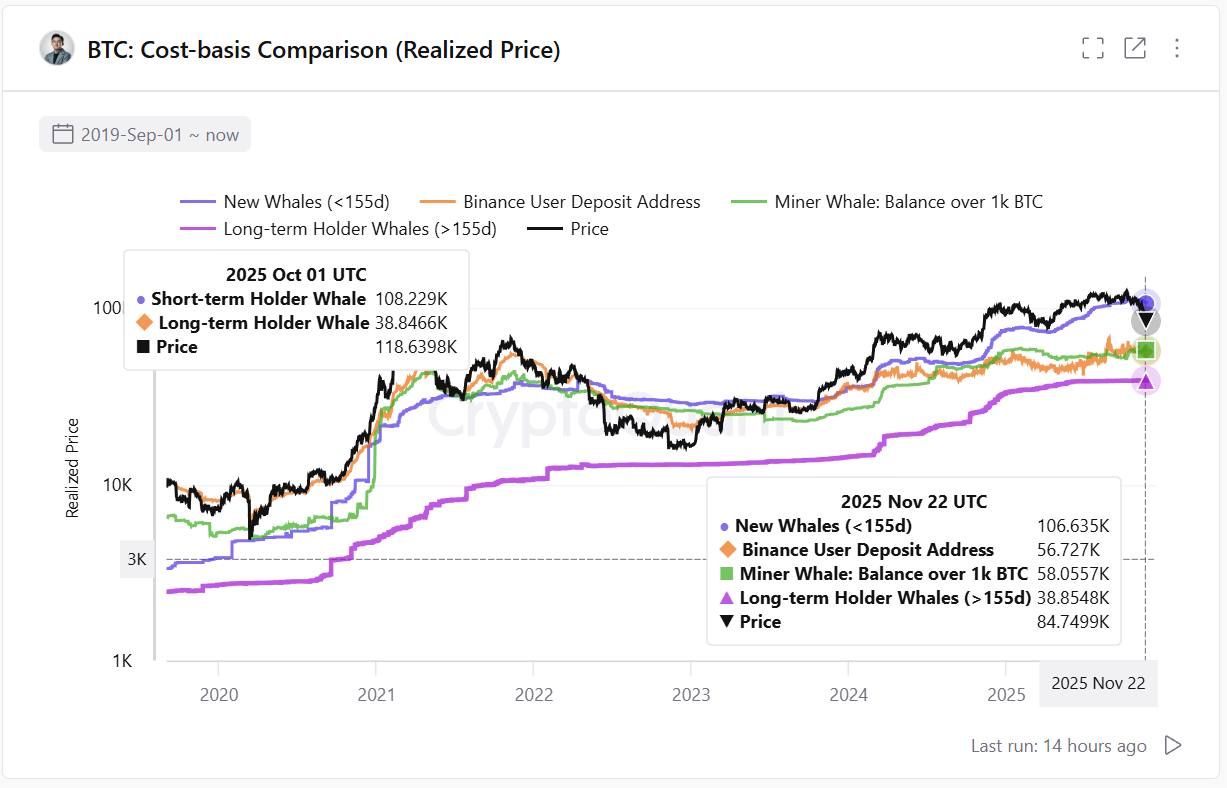
Bitcoin cost basis comparison chartCost basis comparison across different Bitcoin holder categories. Source: CryptoQuant

The CryptoQuant CEO points out that spot ETF and MicroStrategy inflows had boosted the market earlier in 2025. However, those flows have now declined. Outflows have started to dominate the market landscape. For example, data from Farside Investors showed Bitcoin ETFs recorded $42.8 million in net inflows on November 26, 2025, lifting cumulative inflows to $62.68 billion. Despite these figures, the sustained selling from early whales outweighs institutional accumulation.

Market Cycle Analysis Signals Limited Upside

On-chain profit-and-loss metrics offer crucial insights into market cycles. Ju’s analysis using the PnL index with a 365-day moving average reveals that the market has entered a “shoulder” phase. This late-cycle status indicates constrained growth potential and increased risk of a correction.

The valuation multiplier reflects a neutral-to-flat outlook. In previous cycles, each new dollar drove amplified market-cap growth. Now, that multiplier effect has faded. This suggests market leverage is less efficient, and the structure does not support significant gains.
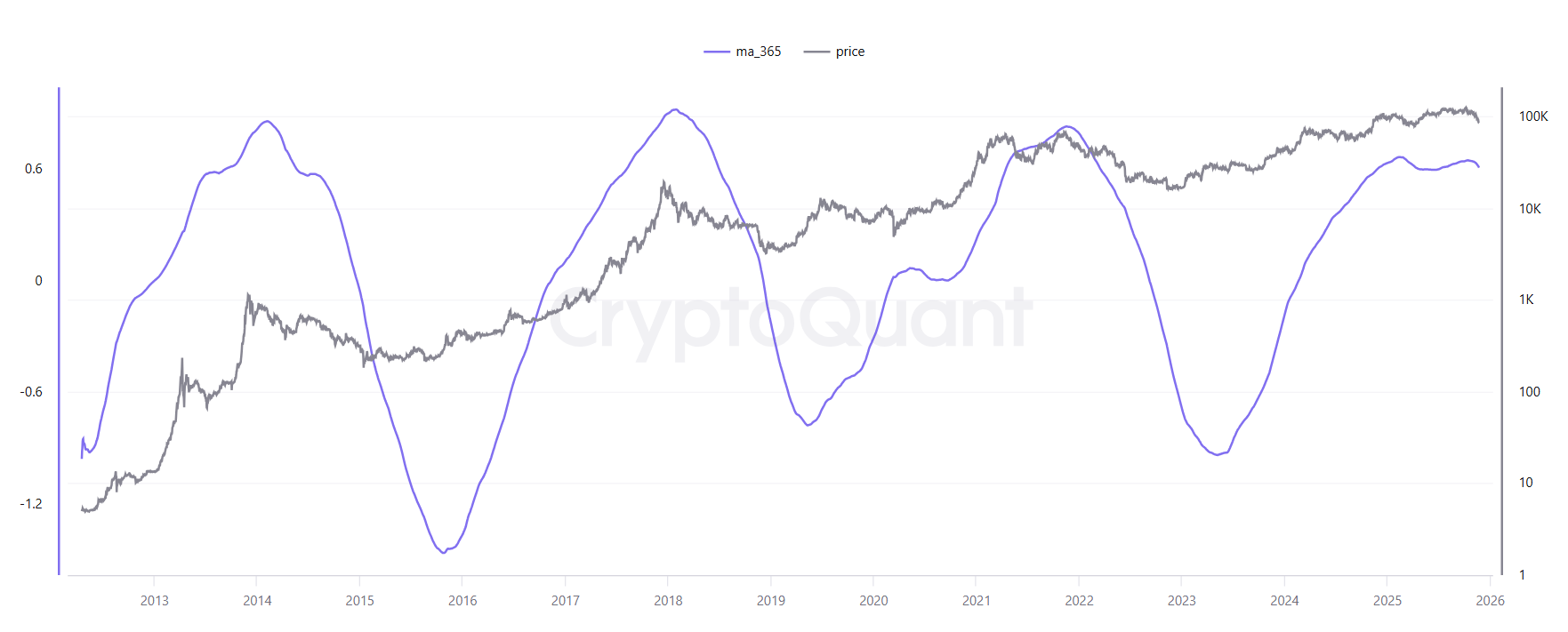
Bitcoin PnL index cyclical signalsPnL index showing Bitcoin’s current cycle position. Source: CryptoQuant

Ju does not expect a dramatic 70-80% crash. Still, he considers corrections up to 30% reasonable. A drop from $100,000 could mean Bitcoin falling to about $70,000. He uses data from OKX futures long-short ratios, exchange leverage ratios, and buy-sell flow patterns to support this view.

Ju underscores the importance of a data-driven approach. In a recent post, he urged traders to use metrics for conviction, not speculation. His focus remains on interpreting on-chain data, exchange activity, and market structure.

This comprehensive analysis provides a grounded assessment based on on-chain evidence. As early Bitcoin whales continue to sell at profits, institutions face a harsh climate. With high leverage ratios, neutral valuation multipliers, and a late-cycle stance, the market has limited potential for a major rally in the near future.

Market Opportunity
NEAR Logo
NEAR Price(NEAR)
$1.824
$1.824$1.824
+0.66%
USD
NEAR (NEAR) Live Price Chart
Disclaimer: The articles reposted on this site are sourced from public platforms and are provided for informational purposes only. They do not necessarily reflect the views of MEXC. All rights remain with the original authors. If you believe any content infringes on third-party rights, please contact service@support.mexc.com for removal. MEXC makes no guarantees regarding the accuracy, completeness, or timeliness of the content and is not responsible for any actions taken based on the information provided. The content does not constitute financial, legal, or other professional advice, nor should it be considered a recommendation or endorsement by MEXC.

You May Also Like

CME Group to Launch Solana and XRP Futures Options

CME Group to Launch Solana and XRP Futures Options

The post CME Group to Launch Solana and XRP Futures Options appeared on BitcoinEthereumNews.com. An announcement was made by CME Group, the largest derivatives exchanger worldwide, revealed that it would introduce options for Solana and XRP futures. It is the latest addition to CME crypto derivatives as institutions and retail investors increase their demand for Solana and XRP. CME Expands Crypto Offerings With Solana and XRP Options Launch According to a press release, the launch is scheduled for October 13, 2025, pending regulatory approval. The new products will allow traders to access options on Solana, Micro Solana, XRP, and Micro XRP futures. Expiries will be offered on business days on a monthly, and quarterly basis to provide more flexibility to market players. CME Group said the contracts are designed to meet demand from institutions, hedge funds, and active retail traders. According to Giovanni Vicioso, the launch reflects high liquidity in Solana and XRP futures. Vicioso is the Global Head of Cryptocurrency Products for the CME Group. He noted that the new contracts will provide additional tools for risk management and exposure strategies. Recently, CME XRP futures registered record open interest amid ETF approval optimism, reinforcing confidence in contract demand. Cumberland, one of the leading liquidity providers, welcomed the development and said it highlights the shift beyond Bitcoin and Ethereum. FalconX, another trading firm, added that rising digital asset treasuries are increasing the need for hedging tools on alternative tokens like Solana and XRP. High Record Trading Volumes Demand Solana and XRP Futures Solana futures and XRP continue to gain popularity since their launch earlier this year. According to CME official records, many have bought and sold more than 540,000 Solana futures contracts since March. A value that amounts to over $22 billion dollars. Solana contracts hit a record 9,000 contracts in August, worth $437 million. Open interest also set a record at 12,500 contracts.…
Share
BitcoinEthereumNews2025/09/18 01:39
XCN Rallies 116% — Can Price Hold as New Holders Gain?

XCN Rallies 116% — Can Price Hold as New Holders Gain?

The post XCN Rallies 116% — Can Price Hold as New Holders Gain? appeared on BitcoinEthereumNews.com. Onyxcoin has delivered one of the strongest performances among
Share
BitcoinEthereumNews2026/01/14 18:59
Worldcoin Price Near $0.65 Faces Pressure as Whales Sell Into the Rally

Worldcoin Price Near $0.65 Faces Pressure as Whales Sell Into the Rally

The post Worldcoin Price Near $0.65 Faces Pressure as Whales Sell Into the Rally appeared on BitcoinEthereumNews.com. Key Insights Retail buyers continue to support
Share
BitcoinEthereumNews2026/01/14 19:12

