The Bitcoin price surged 4% in the past 24 hours to trade at $91,393 as of 2:41 a.m. EST on trading volume that rose 14% [...]The Bitcoin price surged 4% in the past 24 hours to trade at $91,393 as of 2:41 a.m. EST on trading volume that rose 14% [...]

Ripple’s RLUSD Stablecoin Receives Regulatory Greenlight For Institutional Use In Abu Dhabi

2025/11/27 17:51
4 min read
For feedback or concerns regarding this content, please contact us at crypto.news@mexc.com

Ripple’s US dollar-pegged stablecoin RLUSD has been cleared for institutional use in Abu Dhabi after receiving recognition as an Accepted Fiat-Referenced Token by the local financial regulator.

In an announcement today, Ripple said that the recently-gained approval will allow regulated firms to deploy RLUSD within the Abu Dhabi Global Market’s (ADGM) financial zone. This is an international financial center and free zone that is located on Al Maryah and Al Reem Islands in Abu Dhabi. 

The regulatory nod came from Abu Dhabi’s Financial Services Regulatory Authority, which oversees the ADGM. 

“ADGM is recognized globally for its robust and forward-thinking regulatory leadership, so this approval reinforces RLUSD as a compliant stablecoin that meets the highest standards of trust, transparency, and utility,” said Ripple Middle East and Africa Managing Director Reece Merrick.

“This recognition is yet another step forward for Ripple’s operations in the region, where we are experiencing surging interest in our products,” Merrick added. 

Ripple Expanding Its Presence In The UAE

The recent approval is the latest development in Ripple’s broader push to grow its presence in the UAE. 

In October 2024, the company revealed that it was pursuing a license from the Dubai Financial Services Authority (DFSA) to expand its digital asset service offering in the UAE. Later that month, the company then secured in-principle approval. 

Earlier this year, in March, Ripple went on to confirm that it had received full regulatory approval, which allowed the company to offer cross-border crypto payment services inside the Dubai International Financial Centre (DIFC). 

A few months later, the DFSA then approved RLUSD for use by companies operating inside the DIFC. This means that the stablecoin can be used for regulated activities such as treasury management and payments. 

In addition to those regulatory milestones, Ripple has also signed Zand Bank and Mamo, a fintech app, as early users of its blockchain-based payments stack. 

RLUSD Surpasses $1 Billion Market Cap Amid Stablecoin Boom

Ripple’s RLUSD was launched in late 2024, and has since soared to become one of the biggest stablecoins in the market with a capitalization of over $1 billion. 

Data from CoinMarketCap shows that RLUSD is ranked as the 8th-largest stablecoin by market cap, behind Global Dollar (USDG) and above First Digital USD (FDUSD).

Top stablecoins by market cap (Source: CoinMarketCap)

The token is issued under a New York Department of Financial Services Limited Purpose Trust Company Charter. According to Ripple’s announcement, the token has “stringent safeguards” in place. These include a 1:1 USD backing with high-quality liquid assets, strict reserve management and asset segregation, third-party attestation, and clear redemption rights. 

The recent approval for RLUSD to operate in the ADGM follows what has been a record year for stablecoins. 

The space started to gain substantial momentum after US President Donald Trump signed the GENIUS Act into law in July.  

The regulatory clarity that the GENIUS Act provided the industry saw several major traditional finance firms start to explore stablecoins. This led to the capitalization of the stablecoin market soaring to above $300 billion for the first time, according to DefiLlama data

Amid the boom in the stablecoin market, Tether’s USDT has maintained its dominance. Currently, the stablecoin accounts for over 60% of the market, or around $184.529 billion, data from DefiLlama shows. The next-biggest stablecoin is Circle’s USD Coin (USDC), which has a capitalization of over $75.48 billion.

UAE Passed Sweeping New Central Bank Law For DeFi And Web3

The UAE is often regarded as a hub for decentralized finance (DeFi) and Web3, given its crypto-friendly policies. 

As global regulators continue to work towards creating a regulatory framework for digital assets, the UAE passed a sweeping new central bank law earlier this week that brings DeFi and a large portion of the Web3 industry under formal regulatory oversight. 

The UAE’s new central bank law, Federal Decree Law No. 6 of 2025, regulates financial institutions, insurance business, as well as digital asset-related activities. 

The new law’s key provisions, Article 61 and Article 62, list activities that require a license from the Central Bank of the UAE, including crypto payments and digital stored value.

In practice, the law means that DeFi projects can no longer avoid regulation by claiming that they are just code. It also means that decentralization no longer exempts a protocol from compliance. 

Market Opportunity
4 Logo
4 Price(4)
$0.010178
$0.010178$0.010178
+2.22%
USD
4 (4) Live Price Chart
Disclaimer: The articles reposted on this site are sourced from public platforms and are provided for informational purposes only. They do not necessarily reflect the views of MEXC. All rights remain with the original authors. If you believe any content infringes on third-party rights, please contact crypto.news@mexc.com for removal. MEXC makes no guarantees regarding the accuracy, completeness, or timeliness of the content and is not responsible for any actions taken based on the information provided. The content does not constitute financial, legal, or other professional advice, nor should it be considered a recommendation or endorsement by MEXC.

You May Also Like

BTC supply on centralized exchanges is at a 7-year low
BTC supply on centralized exchanges is at a 7-year low

PANews reported on September 18th that crypto analyst The DeFi Investor wrote on the X platform: "The supply of BTC on centralized exchanges is at its lowest level in seven years. The scale of funds invested by institutions in purchasing Bitcoin in this cycle is incredible."
Share
PANews2025/09/18 09:53
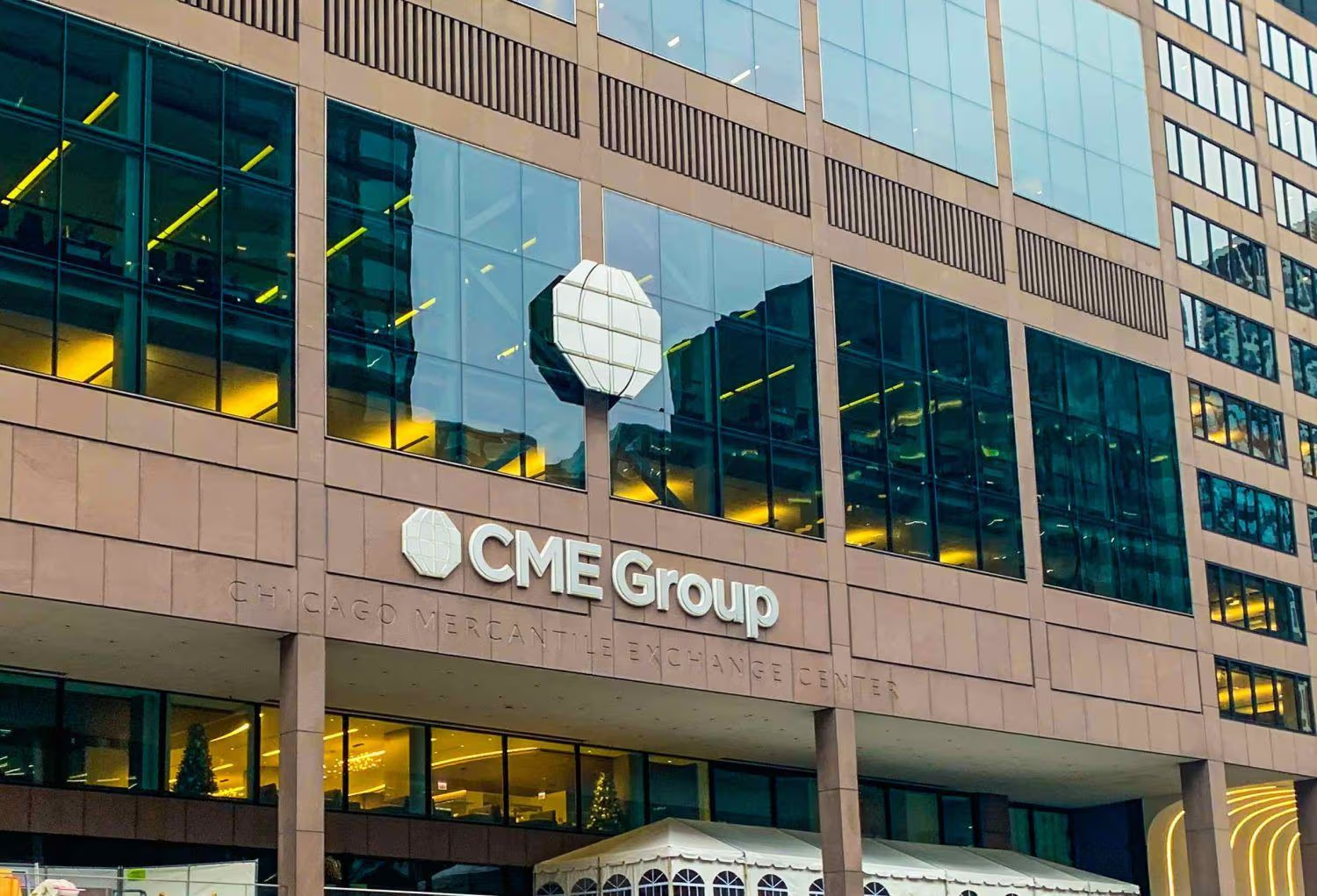
Breaking: CME Group Unveils Solana and XRP Options

Breaking: CME Group Unveils Solana and XRP Options

CME Group launches Solana and XRP options, expanding crypto offerings. SEC delays Solana and XRP ETF approvals, market awaits clarity. Strong institutional demand drives CME’s launch of crypto options contracts. In a bold move to broaden its cryptocurrency offerings, CME Group has officially launched options on Solana (SOL) and XRP futures. Available since October 13, 2025, these options will allow traders to hedge and manage exposure to two of the most widely traded digital assets in the market. The new contracts come in both full-size and micro-size formats, with expiration options available daily, monthly, and quarterly, providing flexibility for a diverse range of market participants. This expansion aligns with the rising demand for innovative products in the crypto space. Giovanni Vicioso, CME Group’s Global Head of Cryptocurrency Products, noted that the new options offer increased flexibility for traders, from institutions to active individual investors. The growing liquidity in Solana and XRP futures has made the introduction of these options a timely move to meet the needs of an expanding market. Also Read: Vitalik Buterin Reveals Ethereum’s Bold Plan to Stay Quantum-Secure and Simple! Rapid Growth in Solana and XRP Futures Trading CME Group’s decision to roll out options on Solana and XRP futures follows the substantial growth in these futures products. Since the launch of Solana futures in March 2025, more than 540,000 contracts, totaling $22.3 billion in notional value, have been traded. In August 2025, Solana futures set new records, with an average daily volume (ADV) of 9,000 contracts valued at $437.4 million. The average daily open interest (ADOI) hit 12,500 contracts, worth $895 million. Similarly, XRP futures, which launched in May 2025, have seen significant adoption, with over 370,000 contracts traded, totaling $16.2 billion. XRP futures also set records in August 2025, with an ADV of 6,600 contracts valued at $385 million and a record ADOI of 9,300 contracts, worth $942 million. Institutional Demand for Advanced Hedging Tools CME Group’s expansion into options is a direct response to growing institutional interest in sophisticated cryptocurrency products. Roman Makarov from Cumberland Options Trading at DRW highlighted the market demand for more varied crypto products, enabling more advanced risk management strategies. Joshua Lim from FalconX also noted that the new options products meet the increasing need for institutional hedging tools for assets like Solana and XRP, further cementing their role in the digital asset space. The launch of options on Solana and XRP futures marks another step toward the maturation of the cryptocurrency market, providing a broader range of tools for managing digital asset exposure. SEC’s Delay on Solana and XRP ETF Approvals While CME Group expands its offerings, the broader market is also watching the progress of Solana and XRP exchange-traded funds (ETFs). The U.S. Securities and Exchange Commission (SEC) has delayed its decisions on multiple crypto-related ETF filings, including those for Solana and XRP. Despite the delay, analysts anticipate approval may be on the horizon. This week, REX Shares and Osprey Funds are expected to launch an XRP ETF that will hold XRP directly and allocate at least 40% of its assets to other XRP-related ETFs. Despite the delays, some analysts believe that approval could come soon, fueling further interest in these assets. The delay by the SEC has left many crypto investors awaiting clarity, but approval of these ETFs could fuel further momentum in the Solana and XRP futures markets. Also Read: Tether CEO Breaks Silence on $117,000 Bitcoin Price – Market Reacts! The post Breaking: CME Group Unveils Solana and XRP Options appeared first on 36Crypto.
Share
Coinstats2025/09/18 02:35
Why Fintech Platforms Are Growing Faster Than Traditional Banks

Why Fintech Platforms Are Growing Faster Than Traditional Banks

Fintech platforms are outpacing traditional banks in growth across nearly every measurable dimension. Customer acquisition rates, revenue growth, geographic expansion
Share
Techbullion2026/03/24 07:58
