Delphi Digital researcher Simon Shockey is arguing that the real story in Zcash is no longer just its price – despite ZEC having one of the most eye-popping rallies of this cycle in recent months. “The most interesting thing about ZEC today is not the price,” he wrote on X. “It’s the fact that a GBTC-style discount dislocation just appeared around ZCSH.” For Shockey, the Zcash trust setup only makes sense when viewed through the lens of what happened with Grayscale’s Bitcoin product. He reminds readers that “funds were built, and later blown up, on two different GBTC trades.” The first was the premium arbitrage, where Grayscale allowed accredited investors to subscribe at NAV with a six-month lock while GBTC traded at a “~30–40%” premium in public markets. Will Zcash Follow The GBTC Playbook? The playbook, he writes, became almost mechanical: “subscribe at NAV, lock for six months, hedge BTC exposure with CME shorts, sell GBTC at a premium, pocket the spread and lever it.” It was so widely adopted that “every TradFi family office, hedge fund tourist, and crypto-native desk was running it. It became the trade. Until, well, it didn’t…” Related Reading: Why is Zcash Surging? Analysts Break Down the ZEC Rally and What Comes Next In February 2021, after years of trading rich to NAV, GBTC flipped to a discount. Anyone mid-lockup was now long an over-priced wrapper, paying to maintain a hedge and watching the discount widen to “-30%, -40%, even -45%.” Shockey calls that dislocation “career/cycle-ending almost overnight,” and notes that it helped detonate players like 3AC, BlockFi, Genesis and DCG. But he stresses that GBTC’s story had a second act: once the discount was entrenched, “a different trade emerged: buy GBTC at a discount, wait for regulatory clarity or ETF approval, redeem at NAV, capture the collapse in the discount.” Value-oriented funds “were early and underwater for a while. But they were ultimately right. The discount evaporated as ETF approval became inevitable.” Shockey’s contention is that a structurally similar phase may now be opening around Grayscale’s Zcash trust. “This morning Grayscale filed to convert ZCSH, their Zcash trust, into an ETP,” he writes. “That filing immediately creates the early outline of a GBTC-style discount trade.” He highlights that ZCSH recently traded around 33.50 dollars per share, even though “yesterday’s trust data, with a lower ZEC price, showed NAV around forty-one dollars per share.” By his math that is “still close to a 20 percent discount. Every ZCSH share is priced materially below the ZEC it represents.” With an implied 0.0817 ZEC per share, “you are effectively getting ZEC exposure at ~$410 per ZEC when spot is well above that.” Related Reading: Why Is Zcash Thriving? Paid Promotion Or Real Momentum? The key structural shift is the proposed move from a closed trust to an exchange-traded product with redemptions. “The current trust structure does not allow redemptions,” Shockey notes. “The proposed ETP would, with one-to-one withdrawals of the actual ZEC held.” If regulators sign off, “the discount should tighten and ZCSH should move toward NAV. This is exactly what happened with GBTC as ETF approval became more realistic.” He is careful to add: “Not guaranteed. Not the same trade. But structurally very similar.” On the money-making angle, Shockey is explicit. “The discount closing is the cleanest angle. Buying ZCSH at a 20 percent discount and selling after convergence is the purest version of the trade.” Beyond that, “there is optionality if ZEC rerates during the approval window. If the privacy-oriented store-of-value narrative strengthens, ZEC can rise while the discount closes. That creates a second leg of upside that GBTC did not offer until very late.” He argues that a ZEC ETP “could unlock new demand,” since “most funds/investors cannot hold ZEC directly due to custody and mandate issues. An ETP solves that. New pools of capital often tighten discounts by themselves.” Narrative and political tailwinds, in his view, are real. “Bitcoin’s lack of privacy is back in focus. The quantum-risk discussion is getting louder.” He points to mainstream airtime, including comments from VanEck’s CEO about Bitcoin’s shortcomings and ZEC as a potential hedge, as a signal that the story has escaped pure crypto-Twitter. His closing summary captures the asymmetric, time-bounded nature of the bet: “If markets keep leaning toward the idea that ZEC is absorbing the role Bitcoin stepped away from, then ZCSH becomes the cleanest vehicle to express that view. You get ZEC exposure in public markets, which could become a major driver of rerating as flows pick up, plus a built-in twenty percent discount that only exists until the ETP is approved. ZODL?” At press time, Zcash traded at $509.84. Featured image created with DALL.E, chart from TradingView.comDelphi Digital researcher Simon Shockey is arguing that the real story in Zcash is no longer just its price – despite ZEC having one of the most eye-popping rallies of this cycle in recent months. “The most interesting thing about ZEC today is not the price,” he wrote on X. “It’s the fact that a GBTC-style discount dislocation just appeared around ZCSH.” For Shockey, the Zcash trust setup only makes sense when viewed through the lens of what happened with Grayscale’s Bitcoin product. He reminds readers that “funds were built, and later blown up, on two different GBTC trades.” The first was the premium arbitrage, where Grayscale allowed accredited investors to subscribe at NAV with a six-month lock while GBTC traded at a “~30–40%” premium in public markets. Will Zcash Follow The GBTC Playbook? The playbook, he writes, became almost mechanical: “subscribe at NAV, lock for six months, hedge BTC exposure with CME shorts, sell GBTC at a premium, pocket the spread and lever it.” It was so widely adopted that “every TradFi family office, hedge fund tourist, and crypto-native desk was running it. It became the trade. Until, well, it didn’t…” Related Reading: Why is Zcash Surging? Analysts Break Down the ZEC Rally and What Comes Next In February 2021, after years of trading rich to NAV, GBTC flipped to a discount. Anyone mid-lockup was now long an over-priced wrapper, paying to maintain a hedge and watching the discount widen to “-30%, -40%, even -45%.” Shockey calls that dislocation “career/cycle-ending almost overnight,” and notes that it helped detonate players like 3AC, BlockFi, Genesis and DCG. But he stresses that GBTC’s story had a second act: once the discount was entrenched, “a different trade emerged: buy GBTC at a discount, wait for regulatory clarity or ETF approval, redeem at NAV, capture the collapse in the discount.” Value-oriented funds “were early and underwater for a while. But they were ultimately right. The discount evaporated as ETF approval became inevitable.” Shockey’s contention is that a structurally similar phase may now be opening around Grayscale’s Zcash trust. “This morning Grayscale filed to convert ZCSH, their Zcash trust, into an ETP,” he writes. “That filing immediately creates the early outline of a GBTC-style discount trade.” He highlights that ZCSH recently traded around 33.50 dollars per share, even though “yesterday’s trust data, with a lower ZEC price, showed NAV around forty-one dollars per share.” By his math that is “still close to a 20 percent discount. Every ZCSH share is priced materially below the ZEC it represents.” With an implied 0.0817 ZEC per share, “you are effectively getting ZEC exposure at ~$410 per ZEC when spot is well above that.” Related Reading: Why Is Zcash Thriving? Paid Promotion Or Real Momentum? The key structural shift is the proposed move from a closed trust to an exchange-traded product with redemptions. “The current trust structure does not allow redemptions,” Shockey notes. “The proposed ETP would, with one-to-one withdrawals of the actual ZEC held.” If regulators sign off, “the discount should tighten and ZCSH should move toward NAV. This is exactly what happened with GBTC as ETF approval became more realistic.” He is careful to add: “Not guaranteed. Not the same trade. But structurally very similar.” On the money-making angle, Shockey is explicit. “The discount closing is the cleanest angle. Buying ZCSH at a 20 percent discount and selling after convergence is the purest version of the trade.” Beyond that, “there is optionality if ZEC rerates during the approval window. If the privacy-oriented store-of-value narrative strengthens, ZEC can rise while the discount closes. That creates a second leg of upside that GBTC did not offer until very late.” He argues that a ZEC ETP “could unlock new demand,” since “most funds/investors cannot hold ZEC directly due to custody and mandate issues. An ETP solves that. New pools of capital often tighten discounts by themselves.” Narrative and political tailwinds, in his view, are real. “Bitcoin’s lack of privacy is back in focus. The quantum-risk discussion is getting louder.” He points to mainstream airtime, including comments from VanEck’s CEO about Bitcoin’s shortcomings and ZEC as a potential hedge, as a signal that the story has escaped pure crypto-Twitter. His closing summary captures the asymmetric, time-bounded nature of the bet: “If markets keep leaning toward the idea that ZEC is absorbing the role Bitcoin stepped away from, then ZCSH becomes the cleanest vehicle to express that view. You get ZEC exposure in public markets, which could become a major driver of rerating as flows pick up, plus a built-in twenty percent discount that only exists until the ETP is approved. ZODL?” At press time, Zcash traded at $509.84. Featured image created with DALL.E, chart from TradingView.com
Grayscale’s Zcash ETF Bid Triggers ‘GBTC 2.0’ Debate: Crash Or Pump Ahead?

2025/11/27 21:00
4 min read
For feedback or concerns regarding this content, please contact us at crypto.news@mexc.com

Delphi Digital researcher Simon Shockey is arguing that the real story in Zcash is no longer just its price – despite ZEC having one of the most eye-popping rallies of this cycle in recent months. “The most interesting thing about ZEC today is not the price,” he wrote on X. “It’s the fact that a GBTC-style discount dislocation just appeared around ZCSH.”

For Shockey, the Zcash trust setup only makes sense when viewed through the lens of what happened with Grayscale’s Bitcoin product. He reminds readers that “funds were built, and later blown up, on two different GBTC trades.” The first was the premium arbitrage, where Grayscale allowed accredited investors to subscribe at NAV with a six-month lock while GBTC traded at a “~30–40%” premium in public markets.

Will Zcash Follow The GBTC Playbook?

The playbook, he writes, became almost mechanical: “subscribe at NAV, lock for six months, hedge BTC exposure with CME shorts, sell GBTC at a premium, pocket the spread and lever it.” It was so widely adopted that “every TradFi family office, hedge fund tourist, and crypto-native desk was running it. It became the trade. Until, well, it didn’t…”

In February 2021, after years of trading rich to NAV, GBTC flipped to a discount. Anyone mid-lockup was now long an over-priced wrapper, paying to maintain a hedge and watching the discount widen to “-30%, -40%, even -45%.” Shockey calls that dislocation “career/cycle-ending almost overnight,” and notes that it helped detonate players like 3AC, BlockFi, Genesis and DCG.

But he stresses that GBTC’s story had a second act: once the discount was entrenched, “a different trade emerged: buy GBTC at a discount, wait for regulatory clarity or ETF approval, redeem at NAV, capture the collapse in the discount.” Value-oriented funds “were early and underwater for a while. But they were ultimately right. The discount evaporated as ETF approval became inevitable.”

Shockey’s contention is that a structurally similar phase may now be opening around Grayscale’s Zcash trust. “This morning Grayscale filed to convert ZCSH, their Zcash trust, into an ETP,” he writes. “That filing immediately creates the early outline of a GBTC-style discount trade.”

He highlights that ZCSH recently traded around 33.50 dollars per share, even though “yesterday’s trust data, with a lower ZEC price, showed NAV around forty-one dollars per share.” By his math that is “still close to a 20 percent discount. Every ZCSH share is priced materially below the ZEC it represents.” With an implied 0.0817 ZEC per share, “you are effectively getting ZEC exposure at ~$410 per ZEC when spot is well above that.”

The key structural shift is the proposed move from a closed trust to an exchange-traded product with redemptions. “The current trust structure does not allow redemptions,” Shockey notes. “The proposed ETP would, with one-to-one withdrawals of the actual ZEC held.” If regulators sign off, “the discount should tighten and ZCSH should move toward NAV. This is exactly what happened with GBTC as ETF approval became more realistic.” He is careful to add: “Not guaranteed. Not the same trade. But structurally very similar.”

On the money-making angle, Shockey is explicit. “The discount closing is the cleanest angle. Buying ZCSH at a 20 percent discount and selling after convergence is the purest version of the trade.” Beyond that, “there is optionality if ZEC rerates during the approval window. If the privacy-oriented store-of-value narrative strengthens, ZEC can rise while the discount closes. That creates a second leg of upside that GBTC did not offer until very late.”

He argues that a ZEC ETP “could unlock new demand,” since “most funds/investors cannot hold ZEC directly due to custody and mandate issues. An ETP solves that. New pools of capital often tighten discounts by themselves.”

Narrative and political tailwinds, in his view, are real. “Bitcoin’s lack of privacy is back in focus. The quantum-risk discussion is getting louder.” He points to mainstream airtime, including comments from VanEck’s CEO about Bitcoin’s shortcomings and ZEC as a potential hedge, as a signal that the story has escaped pure crypto-Twitter.

His closing summary captures the asymmetric, time-bounded nature of the bet: “If markets keep leaning toward the idea that ZEC is absorbing the role Bitcoin stepped away from, then ZCSH becomes the cleanest vehicle to express that view. You get ZEC exposure in public markets, which could become a major driver of rerating as flows pick up, plus a built-in twenty percent discount that only exists until the ETP is approved. ZODL?”

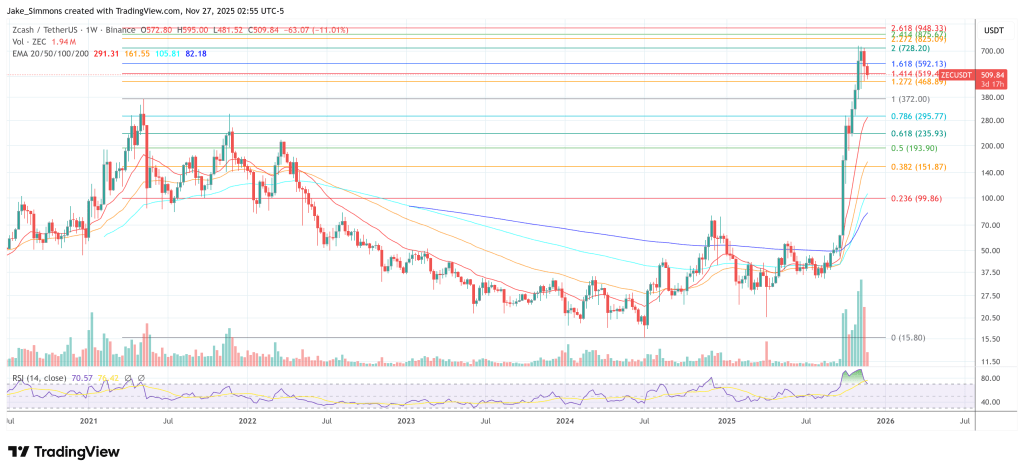
At press time, Zcash traded at $509.84.

ZCash price
Market Opportunity
CreatorBid Logo
CreatorBid Price(BID)
$0.008854
$0.008854$0.008854
+2.90%
USD
CreatorBid (BID) Live Price Chart
Disclaimer: The articles reposted on this site are sourced from public platforms and are provided for informational purposes only. They do not necessarily reflect the views of MEXC. All rights remain with the original authors. If you believe any content infringes on third-party rights, please contact crypto.news@mexc.com for removal. MEXC makes no guarantees regarding the accuracy, completeness, or timeliness of the content and is not responsible for any actions taken based on the information provided. The content does not constitute financial, legal, or other professional advice, nor should it be considered a recommendation or endorsement by MEXC.

You May Also Like

Bitcoin Has Taken Gold’s Role In Today’s World, Eric Trump Says

Bitcoin Has Taken Gold’s Role In Today’s World, Eric Trump Says

Eric Trump on Tuesday described Bitcoin as a “modern-day gold,” calling it a liquid store of value that can act as a hedge to real estate and other assets. Related Reading: XRP’s Biggest Rally Yet? Analyst Projects $20+ In October 2025 According to reports, the remark came during a TV appearance on CNBC’s Squawk Box, tied to the launch of American Bitcoin, the mining and treasury firm he helped start. Company Holdings And Strategy Based on public filings and company summaries, American Bitcoin has accumulated 2,443 BTC on its balance sheet. That stash has been valued in the low hundreds of millions of dollars at recent spot prices. The firm mixes large-scale mining with the goal of holding Bitcoin as a strategic reserve, which it says will help it grow both production and asset holdings over time. Eric Trump’s comments were direct. He told viewers that institutions are treating Bitcoin more like a store of value than a fringe idea, and he warned firms that resist blockchain adoption. The tone was strong at times, and the line about Bitcoin being a modern equivalent of gold was used to frame American Bitcoin’s role as both miner and holder.   Eric Trump has said: bitcoin is modern-day gold — unusual_whales (@unusual_whales) September 16, 2025 How The Company Went Public American Bitcoin moved toward a public listing via an all-stock merger with Gryphon Digital Mining earlier this year, a deal that kept most of the original shareholders in control and positioned the new entity for a Nasdaq debut. Reports show that mining partner Hut 8 holds a large ownership stake, leaving the Trump family and other backers with a minority share. The listing brought fresh attention and capital to the firm as it began trading under the ticker ABTC. Market watchers say the firm’s public debut highlights two trends: mining companies are trying to grow by both producing and holding Bitcoin, and political ties are bringing more headlines to crypto firms. Some analysts point out that holding large amounts of Bitcoin on the balance sheet exposes a company to price swings, while supporters argue it aligns incentives between miners and investors. Related Reading: Ethereum Bulls Target $8,500 With Big Money Backing The Move – Details Reaction And Possible Risks Based on coverage of the launch, investors have reacted with both enthusiasm and caution. Supporters praise the prospect of a US-based miner that aims to be transparent and aggressive about building a reserve. Critics point to governance questions, possible conflicts tied to high-profile backers, and the usual risks of a volatile asset being held on corporate balance sheets. Eric Trump’s remark that Bitcoin has taken gold’s role in today’s world reflects both his belief in its value and American Bitcoin’s strategy of mining and holding. Whether that view sticks will depend on how investors and institutions respond in the months ahead. Featured image from Meta, chart from TradingView
Share
NewsBTC2025/09/18 06:00
President Trump’s Critical Talks With 7 Nations Revealed

President Trump’s Critical Talks With 7 Nations Revealed

The post President Trump’s Critical Talks With 7 Nations Revealed appeared on BitcoinEthereumNews.com. Strait Of Hormuz Crisis: President Trump’s Critical Talks
Share
BitcoinEthereumNews2026/03/16 11:25
Crypto.com Expands TWAP Trading Bot By Integrating HEMI Token Support

Crypto.com Expands TWAP Trading Bot By Integrating HEMI Token Support

Crypto.com adds HEMI token into TWAP Trading Bot, where it supports a total of 200+ coins; bringing together Bitcoin security with Ethereum programmability.
Share
Blockchainreporter2025/09/25 13:00