Bitcoin suffered a sudden and deep drop in November, losing nearly a quarter of its value and wiping out over $1 trillion across the crypto market. Related Reading: Bitcoin’s Sudden Volatility Jump Signals Options Could Be Calling The Shots—Analyst Whales Trim Positions Before Crash According to on-chain data from CryptoQuant, large holders played a central role. Wallets holding between 1,000–10,000 BTC pared back their stakes in the weeks leading up to the fall. Those big sellers took profits after the October rally, and in many cases selling was steady rather than panicked. When large players step back like that, market depth can vanish quickly. A quick overview of Bitcoin’s price decline shows prices slid from record highs above $126,000 in October to roughly $81,000 at the lowest point, before a partial bounce to $87k was recorded. Traders and funds were caught off guard by the speed of the move. At the time of writing, Bitcoin was trading at $87,086, up 1.5% in the last 24 hours. Retail Selling Added To Pressure Based on reports, small wallets also leaned toward safety. Holders under 10 BTC and groups up to 1,000 BTC reduced positions, removing another layer of potential buyers. Has Bitcoin Found Its Bottom? Cohorts Tell the Whole Story “BTC may have formed a local bottom, supported by a strong rebound and accumulation from: 100–1k BTC holders. >10k BTC holders. However, the crucial 1k–10k BTC cohort is still distributing, preventing a full… pic.twitter.com/dGU4CBD1Bw — CryptoQuant.com (@cryptoquant_com) November 25, 2025 Buying interest from casual investors was weaker than expected. Mid-sized holders — those with 10–100 and 100–1,000 BTC — did buy during the correction, and their activity helped slow the slide. Still, their buying power was not enough to match the large outflows. Futures Liquidations Intensified The Drop Reports show that futures market dynamics turned a correction into a crash. Over a 13-day stretch, long positions were forcefully closed out. That cascade removed bids and created a chain reaction of selling that pushed Bitcoin from around $105K down to $81K. Liquidations were heavy, and the selling pressure was compounded as each forced sale fed into the next. A Tentative Rebound Shows Life After the lows were hit, Bitcoin climbed back to about $87,500. This rebound has been taken by some as a sign that a local bottom might be forming. According to CryptoQuant, however, the recovery cannot be considered secure while the 1,000–10,000 BTC group keeps reducing holdings. The market’s health was being tested by who chose to sell and who chose to buy. Bottom Status Hinges On Whale Activity Market watchers say a true reversal needs selling from large wallets to stop. If those whales pause, mid-sized buyers might build a firmer floor and confidence could return. If selling continues, lower levels may be explored once again. The coming sessions will be watched closely by traders who want to see whether large holders change course or keep cashing out. Related Reading: Bitcoin Creator Somehow Becomes ‘Poor’ By Losing $41 Billion Without Saying A Word For now, the situation is simple and tense at the same time: prices have recovered slightly, but the structural weakness that allowed a 25% fall was exposed. Bitcoin could face further losses after its recent crash, if CryptoQuant’s data is anything to go by. Large holders have been taking profits, while retail investors have also been selling, leaving fewer buyers to support the market. Analysts say the next move will depend on whether these big holders continue selling or if mid-sized buyers step in to stabilize prices. Featured image from Vecteezy, chart from TradingViewBitcoin suffered a sudden and deep drop in November, losing nearly a quarter of its value and wiping out over $1 trillion across the crypto market. Related Reading: Bitcoin’s Sudden Volatility Jump Signals Options Could Be Calling The Shots—Analyst Whales Trim Positions Before Crash According to on-chain data from CryptoQuant, large holders played a central role. Wallets holding between 1,000–10,000 BTC pared back their stakes in the weeks leading up to the fall. Those big sellers took profits after the October rally, and in many cases selling was steady rather than panicked. When large players step back like that, market depth can vanish quickly. A quick overview of Bitcoin’s price decline shows prices slid from record highs above $126,000 in October to roughly $81,000 at the lowest point, before a partial bounce to $87k was recorded. Traders and funds were caught off guard by the speed of the move. At the time of writing, Bitcoin was trading at $87,086, up 1.5% in the last 24 hours. Retail Selling Added To Pressure Based on reports, small wallets also leaned toward safety. Holders under 10 BTC and groups up to 1,000 BTC reduced positions, removing another layer of potential buyers. Has Bitcoin Found Its Bottom? Cohorts Tell the Whole Story “BTC may have formed a local bottom, supported by a strong rebound and accumulation from: 100–1k BTC holders. >10k BTC holders. However, the crucial 1k–10k BTC cohort is still distributing, preventing a full… pic.twitter.com/dGU4CBD1Bw — CryptoQuant.com (@cryptoquant_com) November 25, 2025 Buying interest from casual investors was weaker than expected. Mid-sized holders — those with 10–100 and 100–1,000 BTC — did buy during the correction, and their activity helped slow the slide. Still, their buying power was not enough to match the large outflows. Futures Liquidations Intensified The Drop Reports show that futures market dynamics turned a correction into a crash. Over a 13-day stretch, long positions were forcefully closed out. That cascade removed bids and created a chain reaction of selling that pushed Bitcoin from around $105K down to $81K. Liquidations were heavy, and the selling pressure was compounded as each forced sale fed into the next. A Tentative Rebound Shows Life After the lows were hit, Bitcoin climbed back to about $87,500. This rebound has been taken by some as a sign that a local bottom might be forming. According to CryptoQuant, however, the recovery cannot be considered secure while the 1,000–10,000 BTC group keeps reducing holdings. The market’s health was being tested by who chose to sell and who chose to buy. Bottom Status Hinges On Whale Activity Market watchers say a true reversal needs selling from large wallets to stop. If those whales pause, mid-sized buyers might build a firmer floor and confidence could return. If selling continues, lower levels may be explored once again. The coming sessions will be watched closely by traders who want to see whether large holders change course or keep cashing out. Related Reading: Bitcoin Creator Somehow Becomes ‘Poor’ By Losing $41 Billion Without Saying A Word For now, the situation is simple and tense at the same time: prices have recovered slightly, but the structural weakness that allowed a 25% fall was exposed. Bitcoin could face further losses after its recent crash, if CryptoQuant’s data is anything to go by. Large holders have been taking profits, while retail investors have also been selling, leaving fewer buyers to support the market. Analysts say the next move will depend on whether these big holders continue selling or if mid-sized buyers step in to stabilize prices. Featured image from Vecteezy, chart from TradingView

Bitcoin Faces More Downside After Recent Crash, Data Shows

2025/11/26 20:00
3 min read
For feedback or concerns regarding this content, please contact us at crypto.news@mexc.com

Bitcoin suffered a sudden and deep drop in November, losing nearly a quarter of its value and wiping out over $1 trillion across the crypto market.

Whales Trim Positions Before Crash

According to on-chain data from CryptoQuant, large holders played a central role. Wallets holding between 1,000–10,000 BTC pared back their stakes in the weeks leading up to the fall.

Those big sellers took profits after the October rally, and in many cases selling was steady rather than panicked. When large players step back like that, market depth can vanish quickly.

A quick overview of Bitcoin’s price decline shows prices slid from record highs above $126,000 in October to roughly $81,000 at the lowest point, before a partial bounce to $87k was recorded. Traders and funds were caught off guard by the speed of the move.

At the time of writing, Bitcoin was trading at $87,086, up 1.5% in the last 24 hours.

Retail Selling Added To Pressure

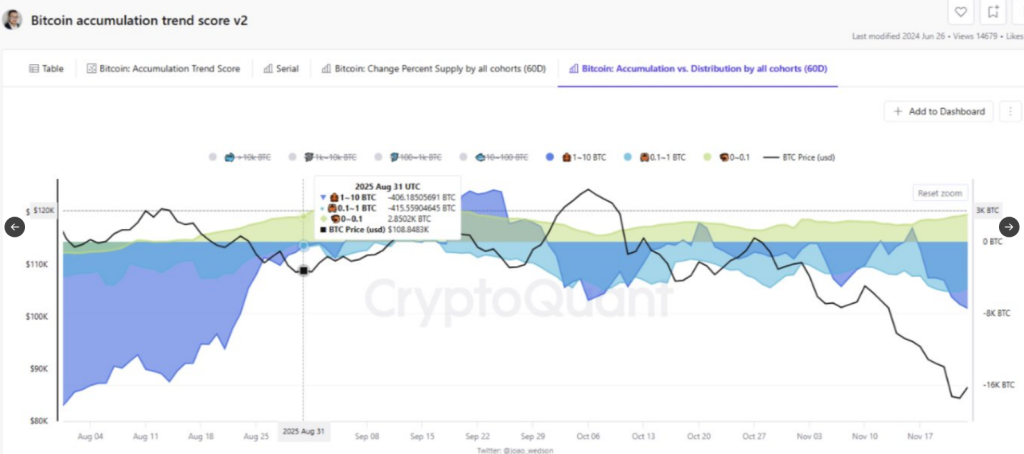
Based on reports, small wallets also leaned toward safety. Holders under 10 BTC and groups up to 1,000 BTC reduced positions, removing another layer of potential buyers.
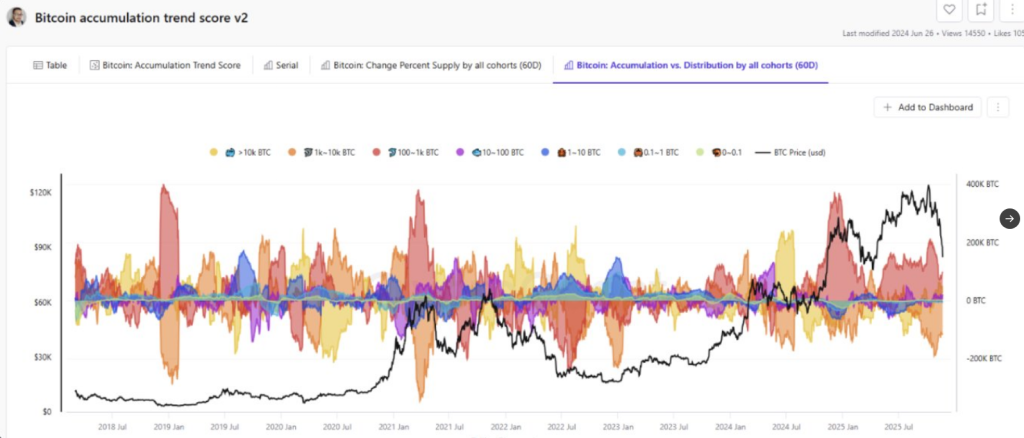
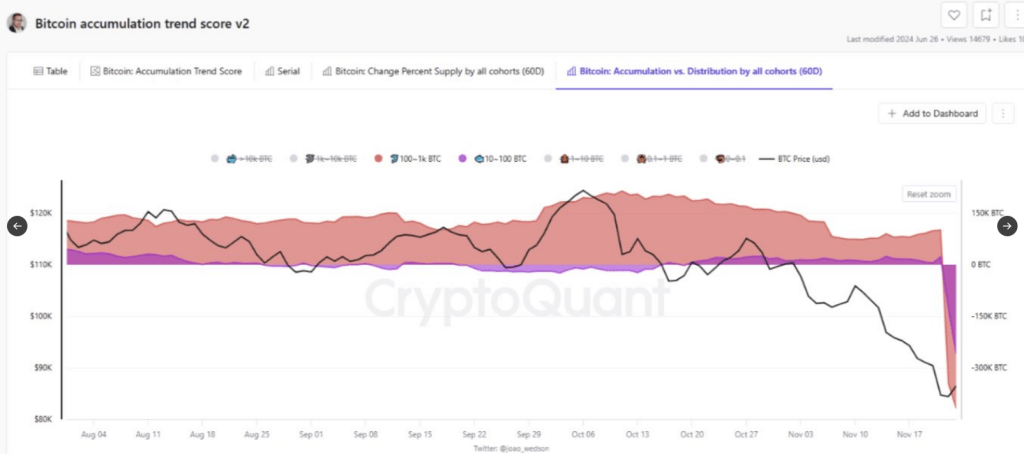
Buying interest from casual investors was weaker than expected. Mid-sized holders — those with 10–100 and 100–1,000 BTC — did buy during the correction, and their activity helped slow the slide. Still, their buying power was not enough to match the large outflows.
Futures Liquidations Intensified The Drop

Reports show that futures market dynamics turned a correction into a crash. Over a 13-day stretch, long positions were forcefully closed out.

That cascade removed bids and created a chain reaction of selling that pushed Bitcoin from around $105K down to $81K. Liquidations were heavy, and the selling pressure was compounded as each forced sale fed into the next.
A Tentative Rebound Shows Life

After the lows were hit, Bitcoin climbed back to about $87,500. This rebound has been taken by some as a sign that a local bottom might be forming.

According to CryptoQuant, however, the recovery cannot be considered secure while the 1,000–10,000 BTC group keeps reducing holdings. The market’s health was being tested by who chose to sell and who chose to buy.

Bottom Status Hinges On Whale Activity

Market watchers say a true reversal needs selling from large wallets to stop. If those whales pause, mid-sized buyers might build a firmer floor and confidence could return.

If selling continues, lower levels may be explored once again. The coming sessions will be watched closely by traders who want to see whether large holders change course or keep cashing out.

For now, the situation is simple and tense at the same time: prices have recovered slightly, but the structural weakness that allowed a 25% fall was exposed.

Bitcoin could face further losses after its recent crash, if CryptoQuant’s data is anything to go by. Large holders have been taking profits, while retail investors have also been selling, leaving fewer buyers to support the market.

Analysts say the next move will depend on whether these big holders continue selling or if mid-sized buyers step in to stabilize prices.

Featured image from Vecteezy, chart from TradingView

Market Opportunity
Moonveil Logo
Moonveil Price(MORE)
$0.0001408
$0.0001408$0.0001408
-6.63%
USD
Moonveil (MORE) Live Price Chart
Disclaimer: The articles reposted on this site are sourced from public platforms and are provided for informational purposes only. They do not necessarily reflect the views of MEXC. All rights remain with the original authors. If you believe any content infringes on third-party rights, please contact crypto.news@mexc.com for removal. MEXC makes no guarantees regarding the accuracy, completeness, or timeliness of the content and is not responsible for any actions taken based on the information provided. The content does not constitute financial, legal, or other professional advice, nor should it be considered a recommendation or endorsement by MEXC.

You May Also Like

TrendX Taps Trusta AI to Develop Safer and Smarter Web3 Network

TrendX Taps Trusta AI to Develop Safer and Smarter Web3 Network

The purpose of collaboration is to advance the Web3 landscape by combining the decentralized infrastructure of TrendX with AI-led capabilities of Trusta AI.
Share
Blockchainreporter2025/09/18 01:07
Top 3 Cryptos Under $1 That Could Hit $10 By 2028

Top 3 Cryptos Under $1 That Could Hit $10 By 2028

The post Top 3 Cryptos Under $1 That Could Hit $10 By 2028 appeared on BitcoinEthereumNews.com. Investors are increasingly looking for tokens with long-term value in 2025. While Cardano (ADA) keeps showing strong performance in the market, and Dogecoin (DOGE) keeps holding onto community-led speculation, a new token, Mutuum Finance (MUTM), is building something much larger.  Unlike speculative memecoins, Mutuum Finance is building real utility in the shape of its decentralized lending and borrowing protocol as it positions itself to be a fundamentals-driven project that will go way, way beyond the $1 threshold. As the market anticipates the next cycle, the following three coins, Cardano (ADA), Dogecoin (DOGE), and Mutuum Finance (MUTM), are gaining traction for their potential surge to $10 by 2028 but MUTM’s unique value proposition shines extremely brightly. Cardano Holds Firm Amid Market Turbulence Cardano (ADA) is trading at $0.86 currently, level with the rest of the market as investors weigh in upcoming network upgrades against shifting macroeconomic trends. Cardano (ADA) retains its place as one of the flagship layer-1 projects focused on scalability and sustainability, but market participants are increasingly turning towards newer protocols with stronger growth drivers, and Mutuum Finance stands as a better choice in the DeFi market as it evolves. Dogecoin Halts After Rally as Market Considers Next Step Dogecoin (DOGE) is at $0.27, still considerably above its recent level of support after a very active rally. There is resistance at $0.30, and support at the $0.22-$0.25 level, which means probable consolidation unless new buying pressure is seen. Volume has reduced somewhat, suggesting some profit-taking by traders as they await better signals. In comparison to DOGE, analysts are now equating Mutuum Finance as having greater potential for gains. Mutuum Finance: Phase 6 Mark Presale Mutuum Finance has enjoyed a phenomenal level of traction in presale with more than 16,370 investors buying coins and more than $15.9 million raised thus…
Share
BitcoinEthereumNews2025/09/18 15:41
Best Sit and Go Poker Sites

Best Sit and Go Poker Sites

The post Best Sit and Go Poker Sites appeared on BitcoinEthereumNews.com. Like its name implies, Sit and Go tournaments, widely popular as SNG poker events, allow players to jump into the action immediately, appealing to players who prefer not to wait for scheduled games.  These events start as soon as the seats are filled rather than at a set time, ensuring a more spontaneous and fast-paced tournament experience than traditional events with specific start times.  That alone explains why the format has grown increasingly popular among tournament crushers, particularly those with busy schedules. Thankfully, some poker sites offer SNG poker format, delivering the flexibility and convenience that many players crave. But the real question is: which among these platforms offer the most rewarding SNG poker experience? Our team of experts provides answers to that question in this article by recommending one of the best Sit and Go poker sites suitable for both newbies and professionals alike. What is SNG Poker? SNG poker is a tournament format defined by its instant start once the required number of players registers. Unlike scheduled multi-table tournaments, there is no waiting for a specific time. The game kicks off as soon as all seats are taken, typically accommodating six, nine, or ten players. Each entrant pays a fixed buy-in that forms the prize pool. Blinds increase at set intervals, creating pressure and pushing players to adjust strategies as the game progresses. This structure makes the format appealing to those seeking a balance between cash games and longer multi-table events. However, prize distribution depends on the format. In a nine-player setup, for instance, the top three positions typically share the pool, with the largest portion awarded to first place. Heads-up versions pay the entire prize pool to the winner, while other variations distribute rewards across multiple seats. This predictability in payouts adds clarity to bankroll management. The…
Share
BitcoinEthereumNews2025/09/18 08:34