

Texas Government Invests $5 Million in BlackRock’s Bitcoin ETF
Texas Makes Major Bitcoin Investment, Eyes Self-Custody
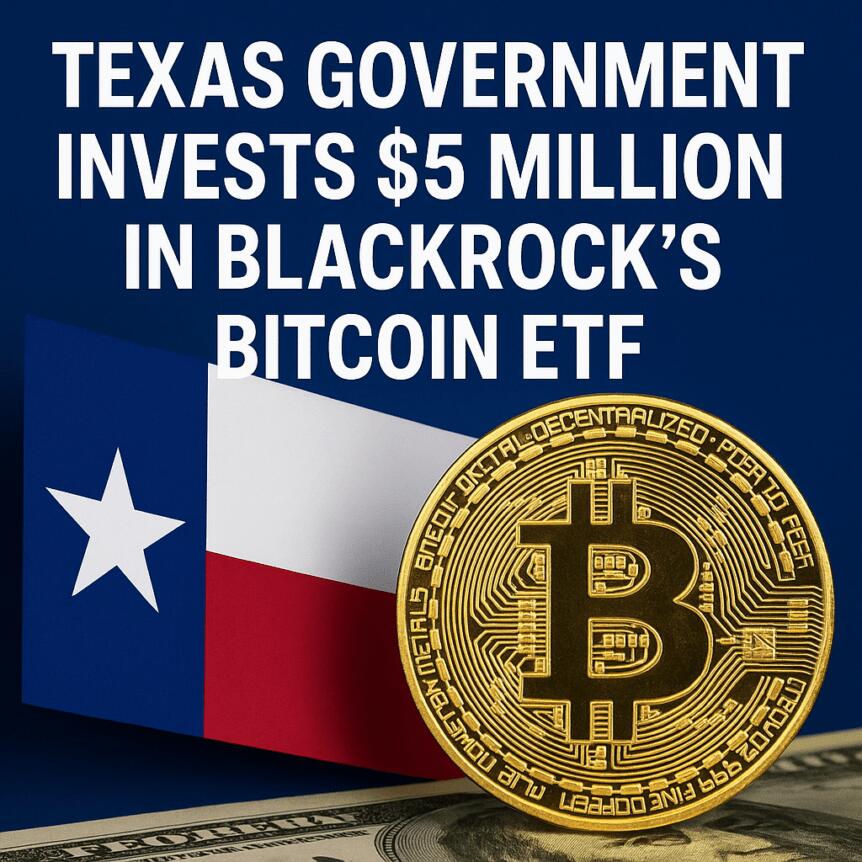
The Texas state government has taken a significant step into the cryptocurrency space by purchasing $5 million worth of shares in BlackRock’s spot Bitcoin exchange-traded fund (ETF), with plans to allocate an additional $5 million toward a self-custodied Bitcoin holding. The move underscores Texas’s evolving approach to digital assets, signaling increased institutional interest and potential for broader adoption within state governance.
The initial purchase was executed on November 20, and the details were announced on Tuesday via X by Lee Bratcher, president of the Texas Blockchain Council. Bratcher stated that while the government aims to eventually **self-custody Bitcoin**, the current allocation was directed through BlackRock’s IBIT ETF as the state finalizes the transitional process.
He added, “$10 million is allocated from general revenue, but not all of it has been committed yet.” This development marks a notable shift in how states are engaging with digital assets, moving beyond mere speculative investment to potentially building a strategic Bitcoin reserve. Recent remarks also suggest that Texas has intentions of expanding its Bitcoin holdings with a long-term perspective.
Source: Lee BratcherCommenting on the move, Pierre Rochard, CEO of The Bitcoin Bond Company, emphasized the significance of Texas’s actions, noting:
While it remains unclear if this particular investment is directly part of Texas’s broader Bitcoin reserve plan, recent legislative developments demonstrate the state’s increasing commitment. In June, Governor Greg Abbott authorized creating a state-managed Bitcoin fund to hold BTC as part of its long-term financial assets, utilizing public funds to build the treasury. The legislation stipulates that assets with a market capitalization over $500 billion—such as Bitcoin—are eligible for inclusion, unlike BlackRock’s ETF which currently falls short of this threshold.
Furthermore, Texas has hinted at broader crypto asset inclusivity. Mid-October, State Senator Charles Schwertner, one of the architects behind the Bitcoin reserve bill, indicated that Ethereum could also be considered for inclusion if its market cap remains above $500 billion over a continued period.
Broader Adoption and Institutional Moves
It’s worth noting that Texas isn’t the only state involved. In May last year, Wisconsin’s investment board purchased nearly $100 million worth of BlackRock’s Bitcoin ETF, IBIT, as filings reveal. This indicates a growing trend among US states to leverage institutional Bitcoin products for strategic reserve and investment purposes.
Recent commentary from Bloomberg senior ETF analyst Eric Balachunas highlighted that Texas, Harvard, and Abu Dhabi collectively hold IBIT ETF shares—an exceptional footprint for such a young fund. Despite the broader institutional interest, IBIT has experienced a slight decline of about 10% year-to-date, currently trading around $49.56, with marginal after-hours gains.
This article was originally published as Texas Government Invests $5 Million in BlackRock’s Bitcoin ETF on Crypto Breaking News – your trusted source for crypto news, Bitcoin news, and blockchain updates.
You May Also Like

Supported by hike speculation and PMIs – Danske Bank

The geopolitics of anti-corruption as global advisory firms face debarment in the Horn of Africa

BitGo wins BaFIN nod to offer regulated crypto trading in Europe
BitGo’s move creates further competition in a burgeoning European crypto market that is expected to generate $26 billion revenue this year, according to one estimate. BitGo, a digital asset infrastructure company with more than $100 billion in assets under custody, has received an extension of its license from Germany’s Federal Financial Supervisory Authority (BaFin), enabling it to offer crypto services to European investors. The company said its local subsidiary, BitGo Europe, can now provide custody, staking, transfer, and trading services. Institutional clients will also have access to an over-the-counter (OTC) trading desk and multiple liquidity venues.The extension builds on BitGo’s previous Markets-in-Crypto-Assets (MiCA) license, also issued by BaFIN, and adds trading to the existing custody, transfer and staking services. BitGo acquired its initial MiCA license in May 2025, which allowed it to offer certain services to traditional institutions and crypto native companies in the European Union.Read more
