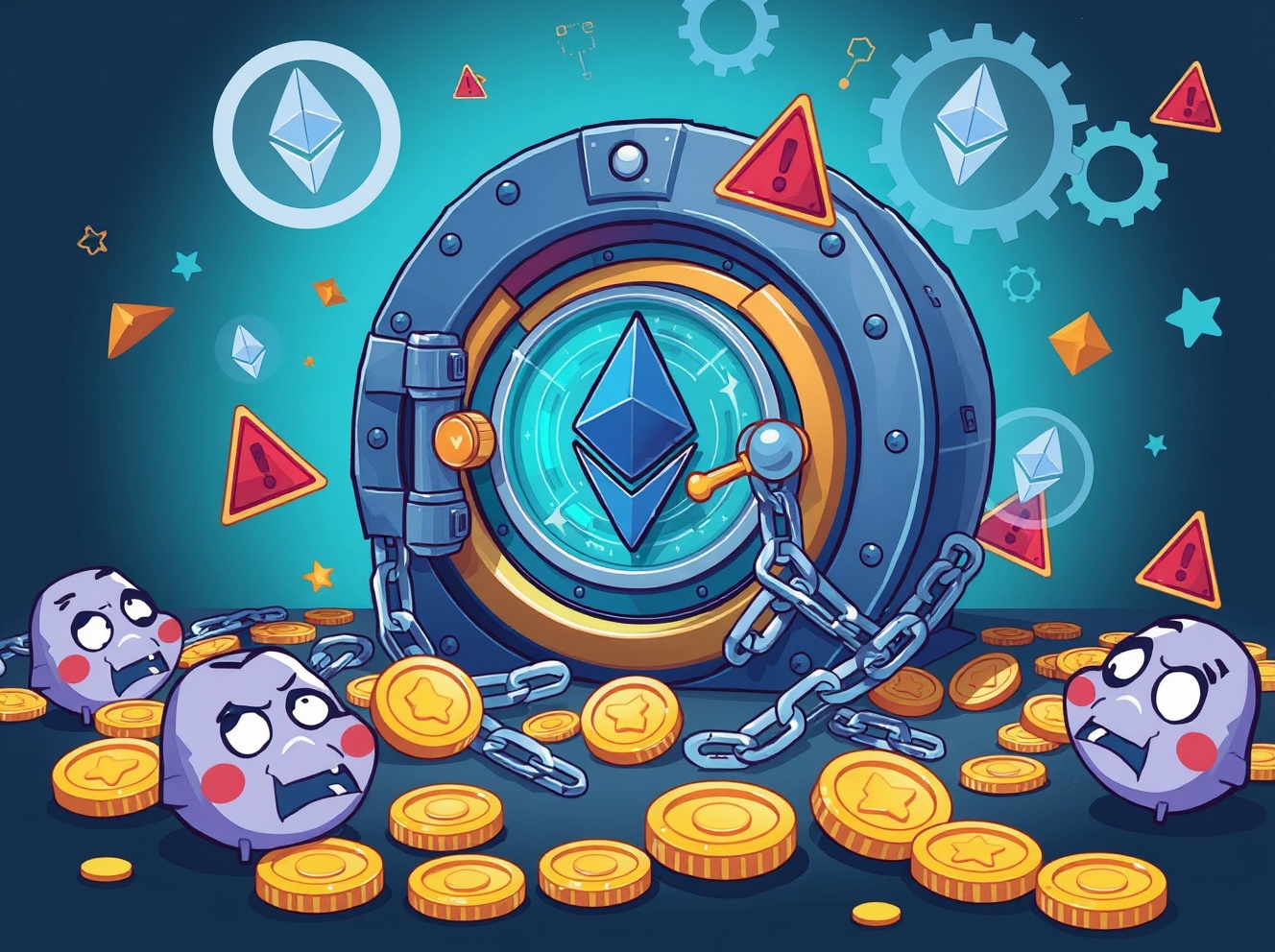
BitcoinWorld MegaETH fundraising disaster: Technical failures force $1 billion plan cancellation The cryptocurrency world witnessed a stunning reversal as MegaETH, one of the most anticipated Ethereum Layer 2 projects, abruptly canceled its ambitious $1 billion MegaETH fundraising plan. This shocking development came after a series of technical failures during the token sale that left investors and industry observers stunned. The project’s ambitious vision for scaling Ethereum […] This post MegaETH fundraising disaster: Technical failures force $1 billion plan cancellation first appeared on BitcoinWorld.BitcoinWorld MegaETH fundraising disaster: Technical failures force $1 billion plan cancellation The cryptocurrency world witnessed a stunning reversal as MegaETH, one of the most anticipated Ethereum Layer 2 projects, abruptly canceled its ambitious $1 billion MegaETH fundraising plan. This shocking development came after a series of technical failures during the token sale that left investors and industry observers stunned. The project’s ambitious vision for scaling Ethereum […] This post MegaETH fundraising disaster: Technical failures force $1 billion plan cancellation first appeared on BitcoinWorld.

MegaETH fundraising disaster: Technical failures force $1 billion plan cancellation

2025/11/26 06:55
5 min read
For feedback or concerns regarding this content, please contact us at crypto.news@mexc.com

BitcoinWorld

MegaETH fundraising disaster: Technical failures force $1 billion plan cancellation

The cryptocurrency world witnessed a stunning reversal as MegaETH, one of the most anticipated Ethereum Layer 2 projects, abruptly canceled its ambitious $1 billion MegaETH fundraising plan. This shocking development came after a series of technical failures during the token sale that left investors and industry observers stunned. The project’s ambitious vision for scaling Ethereum suddenly faced serious questions about its technical capabilities and operational readiness.

What went wrong with the MegaETH fundraising?

The MegaETH fundraising disaster began with critical technical failures that exposed serious vulnerabilities in the project’s infrastructure. According to Cointelegraph’s report, the KYC module designed for verified users on the pre-deposit page failed completely due to configuration errors and rate-limiting problems. This initial failure created a domino effect that would ultimately doom the entire MegaETH fundraising effort.

Meanwhile, a Safe multisig transaction intended for a later cap increase was executed prematurely. This critical error caused the deposit window to open unexpectedly, allowing funds to pour in beyond the initial $250 million cap. The situation quickly spiraled out of control as users who repeatedly refreshed the website managed to fill the entire pre-deposit allocation.

How did the technical failures impact investors?

The cascading technical problems created chaos for participants in the MegaETH fundraising event. Investors found themselves in a confusing situation where the rules of engagement changed unexpectedly. The premature opening of deposit windows meant that some users gained unfair advantages while others were left scrambling.

Key issues that emerged during the failed MegaETH fundraising include:

  • KYC verification system failure due to configuration errors
  • Rate-limiting problems that prevented proper access control
  • Premature execution of multisig transactions
  • Uncontrolled fund inflows beyond established caps

What does this mean for MegaETH’s future?

The cancellation of the $1 billion MegaETH fundraising represents a significant setback for the project. MegaETH announced it would freeze deposits at $500 million and completely scrap the plan to expand the raise to $1 billion. The project team acknowledged the severity of the situation, stating that the cause and responsibility for the failures were clear and that there was no excuse for what happened.

This MegaETH fundraising failure raises important questions about:

  • Technical competency of the development team
  • Risk management protocols for large-scale token sales
  • Investor protection mechanisms
  • Future credibility of the project

Lessons from the MegaETH fundraising disaster

The MegaETH fundraising collapse serves as a cautionary tale for the entire cryptocurrency industry. It highlights the critical importance of thorough testing and robust infrastructure for high-stakes financial operations. Projects planning similar MegaETH fundraising events must learn from these mistakes to prevent similar disasters.

Essential precautions for future token sales include:

  • Comprehensive stress testing of all systems
  • Multiple layers of security verification
  • Clear contingency plans for technical failures
  • Transparent communication protocols

Moving forward after the MegaETH fundraising cancellation

Despite the MegaETH fundraising failure, the project team has taken responsibility for the technical issues. However, rebuilding trust with the cryptocurrency community will require significant effort and demonstrated improvements. The MegaETH fundraising disaster underscores how technical excellence must accompany ambitious vision in the competitive blockchain space.

The project now faces the challenge of addressing both the immediate technical problems and the longer-term credibility issues arising from the failed MegaETH fundraising. How they handle this crisis will likely determine whether MegaETH can recover and eventually achieve its scaling goals for Ethereum.

Frequently Asked Questions

What caused the MegaETH fundraising cancellation?

The cancellation resulted from multiple technical failures including KYC module configuration errors, rate-limiting problems, and premature execution of multisig transactions that allowed uncontrolled fund inflows.

How much money was raised before the cancellation?

MegaETH froze deposits at $500 million, which was double the initial $250 million cap but half of the planned $1 billion MegaETH fundraising target.

Will investors get their money back?

While the article doesn’t specify refund procedures, typically in such cases, projects return funds to investors when fundraising events are canceled due to technical failures.

What is MegaETH?

MegaETH is an Ethereum Layer 2 scaling solution designed to improve transaction speed and reduce costs on the Ethereum network.

Could this happen to other cryptocurrency projects?

Yes, any project conducting large-scale token sales faces similar technical risks, which is why thorough testing and robust infrastructure are essential.

What’s next for MegaETH after this failure?

The project must address its technical issues and rebuild investor confidence, though specific next steps weren’t detailed in the announcement.

Found this analysis of the MegaETH fundraising failure helpful? Share this article with fellow cryptocurrency enthusiasts on social media to spread awareness about the importance of technical due diligence in blockchain projects.

To learn more about the latest Ethereum trends, explore our article on key developments shaping Ethereum institutional adoption.

This post MegaETH fundraising disaster: Technical failures force $1 billion plan cancellation first appeared on BitcoinWorld.

Market Opportunity
Solayer Logo
Solayer Price(LAYER)
$0.08378
$0.08378$0.08378
-1.48%
USD
Solayer (LAYER) Live Price Chart
Disclaimer: The articles reposted on this site are sourced from public platforms and are provided for informational purposes only. They do not necessarily reflect the views of MEXC. All rights remain with the original authors. If you believe any content infringes on third-party rights, please contact crypto.news@mexc.com for removal. MEXC makes no guarantees regarding the accuracy, completeness, or timeliness of the content and is not responsible for any actions taken based on the information provided. The content does not constitute financial, legal, or other professional advice, nor should it be considered a recommendation or endorsement by MEXC.
Tags:

You May Also Like

A Netflix ‘KPop Demon Hunters’ Short Film Has Been Rated For Release

A Netflix ‘KPop Demon Hunters’ Short Film Has Been Rated For Release

The post A Netflix ‘KPop Demon Hunters’ Short Film Has Been Rated For Release appeared on BitcoinEthereumNews.com. KPop Demon Hunters Netflix Everyone has wondered what may be the next step for KPop Demon Hunters as an IP, given its record-breaking success on Netflix. Now, the answer may be something exactly no one predicted. According to a new filing with the MPA, something called Debut: A KPop Demon Hunters Story has been rated PG by the ratings body. It’s listed alongside some other films, and this is obviously something that has not been publicly announced. A short film could be well, very short, a few minutes, and likely no more than ten. Even that might be pushing it. Using say, Pixar shorts as a reference, most are between 4 and 8 minutes. The original movie is an hour and 36 minutes. The “Debut” in the title indicates some sort of flashback, perhaps to when HUNTR/X first arrived on the scene before they blew up. Previously, director Maggie Kang has commented about how there were more backstory components that were supposed to be in the film that were cut, but hinted those could be explored in a sequel. But perhaps some may be put into a short here. I very much doubt those scenes were fully produced and simply cut, but perhaps they were finished up for this short film here. When would Debut: KPop Demon Hunters theoretically arrive? I’m not sure the other films on the list are much help. Dead of Winter is out in less than two weeks. Mother Mary does not have a release date. Ne Zha 2 came out earlier this year. I’ve only seen news stories saying The Perfect Gamble was supposed to come out in Q1 2025, but I’ve seen no evidence that it actually has. KPop Demon Hunters Netflix It could be sooner rather than later as Netflix looks to capitalize…
Share
BitcoinEthereumNews2025/09/18 02:23
Academic Publishing and Fairness: A Game-Theoretic Model of Peer-Review Bias

Academic Publishing and Fairness: A Game-Theoretic Model of Peer-Review Bias

Exploring how biases in the peer-review system impact researchers' choices, showing how principles of fairness relate to the production of scientific knowledge based on topic importance and hardness.
Share
Hackernoon2025/09/17 23:15
Headwind Helps Best Wallet Token

Headwind Helps Best Wallet Token

The post Headwind Helps Best Wallet Token appeared on BitcoinEthereumNews.com. Google has announced the launch of a new open-source protocol called Agent Payments Protocol (AP2) in partnership with Coinbase, the Ethereum Foundation, and 60 other organizations. This allows AI agents to make payments on behalf of users using various methods such as real-time bank transfers, credit and debit cards, and, most importantly, stablecoins. Let’s explore in detail what this could mean for the broader cryptocurrency markets, and also highlight a presale crypto (Best Wallet Token) that could explode as a result of this development. Google’s Push for Stablecoins Agent Payments Protocol (AP2) uses digital contracts known as ‘Intent Mandates’ and ‘Verifiable Credentials’ to ensure that AI agents undertake only those payments authorized by the user. Mandates, by the way, are cryptographically signed, tamper-proof digital contracts that act as verifiable proof of a user’s instruction. For example, let’s say you instruct an AI agent to never spend more than $200 in a single transaction. This instruction is written into an Intent Mandate, which serves as a digital contract. Now, whenever the AI agent tries to make a payment, it must present this mandate as proof of authorization, which will then be verified via the AP2 protocol. Alongside this, Google has also launched the A2A x402 extension to accelerate support for the Web3 ecosystem. This production-ready solution enables agent-based crypto payments and will help reshape the growth of cryptocurrency integration within the AP2 protocol. Google’s inclusion of stablecoins in AP2 is a massive vote of confidence in dollar-pegged cryptocurrencies and a huge step toward making them a mainstream payment option. This widens stablecoin usage beyond trading and speculation, positioning them at the center of the consumption economy. The recent enactment of the GENIUS Act in the U.S. gives stablecoins more structure and legal support. Imagine paying for things like data crawls, per-task…
Share
BitcoinEthereumNews2025/09/18 01:27