Recent commentary from the Kobeissi Letter has underscored a troubling trend in the capital markets: crypto-focused funds have encountered substantial outflows, with a notable $2 billion exiting last week alone.  This marks the most significant withdrawal since February and extends a concerning streak, bringing total outflows to $3.2 billion over the last three weeks. Bitcoin And Ethereum Face Massive Withdrawals Leading these outflows is the market’s leading crypto, Bitcoin (BTC), which experienced a massive $1.4 billion in withdrawals, while the second largest cryptocurrency, Ethereum (ETH), followed closely with $689 million.  As a result of these dynamics, the average daily outflows as a percentage of assets under management (AuM) have reached unprecedented levels. Related Reading: Bitcoin Bear Market Confirmed? Expert Predicts Price Target Of $40,000 By Late 2026 The cumulative impact of these outflows, coupled with declining prices, has led to a 27% reduction in total assets under management, now standing at $191 billion, a situation that the Kobeissi Letter has termed a “structural decline.” Market sentiment remains largely negative, particularly for Bitcoin, with expert Lark Davis examining current trends through the lens of key moving averages.  Davis pointed out that as long as Bitcoin trades below the 50-week exponential moving average (EMA), currently placed just above the $10,000 mark, it remains in a bear market.  He questioned whether the current downturn signifies a “big bear,” hinting at skepticism regarding recovery prospects, or a “mini bear,” reminiscent of April’s decline where Bitcoin, despite losing the 200-day EMA, did not breach the 50-week EMA. Davis proposed three possible scenarios for the coming weeks. The first posits a drastic descent into “goblin town” without recovery, which he considers unlikely given current oversold conditions.  The second scenario involves a short-term rally that tests the 50-week EMA, potentially luring investors back before a sharp downturn.  The third scenario, which Davis leans towards, suggests that Bitcoin could reclaim the 50-week EMA by year-end, fueled by easing macroeconomic conditions, including interest rates and market valuations. Crypto Market Turmoil Intensifies  Compounding these market concerns is the precarious situation of Strategy, formerly known as MicroStrategy, headed by Bitcoin advocate Michael Saylor.  Jacob King, CEO of SwanDesk, remarked that should Bitcoin fall a few more percentage points, specifically below Strategy’s average buy at just below $80,000, the firm would find itself in a precarious position with its Bitcoin holdings.  King fears that forced liquidations could occur again for crypto investors, which could drive Bitcoin prices down toward $10,000 or lower due to increased selling pressure. Related Reading: Saylor’s Strategy Under Threat: Index Status At Risk With $8 Billion On The Line King’s commentary reflects a broader skepticism regarding the sustainability of the crypto market’s structure. He criticized the investment strategies surrounding Bitcoin as being propped up by “unsustainable fraud and hopium.”  Highlighting past statements by Saylor, King recalled when Saylor encouraged extreme measures—such as taking out double mortgages and selling personal assets—to invest in Bitcoin, asserting that the current market turmoil should come as no surprise. At the time of writing, Bitcoin was trading at $84,700, over 30% below all-time high levels of $126,000 reached earlier in October.  Featured image from DALL-E, chart from TradingView.comRecent commentary from the Kobeissi Letter has underscored a troubling trend in the capital markets: crypto-focused funds have encountered substantial outflows, with a notable $2 billion exiting last week alone.  This marks the most significant withdrawal since February and extends a concerning streak, bringing total outflows to $3.2 billion over the last three weeks. Bitcoin And Ethereum Face Massive Withdrawals Leading these outflows is the market’s leading crypto, Bitcoin (BTC), which experienced a massive $1.4 billion in withdrawals, while the second largest cryptocurrency, Ethereum (ETH), followed closely with $689 million.  As a result of these dynamics, the average daily outflows as a percentage of assets under management (AuM) have reached unprecedented levels. Related Reading: Bitcoin Bear Market Confirmed? Expert Predicts Price Target Of $40,000 By Late 2026 The cumulative impact of these outflows, coupled with declining prices, has led to a 27% reduction in total assets under management, now standing at $191 billion, a situation that the Kobeissi Letter has termed a “structural decline.” Market sentiment remains largely negative, particularly for Bitcoin, with expert Lark Davis examining current trends through the lens of key moving averages.  Davis pointed out that as long as Bitcoin trades below the 50-week exponential moving average (EMA), currently placed just above the $10,000 mark, it remains in a bear market.  He questioned whether the current downturn signifies a “big bear,” hinting at skepticism regarding recovery prospects, or a “mini bear,” reminiscent of April’s decline where Bitcoin, despite losing the 200-day EMA, did not breach the 50-week EMA. Davis proposed three possible scenarios for the coming weeks. The first posits a drastic descent into “goblin town” without recovery, which he considers unlikely given current oversold conditions.  The second scenario involves a short-term rally that tests the 50-week EMA, potentially luring investors back before a sharp downturn.  The third scenario, which Davis leans towards, suggests that Bitcoin could reclaim the 50-week EMA by year-end, fueled by easing macroeconomic conditions, including interest rates and market valuations. Crypto Market Turmoil Intensifies  Compounding these market concerns is the precarious situation of Strategy, formerly known as MicroStrategy, headed by Bitcoin advocate Michael Saylor.  Jacob King, CEO of SwanDesk, remarked that should Bitcoin fall a few more percentage points, specifically below Strategy’s average buy at just below $80,000, the firm would find itself in a precarious position with its Bitcoin holdings.  King fears that forced liquidations could occur again for crypto investors, which could drive Bitcoin prices down toward $10,000 or lower due to increased selling pressure. Related Reading: Saylor’s Strategy Under Threat: Index Status At Risk With $8 Billion On The Line King’s commentary reflects a broader skepticism regarding the sustainability of the crypto market’s structure. He criticized the investment strategies surrounding Bitcoin as being propped up by “unsustainable fraud and hopium.”  Highlighting past statements by Saylor, King recalled when Saylor encouraged extreme measures—such as taking out double mortgages and selling personal assets—to invest in Bitcoin, asserting that the current market turmoil should come as no surprise. At the time of writing, Bitcoin was trading at $84,700, over 30% below all-time high levels of $126,000 reached earlier in October.  Featured image from DALL-E, chart from TradingView.com

Crypto Funds Face Third Consecutive Weekly Losses, Totaling $3 Billion In Outflows

2025/11/22 15:00

Recent commentary from the Kobeissi Letter has underscored a troubling trend in the capital markets: crypto-focused funds have encountered substantial outflows, with a notable $2 billion exiting last week alone. 

This marks the most significant withdrawal since February and extends a concerning streak, bringing total outflows to $3.2 billion over the last three weeks.

Bitcoin And Ethereum Face Massive Withdrawals

Leading these outflows is the market’s leading crypto, Bitcoin (BTC), which experienced a massive $1.4 billion in withdrawals, while the second largest cryptocurrency, Ethereum (ETH), followed closely with $689 million. 

As a result of these dynamics, the average daily outflows as a percentage of assets under management (AuM) have reached unprecedented levels.

The cumulative impact of these outflows, coupled with declining prices, has led to a 27% reduction in total assets under management, now standing at $191 billion, a situation that the Kobeissi Letter has termed a “structural decline.”

Market sentiment remains largely negative, particularly for Bitcoin, with expert Lark Davis examining current trends through the lens of key moving averages. 

Davis pointed out that as long as Bitcoin trades below the 50-week exponential moving average (EMA), currently placed just above the $10,000 mark, it remains in a bear market. 

Crypto

He questioned whether the current downturn signifies a “big bear,” hinting at skepticism regarding recovery prospects, or a “mini bear,” reminiscent of April’s decline where Bitcoin, despite losing the 200-day EMA, did not breach the 50-week EMA.

Davis proposed three possible scenarios for the coming weeks. The first posits a drastic descent into “goblin town” without recovery, which he considers unlikely given current oversold conditions. 

The second scenario involves a short-term rally that tests the 50-week EMA, potentially luring investors back before a sharp downturn. 

The third scenario, which Davis leans towards, suggests that Bitcoin could reclaim the 50-week EMA by year-end, fueled by easing macroeconomic conditions, including interest rates and market valuations.

Crypto Market Turmoil Intensifies 

Compounding these market concerns is the precarious situation of Strategy, formerly known as MicroStrategy, headed by Bitcoin advocate Michael Saylor. 

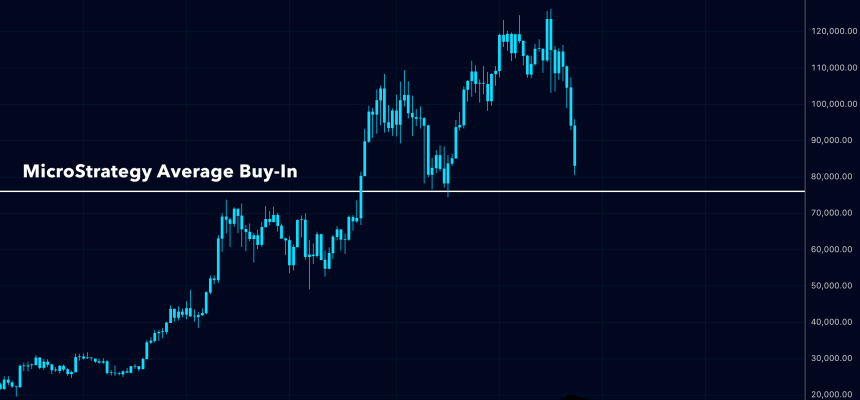
Jacob King, CEO of SwanDesk, remarked that should Bitcoin fall a few more percentage points, specifically below Strategy’s average buy at just below $80,000, the firm would find itself in a precarious position with its Bitcoin holdings. 

Crypto

King fears that forced liquidations could occur again for crypto investors, which could drive Bitcoin prices down toward $10,000 or lower due to increased selling pressure.

King’s commentary reflects a broader skepticism regarding the sustainability of the crypto market’s structure. He criticized the investment strategies surrounding Bitcoin as being propped up by “unsustainable fraud and hopium.” 

Highlighting past statements by Saylor, King recalled when Saylor encouraged extreme measures—such as taking out double mortgages and selling personal assets—to invest in Bitcoin, asserting that the current market turmoil should come as no surprise.

At the time of writing, Bitcoin was trading at $84,700, over 30% below all-time high levels of $126,000 reached earlier in October. 

Featured image from DALL-E, chart from TradingView.com

Market Opportunity
Bitcoin Logo
Bitcoin Price(BTC)
$95,435.61
$95,435.61$95,435.61
-1.38%
USD
Bitcoin (BTC) Live Price Chart
Disclaimer: The articles reposted on this site are sourced from public platforms and are provided for informational purposes only. They do not necessarily reflect the views of MEXC. All rights remain with the original authors. If you believe any content infringes on third-party rights, please contact service@support.mexc.com for removal. MEXC makes no guarantees regarding the accuracy, completeness, or timeliness of the content and is not responsible for any actions taken based on the information provided. The content does not constitute financial, legal, or other professional advice, nor should it be considered a recommendation or endorsement by MEXC.

You May Also Like

A Radical Neural Network Approach to Modeling Shock Dynamics

A Radical Neural Network Approach to Modeling Shock Dynamics

This paper introduces a non-diffusive neural network (NDNN) method for solving hyperbolic conservation laws, designed to overcome the shortcomings of standard Physics-Informed Neural Networks (PINNs) in modeling shock waves. The NDNN framework decomposes the solution domain into smooth subdomains separated by discontinuity lines, identified via Rankine-Hugoniot conditions. This approach enables accurate tracking of entropic shocks, shock generation, and wave interactions, while reducing the diffusive errors typical in PINNs. Numerical experiments validate the algorithm’s potential, highlighting its promise for extending shock-wave computations to higher-dimensional problems.
Share
Hackernoon2025/09/19 18:38
A Netflix ‘KPop Demon Hunters’ Short Film Has Been Rated For Release

A Netflix ‘KPop Demon Hunters’ Short Film Has Been Rated For Release

The post A Netflix ‘KPop Demon Hunters’ Short Film Has Been Rated For Release appeared on BitcoinEthereumNews.com. KPop Demon Hunters Netflix Everyone has wondered what may be the next step for KPop Demon Hunters as an IP, given its record-breaking success on Netflix. Now, the answer may be something exactly no one predicted. According to a new filing with the MPA, something called Debut: A KPop Demon Hunters Story has been rated PG by the ratings body. It’s listed alongside some other films, and this is obviously something that has not been publicly announced. A short film could be well, very short, a few minutes, and likely no more than ten. Even that might be pushing it. Using say, Pixar shorts as a reference, most are between 4 and 8 minutes. The original movie is an hour and 36 minutes. The “Debut” in the title indicates some sort of flashback, perhaps to when HUNTR/X first arrived on the scene before they blew up. Previously, director Maggie Kang has commented about how there were more backstory components that were supposed to be in the film that were cut, but hinted those could be explored in a sequel. But perhaps some may be put into a short here. I very much doubt those scenes were fully produced and simply cut, but perhaps they were finished up for this short film here. When would Debut: KPop Demon Hunters theoretically arrive? I’m not sure the other films on the list are much help. Dead of Winter is out in less than two weeks. Mother Mary does not have a release date. Ne Zha 2 came out earlier this year. I’ve only seen news stories saying The Perfect Gamble was supposed to come out in Q1 2025, but I’ve seen no evidence that it actually has. KPop Demon Hunters Netflix It could be sooner rather than later as Netflix looks to capitalize…
Share
BitcoinEthereumNews2025/09/18 02:23
Headwind Helps Best Wallet Token

Headwind Helps Best Wallet Token

The post Headwind Helps Best Wallet Token appeared on BitcoinEthereumNews.com. Google has announced the launch of a new open-source protocol called Agent Payments Protocol (AP2) in partnership with Coinbase, the Ethereum Foundation, and 60 other organizations. This allows AI agents to make payments on behalf of users using various methods such as real-time bank transfers, credit and debit cards, and, most importantly, stablecoins. Let’s explore in detail what this could mean for the broader cryptocurrency markets, and also highlight a presale crypto (Best Wallet Token) that could explode as a result of this development. Google’s Push for Stablecoins Agent Payments Protocol (AP2) uses digital contracts known as ‘Intent Mandates’ and ‘Verifiable Credentials’ to ensure that AI agents undertake only those payments authorized by the user. Mandates, by the way, are cryptographically signed, tamper-proof digital contracts that act as verifiable proof of a user’s instruction. For example, let’s say you instruct an AI agent to never spend more than $200 in a single transaction. This instruction is written into an Intent Mandate, which serves as a digital contract. Now, whenever the AI agent tries to make a payment, it must present this mandate as proof of authorization, which will then be verified via the AP2 protocol. Alongside this, Google has also launched the A2A x402 extension to accelerate support for the Web3 ecosystem. This production-ready solution enables agent-based crypto payments and will help reshape the growth of cryptocurrency integration within the AP2 protocol. Google’s inclusion of stablecoins in AP2 is a massive vote of confidence in dollar-pegged cryptocurrencies and a huge step toward making them a mainstream payment option. This widens stablecoin usage beyond trading and speculation, positioning them at the center of the consumption economy. The recent enactment of the GENIUS Act in the U.S. gives stablecoins more structure and legal support. Imagine paying for things like data crawls, per-task…
Share
BitcoinEthereumNews2025/09/18 01:27