CryptoQuant founder and CEO Ki Young Ju pushed back on a renewed wave of forced Bitcoin liquidation and bankruptcy chatter around Strategy (formerly MicroStrategy, MSTR), arguing that the bearish thesis misreads the company’s capital structure and shareholder incentives. In a Nov. 20, 2025 post on X, Ju wrote, “MSTR only goes bankrupt if an asteroid hits Earth,” adding that critics should “bring a single piece of evidence” before claiming Michael Saylor would be liquidated. The comments came as Bitcoin and high-beta crypto proxies retraced into late November, reviving legacy narratives that Strategy’s debt stack could compel BTC sales. Why Strategy Will Never Sell Bitcoin Ju’s central claim is that Strategy is not structurally set up like a margin trader. Addressing the most common fear—that convertible notes “missing” their conversion price forces liquidation—he stated: “Convertible debt not reaching the conversion price is not liquidation. It simply means the notes get repaid in cash […] Failing to convert is not a bankruptcy trigger. It is just normal debt maturity.” Related Reading: Is The Bitcoin Bottom In? Fidelity Research Lead Weighs The Odds In his view, the repayment pathways are conventional corporate finance tools: refinancing, rolling into new notes, secured borrowing, or operating cash flow. That framing aligns with how convertibles function in practice; if equity is below strike at maturity, the embedded option expires and the instrument reverts to straight debt rather than a forced-sale event. He also grounded his argument in governance and identity. “Saylor would never sell Bitcoin unless shareholders want it,” Ju wrote, warning that “selling even a single BTC would destroy MSTR’s identity as a Bitcoin treasury company and trigger a death spiral for both Bitcoin and MSTR.” Strategy has repeatedly defined itself as a BTC-treasury vehicle, and its shareholder base largely bought into that mandate, making voluntary divestment politically and strategically improbable absent a radical shift in investor preference. Balance-sheet data underpins Ju’s confidence. Strategy reported 640,808 BTC as of Oct. 30, 2025, acquired for about $47.44 billion; subsequent filings cited major November additions taking holdings to roughly 649,870 BTC. Even after accounting for the growing convertible and preferred layers, the BTC treasury remains the dominant asset, meaning solvency stress would require an extreme, prolonged Bitcoin collapse rather than a cyclical drawdown. Related Reading: Why Bitwise Thinks Bitcoin Still Hits $200,000 In 2026 Ju did not claim the equity is risk-free. “This does not mean MSTR’s stock price will always stay high,” he wrote, but called the idea that Strategy would sell BTC to support the stock or face imminent bankruptcy “completely absurd.” He added that even at a price of $10,000 per coin, Strategy would face “a debt restructuring, nothing more.” On preferred shares, he acknowledged dividend obligations, noting payments have not been missed and can be covered via new share issuance—dilutive, but not a liquidation vector. Posting BTC as collateral, he said, would be a last resort because that would introduce real margin risk. In short, Ju’s rebuttal draws a hard line between volatility and insolvency: Strategy may trade like leveraged Bitcoin, but its liabilities do not mechanically force BTC sales. The “Saylor liquidation” narrative, he argues, is a Twitter myth unless the world ends—by asteroid. At press time, BTC traded at $82,050. Featured image created with DALL.E, chart from TradingView.comCryptoQuant founder and CEO Ki Young Ju pushed back on a renewed wave of forced Bitcoin liquidation and bankruptcy chatter around Strategy (formerly MicroStrategy, MSTR), arguing that the bearish thesis misreads the company’s capital structure and shareholder incentives. In a Nov. 20, 2025 post on X, Ju wrote, “MSTR only goes bankrupt if an asteroid hits Earth,” adding that critics should “bring a single piece of evidence” before claiming Michael Saylor would be liquidated. The comments came as Bitcoin and high-beta crypto proxies retraced into late November, reviving legacy narratives that Strategy’s debt stack could compel BTC sales. Why Strategy Will Never Sell Bitcoin Ju’s central claim is that Strategy is not structurally set up like a margin trader. Addressing the most common fear—that convertible notes “missing” their conversion price forces liquidation—he stated: “Convertible debt not reaching the conversion price is not liquidation. It simply means the notes get repaid in cash […] Failing to convert is not a bankruptcy trigger. It is just normal debt maturity.” Related Reading: Is The Bitcoin Bottom In? Fidelity Research Lead Weighs The Odds In his view, the repayment pathways are conventional corporate finance tools: refinancing, rolling into new notes, secured borrowing, or operating cash flow. That framing aligns with how convertibles function in practice; if equity is below strike at maturity, the embedded option expires and the instrument reverts to straight debt rather than a forced-sale event. He also grounded his argument in governance and identity. “Saylor would never sell Bitcoin unless shareholders want it,” Ju wrote, warning that “selling even a single BTC would destroy MSTR’s identity as a Bitcoin treasury company and trigger a death spiral for both Bitcoin and MSTR.” Strategy has repeatedly defined itself as a BTC-treasury vehicle, and its shareholder base largely bought into that mandate, making voluntary divestment politically and strategically improbable absent a radical shift in investor preference. Balance-sheet data underpins Ju’s confidence. Strategy reported 640,808 BTC as of Oct. 30, 2025, acquired for about $47.44 billion; subsequent filings cited major November additions taking holdings to roughly 649,870 BTC. Even after accounting for the growing convertible and preferred layers, the BTC treasury remains the dominant asset, meaning solvency stress would require an extreme, prolonged Bitcoin collapse rather than a cyclical drawdown. Related Reading: Why Bitwise Thinks Bitcoin Still Hits $200,000 In 2026 Ju did not claim the equity is risk-free. “This does not mean MSTR’s stock price will always stay high,” he wrote, but called the idea that Strategy would sell BTC to support the stock or face imminent bankruptcy “completely absurd.” He added that even at a price of $10,000 per coin, Strategy would face “a debt restructuring, nothing more.” On preferred shares, he acknowledged dividend obligations, noting payments have not been missed and can be covered via new share issuance—dilutive, but not a liquidation vector. Posting BTC as collateral, he said, would be a last resort because that would introduce real margin risk. In short, Ju’s rebuttal draws a hard line between volatility and insolvency: Strategy may trade like leveraged Bitcoin, but its liabilities do not mechanically force BTC sales. The “Saylor liquidation” narrative, he argues, is a Twitter myth unless the world ends—by asteroid. At press time, BTC traded at $82,050. Featured image created with DALL.E, chart from TradingView.com

Only An Asteroid Can Sink MSTR’s Bitcoin Bet, CryptoQuant CEO Says

2025/11/22 00:00
3 min read
For feedback or concerns regarding this content, please contact us at crypto.news@mexc.com

CryptoQuant founder and CEO Ki Young Ju pushed back on a renewed wave of forced Bitcoin liquidation and bankruptcy chatter around Strategy (formerly MicroStrategy, MSTR), arguing that the bearish thesis misreads the company’s capital structure and shareholder incentives.

In a Nov. 20, 2025 post on X, Ju wrote, “MSTR only goes bankrupt if an asteroid hits Earth,” adding that critics should “bring a single piece of evidence” before claiming Michael Saylor would be liquidated. The comments came as Bitcoin and high-beta crypto proxies retraced into late November, reviving legacy narratives that Strategy’s debt stack could compel BTC sales.

Why Strategy Will Never Sell Bitcoin

Ju’s central claim is that Strategy is not structurally set up like a margin trader. Addressing the most common fear—that convertible notes “missing” their conversion price forces liquidation—he stated: “Convertible debt not reaching the conversion price is not liquidation. It simply means the notes get repaid in cash […] Failing to convert is not a bankruptcy trigger. It is just normal debt maturity.”

In his view, the repayment pathways are conventional corporate finance tools: refinancing, rolling into new notes, secured borrowing, or operating cash flow. That framing aligns with how convertibles function in practice; if equity is below strike at maturity, the embedded option expires and the instrument reverts to straight debt rather than a forced-sale event.

He also grounded his argument in governance and identity. “Saylor would never sell Bitcoin unless shareholders want it,” Ju wrote, warning that “selling even a single BTC would destroy MSTR’s identity as a Bitcoin treasury company and trigger a death spiral for both Bitcoin and MSTR.” Strategy has repeatedly defined itself as a BTC-treasury vehicle, and its shareholder base largely bought into that mandate, making voluntary divestment politically and strategically improbable absent a radical shift in investor preference.

Balance-sheet data underpins Ju’s confidence. Strategy reported 640,808 BTC as of Oct. 30, 2025, acquired for about $47.44 billion; subsequent filings cited major November additions taking holdings to roughly 649,870 BTC. Even after accounting for the growing convertible and preferred layers, the BTC treasury remains the dominant asset, meaning solvency stress would require an extreme, prolonged Bitcoin collapse rather than a cyclical drawdown.

Ju did not claim the equity is risk-free. “This does not mean MSTR’s stock price will always stay high,” he wrote, but called the idea that Strategy would sell BTC to support the stock or face imminent bankruptcy “completely absurd.”

He added that even at a price of $10,000 per coin, Strategy would face “a debt restructuring, nothing more.” On preferred shares, he acknowledged dividend obligations, noting payments have not been missed and can be covered via new share issuance—dilutive, but not a liquidation vector. Posting BTC as collateral, he said, would be a last resort because that would introduce real margin risk.

In short, Ju’s rebuttal draws a hard line between volatility and insolvency: Strategy may trade like leveraged Bitcoin, but its liabilities do not mechanically force BTC sales. The “Saylor liquidation” narrative, he argues, is a Twitter myth unless the world ends—by asteroid.

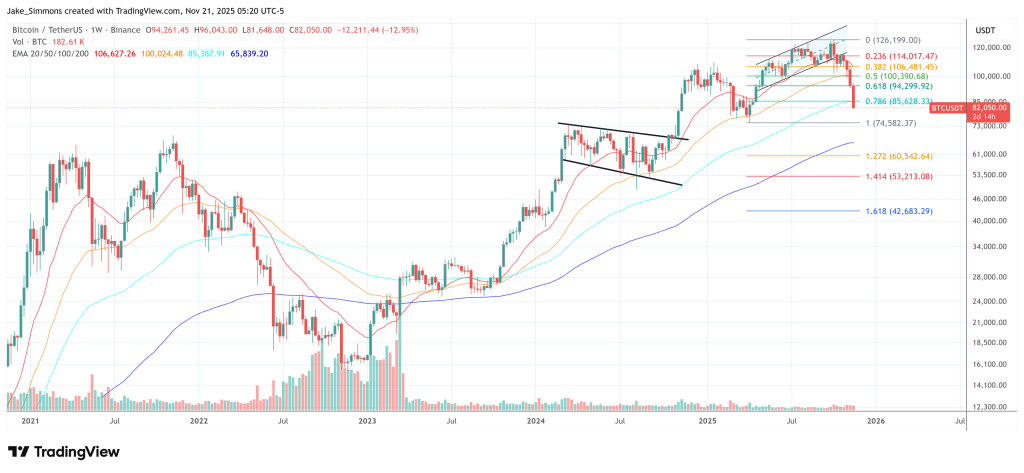
At press time, BTC traded at $82,050.
Bitcoin price
Market Opportunity
Bitcoin Logo
Bitcoin Price(BTC)
$70,856.86
$70,856.86$70,856.86
-1.35%
USD
Bitcoin (BTC) Live Price Chart
Disclaimer: The articles reposted on this site are sourced from public platforms and are provided for informational purposes only. They do not necessarily reflect the views of MEXC. All rights remain with the original authors. If you believe any content infringes on third-party rights, please contact crypto.news@mexc.com for removal. MEXC makes no guarantees regarding the accuracy, completeness, or timeliness of the content and is not responsible for any actions taken based on the information provided. The content does not constitute financial, legal, or other professional advice, nor should it be considered a recommendation or endorsement by MEXC.

You May Also Like

U.S. Moves Grip on Crypto Regulation Intensifies

U.S. Moves Grip on Crypto Regulation Intensifies

The post U.S. Moves Grip on Crypto Regulation Intensifies appeared on BitcoinEthereumNews.com. The United States is contending with the intricacies of cryptocurrency regulation as newly enacted legislation stirs debate over centralized versus decentralized finance. The recent passage of the GENIUS Act under Bo Hines’ leadership is perceived to skew favor towards centralized entities, potentially disadvantaging decentralized innovations. Continue Reading:U.S. Moves Grip on Crypto Regulation Intensifies Source: https://en.bitcoinhaber.net/u-s-moves-grip-on-crypto-regulation-intensifies
Share
BitcoinEthereumNews2025/09/18 01:09
Cryptos Signal Divergence Ahead of Fed Rate Decision

Cryptos Signal Divergence Ahead of Fed Rate Decision

The post Cryptos Signal Divergence Ahead of Fed Rate Decision appeared on BitcoinEthereumNews.com. Crypto assets send conflicting signals ahead of the Federal Reserve’s September rate decision. On-chain data reveals a clear decrease in Bitcoin and Ethereum flowing into centralized exchanges, but a sharp increase in altcoin inflows. The findings come from a Tuesday report by CryptoQuant, an on-chain data platform. The firm’s data shows a stark divergence in coin volume, which has been observed in movements onto centralized exchanges over the past few weeks. Bitcoin and Ethereum Inflows Drop to Multi-Month Lows Sponsored Sponsored Bitcoin has seen a dramatic drop in exchange inflows, with the 7-day moving average plummeting to 25,000 BTC, its lowest level in over a year. The average deposit per transaction has fallen to 0.57 BTC as of September. This suggests that smaller retail investors, rather than large-scale whales, are responsible for the recent cash-outs. Ethereum is showing a similar trend, with its daily exchange inflows decreasing to a two-month low. CryptoQuant reported that the 7-day moving average for ETH deposits on exchanges is around 783,000 ETH, the lowest in two months. Other Altcoins See Renewed Selling Pressure In contrast, other altcoin deposit activity on exchanges has surged. The number of altcoin deposit transactions on centralized exchanges was quite steady in May and June of this year, maintaining a 7-day moving average of about 20,000 to 30,000. Recently, however, that figure has jumped to 55,000 transactions. Altcoins: Exchange Inflow Transaction Count. Source: CryptoQuant CryptoQuant projects that altcoins, given their increased inflow activity, could face relatively higher selling pressure compared to BTC and ETH. Meanwhile, the balance of stablecoins on exchanges—a key indicator of potential buying pressure—has increased significantly. The report notes that the exchange USDT balance, around $273 million in April, grew to $379 million by August 31, marking a new yearly high. CryptoQuant interprets this surge as a reflection of…
Share
BitcoinEthereumNews2025/09/18 01:01
Trump claims Iran plotted to 'take over the entire Middle East' after touting bombing raid

Trump claims Iran plotted to 'take over the entire Middle East' after touting bombing raid

President Donald Trump escalated his rhetoric against Iran on Friday, claiming the country had plans to dominate the Middle East shortly after announcing a major
Share
Rawstory2026/03/14 08:13