Ethereum (ETH) briefly dropped to near $2,870 on November 19, its lowest point since July, after the release of Federal Reserve minutes raised market uncertainty. Despite the pullback, on-chain indicators and analyst insights suggest that the second-largest cryptocurrency may be forming a potential bottom. Federal Reserve Minutes Ignite Market Volatility The sharp decline in Ethereum was triggered by the Federal Reserve’s October 28–29 meeting minutes. It introduced significant uncertainty about December’s policy outlook. The document showed a slim majority of Fed officials against a December rate cut, while others suggested it “could well be appropriate.” This divided stance sparked volatility across both traditional and cryptocurrency markets. Bitcoin slid to a seven-month low, and Ethereum reached near $2,870. Ethereum (ETH) Price Performance. Source: BeInCrypto Markets At the time of writing, it had recovered to $3,036. It was still down 1.13% over the past day. But the worst may be over for the coin. On-Chain Data Highlights Strong $2,800 Support Insights from an analyst identify the $2,800 area as strong on-chain support. This level aligns with realized price clusters for both retail traders and whales, which have often marked previous market bottoms. “Historically, realized price levels have often marked cycle bottoms, suggesting that this range could once again provide a foundation for a short-term rebound,” an analyst wrote. The analysis also revealed that retail traders are selling, while whales holding more than 10,000 ETH are buying. This usually indicates healthy redistribution. Additionally, the amount of forced long liquidations is shrinking, meaning there’s less forced-selling pressure. At the same time, more traders are opening shorts. This increases the chances of a short squeeze—a rapid upward move if the price bounces and shorts get liquidated in a low-liquidity market. Technical analysts have weighed in on this support level. A trader flagged $2,800 as a critical zone for the formation of a bottom. Analyst Matt Hughes also noted that Ethereum’s drop to roughly $2,870 represents the midpoint between its 2021 market peak and its 2022 bottom. Despite the pullback, he argues the move remains within the bounds of normal crypto-market volatility. “If you remain objective this is still just normal volatility in crypto and yes, it is still a bullish backtest,” Hughes said. Liquidity Reset and Market Bottoming Patterns Altcoin Vector provided further context by examining Ethereum’s liquidity trends. Historical patterns show that when ETH liquidity fully resets, it often precedes a multi-week bottoming period rather than a breakdown. ETH just repeated the same liquidity event that marked the last two major bottoms, almost to the week. Every major ETH reversal started with a full liquidity reset,” Milk Road added. ETH Liquidity Index Indicating Full Reset at Current Levels. Source: X/Altcoin Vector This “correction/bottoming window” is expected to remain open as long as liquidity slowly rebuilds. If it returns in the coming weeks, Ethereum could be positioned for its next expansion leg. However, Altcoin Vector warned that a delayed recovery in liquidity increases the risk of prolonged stagnation, leaving the asset’s market structure more vulnerable. Institutional Accumulation And Network Fundamentals Despite turbulence in price, network fundamentals remain resilient. ETH staking hit a record high in November 2025, with over 33 million tokens now locked. Milk Road observed that although sentiment has been weak, the high level of staked ETH indicates strong long-term confidence in the network. “ETH staking just hit a new all time high… again. Price has been messy, and sentiment has been worse. But the one thing that hasn’t moved is the amount of ETH people are willing to lock away for years,” the post read. At the same time, institutional accumulation is accelerating. Corporate interest now goes beyond simply buying ETH on the open market. BlackRock is also making progress on its iShares Staked Ethereum Trust ETF. This development could amplify long-term demand and signal a deeper institutional commitment to Ethereum’s ecosystem. Furthermore, exchange reserves decreased by over 1 million ETH over the past few months. “This is the kind of silent supply shock that never looks bullish… until the chart violently catches up. ETH is being accumulated aggressively!” an analyst remarked. The convergence of on-chain signals, whale accumulation, shrinking exchange reserves, and record staking paints a positive picture for Ethereum. Whether the coin moves toward a sustained recovery will hinge on any potential macroeconomic drivers and the overall market state.Ethereum (ETH) briefly dropped to near $2,870 on November 19, its lowest point since July, after the release of Federal Reserve minutes raised market uncertainty. Despite the pullback, on-chain indicators and analyst insights suggest that the second-largest cryptocurrency may be forming a potential bottom. Federal Reserve Minutes Ignite Market Volatility The sharp decline in Ethereum was triggered by the Federal Reserve’s October 28–29 meeting minutes. It introduced significant uncertainty about December’s policy outlook. The document showed a slim majority of Fed officials against a December rate cut, while others suggested it “could well be appropriate.” This divided stance sparked volatility across both traditional and cryptocurrency markets. Bitcoin slid to a seven-month low, and Ethereum reached near $2,870. Ethereum (ETH) Price Performance. Source: BeInCrypto Markets At the time of writing, it had recovered to $3,036. It was still down 1.13% over the past day. But the worst may be over for the coin. On-Chain Data Highlights Strong $2,800 Support Insights from an analyst identify the $2,800 area as strong on-chain support. This level aligns with realized price clusters for both retail traders and whales, which have often marked previous market bottoms. “Historically, realized price levels have often marked cycle bottoms, suggesting that this range could once again provide a foundation for a short-term rebound,” an analyst wrote. The analysis also revealed that retail traders are selling, while whales holding more than 10,000 ETH are buying. This usually indicates healthy redistribution. Additionally, the amount of forced long liquidations is shrinking, meaning there’s less forced-selling pressure. At the same time, more traders are opening shorts. This increases the chances of a short squeeze—a rapid upward move if the price bounces and shorts get liquidated in a low-liquidity market. Technical analysts have weighed in on this support level. A trader flagged $2,800 as a critical zone for the formation of a bottom. Analyst Matt Hughes also noted that Ethereum’s drop to roughly $2,870 represents the midpoint between its 2021 market peak and its 2022 bottom. Despite the pullback, he argues the move remains within the bounds of normal crypto-market volatility. “If you remain objective this is still just normal volatility in crypto and yes, it is still a bullish backtest,” Hughes said. Liquidity Reset and Market Bottoming Patterns Altcoin Vector provided further context by examining Ethereum’s liquidity trends. Historical patterns show that when ETH liquidity fully resets, it often precedes a multi-week bottoming period rather than a breakdown. ETH just repeated the same liquidity event that marked the last two major bottoms, almost to the week. Every major ETH reversal started with a full liquidity reset,” Milk Road added. ETH Liquidity Index Indicating Full Reset at Current Levels. Source: X/Altcoin Vector This “correction/bottoming window” is expected to remain open as long as liquidity slowly rebuilds. If it returns in the coming weeks, Ethereum could be positioned for its next expansion leg. However, Altcoin Vector warned that a delayed recovery in liquidity increases the risk of prolonged stagnation, leaving the asset’s market structure more vulnerable. Institutional Accumulation And Network Fundamentals Despite turbulence in price, network fundamentals remain resilient. ETH staking hit a record high in November 2025, with over 33 million tokens now locked. Milk Road observed that although sentiment has been weak, the high level of staked ETH indicates strong long-term confidence in the network. “ETH staking just hit a new all time high… again. Price has been messy, and sentiment has been worse. But the one thing that hasn’t moved is the amount of ETH people are willing to lock away for years,” the post read. At the same time, institutional accumulation is accelerating. Corporate interest now goes beyond simply buying ETH on the open market. BlackRock is also making progress on its iShares Staked Ethereum Trust ETF. This development could amplify long-term demand and signal a deeper institutional commitment to Ethereum’s ecosystem. Furthermore, exchange reserves decreased by over 1 million ETH over the past few months. “This is the kind of silent supply shock that never looks bullish… until the chart violently catches up. ETH is being accumulated aggressively!” an analyst remarked. The convergence of on-chain signals, whale accumulation, shrinking exchange reserves, and record staking paints a positive picture for Ethereum. Whether the coin moves toward a sustained recovery will hinge on any potential macroeconomic drivers and the overall market state.

Why Ethereum May Have Successfully Bottomed at the $2,800 Support Zone

Ethereum (ETH) briefly dropped to near $2,870 on November 19, its lowest point since July, after the release of Federal Reserve minutes raised market uncertainty.

Despite the pullback, on-chain indicators and analyst insights suggest that the second-largest cryptocurrency may be forming a potential bottom.

Federal Reserve Minutes Ignite Market Volatility

The sharp decline in Ethereum was triggered by the Federal Reserve’s October 28–29 meeting minutes. It introduced significant uncertainty about December’s policy outlook.

The document showed a slim majority of Fed officials against a December rate cut, while others suggested it “could well be appropriate.”

This divided stance sparked volatility across both traditional and cryptocurrency markets. Bitcoin slid to a seven-month low, and Ethereum reached near $2,870.
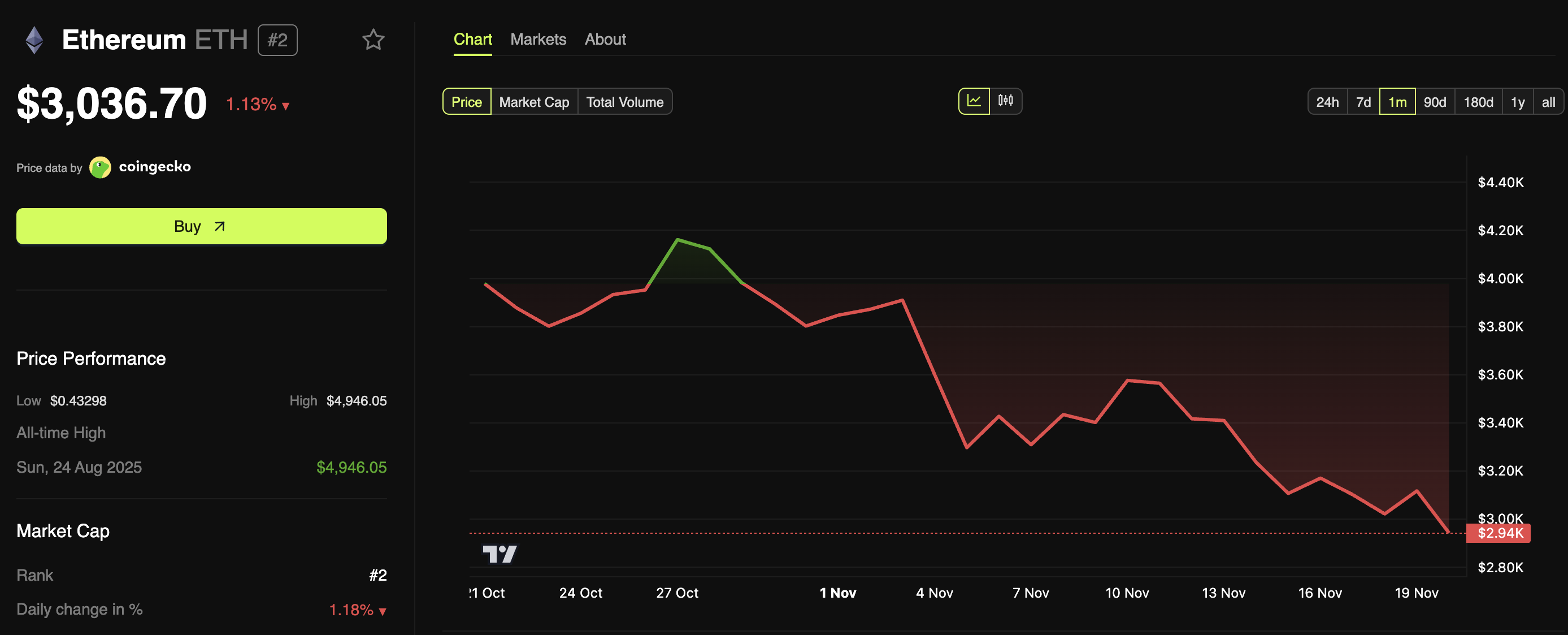
Ethereum (ETH) Price PerformanceEthereum (ETH) Price Performance. Source: BeInCrypto Markets

At the time of writing, it had recovered to $3,036. It was still down 1.13% over the past day. But the worst may be over for the coin.

On-Chain Data Highlights Strong $2,800 Support

Insights from an analyst identify the $2,800 area as strong on-chain support. This level aligns with realized price clusters for both retail traders and whales, which have often marked previous market bottoms.

The analysis also revealed that retail traders are selling, while whales holding more than 10,000 ETH are buying. This usually indicates healthy redistribution.

Additionally, the amount of forced long liquidations is shrinking, meaning there’s less forced-selling pressure. At the same time, more traders are opening shorts.

This increases the chances of a short squeeze—a rapid upward move if the price bounces and shorts get liquidated in a low-liquidity market.

Technical analysts have weighed in on this support level. A trader flagged $2,800 as a critical zone for the formation of a bottom.

Analyst Matt Hughes also noted that Ethereum’s drop to roughly $2,870 represents the midpoint between its 2021 market peak and its 2022 bottom. Despite the pullback, he argues the move remains within the bounds of normal crypto-market volatility.

Liquidity Reset and Market Bottoming Patterns

Altcoin Vector provided further context by examining Ethereum’s liquidity trends. Historical patterns show that when ETH liquidity fully resets, it often precedes a multi-week bottoming period rather than a breakdown.
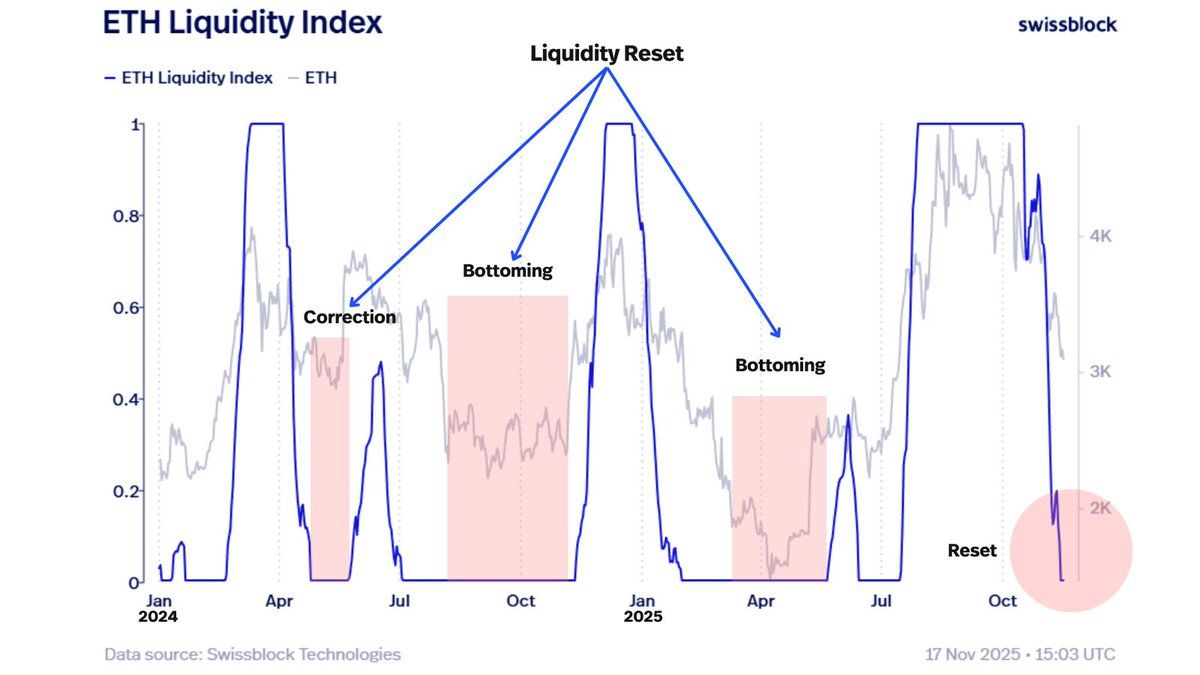
ETH Liquidity Index chart showing reset patternETH Liquidity Index Indicating Full Reset at Current Levels. Source: X/Altcoin Vector

This “correction/bottoming window” is expected to remain open as long as liquidity slowly rebuilds. If it returns in the coming weeks, Ethereum could be positioned for its next expansion leg.

However, Altcoin Vector warned that a delayed recovery in liquidity increases the risk of prolonged stagnation, leaving the asset’s market structure more vulnerable.

Institutional Accumulation And Network Fundamentals

Despite turbulence in price, network fundamentals remain resilient. ETH staking hit a record high in November 2025, with over 33 million tokens now locked.

Milk Road observed that although sentiment has been weak, the high level of staked ETH indicates strong long-term confidence in the network.

At the same time, institutional accumulation is accelerating.

Corporate interest now goes beyond simply buying ETH on the open market. BlackRock is also making progress on its iShares Staked Ethereum Trust ETF.

This development could amplify long-term demand and signal a deeper institutional commitment to Ethereum’s ecosystem. Furthermore, exchange reserves decreased by over 1 million ETH over the past few months.

The convergence of on-chain signals, whale accumulation, shrinking exchange reserves, and record staking paints a positive picture for Ethereum. Whether the coin moves toward a sustained recovery will hinge on any potential macroeconomic drivers and the overall market state.

Market Opportunity
Ethereum Logo
Ethereum Price(ETH)
$3,328.59
$3,328.59$3,328.59
+1.97%
USD
Ethereum (ETH) Live Price Chart
Disclaimer: The articles reposted on this site are sourced from public platforms and are provided for informational purposes only. They do not necessarily reflect the views of MEXC. All rights remain with the original authors. If you believe any content infringes on third-party rights, please contact service@support.mexc.com for removal. MEXC makes no guarantees regarding the accuracy, completeness, or timeliness of the content and is not responsible for any actions taken based on the information provided. The content does not constitute financial, legal, or other professional advice, nor should it be considered a recommendation or endorsement by MEXC.

You May Also Like

XRP Price Prediction: $DSNT Could Outperform Ripple Once the Token Goes Live on Multiple Rumored CEXs at the End of January

XRP Price Prediction: $DSNT Could Outperform Ripple Once the Token Goes Live on Multiple Rumored CEXs at the End of January

Galaxy Digital’s $75 million tokenized loan deal shows how fast institutions are pushing traditional finance on-chain.  But while firms focus on private credit
Share
Coinstats2026/01/17 22:00
Crypto Market Cap Edges Up 2% as Bitcoin Approaches $118K After Fed Rate Trim

Crypto Market Cap Edges Up 2% as Bitcoin Approaches $118K After Fed Rate Trim

The global crypto market cap rose 2% to $4.2 trillion on Thursday, lifted by Bitcoin’s steady climb toward $118,000 after the Fed delivered its first interest rate cut of the year. Gains were measured, however, as investors weighed the central bank’s cautious tone on future policy moves. Bitcoin last traded 1% higher at $117,426. Ether rose 2.8% to $4,609. XRP also gained, rising 2.9% to $3.10. Fed Chair Jerome Powell described Wednesday’s quarter-point reduction as a risk-management step, stressing that policymakers were in no hurry to speed up the easing cycle. His comments dampened expectations of more aggressive cuts, limiting enthusiasm across risk assets. Traders Anticipated Fed Rate Trim, Leaving Little Room for Surprise Rally The Federal Open Market Committee voted 11-to-1 to lower the benchmark lending rate to a range of 4.00% to 4.25%. The sole dissent came from newly appointed governor Stephen Miran, who pushed for a half-point cut. Traders were largely prepared for the move. Futures markets tracked by the CME FedWatch tool had assigned a 96% probability to a 25 basis point cut, making the decision widely anticipated. That advance positioning meant much of the potential boost was already priced in, creating what analysts described as a “buy the rumour, sell the news” environment. Fed Rate Decision Creates Conditions for Crypto, But Traders Still Hold Back Andrew Forson, president of DeFi Technologies, said lower borrowing costs would eventually steer more money toward digital assets. “A lower cost of capital indicates more capital flows into the digital assets space because the risk hurdle rate for money is lower,” he noted. He added that staking products and blockchain projects could become attractive alternatives to traditional bonds, offering both yield and appreciation. Despite the cut, crypto markets remained calm. Open interest in Bitcoin futures held steady and no major liquidation cascades followed the Fed’s decision. Analysts pointed to Powell’s language and upcoming economic data as the key factors for traders before building larger positions. Powell’s Caution Tempers Immediate Impact of Fed Rate Move on Crypto Markets History also suggests crypto rallies after rate cuts often take time. When the Fed eased in Dec. 2024, Bitcoin briefly surged 5% cent before consolidating, with sustained gains arriving only weeks later. This time, market watchers are bracing for a similar pattern. Powell’s insistence on caution, combined with uncertainty around inflation and growth, has kept short-term volatility muted even as sentiment for risk assets improves. BitMine’s Tom Lee this week predicted that Bitcoin and Ether could deliver “monster gains” in the next three months if the Fed continues on an easing path. His view echoes broader expectations that liquidity-sensitive assets will outperform once the cycle gathers pace. For now, the crypto sector has digested the Fed’s move with restraint. Traders remain focused on signals from the central bank’s October meeting to determine whether Wednesday’s step marks the beginning of a broader policy shift or just a one-off adjustment
Share
CryptoNews2025/09/18 13:14
‘The White Lotus’ Season 4 Officially Casts Its Next Two Actors

‘The White Lotus’ Season 4 Officially Casts Its Next Two Actors

The post ‘The White Lotus’ Season 4 Officially Casts Its Next Two Actors appeared on BitcoinEthereumNews.com. With filming on the near horizon, The White Lotus
Share
BitcoinEthereumNews2026/01/17 22:35