Michael Saylor says big finance hasn’t made Bitcoin wilder. Swings are narrowing as the asset base and market structure deepen. The post Bitcoin Volatility Keeps Dropping, And Michael Saylor Has the Data appeared first on Coinspeaker.Michael Saylor says big finance hasn’t made Bitcoin wilder. Swings are narrowing as the asset base and market structure deepen. The post Bitcoin Volatility Keeps Dropping, And Michael Saylor Has the Data appeared first on Coinspeaker.

Bitcoin Volatility Keeps Dropping, And Michael Saylor Has the Data

Michael Saylor argues the entry of big finance hasn’t made Bitcoin wilder. If anything, he says, swings are narrowing as the asset base and market structure deepen.

In a Fox Business spot this week, the MicroStrategy executive chairman said BTC $91 654 24h volatility: 1.4% Market cap: $1.82 T Vol. 24h: $81.92 B annualized volatility has dropped from ~80% when his firm began buying in 2020 to roughly the 50% area today, and he expects further incremental declines as the market scales.

That claim isn’t out of left field. Independent research has documented a multi-year downtrend in BTC’s realized volatility: Fidelity has shown long stretches where Bitcoin’s risk is comparable to a non-trivial slice of S&P 500 constituents, while iShares likewise charts a steady glide lower. Even if BTC still runs hotter than broad equities or gold. In short: still volatile, but less so than before, and trending down.

Bitcoin price is down, but the structure is sturdier

Yes, the latest slide has been sharp. BTC has given back a chunk of 2025’s gains amid risk-off flows and ETF outflows. Still, that doesn’t automatically contradict the longer-term volatility compression Saylor describes. Recent coverage tallied a double-digit weekly drop and highlighted thinner liquidity as a key amplifier of short-term swings.
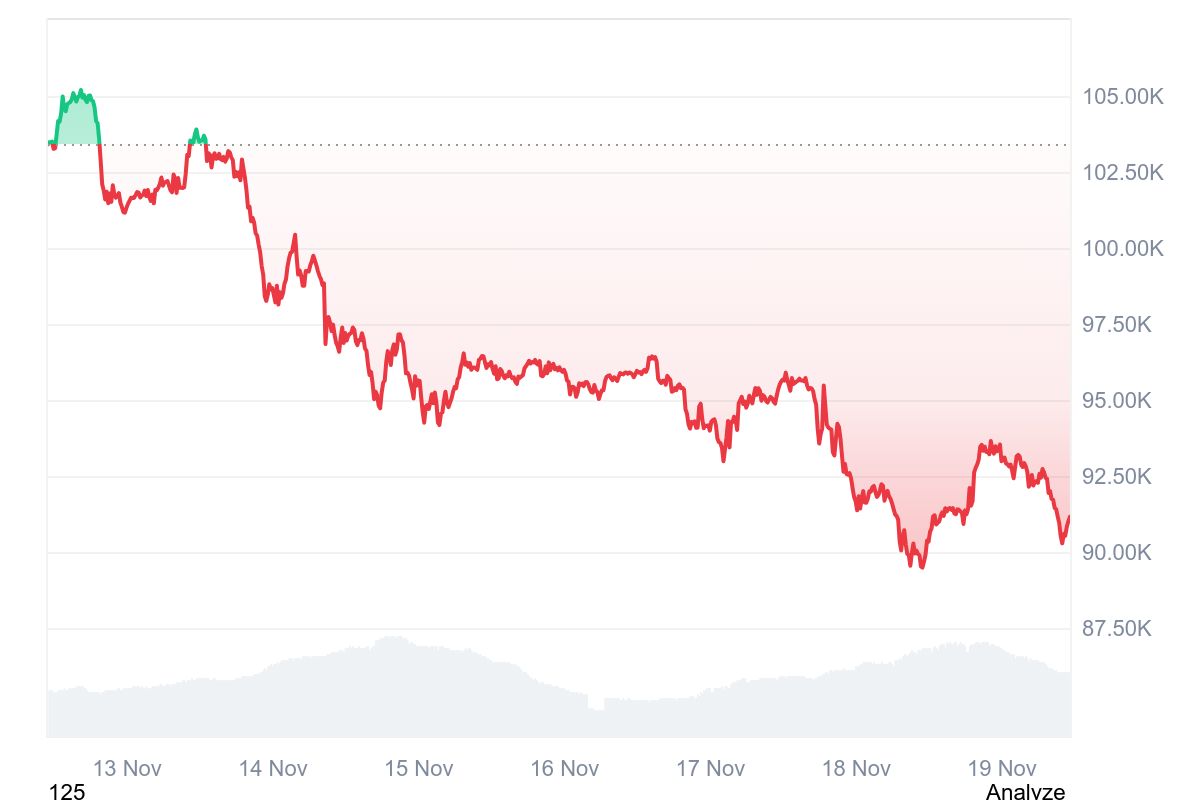
Bitcoin price in 7 days | Source: CoinMarketCap

Bitcoin price in 7 days | Source: CoinMarketCap

MicroStrategy’s exposure and the “premium”

Saylor doubled down on the claim that his company is built to weather deep drawdowns. As of this week, third-party dashboards and trade disclosures put MicroStrategy’s holdings near 649,870 BTC, after another 8,178 BTC buy, cementing its role as the largest corporate owner.

The firm’s website and trackers also display an mNAV multiple (a real-time gauge of the stock’s premium/discount to its bitcoin per-share value), which has compressed alongside the market.

A snapshot of MSTR fundamentals, including mNAV | Source: strategy.com

A snapshot of MSTR fundamentals, including mNAV | Source: strategy.com

MicroStrategy’s stock reflects that torque: MSTR often overshoots BTC both ways. Into this pullback, it has traded off with the coin. Recent closing prints and five-day moves show the dynamics: Microstrategy stock closed 5.8% up on Nov. 18 despite the sell-off.

Does lower volatility ahead make sense?

There’s a coherent case. Macro adoption (spot ETFs, institutional risk controls), deeper derivatives markets, and a wider base of long-only holders can all dampen realized volatility over time, even if episodic air-pockets remain. The researches mentioned above emphasize this pattern: declining secular volatility with cyclical spikes.

Saylor’s message isn’t that Bitcoin is suddenly “low risk,” but that the direction of travel for volatility is down as the asset matures. In that case, Wall Street’s arrival is part of the stabilization, not the problem. The latest sell-off stings, but the long-run data he points to (plus MicroStrategy’s continued accumulation and mNAV transparency) support the view that market structure is hardening even when prices aren’t.

next

The post Bitcoin Volatility Keeps Dropping, And Michael Saylor Has the Data appeared first on Coinspeaker.

Market Opportunity
Threshold Logo
Threshold Price(T)
$0.010072
$0.010072$0.010072
+2.52%
USD
Threshold (T) Live Price Chart
Disclaimer: The articles reposted on this site are sourced from public platforms and are provided for informational purposes only. They do not necessarily reflect the views of MEXC. All rights remain with the original authors. If you believe any content infringes on third-party rights, please contact service@support.mexc.com for removal. MEXC makes no guarantees regarding the accuracy, completeness, or timeliness of the content and is not responsible for any actions taken based on the information provided. The content does not constitute financial, legal, or other professional advice, nor should it be considered a recommendation or endorsement by MEXC.

You May Also Like

CLARITY Act ‘Has a Long Way to Go‘

CLARITY Act ‘Has a Long Way to Go‘

The post CLARITY Act ‘Has a Long Way to Go‘ appeared on BitcoinEthereumNews.com. David Solomon, CEO of banking giant Goldman Sachs, has weighed in on the pending
Share
BitcoinEthereumNews2026/01/17 11:16
Best Meme Coin to Buy Now? Why $HUGS From Milk & Mocha Is Winning Over 2025 Crypto Investors

Best Meme Coin to Buy Now? Why $HUGS From Milk & Mocha Is Winning Over 2025 Crypto Investors

Looking for the best meme coin to buy now? Discover why Milk & Mocha’s $HUGS token, with staking, burns, and lifetime rewards, is leading the 2025 presale race.
Share
Blockchainreporter2025/09/20 23:55
EUR/CHF slides as Euro struggles post-inflation data

EUR/CHF slides as Euro struggles post-inflation data

The post EUR/CHF slides as Euro struggles post-inflation data appeared on BitcoinEthereumNews.com. EUR/CHF weakens for a second straight session as the euro struggles to recover post-Eurozone inflation data. Eurozone core inflation steady at 2.3%, headline CPI eases to 2.0% in August. SNB maintains a flexible policy outlook ahead of its September 25 decision, with no immediate need for easing. The Euro (EUR) trades under pressure against the Swiss Franc (CHF) on Wednesday, with EUR/CHF extending losses for the second straight session as the common currency struggles to gain traction following Eurozone inflation data. At the time of writing, the cross is trading around 0.9320 during the American session. The latest inflation data from Eurostat showed that Eurozone price growth remained broadly stable in August, reinforcing the European Central Bank’s (ECB) cautious stance on monetary policy. The Core Harmonized Index of Consumer Prices (HICP), which excludes volatile items such as food and energy, rose 2.3% YoY, in line with both forecasts and the previous month’s reading. On a monthly basis, core inflation increased by 0.3%, unchanged from July, highlighting persistent underlying price pressures in the bloc. Meanwhile, headline inflation eased to 2.0% YoY in August, down from 2.1% in July and slightly below expectations. On a monthly basis, prices rose just 0.1%, missing forecasts for a 0.2% increase and decelerating from July’s 0.2% rise. The inflation release follows last week’s ECB policy decision, where the central bank kept all three key interest rates unchanged and signaled that policy is likely at its terminal level. While officials acknowledged progress in bringing inflation down, they reiterated a cautious, data-dependent approach going forward, emphasizing the need to maintain restrictive conditions for an extended period to ensure price stability. On the Swiss side, disinflation appears to be deepening. The Producer and Import Price Index dropped 0.6% in August, marking a sharp 1.8% annual decline. Broader inflation remains…
Share
BitcoinEthereumNews2025/09/18 03:08