Deutsche Börse to integrate SocGen stablecoins into Clearstream settlement system
German stock exchange operator Deutsche Börse Group (DB1) plans to integrate stablecoins made by French bank Société Générale in its settlement business. According to the announcement, both a dollar-backed stablecoin and a euro-backed version developed by SocGen’s crypto arm SG-FORGE will be added to Clearstream’s custody services.
According to reports, the groups have already signed an agreement to integrate SG-FORGE’s euro and dollar CoinVertible tokens with Deutsche Börse’s post-trade operations.
Jean-Marc Stenger, CEO of Société Générale–FORGE, stated, “This strategic partnership reinforces SG-FORGE’s position as Europe’s reference stablecoin issuer and creates a link between the crypto-native players we serve and established financial market infrastructures like Deutsche Börse Group.”
Deutsche Börse to list the tokens on its digital trading platforms
The partnership is the first time SG-FORGE’s stablecoins will be integrated into a mainstream financial platform. The first phase will test CoinVertible as a settlement asset for securities and collateral workflows and explore its role in treasury functions.
Both groups will study whether stablecoins can be used across Deutsche Börse’s broader service offerings. That includes clearing, custody, and data tools that reach banks, asset managers, and crypto firms.
Additionally, the Swiss-German group, already licensed under Europe’s Markets in Crypto-Assets Regulation (MiCA), plans to list the tokens on its digital trading platforms to support liquidity.
Jean-Marc Stenger said that using stablecoins is a quicker and cheaper way to move money. “What we want to achieve here is to bring to the traditional financial ecosystem the efficiency and speed we all see in the crypto ecosystem,” he said.
This partnership follows a previous collaboration with Circle Internet Group Inc. The firm announced that it has signed a memorandum of understanding with Circle to deploy its products. This includes its EURC and USDC stablecoins across Deutsche Börse’s ecosystem.
The firm has made other huge steps. Recently, Crypto Finance, part of Deutsche Börse Group, began offering staking services for institutional clients in Europe. This means that clients who custody their digital assets with Crypto Finance (Deutschland) GmbH stake their holdings in Ethereum and Solana. Also, the two are involved in the ongoing wholesale central bank digital currency pilots.
Europe’s MICA scrutiny on stablecoins persists
Regulatory clarity under frameworks like MiCA will be essential. As Europe’s digital asset regulation evolves, Deutsche Börse is expected to serve as a blueprint for other exchanges and post-trade providers seeking to bridge traditional and digital markets.
However, as previously reported by Cryptopolitan, the European Systemic Risk Board, tasked with guarding Europe’s financial system, is considering tightening regulations. They passed a recommendation to ban so-called multi-issuance stablecoins.
The ESRB’s guidance, approved by a board of central bank governors and EU officials, is not legally binding. However, it is expected to pressure authorities to either adopt the restrictions or justify how financial stability could be maintained without them.
Dutch central bank governor Olaf Sleijpen stated, “If stablecoins in the US increase at the same pace as they have been increasing, they will become systemically relevant at a certain point.”
Another senior ECB official warned this summer that the dominance of dollar stablecoins could hinder European policymakers’ ability to set interest rates or control the money supply.
Meanwhile, DefiLama data show that euro-pegged stablecoins remain marginal, with a circulation of under $549 million, representing just 0.18% of the global market, compared to dollar tokens’ 99.58% dominance.
Nearly $30 million worth of Societe Generale’s dollar-backed token is in circulation
SG-FORGE previously launched a euro-peg token called EUR CoinVertible (EURCV). More recently, they introduced a USD-pegged stablecoin called USD CoinVertible (USDCV), built on public blockchains such as Ethereum and Solana.
The reserves backing this USDCV are held by Bank of New York Mellon, according to SG-FORGE’s press release.
Meanwhile, there are $29.6 million worth of Societe Generale’s dollar-backed token in circulation, and 65.2 million euros ($75.6 million) of the euro-backed equivalent, according to the company’s website.
The stablecoin market is dominated by Tether, a company based in El Salvador, which claims to have issued $184 billion worth of tokens.
Don’t just read crypto news. Understand it. Subscribe to our newsletter. It's free.


You May Also Like
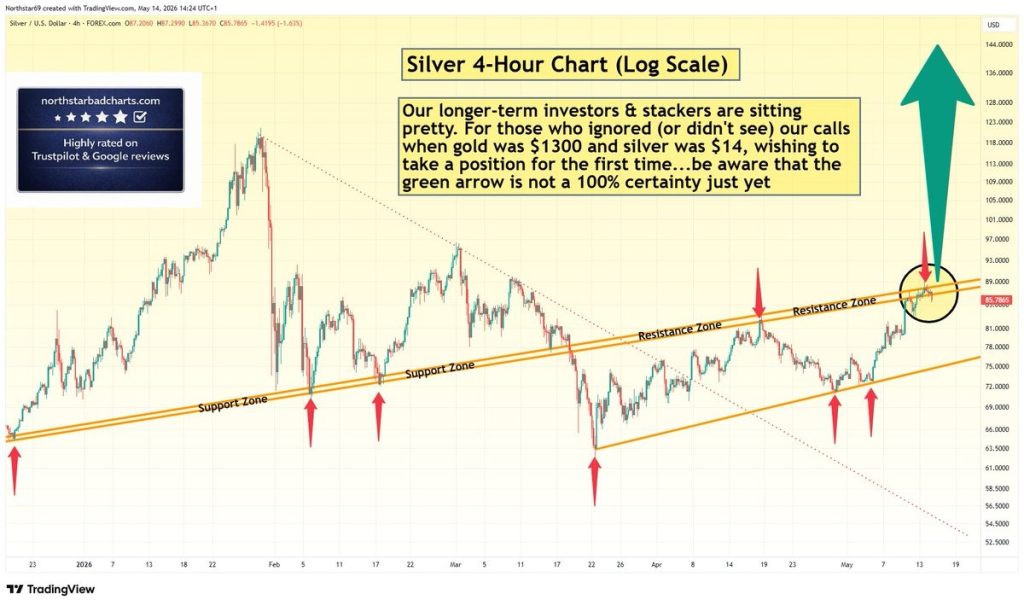
Silver Price Warning: Green Arrow Setup Is Not Confirmed – Wait for Clear Signal

Facebook spotlights African cinema in 6th ‘Made by Africa, loved by the world’ campaign