BitcoinWorld Revolutionary ZK Proof Marketplace: Brevis Unveils ProverNet White Paper for Decentralized Future Imagine a world where zero-knowledge proof generation becomes as accessible as trading cryptocurrencies. That future is closer than you think. Brevis, a leading zero-knowledge technology firm, just dropped a bombshell announcement that could reshape how we approach computational verification in Web3. Their newly released white paper details ProverNet – a groundbreaking decentralized ZK proof marketplace designed to democratize proof generation. What Makes This ZK Proof Marketplace Different? Traditional proof infrastructures face significant limitations by relying on single providers. This creates bottlenecks and centralization risks. However, Brevis introduces a revolutionary approach with ProverNet’s decentralized architecture. The platform connects various computational tasks with professional provers through an innovative Truthful Online Double Auction mechanism. This system ensures fair pricing and efficient resource allocation. Think of it as a marketplace where computational power meets verification needs seamlessly. The TODA mechanism prevents manipulation while optimizing for both provers and users seeking proof generation services. How Does ProverNet’s Architecture Work? Brevis didn’t build this system in a vacuum. They leveraged extensive operational experience from major platforms including: PancakeSwap – for decentralized exchange mechanics Uniswap – for automated market making insights Euler – for complex financial protocol integration This real-world testing grounds shaped ProverNet’s robust foundation. The platform’s architecture matches computational tasks with the most suitable provers based on: Computational complexity requirements Cost efficiency parameters Time sensitivity factors Prover reputation and reliability What Role Does the BREV Token Play? The native BREV token serves as the economic engine powering this ZK proof marketplace. It enables three critical functions within the ecosystem: Fee payments – Users pay for proof generation services using BREV Staking mechanisms – Provers stake tokens to guarantee service quality Governance rights – Token holders participate in platform decisions This triple-purpose design creates a sustainable economic model that aligns incentives across all participants. The token economy ensures provers maintain high service standards while users receive reliable proof generation. When Can We Expect ProverNet’s Launch? Mark your calendars for a significant blockchain milestone. Brevis plans to launch ProverNet on their dedicated chain by the end of 2025. This timeline allows for thorough testing and community building. The phased approach includes: Testnet deployment in Q2 2025 Mainnet launch in Q4 2025 Gradual feature rollouts throughout 2026 This careful planning demonstrates Brevis’s commitment to delivering a polished, reliable ZK proof marketplace that meets enterprise-grade requirements. Why Does This Matter for Web3 Development? The implications extend far beyond technical circles. A decentralized ZK proof marketplace unlocks new possibilities for: Scalable blockchain applications Privacy-preserving computations Cost-effective verification services Democratized access to advanced cryptography Developers can focus on building innovative dApps without worrying about proof generation infrastructure. Meanwhile, computational providers can monetize their resources efficiently through this ZK proof marketplace. Conclusion: The Future of Verification is Decentralized Brevis’s ProverNet represents a paradigm shift in how we approach computational verification. By creating a decentralized ZK proof marketplace, they’re addressing critical limitations in current infrastructure while paving the way for more accessible, efficient proof generation. The combination of proven operational experience, innovative auction mechanisms, and thoughtful token economics positions ProverNet as a potential game-changer. As we approach the 2025 launch, the blockchain community watches with anticipation – this could be the missing piece that accelerates Web3 adoption across industries. Frequently Asked Questions What is a ZK proof marketplace? A ZK proof marketplace connects users who need zero-knowledge proofs generated with providers who have computational resources to create those proofs. It’s like a decentralized marketplace for verification services. How does the TODA mechanism work? The Truthful Online Double Auction ensures fair pricing by allowing both buyers and sellers to bid honestly without gaming the system. It matches computational tasks with the most suitable provers at optimal prices. What can I use the BREV token for? BREV tokens serve three main purposes: paying for proof generation services, staking to guarantee service quality, and participating in governance decisions about the platform’s future development. When will ProverNet launch? Brevis plans to launch ProverNet on their dedicated chain by the end of 2025, with testnet deployment expected in Q2 2025 and mainnet launch in Q4 2025. Which blockchains will ProverNet support? While initially launching on the Brevis chain, the platform is designed to be blockchain-agnostic, meaning it can eventually support proof generation for multiple blockchain networks. How does this benefit developers? Developers can access reliable, cost-effective proof generation without building their own infrastructure, allowing them to focus on application development rather than cryptographic implementation. Found this insight into the future of ZK proof marketplaces valuable? Share this article with your blockchain community and help spread knowledge about this groundbreaking development in decentralized technology! To learn more about the latest zero-knowledge proof trends, explore our article on key developments shaping blockchain privacy solutions and institutional adoption. This post Revolutionary ZK Proof Marketplace: Brevis Unveils ProverNet White Paper for Decentralized Future first appeared on BitcoinWorld.BitcoinWorld Revolutionary ZK Proof Marketplace: Brevis Unveils ProverNet White Paper for Decentralized Future Imagine a world where zero-knowledge proof generation becomes as accessible as trading cryptocurrencies. That future is closer than you think. Brevis, a leading zero-knowledge technology firm, just dropped a bombshell announcement that could reshape how we approach computational verification in Web3. Their newly released white paper details ProverNet – a groundbreaking decentralized ZK proof marketplace designed to democratize proof generation. What Makes This ZK Proof Marketplace Different? Traditional proof infrastructures face significant limitations by relying on single providers. This creates bottlenecks and centralization risks. However, Brevis introduces a revolutionary approach with ProverNet’s decentralized architecture. The platform connects various computational tasks with professional provers through an innovative Truthful Online Double Auction mechanism. This system ensures fair pricing and efficient resource allocation. Think of it as a marketplace where computational power meets verification needs seamlessly. The TODA mechanism prevents manipulation while optimizing for both provers and users seeking proof generation services. How Does ProverNet’s Architecture Work? Brevis didn’t build this system in a vacuum. They leveraged extensive operational experience from major platforms including: PancakeSwap – for decentralized exchange mechanics Uniswap – for automated market making insights Euler – for complex financial protocol integration This real-world testing grounds shaped ProverNet’s robust foundation. The platform’s architecture matches computational tasks with the most suitable provers based on: Computational complexity requirements Cost efficiency parameters Time sensitivity factors Prover reputation and reliability What Role Does the BREV Token Play? The native BREV token serves as the economic engine powering this ZK proof marketplace. It enables three critical functions within the ecosystem: Fee payments – Users pay for proof generation services using BREV Staking mechanisms – Provers stake tokens to guarantee service quality Governance rights – Token holders participate in platform decisions This triple-purpose design creates a sustainable economic model that aligns incentives across all participants. The token economy ensures provers maintain high service standards while users receive reliable proof generation. When Can We Expect ProverNet’s Launch? Mark your calendars for a significant blockchain milestone. Brevis plans to launch ProverNet on their dedicated chain by the end of 2025. This timeline allows for thorough testing and community building. The phased approach includes: Testnet deployment in Q2 2025 Mainnet launch in Q4 2025 Gradual feature rollouts throughout 2026 This careful planning demonstrates Brevis’s commitment to delivering a polished, reliable ZK proof marketplace that meets enterprise-grade requirements. Why Does This Matter for Web3 Development? The implications extend far beyond technical circles. A decentralized ZK proof marketplace unlocks new possibilities for: Scalable blockchain applications Privacy-preserving computations Cost-effective verification services Democratized access to advanced cryptography Developers can focus on building innovative dApps without worrying about proof generation infrastructure. Meanwhile, computational providers can monetize their resources efficiently through this ZK proof marketplace. Conclusion: The Future of Verification is Decentralized Brevis’s ProverNet represents a paradigm shift in how we approach computational verification. By creating a decentralized ZK proof marketplace, they’re addressing critical limitations in current infrastructure while paving the way for more accessible, efficient proof generation. The combination of proven operational experience, innovative auction mechanisms, and thoughtful token economics positions ProverNet as a potential game-changer. As we approach the 2025 launch, the blockchain community watches with anticipation – this could be the missing piece that accelerates Web3 adoption across industries. Frequently Asked Questions What is a ZK proof marketplace? A ZK proof marketplace connects users who need zero-knowledge proofs generated with providers who have computational resources to create those proofs. It’s like a decentralized marketplace for verification services. How does the TODA mechanism work? The Truthful Online Double Auction ensures fair pricing by allowing both buyers and sellers to bid honestly without gaming the system. It matches computational tasks with the most suitable provers at optimal prices. What can I use the BREV token for? BREV tokens serve three main purposes: paying for proof generation services, staking to guarantee service quality, and participating in governance decisions about the platform’s future development. When will ProverNet launch? Brevis plans to launch ProverNet on their dedicated chain by the end of 2025, with testnet deployment expected in Q2 2025 and mainnet launch in Q4 2025. Which blockchains will ProverNet support? While initially launching on the Brevis chain, the platform is designed to be blockchain-agnostic, meaning it can eventually support proof generation for multiple blockchain networks. How does this benefit developers? Developers can access reliable, cost-effective proof generation without building their own infrastructure, allowing them to focus on application development rather than cryptographic implementation. Found this insight into the future of ZK proof marketplaces valuable? Share this article with your blockchain community and help spread knowledge about this groundbreaking development in decentralized technology! To learn more about the latest zero-knowledge proof trends, explore our article on key developments shaping blockchain privacy solutions and institutional adoption. This post Revolutionary ZK Proof Marketplace: Brevis Unveils ProverNet White Paper for Decentralized Future first appeared on BitcoinWorld.

Revolutionary ZK Proof Marketplace: Brevis Unveils ProverNet White Paper for Decentralized Future

2025/11/17 20:25
5 min read
For feedback or concerns regarding this content, please contact us at crypto.news@mexc.com
Decentralized ZK proof marketplace connecting computational nodes in vibrant blockchain network

BitcoinWorld

Revolutionary ZK Proof Marketplace: Brevis Unveils ProverNet White Paper for Decentralized Future

Imagine a world where zero-knowledge proof generation becomes as accessible as trading cryptocurrencies. That future is closer than you think. Brevis, a leading zero-knowledge technology firm, just dropped a bombshell announcement that could reshape how we approach computational verification in Web3. Their newly released white paper details ProverNet – a groundbreaking decentralized ZK proof marketplace designed to democratize proof generation.

What Makes This ZK Proof Marketplace Different?

Traditional proof infrastructures face significant limitations by relying on single providers. This creates bottlenecks and centralization risks. However, Brevis introduces a revolutionary approach with ProverNet’s decentralized architecture. The platform connects various computational tasks with professional provers through an innovative Truthful Online Double Auction mechanism.

This system ensures fair pricing and efficient resource allocation. Think of it as a marketplace where computational power meets verification needs seamlessly. The TODA mechanism prevents manipulation while optimizing for both provers and users seeking proof generation services.

How Does ProverNet’s Architecture Work?

Brevis didn’t build this system in a vacuum. They leveraged extensive operational experience from major platforms including:

  • PancakeSwap – for decentralized exchange mechanics
  • Uniswap – for automated market making insights
  • Euler – for complex financial protocol integration

This real-world testing grounds shaped ProverNet’s robust foundation. The platform’s architecture matches computational tasks with the most suitable provers based on:

  • Computational complexity requirements
  • Cost efficiency parameters
  • Time sensitivity factors
  • Prover reputation and reliability

What Role Does the BREV Token Play?

The native BREV token serves as the economic engine powering this ZK proof marketplace. It enables three critical functions within the ecosystem:

  • Fee payments – Users pay for proof generation services using BREV
  • Staking mechanisms – Provers stake tokens to guarantee service quality
  • Governance rights – Token holders participate in platform decisions

This triple-purpose design creates a sustainable economic model that aligns incentives across all participants. The token economy ensures provers maintain high service standards while users receive reliable proof generation.

When Can We Expect ProverNet’s Launch?

Mark your calendars for a significant blockchain milestone. Brevis plans to launch ProverNet on their dedicated chain by the end of 2025. This timeline allows for thorough testing and community building.

The phased approach includes:

  • Testnet deployment in Q2 2025
  • Mainnet launch in Q4 2025
  • Gradual feature rollouts throughout 2026

This careful planning demonstrates Brevis’s commitment to delivering a polished, reliable ZK proof marketplace that meets enterprise-grade requirements.

Why Does This Matter for Web3 Development?

The implications extend far beyond technical circles. A decentralized ZK proof marketplace unlocks new possibilities for:

  • Scalable blockchain applications
  • Privacy-preserving computations
  • Cost-effective verification services
  • Democratized access to advanced cryptography

Developers can focus on building innovative dApps without worrying about proof generation infrastructure. Meanwhile, computational providers can monetize their resources efficiently through this ZK proof marketplace.

Conclusion: The Future of Verification is Decentralized

Brevis’s ProverNet represents a paradigm shift in how we approach computational verification. By creating a decentralized ZK proof marketplace, they’re addressing critical limitations in current infrastructure while paving the way for more accessible, efficient proof generation.

The combination of proven operational experience, innovative auction mechanisms, and thoughtful token economics positions ProverNet as a potential game-changer. As we approach the 2025 launch, the blockchain community watches with anticipation – this could be the missing piece that accelerates Web3 adoption across industries.

Frequently Asked Questions

What is a ZK proof marketplace?

A ZK proof marketplace connects users who need zero-knowledge proofs generated with providers who have computational resources to create those proofs. It’s like a decentralized marketplace for verification services.

How does the TODA mechanism work?

The Truthful Online Double Auction ensures fair pricing by allowing both buyers and sellers to bid honestly without gaming the system. It matches computational tasks with the most suitable provers at optimal prices.

What can I use the BREV token for?

BREV tokens serve three main purposes: paying for proof generation services, staking to guarantee service quality, and participating in governance decisions about the platform’s future development.

When will ProverNet launch?

Brevis plans to launch ProverNet on their dedicated chain by the end of 2025, with testnet deployment expected in Q2 2025 and mainnet launch in Q4 2025.

Which blockchains will ProverNet support?

While initially launching on the Brevis chain, the platform is designed to be blockchain-agnostic, meaning it can eventually support proof generation for multiple blockchain networks.

How does this benefit developers?

Developers can access reliable, cost-effective proof generation without building their own infrastructure, allowing them to focus on application development rather than cryptographic implementation.

Found this insight into the future of ZK proof marketplaces valuable? Share this article with your blockchain community and help spread knowledge about this groundbreaking development in decentralized technology!

To learn more about the latest zero-knowledge proof trends, explore our article on key developments shaping blockchain privacy solutions and institutional adoption.

This post Revolutionary ZK Proof Marketplace: Brevis Unveils ProverNet White Paper for Decentralized Future first appeared on BitcoinWorld.


Market Opportunity
ZKsync Logo
ZKsync Price(ZK)
$0.01681
$0.01681$0.01681
-5.72%
USD
ZKsync (ZK) Live Price Chart
Disclaimer: The articles reposted on this site are sourced from public platforms and are provided for informational purposes only. They do not necessarily reflect the views of MEXC. All rights remain with the original authors. If you believe any content infringes on third-party rights, please contact crypto.news@mexc.com for removal. MEXC makes no guarantees regarding the accuracy, completeness, or timeliness of the content and is not responsible for any actions taken based on the information provided. The content does not constitute financial, legal, or other professional advice, nor should it be considered a recommendation or endorsement by MEXC.
Tags:

You May Also Like

This week, NFT transaction volume rebounded by 1.27% to US$108.6 million, and the number of buyers and sellers increased by more than 50%.

This week, NFT transaction volume rebounded by 1.27% to US$108.6 million, and the number of buyers and sellers increased by more than 50%.

PANews reported on September 21st that Crypto.news reported that CryptoSlam data showed that NFT market transaction volume increased by 1.27% over the past week, reaching $108.6 million. Market participation has rebounded, with the number of NFT buyers increasing by 53.24% to 276,735 and the number of NFT sellers increasing by 67.19% to 206,669. However, the number of NFT transactions decreased by 6.65% to 1,630,579. Ethereum network transaction volume reached $46.7 million, a 42.85% surge from the previous week. Mythos Chain network transaction volume reached $12.15 million, down 21.91%. Bitcoin network transaction volume reached $9.82 million, down 2.17%. This week's high-value transactions include: BOOGLE sold for 1,380 SOL ($324,846 USD) CryptoPunks #8521 sold for 55.48 ETH ($255,288 USD) CryptoPunks #4420 sold for 56.388 ETH ($254,250) CryptoPunks #2642 sold for 52.1 ETH ($239,735) CryptoPunks #1180 sold for 49.89 ETH ($232,394)
Share
PANews2025/09/21 09:01
XRP’s ‘True Value’ Could Be $32, Says BlackRock Executive
XRP’s ‘True Value’ Could Be $32, Says BlackRock Executive

Robert Mitchnick and Susan Athey’s 2018 study valued XRP up to $32 under adoption scenarios. Bitcoin is trading above the modeled fair value of $93,000 at $112,800, while XRP has remained stagnant around $3. A resurfaced research paper co-authored in 2018 by Robert Mitchnick, now Head of Digital Assets at BlackRock, has drawn fresh attention [...]]]>
Share
Crypto News Flash2025/09/22 16:40
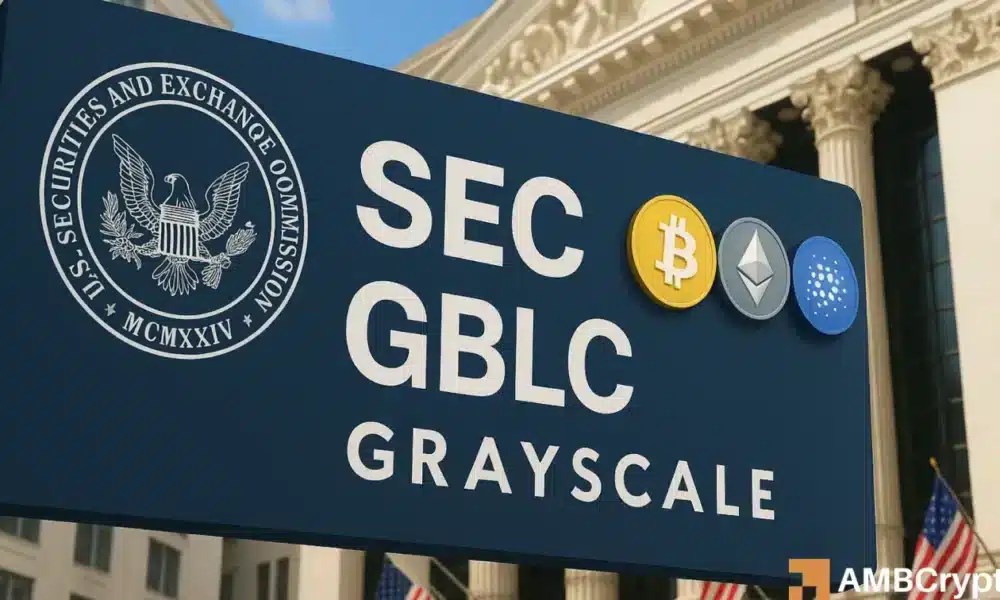
Grayscale’s ‘first multi-crypto asset ETP’ in the works: Will BTC, ETH win?

Grayscale’s ‘first multi-crypto asset ETP’ in the works: Will BTC, ETH win?

The post Grayscale’s ‘first multi-crypto asset ETP’ in the works: Will BTC, ETH win? appeared on BitcoinEthereumNews.com. Key Takeaways What does this approval mean for investors? It allows traditional investors to access diversified exposure to major cryptocurrencies without buying tokens directly. Which cryptocurrencies are included in GDLC? Bitcoin, Ether, XRP, Solana, and Cardano. The U.S. Securities and Exchange Commission (SEC) has greenlit the Grayscale Digital Large Cap Fund (GDLC) for stock exchange trading.  The approval, coinciding with relaxed ETF listing standards, opens the door for traditional investors to access the crypto market more easily and signals growing institutional support. Grayscale CEO Peter Mintzberg weighs in Grayscale CEO Peter Mintzberg confirmed the development on X (formerly Twitter), praising the SEC’s Crypto Task Force for providing much-needed clarity to the sector. He said,  “The Grayscale team is working expeditiously to bring the FIRST multi #crypto asset ETP to market with Bitcoin, Ethereum, XRP, Solana, and Cardano.” He further added,  “Thank you to the SEC #Crypto Task Force for their continued, unmatched efforts in bringing the regulatory clarity our industry deserves.” The newly approved Grayscale Digital Large Cap Fund (GDLC) offers investors exposure to five of the world’s largest cryptocurrencies: Bitcoin [BTC], Ethereum [ETH], Ripple [XRP], Solana [SOL], and Cardano [ADA]. Impact on included tokens Following the announcement, markets reacted positively. BTC traded at $117,153.61 after a 0.69% rise in the past 24 hours, Ether climbed 2.02% to $4,579.73, XRP at $3.10 up by 3.07%, Solana at $245.94 up by 4.78%, and Cardano reached $0.9130 up by 4.85%, per CoinMarketCap. By packaging multiple cryptocurrencies into a single ETP, GDLC allows traditional investors to gain diversified crypto exposure without the need to open exchange accounts or purchase individual tokens. This green light comes just months after the SEC had delayed Grayscale’s plan to convert GDLC from an over-the-counter fund to an ETP listed on NYSE Arca. With approval now granted, the fund is…
Share
BitcoinEthereumNews2025/09/19 12:53

Trade GOLD, Share 1,000,000 USDT

Trade GOLD, Share 1,000,000 USDTTrade GOLD, Share 1,000,000 USDT

0 fees, up to 1,000x leverage, deep liquidity