Bitcoin price bounced after a six-month low, but weak liquidity and ongoing liquidations keep the market unsure about near-term direction. Bitcoin hit a six-month low over the weekend as liquidity thinned across global markets. Bitcoin dropped to the 92,970 range…Bitcoin price bounced after a six-month low, but weak liquidity and ongoing liquidations keep the market unsure about near-term direction. Bitcoin hit a six-month low over the weekend as liquidity thinned across global markets. Bitcoin dropped to the 92,970 range…

Bitcoin price bounced from a six-month low: what comes next?

Bitcoin price bounced after a six-month low, but weak liquidity and ongoing liquidations keep the market unsure about near-term direction.

Summary
  • Bitcoin price hit a six-month low on Sunday before a mild rebound toward 95,500.
  • Weak liquidity, ETF outflows, and heavy leverage continue to pressure the market.
  • Analysts expect slow or sideways movement unless support holds and conditions improve.

Bitcoin hit a six-month low over the weekend as liquidity thinned across global markets. Bitcoin dropped to the 92,970 range on Sunday and has since climbed back to around 95,500 as of Nov. 17.
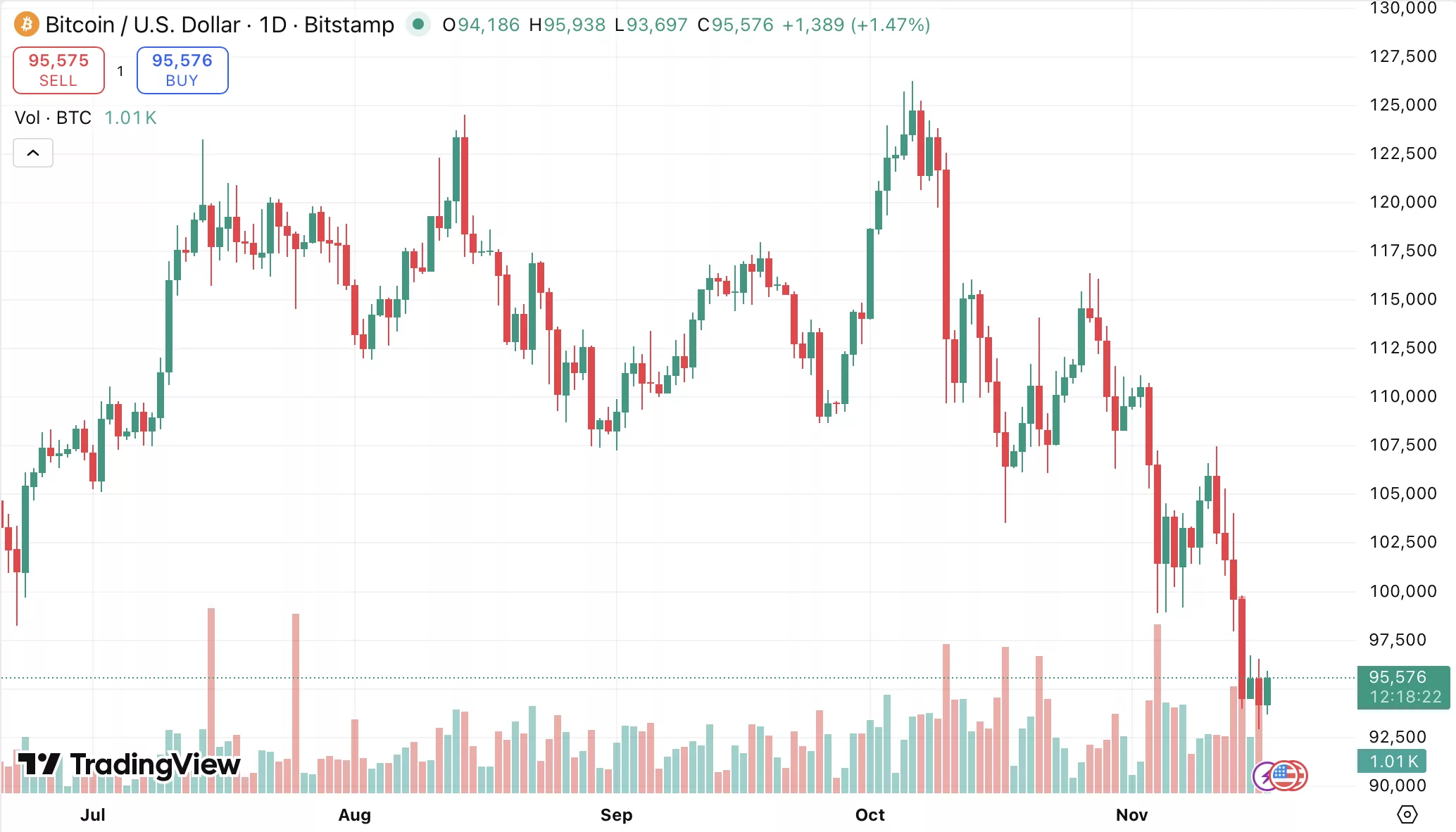
Bitcoin price bounced from a six-month low: what comes next? - 1

The fall erased part of the gains made earlier this year. Data shows heavy liquidations across the crypto market in the past day, with Bitcoin (BTC) carrying most of the impact.

Sentiment has weakened sharply. The Crypto Fear and Greed Index has fallen into the “Extreme Fear” band. Since 2017, four of the last five market cycles reached their lowest points when the index touched these levels. Only 2022 played out differently because fear lasted for months.

Some analysts believe liquidity pressure could ease soon as government spending resumes and pending payments start circulating again. A large stimulus package under review in Japan is another factor traders are watching closely.

ETF outflows and the October overhang

Fading expectations for another rate cut in December have added to the pressure. That mix pushed investors out of U.S. spot Bitcoin ETFs last week, reinforcing downward momentum.

Gold and Bitcoin also moved apart after the record liquidation wave in early October. Gold has outperformed Bitcoin through the past month even though the two moved together earlier this year. Markets still have not recovered from the October sell-off.

Analysts point to heavy leverage and forced unwinds as key drivers of recent losses. Digital assets have shed large value since October, with daily losses stacking up. Current valuations remain below pre-liquidation levels, even though crypto fundamentals have not deteriorated.

More political support emerged for digital assets in recent weeks, but Bitcoin has still continued to drift lower.

Technical pressure and near-term outlook

Bitcoin is now testing key support zones. Traders say the lower support band needs to hold to avoid deeper technical stress. Charts point to a bear phase, but earlier cycles show that deep pullbacks have often come before larger rallies.

Economists also point to a changing macro backdrop, with government functions restored, possible rate cuts ahead, and central bank balance sheet tightening nearing its end.

Even with the current weakness, many analysts believe that the market still has a fair chance of recovering over time.


Market Opportunity
SIX Logo
SIX Price(SIX)
$0.0119
$0.0119$0.0119
-2.61%
USD
SIX (SIX) Live Price Chart
Disclaimer: The articles reposted on this site are sourced from public platforms and are provided for informational purposes only. They do not necessarily reflect the views of MEXC. All rights remain with the original authors. If you believe any content infringes on third-party rights, please contact service@support.mexc.com for removal. MEXC makes no guarantees regarding the accuracy, completeness, or timeliness of the content and is not responsible for any actions taken based on the information provided. The content does not constitute financial, legal, or other professional advice, nor should it be considered a recommendation or endorsement by MEXC.

You May Also Like

Modernizing Legacy E-Commerce Platforms: From Oracle ATG To Cloud-Native Architectures

Modernizing Legacy E-Commerce Platforms: From Oracle ATG To Cloud-Native Architectures

Oracle ATG Commerce was the platform of record for large enterprises for many years. But the e-commerce game has changed, and now, speed, agility, and scalability are the name of the game.
Share
Hackernoon2025/09/18 04:42
ArtGis Finance Partners with MetaXR to Expand its DeFi Offerings in the Metaverse

ArtGis Finance Partners with MetaXR to Expand its DeFi Offerings in the Metaverse

By using this collaboration, ArtGis utilizes MetaXR’s infrastructure to widen access to its assets and enable its customers to interact with the metaverse.
Share
Blockchainreporter2025/09/18 00:07
Headwind Helps Best Wallet Token

Headwind Helps Best Wallet Token

The post Headwind Helps Best Wallet Token appeared on BitcoinEthereumNews.com. Google has announced the launch of a new open-source protocol called Agent Payments Protocol (AP2) in partnership with Coinbase, the Ethereum Foundation, and 60 other organizations. This allows AI agents to make payments on behalf of users using various methods such as real-time bank transfers, credit and debit cards, and, most importantly, stablecoins. Let’s explore in detail what this could mean for the broader cryptocurrency markets, and also highlight a presale crypto (Best Wallet Token) that could explode as a result of this development. Google’s Push for Stablecoins Agent Payments Protocol (AP2) uses digital contracts known as ‘Intent Mandates’ and ‘Verifiable Credentials’ to ensure that AI agents undertake only those payments authorized by the user. Mandates, by the way, are cryptographically signed, tamper-proof digital contracts that act as verifiable proof of a user’s instruction. For example, let’s say you instruct an AI agent to never spend more than $200 in a single transaction. This instruction is written into an Intent Mandate, which serves as a digital contract. Now, whenever the AI agent tries to make a payment, it must present this mandate as proof of authorization, which will then be verified via the AP2 protocol. Alongside this, Google has also launched the A2A x402 extension to accelerate support for the Web3 ecosystem. This production-ready solution enables agent-based crypto payments and will help reshape the growth of cryptocurrency integration within the AP2 protocol. Google’s inclusion of stablecoins in AP2 is a massive vote of confidence in dollar-pegged cryptocurrencies and a huge step toward making them a mainstream payment option. This widens stablecoin usage beyond trading and speculation, positioning them at the center of the consumption economy. The recent enactment of the GENIUS Act in the U.S. gives stablecoins more structure and legal support. Imagine paying for things like data crawls, per-task…
Share
BitcoinEthereumNews2025/09/18 01:27