Publicly listed crypto treasuries are turning defensive as market volatility prompts a wave of corporate share buybacks across the digital asset treasury (DAT) sector. Recently, Nasdaq-listed Upexi has authorized a $50 million share repurchase program, showing a broader shift toward capital preservation even as firms continue to hold massive Solana reserves on their balance sheets. Upexi Greenlights Share Buyback Amid 47% Stock Drop Upexi, a Solana-focused digital asset treasury company and consumer brands operator, said its board approved the buyback to provide “flexibility to purchase shares in the open market” depending on market conditions. The company emphasized that the program reflects confidence in its long-term strategy while maintaining a strong treasury position. The CEO, Allan Marshall, also added that the repurchase is a tool to enhance shareholder value and will be executed only when returns are attractive. The company’s treasury holds roughly 2 million SOL, valued at $283 million, representing about 0.35% of Solana’s total supply.Source: Sol Treasury Despite a recent decline in Solana’s price, from about $143 to $134, Upexi’s on-chain reserves remain among the largest institutional holdings in the ecosystem. The firm’s crypto-backed position has, however, been mirrored by sharp volatility in its own stock, which has fallen nearly 47% over the past month from a high of $6.50 to around $3.43.Source: Sol Treasury Upexi’s move comes amid a turbulent period for Solana-linked treasuries. According to institutional reserve data, the top 20 Solana treasury and ETF holders control 24 million SOL worth about $3.4 billion, or 3.5% of the total supply.Source: Sol Treasury Around half of these holdings are staked for yield at an average return of 7.7%, while the remainder remains liquid for balance sheet management. Forward Industries (FORD) leads with 6.8 million SOL valued near $966 million, followed by Solana Company (HSDT), DeFi Development Corp (DFDV), Sharps Technology (STSS), and Upexi rounding out the top five. These firms account for roughly 76% of all institutional Solana holdings, showing how companies use digital assets strategically. Solana Treasury Firms Trade Below Asset Value as Institutions Maintain Positions Market data shows that despite Solana’s price drop of nearly 7% in 24 hours, institutional positions have largely remained intact, with no major liquidations reported. Analysts view this stability as a sign of long-term confidence in Solana’s network fundamentals and its growing role as a blockchain for corporate treasuries. Public market valuations differ. Most Solana treasuries are currently trading at a discount to their net asset value (mNAV), indicating investor caution Upexi’s mNAV stands at 0.68, while Forward Industries sits at 0.82, suggesting cautious sentiment in equity markets despite strong on-chain balance sheets. The divergence between treasury value and stock performance has been a defining feature of the DAT sector. Upexi, which reported $66.7 million in net income in its most recent quarter, driven largely by $78 million in unrealized Solana gains, still faces investor skepticism tied to broader crypto market swings. Its stock previously surged more than 600% after revealing its Solana strategy earlier this year, but has since retraced sharply as digital assets weakened. Other treasuries act similarly. On November 6, Forward Industries authorized a $1 billion share repurchase program for flexibility amid volatility. Despite the short-term pullback in prices, the overall trend in corporate Solana holdings remains upward. The rise of Solana-focused treasuries marks an evolution from the Bitcoin treasury strategies that dominated earlier cycles. These firms use Solana not only as a store of value but also as a yield-generating asset through staking and validator participation. Companies like DFDV, which stakes its entire 2.2 million SOL holding, illustrate how treasury management in crypto is becoming more active and income-drivenPublicly listed crypto treasuries are turning defensive as market volatility prompts a wave of corporate share buybacks across the digital asset treasury (DAT) sector. Recently, Nasdaq-listed Upexi has authorized a $50 million share repurchase program, showing a broader shift toward capital preservation even as firms continue to hold massive Solana reserves on their balance sheets. Upexi Greenlights Share Buyback Amid 47% Stock Drop Upexi, a Solana-focused digital asset treasury company and consumer brands operator, said its board approved the buyback to provide “flexibility to purchase shares in the open market” depending on market conditions. The company emphasized that the program reflects confidence in its long-term strategy while maintaining a strong treasury position. The CEO, Allan Marshall, also added that the repurchase is a tool to enhance shareholder value and will be executed only when returns are attractive. The company’s treasury holds roughly 2 million SOL, valued at $283 million, representing about 0.35% of Solana’s total supply.Source: Sol Treasury Despite a recent decline in Solana’s price, from about $143 to $134, Upexi’s on-chain reserves remain among the largest institutional holdings in the ecosystem. The firm’s crypto-backed position has, however, been mirrored by sharp volatility in its own stock, which has fallen nearly 47% over the past month from a high of $6.50 to around $3.43.Source: Sol Treasury Upexi’s move comes amid a turbulent period for Solana-linked treasuries. According to institutional reserve data, the top 20 Solana treasury and ETF holders control 24 million SOL worth about $3.4 billion, or 3.5% of the total supply.Source: Sol Treasury Around half of these holdings are staked for yield at an average return of 7.7%, while the remainder remains liquid for balance sheet management. Forward Industries (FORD) leads with 6.8 million SOL valued near $966 million, followed by Solana Company (HSDT), DeFi Development Corp (DFDV), Sharps Technology (STSS), and Upexi rounding out the top five. These firms account for roughly 76% of all institutional Solana holdings, showing how companies use digital assets strategically. Solana Treasury Firms Trade Below Asset Value as Institutions Maintain Positions Market data shows that despite Solana’s price drop of nearly 7% in 24 hours, institutional positions have largely remained intact, with no major liquidations reported. Analysts view this stability as a sign of long-term confidence in Solana’s network fundamentals and its growing role as a blockchain for corporate treasuries. Public market valuations differ. Most Solana treasuries are currently trading at a discount to their net asset value (mNAV), indicating investor caution Upexi’s mNAV stands at 0.68, while Forward Industries sits at 0.82, suggesting cautious sentiment in equity markets despite strong on-chain balance sheets. The divergence between treasury value and stock performance has been a defining feature of the DAT sector. Upexi, which reported $66.7 million in net income in its most recent quarter, driven largely by $78 million in unrealized Solana gains, still faces investor skepticism tied to broader crypto market swings. Its stock previously surged more than 600% after revealing its Solana strategy earlier this year, but has since retraced sharply as digital assets weakened. Other treasuries act similarly. On November 6, Forward Industries authorized a $1 billion share repurchase program for flexibility amid volatility. Despite the short-term pullback in prices, the overall trend in corporate Solana holdings remains upward. The rise of Solana-focused treasuries marks an evolution from the Bitcoin treasury strategies that dominated earlier cycles. These firms use Solana not only as a store of value but also as a yield-generating asset through staking and validator participation. Companies like DFDV, which stakes its entire 2.2 million SOL holding, illustrate how treasury management in crypto is becoming more active and income-driven

Crypto Treasuries Turn Defensive as Solana Upexi’s Buyback Adds to Growing DAT Trend

Publicly listed crypto treasuries are turning defensive as market volatility prompts a wave of corporate share buybacks across the digital asset treasury (DAT) sector.

Recently, Nasdaq-listed Upexi has authorized a $50 million share repurchase program, showing a broader shift toward capital preservation even as firms continue to hold massive Solana reserves on their balance sheets.

Upexi Greenlights Share Buyback Amid 47% Stock Drop

Upexi, a Solana-focused digital asset treasury company and consumer brands operator, said its board approved the buyback to provide “flexibility to purchase shares in the open market” depending on market conditions.

The company emphasized that the program reflects confidence in its long-term strategy while maintaining a strong treasury position.

The CEO, Allan Marshall, also added that the repurchase is a tool to enhance shareholder value and will be executed only when returns are attractive.

The company’s treasury holds roughly 2 million SOL, valued at $283 million, representing about 0.35% of Solana’s total supply.
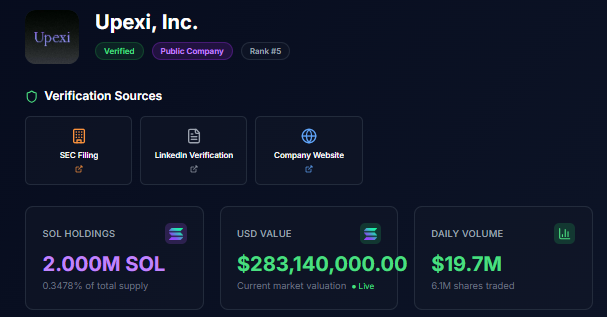
Source: Sol Treasury

Despite a recent decline in Solana’s price, from about $143 to $134, Upexi’s on-chain reserves remain among the largest institutional holdings in the ecosystem.

The firm’s crypto-backed position has, however, been mirrored by sharp volatility in its own stock, which has fallen nearly 47% over the past month from a high of $6.50 to around $3.43.

Source: Sol Treasury

Upexi’s move comes amid a turbulent period for Solana-linked treasuries. According to institutional reserve data, the top 20 Solana treasury and ETF holders control 24 million SOL worth about $3.4 billion, or 3.5% of the total supply.

Source: Sol Treasury

Around half of these holdings are staked for yield at an average return of 7.7%, while the remainder remains liquid for balance sheet management.

Forward Industries (FORD) leads with 6.8 million SOL valued near $966 million, followed by Solana Company (HSDT), DeFi Development Corp (DFDV), Sharps Technology (STSS), and Upexi rounding out the top five.

These firms account for roughly 76% of all institutional Solana holdings, showing how companies use digital assets strategically.

Solana Treasury Firms Trade Below Asset Value as Institutions Maintain Positions

Market data shows that despite Solana’s price drop of nearly 7% in 24 hours, institutional positions have largely remained intact, with no major liquidations reported.

Analysts view this stability as a sign of long-term confidence in Solana’s network fundamentals and its growing role as a blockchain for corporate treasuries.

Public market valuations differ. Most Solana treasuries are currently trading at a discount to their net asset value (mNAV), indicating investor caution

Upexi’s mNAV stands at 0.68, while Forward Industries sits at 0.82, suggesting cautious sentiment in equity markets despite strong on-chain balance sheets.

The divergence between treasury value and stock performance has been a defining feature of the DAT sector.

Upexi, which reported $66.7 million in net income in its most recent quarter, driven largely by $78 million in unrealized Solana gains, still faces investor skepticism tied to broader crypto market swings.

Its stock previously surged more than 600% after revealing its Solana strategy earlier this year, but has since retraced sharply as digital assets weakened.

Other treasuries act similarly. On November 6, Forward Industries authorized a $1 billion share repurchase program for flexibility amid volatility.

Despite the short-term pullback in prices, the overall trend in corporate Solana holdings remains upward.

The rise of Solana-focused treasuries marks an evolution from the Bitcoin treasury strategies that dominated earlier cycles.

These firms use Solana not only as a store of value but also as a yield-generating asset through staking and validator participation.

Companies like DFDV, which stakes its entire 2.2 million SOL holding, illustrate how treasury management in crypto is becoming more active and income-driven.


Disclaimer: The articles reposted on this site are sourced from public platforms and are provided for informational purposes only. They do not necessarily reflect the views of MEXC. All rights remain with the original authors. If you believe any content infringes on third-party rights, please contact service@support.mexc.com for removal. MEXC makes no guarantees regarding the accuracy, completeness, or timeliness of the content and is not responsible for any actions taken based on the information provided. The content does not constitute financial, legal, or other professional advice, nor should it be considered a recommendation or endorsement by MEXC.

You May Also Like

Crypto News: Donald Trump-Aligned Fed Governor To Speed Up Fed Rate Cuts?

Crypto News: Donald Trump-Aligned Fed Governor To Speed Up Fed Rate Cuts?

The post Crypto News: Donald Trump-Aligned Fed Governor To Speed Up Fed Rate Cuts? appeared on BitcoinEthereumNews.com. In recent crypto news, Stephen Miran swore in as the latest Federal Reserve governor on September 16, 2025, slipping into the board’s last open spot right before the Federal Open Market Committee kicks off its two-day rate discussion. Traders are betting heavily on a 25-basis-point trim, which would bring the federal funds rate down to 4.00%-4.25%, based on CME FedWatch Tool figures from September 15, 2025. Miran, who’s been Trump’s top economic advisor and a supporter of his trade ideas, joins a seven-member board where just three governors come from Democratic picks, according to the Fed’s records updated that same day. Crypto News: Miran’s Background and Quick Path to Confirmation The Senate greenlit Miran on September 15, 2025, with a tight 48-47 vote, following his nomination on September 2, 2025, as per a recent crypto news update. His stint runs only until January 31, 2026, stepping in for Adriana D. Kugler, who stepped down in August 2025 for reasons not made public. Miran earned his economics Ph.D. from Harvard and worked at the Treasury back in Trump’s first go-around. Afterward, he moved to Hudson Bay Capital Management as an economist, then looped back to the White House in December 2024 to head the Council of Economic Advisers. There, he helped craft Trump’s “reciprocal tariffs” approach, aimed at fixing trade gaps with China and the EU. He wouldn’t quit his White House gig, which irked Senator Elizabeth Warren at the September 7, 2025, confirmation hearings. That limited time frame means Miran gets to cast a vote straight away at the FOMC session starting September 16, 2025. The full board now features Chair Jerome H. Powell (Trump pick, term ends 2026), Vice Chair Philip N. Jefferson (Biden, to 2036), and folks like Lisa D. Cook (Biden, to 2028) and Michael S. Barr…
Share
BitcoinEthereumNews2025/09/18 03:14
Solana Staking Strategy: Why Co-Founder’s Vision Offers a Revolutionary Path Beyond Token Buybacks

Solana Staking Strategy: Why Co-Founder’s Vision Offers a Revolutionary Path Beyond Token Buybacks

BitcoinWorld Solana Staking Strategy: Why Co-Founder’s Vision Offers a Revolutionary Path Beyond Token Buybacks In a significant declaration that could reshape
Share
bitcoinworld2026/01/03 20:55
BlackRock Transfers Bitcoin and Ethereum as ETF Outflows Weigh on Market

BlackRock Transfers Bitcoin and Ethereum as ETF Outflows Weigh on Market

The XRP price soared 8% over the past 24 hours to trade at $2.03 as of 1:10 a.m. EST on trading volume that skyrocketed 211% [...]
Share
Insidebitcoins2026/01/03 11:32