Traditional KPIs like ticket counts or lines of code harm developer productivity. Focus on measuring Cycle Time (how quickly tasks are delivered) and Story Points (task complexity) instead. Use metrics to support, not punish, teams. Consider context, team health, and collaboration to truly boost efficiency and morale.Traditional KPIs like ticket counts or lines of code harm developer productivity. Focus on measuring Cycle Time (how quickly tasks are delivered) and Story Points (task complexity) instead. Use metrics to support, not punish, teams. Consider context, team health, and collaboration to truly boost efficiency and morale.

KPIs Are Destroying IT Teams: How to Actually Measure Developer Performance

2025/11/07 13:15
5 min read
For feedback or concerns regarding this content, please contact us at crypto.news@mexc.com

The effectiveness of an IT team directly impacts a company's success, but measuring that effectiveness can be really difficult. Counting output is tempting and simple, but that is not what really works with software, because our tasks are mostly unique and require a creative approach. Developers can fix a single bug both in 10 lines of quality code or write a hundred lines and accidentally create a technical debt. Ticket counts and lines of code encourage ‘closing for the record’ rather than closing for value.

As the CTO of a global gifting marketplace Flowwow, I mostly rely not on vanity data, but on those metrics that measure the result and its value to the business. Thus, I can feel the team health, conduct in-depth performance reviews, and track growth.

The Two Metrics To Track Productivity

To get the most of my teams' work, I mostly rely on Cycle Time and Story Points. The first shows me how quickly we're delivering value, and the second helps the team to estimate complexity of the work ahead.

Measure Flow, Not Hours

==Cycle Time== is the time from starting work on a ticket or task to the change being deployed to production.

The Cycle Time calculation consists of:

  • Grooming: Defining the task and estimating it in Story Points.

  • Coding: The actual writing of the software.

  • Code Review: Peer or team lead review of the written code.

  • Testing: Checking for bugs and overall functionality.

Every company has its ==own ideal targets.== At Flowwow, for instance, teams with highly optimised value delivery processes hit around 10–11 days. Our average teams typically take 11–15 days to implement a solution. If it's more than 15 days, then, probably, it’s time to overlook the flow or pay attention to the team’s moods.

I remember reading about a large tech company that wanted to boost developer output without sacrificing quality. They implemented the SPACE framework and focused on reducing Cycle Time. By improving code reviews and automating testing, they saw their average Cycle Time drop from 8 to 6 days in just six months. As a result, a 30% reduction in customer-facing defects and a huge jump in satisfaction rates.

Focus On Complexity

==Story Points== are our way of estimating the relative complexity of a task. This assessment is given by the team collectively during the grooming phase, before coding begins. Instead of trying to guess how many hours a task will take (a game everyone loses), developers compare tasks to build a complexity score. Usually, Story Points are estimated similar to the Fibonacci sequence: 1, 2, 3, 5, 8, 13, etc – the higher the number, the harder the task.
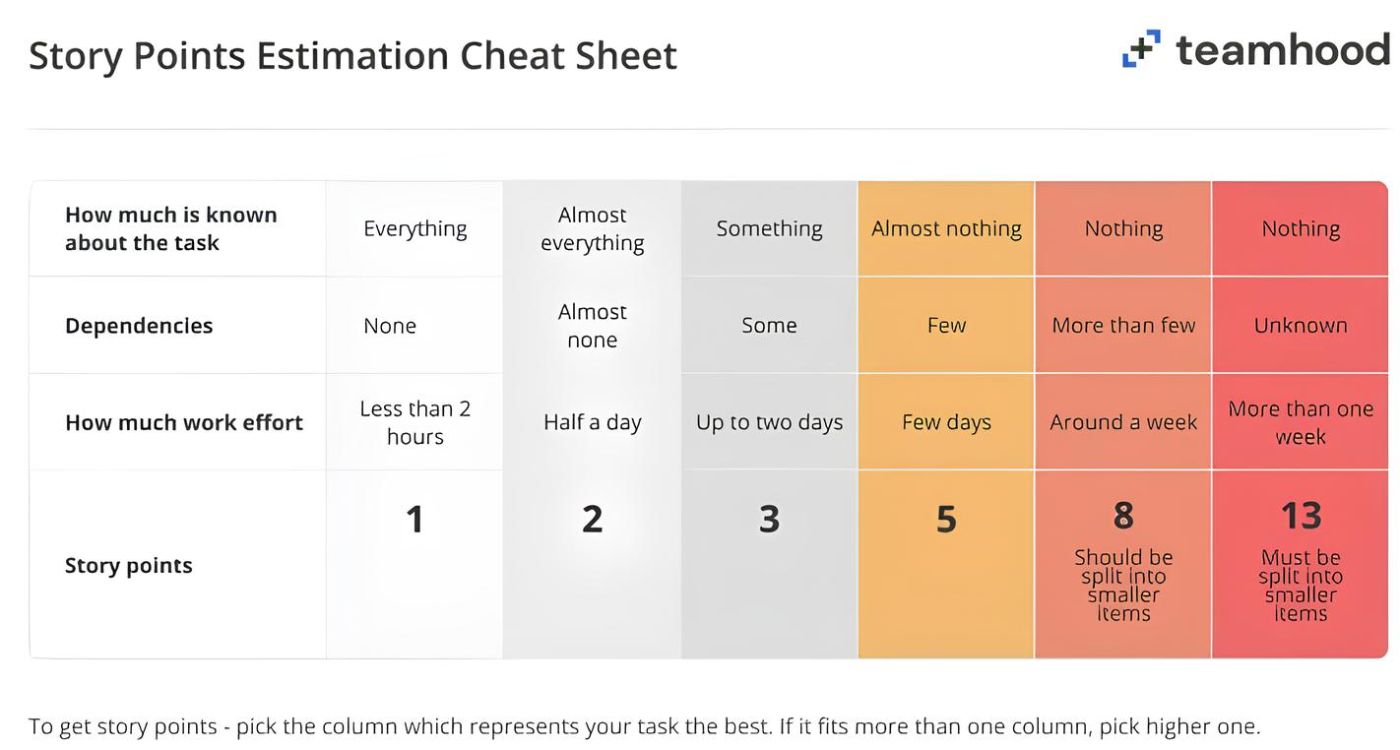
How to estimate tasks. Source: TeamhoodThe estimate takes into account:

  • The sheer volume of work.
  • Any uncertainty in the requirements.
  • Potential risks.
  • The core technical difficulty involved.

This method helps to understand how much work the team can realistically take on in an upcoming sprint. Crucially, it’s low-stress because the estimates are collaborative and non-punitive. Developers focus on writing the code, and managers get a clearer picture of the team’s capacity with an ability to optimize processes when needed.

I believe that breaking down large tasks is what makes a huge difference in productivity and spirits. ==Split it== into smaller, manageable milestones, so ==the developer can see the results== more frequently.

Usually, the total number of closed Story Points per month is pretty predictable for the whole team and for each developer. So, if I get the numbers that are lower than expected, it's a warning flag to me. Is everything fine with the person or the spirits in the team?

Checklist: How To Interpret Metrics Wisely

When it comes to measuring effectiveness, there’s one final point to highlight: Context is often more important than the numbers themselves. It’s easy to look at metrics and jump to a negative conclusion when something goes wrong. But the 'low' volume developer might be the one tackling the most ambiguous, complex tasks or spending crucial time mentoring others. The real lesson is that a metric should always become an opportunity for support and discussion about balancing the workload.

Here’s my ==checklist== for an honest measurement system:

  • Start with a problem: what do we want to improve?
  • Separate metrics from rewards: your performance metrics must not directly influence a developer's income. Good programmers will simply game the numbers.
  • Automate data collection, because no one likes complex bureaucracy for the sake of bureaucracy.
  • Make dashboards transparent for the whole team, and highlight it’s all done for the team itself.
  • Always look behind the numbers for the context.
  • Review your metrics with the team regularly.
  • Overlook the environment within the team. People achieve more when they are surrounded by supportive and friendly professionals.

Make a transparent system that is interpreted with context and is based on mutual respect and focus on value. Add engaging tasks and supportive colleagues. That’s how a strong performing team is done.

\n

Market Opportunity
Wink Logo
Wink Price(LIKE)
$0,001664
$0,001664$0,001664
-2,46%
USD
Wink (LIKE) Live Price Chart
Disclaimer: The articles reposted on this site are sourced from public platforms and are provided for informational purposes only. They do not necessarily reflect the views of MEXC. All rights remain with the original authors. If you believe any content infringes on third-party rights, please contact crypto.news@mexc.com for removal. MEXC makes no guarantees regarding the accuracy, completeness, or timeliness of the content and is not responsible for any actions taken based on the information provided. The content does not constitute financial, legal, or other professional advice, nor should it be considered a recommendation or endorsement by MEXC.
Tags:

You May Also Like

Wormhole launches reserve tying protocol revenue to token

Wormhole launches reserve tying protocol revenue to token

The post Wormhole launches reserve tying protocol revenue to token appeared on BitcoinEthereumNews.com. Wormhole is changing how its W token works by creating a new reserve designed to hold value for the long term. Announced on Wednesday, the Wormhole Reserve will collect onchain and offchain revenues and other value generated across the protocol and its applications (including Portal) and accumulate them into W, locking the tokens within the reserve. The reserve is part of a broader update called W 2.0. Other changes include a 4% targeted base yield for tokenholders who stake and take part in governance. While staking rewards will vary, Wormhole said active users of ecosystem apps can earn boosted yields through features like Portal Earn. The team stressed that no new tokens are being minted; rewards come from existing supply and protocol revenues, keeping the cap fixed at 10 billion. Wormhole is also overhauling its token release schedule. Instead of releasing large amounts of W at once under the old “cliff” model, the network will shift to steady, bi-weekly unlocks starting October 3, 2025. The aim is to avoid sharp periods of selling pressure and create a more predictable environment for investors. Lockups for some groups, including validators and investors, will extend an additional six months, until October 2028. Core contributor tokens remain under longer contractual time locks. Wormhole launched in 2020 as a cross-chain bridge and now connects more than 40 blockchains. The W token powers governance and staking, with a capped supply of 10 billion. By redirecting fees and revenues into the new reserve, Wormhole is betting that its token can maintain value as demand for moving assets and data between chains grows. This is a developing story. This article was generated with the assistance of AI and reviewed by editor Jeffrey Albus before publication. Get the news in your inbox. Explore Blockworks newsletters: Source: https://blockworks.co/news/wormhole-launches-reserve
Share
BitcoinEthereumNews2025/09/18 01:55
UK crypto holders brace for FCA’s expanded regulatory reach

UK crypto holders brace for FCA’s expanded regulatory reach

The post UK crypto holders brace for FCA’s expanded regulatory reach appeared on BitcoinEthereumNews.com. British crypto holders may soon face a very different landscape as the Financial Conduct Authority (FCA) moves to expand its regulatory reach in the industry. A new consultation paper outlines how the watchdog intends to apply its rulebook to crypto firms, shaping everything from asset safeguarding to trading platform operation. According to the financial regulator, these proposals would translate into clearer protections for retail investors and stricter oversight of crypto firms. UK FCA plans Until now, UK crypto users mostly encountered the FCA through rules on promotions and anti-money laundering checks. The consultation paper goes much further. It proposes direct oversight of stablecoin issuers, custodians, and crypto-asset trading platforms (CATPs). For investors, that means the wallets, exchanges, and coins they rely on could soon be subject to the same governance and resilience standards as traditional financial institutions. The regulator has also clarified that firms need official authorization before serving customers. This condition should, in theory, reduce the risk of sudden platform failures or unclear accountability. David Geale, the FCA’s executive director of payments and digital finance, said the proposals are designed to strike a balance between innovation and protection. He explained: “We want to develop a sustainable and competitive crypto sector – balancing innovation, market integrity and trust.” Geale noted that while the rules will not eliminate investment risks, they will create consistent standards, helping consumers understand what to expect from registered firms. Why does this matter for crypto holders? The UK regulatory framework shift would provide safer custody of assets, better disclosure of risks, and clearer recourse if something goes wrong. However, the regulator was also frank in its submission, arguing that no rulebook can eliminate the volatility or inherent risks of holding digital assets. Instead, the focus is on ensuring that when consumers choose to invest, they do…
Share
BitcoinEthereumNews2025/09/17 23:52
Trump rages at 'independent' Supreme Court judges: 'I just want smart decisions'

Trump rages at 'independent' Supreme Court judges: 'I just want smart decisions'

President Donald Trump raged at "independent" Supreme Court judges on Monday during a bill signing ceremony in the Oval Office. Trump and several administration
Share
Rawstory2026/03/17 05:07