

Nvidia CEO Predicts China’s AI Rise: Is the U.S. Falling Behind Already?
TLDR
- Nvidia CEO Jensen Huang said China will surpass the United States in the race for AI leadership.
- He explained that China benefits from lower energy costs and a more flexible regulatory environment.
- Huang criticized the U.S. approach, saying excessive regulations could slow innovation and growth in AI.
- He warned that as many as 50 new state-level regulations may burden American tech companies.
- The U.S. government continues to restrict Nvidia’s advanced chip sales to China under current trade policies.
Nvidia CEO Jensen Huang said China will surpass the United States in artificial intelligence development due to friendlier policies and cheaper energy. He made the statement during an interview with the Financial Times, highlighting his concerns about U.S. regulations. Huang’s remarks came during the FT’s Future of AI Summit, where he discussed the competitive global landscape.
China’s Advantage in AI Development
Huang stated that China’s regulatory environment gives its companies more flexibility to grow and innovate. He explained that energy subsidies support data centers run by major Chinese firms.
He pointed to companies such as ByteDance, Alibaba, and Tencent that are using these advantages to expand rapidly. These firms, according to Huang, operate massive AI data centers without the burden of high energy costs. Nvidia continues to observe these developments as competition intensifies in global AI leadership.
Huang also said Western restrictions create barriers that slow progress. He described the U.S. approach as “cynicism” that discourages innovation. Nvidia maintains that balanced regulation is necessary to sustain global technological progress.
U.S. Restrictions and Political Tensions
The U.S. government has restricted sales of Nvidia’s most advanced chips to China. President Donald Trump reaffirmed this stance after a meeting with Chinese President Xi Jinping. However, he said he might allow the sale of modified versions of Nvidia’s Blackwell chips.
Huang said these export limits could harm global competitiveness. Nvidia is working closely with U.S. officials to ensure compliance while protecting its market position.
Regulatory uncertainty in the U.S. continues to concern technology companies. Huang warned that “50 new regulations” across states could slow innovation. Nvidia remains focused on maintaining its global lead while navigating complex policy environments.
Nvidia hits five trillion market value
Chinese companies are moving fast to develop homegrown AI systems. DeepSeek, a new AI lab in China, recently launched a powerful language model. Its progress has drawn attention in Silicon Valley, where competition is fierce.
Huang acknowledged China’s rapid growth in AI research and deployment. He said the country’s unified strategy allows faster execution and scaling. Nvidia tracks these developments closely, as they influence future hardware demand.
Nvidia’s market capitalization recently reached $5 trillion, driven by renewed optimism in U.S.-China tech talks. Investors expect potential negotiations over chip exports to continue. Huang remains confident that Nvidia can adapt to both U.S. and Chinese markets.
Despite growing challenges, Nvidia continues to dominate the global semiconductor market. The company’s next steps will likely depend on government decisions and market reactions. Huang’s prediction of China’s lead underscores the shifting balance in global technology power.
The post Nvidia CEO Predicts China’s AI Rise: Is the U.S. Falling Behind Already? appeared first on CoinCentral.


You May Also Like
Ringgit opens higher on US Fed rate-hold expectations
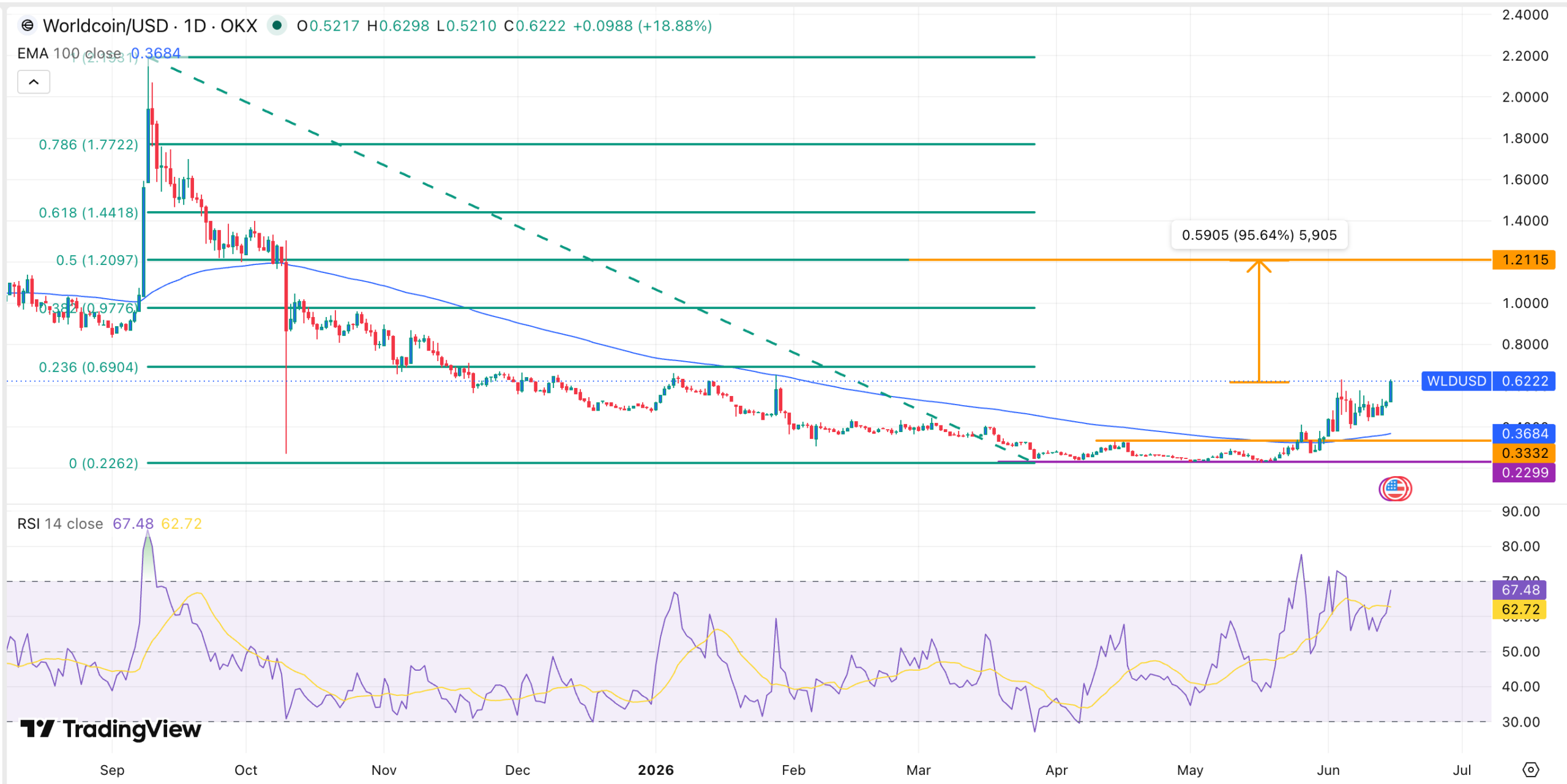
Here’s Why the Worldcoin Price is in a Strong Bull Run

Covéa Chooses Shift Technology as Strategic Partner for Fraud and Risk Management



