The United States Supreme Court held a session hearing the oral arguments in a challenge to President Donald Trump's use of the IEEPA to impose tariffs.The United States Supreme Court held a session hearing the oral arguments in a challenge to President Donald Trump's use of the IEEPA to impose tariffs.

Trump’s Tariffs on Trial: Will the Supreme Court Clip Trump’s Trade Wings?
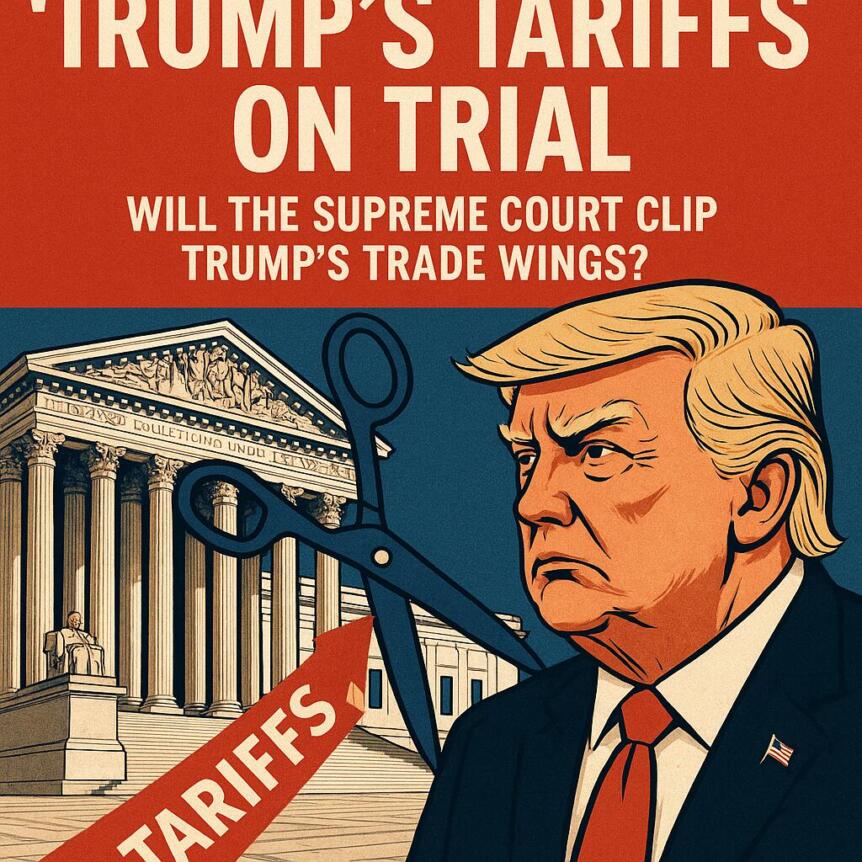
Trump's Tariffs On Trial: Will The Supreme Court Clip Trump's Trade Wings?

The United States Supreme Court held a session hearing the oral arguments today in a challenge to President Donald Trump’s use of the International Emergency Economic Powers Act (IEEPA) to impose tariffs.

The cases, Learning Resources, Inc. v. Trump and Trump v. V.O.S. Selections, Inc., present questions on whether the president can declare an “economic emergency” under IEEPA to justify tariffs without explicit congressional authorization.

With lower courts, the Court of International Trade in May and the Federal Circuit in August had already ruled against the administration, finding President Trump exceeded statutory authority. That division makes the outcome uncertain, as a 6-3 conservative majority at the high court includes three justices appointed by Trump, and legal analysts also remain divided on how the court is likely to rule.

Since February, the administration has applied IEEPA-based tariffs, from 10% to 145%, on imports from nearly all trading partners, citing trade imbalances in autos, steel, and consumer goods.

Officials have declared emergencies related to fentanyl trafficking and foreign retaliatory measures, estimating $90 billion in revenue in 2025. Opponents, from small businesses and California officials, argue that IEEPA, passed in 1977 to limit executive overreach post-Vietnam, lacks specific tariff language, a power constitutionally held by Congress.

The IEEPA Dispute: 1975 Precedent vs. 2025 Reality:

The major issue is if IEEPA’s provision to “regulate” commerce during emergencies includes tariffs, which function as import taxes.

The government maintains that the measures are essential to national security and swift negotiations on trade, citing a 1975 appellate ruling in United States v. Yoshida International, where a court equated regulatory authority with the imposition of tariffs.

Trump took to Truth Social to raise the stakes, warning a loss would leave the United States “defenseless” against imports and require billions in refunds to importers.

Federal courts rejected the view, invoking the Supreme Court’s major questions doctrine, which demands clear congressional authorization for executive actions with major economic impact.

In an August 7-4 en banc ruling, the Federal Circuit invalidated specific orders, including the April “Liberation Day” tariffs and duties on Canada and Mexico, while staying enforcement pending appeal.

Tariffs under Section 232 of the 1962 Trade Expansion Act, applicable to steel, aluminum, autos, and related industries, and Section 301 which targets unfair practices, such as those in China, were expressly exempted.

Administration officials express confidence in alternatives. Treasury Secretary Scott Bessent told CNBC the White House has “lots of options,” including extending Section 232 investigations into semiconductors, pharmaceuticals, and critical minerals, or using Section 122 for temporary 15% balance-of-payments tariffs.

Bessent stated the court “has been loath to interfere with signature policies,” though Section 301 pathways require extended investigations that slow execution relative to IEEPA.

Will Ideology Defeat the  Precedent as Conservative Justices in the Hot Seat

Analysts are divided on an outcome, showing a disagreement and division between the court’s conservative wing. Ed Mills at Raymond James said he sees a 50-50 chance, citing judicial deference to the president in matters of foreign policy.

Veda Partners’ Henrietta Treyz estimates a 50-65% chance the court will uphold lower rulings, drawing similarities to major questions used in the 2023 student loan forgiveness case. Pangaea Policy’s Terry Haines sees a slight administration edge but cautions it is “not a slam dunk” and could result in a mixed ruling instead of a complete validation or rejection of tariff authority.

Justices weigh conflicting precedents. A 2025 ruling sustains FCC authority over the Universal Service Fund and strengthens delegations under an “intelligible principle.” Applying major questions here risks accusations of inconsistency, given previous reversals of Biden administration programs.

Justice Brett Kavanaugh’s April concurrence showed exceptions for national security, potentially favoring the president. Also, former Solicitor General Donald Verrilli noted President Trump sees a loss as a personal blow to his legacy.

Stakeholder views remain divided on this matter. California Governor Gavin Newsom urged the court to invalidate and cancel all the tariffs, calling them “extreme and erratic” burdens on the state’s import-heavy economy. European diplomats expect to see the tariffs approved and upheld but think they will be reimposed through other means to maintain leverage in negotiations.

The Hidden Cost of Tariff Victory

If the administration wins this fight, it would further solidify IEEPA as a tariff channel, supporting and advancing President Trump’s reciprocal trade strategy and imposing 10% baseline import duties to secure concessions on United States exports and investments.

The Tax Foundation predicts a $1,200 increase in average household costs for 2025, increasing inflation while supporting infrastructure funding. Industrial interests such as manufacturing executives claim the policies have helped protect industries such as robotics and aviation and continued supply chain migrations out of India and China.

A revisal or defeat would not remove the existing barriers; Section 232 covers more than one-third of imports, but it would limit unilateral moves.

Potential refunds could reach tens of billions of dollars, according to Yale’s Budget Lab, clearing 71% of projected IEEPA revenue. Congress may push for votes on emergency declarations, with House Republicans delaying reforms until January.

Globally, the ruling would moderate Trump’s tariff-based demands on Ukraine aid and fentanyl controls in favor of more deliberate diplomatic channels.

This article was originally published as Trump’s Tariffs on Trial: Will the Supreme Court Clip Trump’s Trade Wings? on Crypto Breaking News – your trusted source for crypto news, Bitcoin news, and blockchain updates.


Market Opportunity
OFFICIAL TRUMP Logo
OFFICIAL TRUMP Price(TRUMP)
$5.477
$5.477$5.477
-3.42%
USD
OFFICIAL TRUMP (TRUMP) Live Price Chart
Disclaimer: The articles reposted on this site are sourced from public platforms and are provided for informational purposes only. They do not necessarily reflect the views of MEXC. All rights remain with the original authors. If you believe any content infringes on third-party rights, please contact service@support.mexc.com for removal. MEXC makes no guarantees regarding the accuracy, completeness, or timeliness of the content and is not responsible for any actions taken based on the information provided. The content does not constitute financial, legal, or other professional advice, nor should it be considered a recommendation or endorsement by MEXC.

You May Also Like

Ethereum Fusaka Upgrade Set for December 3 Mainnet Launch, Blob Capacity to Double

Ethereum Fusaka Upgrade Set for December 3 Mainnet Launch, Blob Capacity to Double

Ethereum developers confirmed the Fusaka upgrade will activate on mainnet on December 3, 2025, following a systematic testnet rollout beginning on October 1 on Holesky. The major hard fork will implement around 11-12 Ethereum Improvement Proposals targeting scalability, node efficiency, and data availability improvements without adding new user-facing features. According to Christine Kim, the upgrade introduces a phased blob capacity expansion through Blob Parameter Only forks occurring two weeks after Fusaka activation. Initially maintaining current blob limits of 6/9 target/max, the first BPO fork will increase capacity to 10/15 blobs one week later. A second BPO fork will further expand limits to 14/21 blobs, more than doubling total capacity within two weeks. Strategic Infrastructure Overhaul Fusaka prioritizes backend protocol improvements over user-facing features, focusing on making Ethereum faster and less resource-intensive. The upgrade includes PeerDAS implementation through EIP-7594, allowing validator nodes to verify data by sampling small pieces rather than downloading entire blobs. This reduces bandwidth and storage requirements while enhancing Layer 2 rollup scalability. The upgrade builds on recent gas limit increases from 30 million to 45 million gas, with ongoing discussions for further expansion. EIP-7935 proposes increasing limits to 150 million gas, potentially enabling significantly higher transaction throughput. These improvements complement broader scalability efforts, including EIP-9698, which suggests a 100x gas limit increase over two years to reach 2,000 transactions per second. Fusaka removes the previously planned EVM Object Format redesign to reduce complexity while maintaining focus on essential infrastructure improvements. The upgrade introduces bounded base fees for blob transactions via EIP-7918, creating more predictable transaction costs for data-heavy applications. Enhanced spam resistance and security improvements strengthen network resilience against scalability bottlenecks and attacks. Technical Implementation and Testing Timeline The Fusaka rollout follows a conservative four-phase approach across Ethereum testnets before mainnet deployment. Holesky upgrade occurs October 1, followed by Sepolia on October 14 and Hoodi on October 28. Each testnet will undergo the complete BPO fork sequence to validate the blob capacity expansion mechanism. BPO forks activate automatically based on predetermined epochs rather than requiring separate hard fork processes. On mainnet, the first BPO fork launches December 17, increasing blob capacity to 10/15 target/max. The second BPO fork activates January 7, 2026, reaching the final capacity of 14/21 blobs. This automated approach enables flexible blob scaling without requiring full network upgrades. Notably, node operators face release deadlines ranging from September 25 for Holesky to November 3 for mainnet preparation. The staggered timeline, according to the developers, allows comprehensive testing while giving infrastructure providers sufficient preparation time. Speculatively, the developers use this backward-compatible approach to ensure smooth transitions with minimal disruption to existing applications. PeerDAS implementation reduces node resource demands, potentially increasing network decentralization by lowering barriers for smaller operators. The technology enables more efficient data availability sampling, crucial for supporting growing Layer 2 rollup adoption. Overall, these improvements, combined with increased gas limits, will enable Ethereum to handle higher transaction volumes while maintaining security guarantees. Addressing Network Scalability Pressures The Fusaka upgrade addresses mounting pressure for Ethereum base layer improvements amid criticism of Layer 2 fragmentation strategies. Critics argue that reliance on rollups has created isolated chains with limited interoperability, complicating user experiences. The upgrade’s focus on infrastructure improvements aims to enhance base layer capacity while supporting continued Layer 2 growth. The recent validator queue controversy particularly highlights ongoing network scalability challenges. According to a Cryptonews report covered yesterday, currently, over 2M ETH sits in exit queues facing 43-day delays, while entry queues process in just 7 days.Ethereum Validator Queue (Source: ValidatorQueue) However, Vitalik Buterin defended these delays as essential for network security, comparing validator commitments to military service requiring “friction in quitting.” The upgrade coincides with growing institutional interest in Ethereum infrastructure, with VanEck predicting that Layer 2 networks could reach $1 trillion market capitalization within six years. Fusaka’s emphasis on data availability and node efficiency supports Ethereum’s evolution toward seamless cross-chain interoperability. The upgrade complements initiatives like the Open Intents Framework, where Coinbase Payments recently joined as a core contributor. The initiative, if successful, will address the $21B surge in cross-chain crime. These coordinated efforts aim to unify the fragmented multichain experience while maintaining Ethereum’s security and decentralization principles
Share
CryptoNews2025/09/19 16:37
Eyes nine-day EMA barrier near 1.3450

Eyes nine-day EMA barrier near 1.3450

The post Eyes nine-day EMA barrier near 1.3450 appeared on BitcoinEthereumNews.com. GBP/USD remains steady for the second successive session, trading around 1.3430
Share
BitcoinEthereumNews2026/01/15 11:59
Why Bitcoin Is Rising Despite Hot US Inflation Data

Why Bitcoin Is Rising Despite Hot US Inflation Data

Bitcoin is showing renewed strength, climbing close to $97,000 and reaching its highest level in nearly two months. What makes the move notable is not just the
Share
Coinstats2026/01/15 11:53