Grayscale Investments launched its Solana Trust ETF on NYSE Arca on Tuesday, becoming the first of the firm’s staking products to uplist under new SEC-approved generic listing standards. The move intensifies competition in the nascent Solana ETF market, where Bitwise’s debut product already captured $69.5 million in first-day inflows. The launch expands Grayscale’s digital asset lineup beyond Bitcoin and Ethereum, offering investors exposure to Solana’s proof-of-stake blockchain through a familiar exchange-traded wrapper. GSOL now joins Bitwise’s BSOL and Rex-Osprey’s SSK as the third Solana ETF trading on U.S. exchanges. Grayscale Enters With Staking-Enabled Structure GSOL carries a 0.35% expense ratio and holds 525,387 SOL tokens, with 74.89% currently staked to generate network rewards. Grayscale intends to pass on 77% of all staking rewards to investors on a net basis, potentially adding 5-6% annual returns based on historical Solana staking yields of 6-8%. The fund first launched as a private trust in 2021, was listed on OTCQX in 2023, and began staking in October 2025. Inkoo Kang, Senior Vice President of ETFs at Grayscale, framed the launch as evidence that digital assets belong in “modern portfolios” alongside traditional equities and bonds. Kristin Smith, President of Solana Policy Institute, also noted that staking ETPs allows investors “to help secure the network, accelerate innovation for developers, and earn rewards on one of the most dynamic assets in modern finance.” The product is not registered under the Investment Company Act of 1940, meaning it lacks the regulatory protections of traditional ETFs and mutual funds. Grayscale emphasized that GSOL represents indirect exposure to Solana and carries significant risks, including the potential loss of principal. Bitwise Dominates Early Solana ETF Flows Bitwise’s Solana ETF captured $69.5 million on its October 28 debut, nearly six times the $12 million raised by Rex-Osprey’s competing product. BSOL stakes 100% of its held SOL tokens in-house to deliver Solana’s full network yield to investors, charging a 0.20% management fee that has been waived for the first three months. Matt Hougan, Bitwise’s Chief Investment Officer, attributed institutional enthusiasm to Solana’s on-chain revenue leadership. “Institutional investors love ETFs, and they love revenue,” he said. Rex-Osprey’s SSK takes a different approach, holding 54% in direct Solana, 43.5% in a Swiss-listed CoinShares ETP, and the remainder in JitoSOL and cash, with monthly staking rewards classified as return of capital for tax purposes. Despite positive sentiment around ETFs, the market remains cautious about near-term price action. Traders on Polymarket give Solana just a 28% chance of reaching a new all-time high before 2026, with SOL trading at $200 today, up nearly 1% over 24 hours.Source: Polymarket Solana Challenges Ethereum’s Institutional Dominance Speaking with Cryptonews, Maria Carola, CEO of StealthEX, views the Solana ETF launch as a defining moment in the battle for Layer 1 blockchain dominance. “The launch of a spot ETF on Solana is a signal that has broken out in the protracted battle for dominance in the Layer 1 blockchain space,” she said. “For the first time, institutional investors are being invited to consider Solana as a standalone macro asset.“ Carola notes that projections of $3 billion in ETF inflows over the next 12-18 months depend on Solana maintaining its 2024 momentum in DeFi expansion and network stability. She acknowledges that while Solana offers technological advantages in speed and scalability, “it’s Ethereum’s fundamentals, such as stability, institutional reputation, and integration into the global financial system, that maintain its leadership.” Ethereum currently holds over $60 billion locked in DeFi with a mature staking ecosystem that continues to set the standard for institutional investors seeking predictability and reliability. However, Carola suggests a potential coexistence model where “Ethereum serves as the underlying trust and settlement layer in the on-chain economy, while Solana becomes its high-performance execution engine.” She adds that if ETF inflow projections are met by the end of 2025, “Solana could become the first blockchain since Ethereum to break the institutional glass ceiling.“ Regulatory Momentum Builds Across Multiple Blockchains The Solana ETF wave follows Hong Kong’s October approval of China Asset Management’s SOL spot fund, which began trading on October 27 with a minimum investment of $100. The product carries a 0.99% management fee and a 1.99% total expense ratio, making Solana the third cryptocurrency, after Bitcoin and Ethereum, to receive spot ETF clearance in the territory. Multiple U.S. issuers, including VanEck, Canary Capital, Franklin Templeton, Fidelity, and CoinShares, have also received approval for Solana ETF proposals. Recently, Bloomberg analyst Eric Balchunas also confirmed that the SEC is expected to approve the first Hedera and Litecoin ETFs, with listing notices for Canary’s HBAR and LTC products scheduled for October 28Grayscale Investments launched its Solana Trust ETF on NYSE Arca on Tuesday, becoming the first of the firm’s staking products to uplist under new SEC-approved generic listing standards. The move intensifies competition in the nascent Solana ETF market, where Bitwise’s debut product already captured $69.5 million in first-day inflows. The launch expands Grayscale’s digital asset lineup beyond Bitcoin and Ethereum, offering investors exposure to Solana’s proof-of-stake blockchain through a familiar exchange-traded wrapper. GSOL now joins Bitwise’s BSOL and Rex-Osprey’s SSK as the third Solana ETF trading on U.S. exchanges. Grayscale Enters With Staking-Enabled Structure GSOL carries a 0.35% expense ratio and holds 525,387 SOL tokens, with 74.89% currently staked to generate network rewards. Grayscale intends to pass on 77% of all staking rewards to investors on a net basis, potentially adding 5-6% annual returns based on historical Solana staking yields of 6-8%. The fund first launched as a private trust in 2021, was listed on OTCQX in 2023, and began staking in October 2025. Inkoo Kang, Senior Vice President of ETFs at Grayscale, framed the launch as evidence that digital assets belong in “modern portfolios” alongside traditional equities and bonds. Kristin Smith, President of Solana Policy Institute, also noted that staking ETPs allows investors “to help secure the network, accelerate innovation for developers, and earn rewards on one of the most dynamic assets in modern finance.” The product is not registered under the Investment Company Act of 1940, meaning it lacks the regulatory protections of traditional ETFs and mutual funds. Grayscale emphasized that GSOL represents indirect exposure to Solana and carries significant risks, including the potential loss of principal. Bitwise Dominates Early Solana ETF Flows Bitwise’s Solana ETF captured $69.5 million on its October 28 debut, nearly six times the $12 million raised by Rex-Osprey’s competing product. BSOL stakes 100% of its held SOL tokens in-house to deliver Solana’s full network yield to investors, charging a 0.20% management fee that has been waived for the first three months. Matt Hougan, Bitwise’s Chief Investment Officer, attributed institutional enthusiasm to Solana’s on-chain revenue leadership. “Institutional investors love ETFs, and they love revenue,” he said. Rex-Osprey’s SSK takes a different approach, holding 54% in direct Solana, 43.5% in a Swiss-listed CoinShares ETP, and the remainder in JitoSOL and cash, with monthly staking rewards classified as return of capital for tax purposes. Despite positive sentiment around ETFs, the market remains cautious about near-term price action. Traders on Polymarket give Solana just a 28% chance of reaching a new all-time high before 2026, with SOL trading at $200 today, up nearly 1% over 24 hours.Source: Polymarket Solana Challenges Ethereum’s Institutional Dominance Speaking with Cryptonews, Maria Carola, CEO of StealthEX, views the Solana ETF launch as a defining moment in the battle for Layer 1 blockchain dominance. “The launch of a spot ETF on Solana is a signal that has broken out in the protracted battle for dominance in the Layer 1 blockchain space,” she said. “For the first time, institutional investors are being invited to consider Solana as a standalone macro asset.“ Carola notes that projections of $3 billion in ETF inflows over the next 12-18 months depend on Solana maintaining its 2024 momentum in DeFi expansion and network stability. She acknowledges that while Solana offers technological advantages in speed and scalability, “it’s Ethereum’s fundamentals, such as stability, institutional reputation, and integration into the global financial system, that maintain its leadership.” Ethereum currently holds over $60 billion locked in DeFi with a mature staking ecosystem that continues to set the standard for institutional investors seeking predictability and reliability. However, Carola suggests a potential coexistence model where “Ethereum serves as the underlying trust and settlement layer in the on-chain economy, while Solana becomes its high-performance execution engine.” She adds that if ETF inflow projections are met by the end of 2025, “Solana could become the first blockchain since Ethereum to break the institutional glass ceiling.“ Regulatory Momentum Builds Across Multiple Blockchains The Solana ETF wave follows Hong Kong’s October approval of China Asset Management’s SOL spot fund, which began trading on October 27 with a minimum investment of $100. The product carries a 0.99% management fee and a 1.99% total expense ratio, making Solana the third cryptocurrency, after Bitcoin and Ethereum, to receive spot ETF clearance in the territory. Multiple U.S. issuers, including VanEck, Canary Capital, Franklin Templeton, Fidelity, and CoinShares, have also received approval for Solana ETF proposals. Recently, Bloomberg analyst Eric Balchunas also confirmed that the SEC is expected to approve the first Hedera and Litecoin ETFs, with listing notices for Canary’s HBAR and LTC products scheduled for October 28

Solana ETF Race Heats Up as Grayscale Joins Bitwise on Wall Street

2025/10/29 23:01
4 min read

Grayscale Investments launched its Solana Trust ETF on NYSE Arca on Tuesday, becoming the first of the firm’s staking products to uplist under new SEC-approved generic listing standards.

The move intensifies competition in the nascent Solana ETF market, where Bitwise’s debut product already captured $69.5 million in first-day inflows.

The launch expands Grayscale’s digital asset lineup beyond Bitcoin and Ethereum, offering investors exposure to Solana’s proof-of-stake blockchain through a familiar exchange-traded wrapper.

GSOL now joins Bitwise’s BSOL and Rex-Osprey’s SSK as the third Solana ETF trading on U.S. exchanges.

Grayscale Enters With Staking-Enabled Structure

GSOL carries a 0.35% expense ratio and holds 525,387 SOL tokens, with 74.89% currently staked to generate network rewards.

Grayscale intends to pass on 77% of all staking rewards to investors on a net basis, potentially adding 5-6% annual returns based on historical Solana staking yields of 6-8%.

The fund first launched as a private trust in 2021, was listed on OTCQX in 2023, and began staking in October 2025.

Inkoo Kang, Senior Vice President of ETFs at Grayscale, framed the launch as evidence that digital assets belong in “modern portfolios” alongside traditional equities and bonds.

Kristin Smith, President of Solana Policy Institute, also noted that staking ETPs allows investors “to help secure the network, accelerate innovation for developers, and earn rewards on one of the most dynamic assets in modern finance.”

The product is not registered under the Investment Company Act of 1940, meaning it lacks the regulatory protections of traditional ETFs and mutual funds.

Grayscale emphasized that GSOL represents indirect exposure to Solana and carries significant risks, including the potential loss of principal.

Bitwise Dominates Early Solana ETF Flows

Bitwise’s Solana ETF captured $69.5 million on its October 28 debut, nearly six times the $12 million raised by Rex-Osprey’s competing product.

BSOL stakes 100% of its held SOL tokens in-house to deliver Solana’s full network yield to investors, charging a 0.20% management fee that has been waived for the first three months.

Matt Hougan, Bitwise’s Chief Investment Officer, attributed institutional enthusiasm to Solana’s on-chain revenue leadership.

“Institutional investors love ETFs, and they love revenue,” he said.

Rex-Osprey’s SSK takes a different approach, holding 54% in direct Solana, 43.5% in a Swiss-listed CoinShares ETP, and the remainder in JitoSOL and cash, with monthly staking rewards classified as return of capital for tax purposes.

Despite positive sentiment around ETFs, the market remains cautious about near-term price action.

Traders on Polymarket give Solana just a 28% chance of reaching a new all-time high before 2026, with SOL trading at $200 today, up nearly 1% over 24 hours.
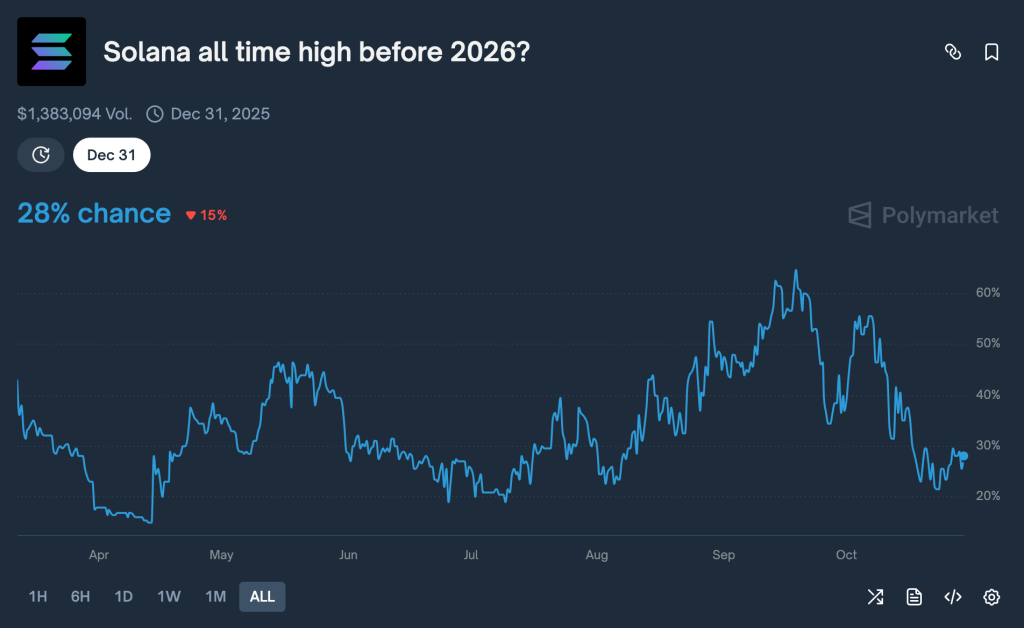
Solana ETF Race Heats Up as Grayscale Joins Bitwise on Wall StreetSource: Polymarket

Solana Challenges Ethereum’s Institutional Dominance

Speaking with Cryptonews, Maria Carola, CEO of StealthEX, views the Solana ETF launch as a defining moment in the battle for Layer 1 blockchain dominance.

The launch of a spot ETF on Solana is a signal that has broken out in the protracted battle for dominance in the Layer 1 blockchain space,” she said.

For the first time, institutional investors are being invited to consider Solana as a standalone macro asset.

Carola notes that projections of $3 billion in ETF inflows over the next 12-18 months depend on Solana maintaining its 2024 momentum in DeFi expansion and network stability.

She acknowledges that while Solana offers technological advantages in speed and scalability, “it’s Ethereum’s fundamentals, such as stability, institutional reputation, and integration into the global financial system, that maintain its leadership.

Ethereum currently holds over $60 billion locked in DeFi with a mature staking ecosystem that continues to set the standard for institutional investors seeking predictability and reliability.

However, Carola suggests a potential coexistence model where “Ethereum serves as the underlying trust and settlement layer in the on-chain economy, while Solana becomes its high-performance execution engine.”

She adds that if ETF inflow projections are met by the end of 2025, “Solana could become the first blockchain since Ethereum to break the institutional glass ceiling.

Regulatory Momentum Builds Across Multiple Blockchains

The Solana ETF wave follows Hong Kong’s October approval of China Asset Management’s SOL spot fund, which began trading on October 27 with a minimum investment of $100.

The product carries a 0.99% management fee and a 1.99% total expense ratio, making Solana the third cryptocurrency, after Bitcoin and Ethereum, to receive spot ETF clearance in the territory.

Multiple U.S. issuers, including VanEck, Canary Capital, Franklin Templeton, Fidelity, and CoinShares, have also received approval for Solana ETF proposals.

Recently, Bloomberg analyst Eric Balchunas also confirmed that the SEC is expected to approve the first Hedera and Litecoin ETFs, with listing notices for Canary’s HBAR and LTC products scheduled for October 28.


Disclaimer: The articles reposted on this site are sourced from public platforms and are provided for informational purposes only. They do not necessarily reflect the views of MEXC. All rights remain with the original authors. If you believe any content infringes on third-party rights, please contact crypto.news@mexc.com for removal. MEXC makes no guarantees regarding the accuracy, completeness, or timeliness of the content and is not responsible for any actions taken based on the information provided. The content does not constitute financial, legal, or other professional advice, nor should it be considered a recommendation or endorsement by MEXC.

You May Also Like

Solana (SOL) Price: Is a Breakout Coming After Four Weeks Stuck in the Same Range?

Solana (SOL) Price: Is a Breakout Coming After Four Weeks Stuck in the Same Range?

TLDR Solana (SOL) has traded in a tight $77–$88 range for nearly four weeks with no clear trend direction US spot Solana ETFs recorded over $44 million in weekly
Share
Coincentral2026/03/02 15:55
South Africa Tax Collector Deploys New Tech to Track Crypto and Offshore Assets

South Africa Tax Collector Deploys New Tech to Track Crypto and Offshore Assets

The post South Africa Tax Collector Deploys New Tech to Track Crypto and Offshore Assets appeared on BitcoinEthereumNews.com. South African crypto-asset service
Share
BitcoinEthereumNews2026/03/02 16:33
Crypto Futures Liquidation: Unpacking the Stunning $105 Million Market Shock

Crypto Futures Liquidation: Unpacking the Stunning $105 Million Market Shock

BitcoinWorld Crypto Futures Liquidation: Unpacking the Stunning $105 Million Market Shock The cryptocurrency market just experienced a sudden jolt, with a staggering $105 million worth of futures liquidated in a single hour. This dramatic event, part of a larger $311 million wipeout over the past 24 hours, has sent ripples across major exchanges. For many traders, this recent wave of crypto futures liquidation serves as a stark reminder of the inherent volatility and risks associated with leveraged trading in digital assets. What Exactly is Crypto Futures Liquidation? Understanding what happened requires a quick look at futures trading. A crypto futures contract is essentially an agreement to buy or sell a cryptocurrency at a predetermined price on a specified future date. Traders use these contracts to speculate on future price movements without owning the underlying asset. Leverage Amplifies Gains and Losses: Many traders utilize leverage, which means they borrow funds to increase their trading position beyond their initial capital. While leverage can magnify profits, it also significantly amplifies potential losses. Margin Calls and Forced Selling: When the market moves against a leveraged position, a trader’s margin (the collateral they put up) might fall below a required threshold. This triggers a “margin call,” where they need to add more funds. If they fail to do so, the exchange automatically closes their position to prevent further losses – this forced closure is known as crypto futures liquidation. The Recent $105 Million Crypto Futures Liquidation: What Triggered It? The recent surge in crypto futures liquidation, particularly the rapid $105 million in one hour, indicates a sharp and unexpected price movement. While the exact catalyst can be complex, such rapid liquidations often occur during: Sudden Price Swings: A rapid upward or downward movement in a major cryptocurrency’s price can quickly push many leveraged positions into unprofitable territory, leading to widespread liquidations. Market-Wide Sentiment Shifts: Unexpected news, regulatory announcements, or macroeconomic data can trigger a sudden shift in market sentiment, causing a cascade of selling or buying pressure. Over the past 24 hours, the total figure climbed to $311 million, highlighting a period of sustained volatility that caught many leveraged traders off guard. Why Does Leverage Play a Crucial Role in Futures Liquidation? Leverage is a double-edged sword. It allows traders to control large positions with relatively small amounts of capital. However, even a minor price fluctuation can have a significant impact on highly leveraged positions. When the market moves contrary to a trader’s bet, their equity can diminish rapidly. This is where the automatic liquidation mechanism kicks in. Exchanges implement this system to protect themselves and other traders from excessive losses. It ensures that a trader’s losses do not exceed their collateral, but it also means positions can be closed unexpectedly and quickly, contributing to the dramatic numbers seen in the recent crypto futures liquidation event. Navigating the Volatility: How Can Traders Prepare for Futures Liquidation Events? For those involved in or considering crypto futures trading, understanding and managing risk is paramount. The recent crypto futures liquidation serves as a powerful lesson. Here are some actionable insights: Use Lower Leverage: While tempting, high leverage dramatically increases risk. Opting for lower leverage significantly reduces the chance of premature liquidation. Implement Stop-Loss Orders: These orders automatically close a position if the price reaches a predetermined level, limiting potential losses before a full liquidation occurs. Manage Position Sizing: Never allocate too much of your portfolio to a single trade, especially a leveraged one. Diversification and responsible position sizing are key. Stay Informed: Keep abreast of market news, technical analysis, and global economic factors that could influence cryptocurrency prices. Beyond the Headlines: What Does This Mean for the Broader Crypto Market? While large-scale crypto futures liquidation events can be unsettling, they are a regular, albeit dramatic, feature of highly leveraged markets. Often, such events can “cleanse” the market of over-leveraged positions, potentially paving the way for more stable price action in the short term. However, they also underscore the need for caution and robust risk management practices, especially for new traders entering the volatile world of crypto futures. The recent $105 million liquidation is a stark reminder that while opportunities abound in crypto, so do significant risks. It emphasizes the importance of understanding the tools you’re using, especially leverage, and trading responsibly to protect your capital. Stay informed, manage your risks, and approach the market with a clear strategy. Frequently Asked Questions About Crypto Futures Liquidation Q1: What is the primary cause of crypto futures liquidation? A1: The primary cause is typically a sudden and significant price movement in the underlying cryptocurrency that goes against a trader’s leveraged position, causing their margin to fall below the exchange’s required maintenance level. Q2: How can traders avoid liquidation in futures trading? A2: Traders can reduce their risk of liquidation by using lower leverage, setting stop-loss orders to automatically close positions at a certain loss level, managing their position sizes responsibly, and continuously monitoring market conditions. Q3: Does liquidation only happen with leveraged positions? A3: Yes, liquidation specifically refers to the forced closure of a leveraged position when the trader’s collateral (margin) is insufficient to cover potential losses. Spot trading, where you own the asset outright, does not involve liquidation in the same manner. Q4: Is a crypto futures liquidation event bad for the entire market? A4: While immediate liquidations can cause further price volatility and negatively impact sentiment, some analysts view them as a “cleansing” event that removes excessive leverage from the market, potentially leading to a healthier, more stable environment in the long run. However, it certainly signifies a period of heightened risk. Q5: What is the difference between a margin call and liquidation? A5: A margin call is a notification from the exchange that your margin level is too low and you need to deposit more funds to maintain your position. Liquidation is what happens if you fail to meet that margin call; the exchange automatically closes your position to prevent further losses. Understanding market dynamics like crypto futures liquidation is crucial for navigating the cryptocurrency space. If you found this article insightful, please share it with your network on social media to help others better understand these significant market events and trade more responsibly. To learn more about the latest crypto market trends, explore our article on key developments shaping Bitcoin price action. This post Crypto Futures Liquidation: Unpacking the Stunning $105 Million Market Shock first appeared on BitcoinWorld.
Share
Coinstats2025/09/19 23:40