An exchange on X between Polygon’s CTO Mudit Gupta and Zcash founder Zooko Wilcox reignited a long-simmering debate over whether privacy-preserving shielded pools can be perfectly audited — and, by extension, whether ZEC’s 21 million cap can be trusted under all conceivable failure modes. The dispute hinged on a familiar fault line in privacy-coin design: […]An exchange on X between Polygon’s CTO Mudit Gupta and Zcash founder Zooko Wilcox reignited a long-simmering debate over whether privacy-preserving shielded pools can be perfectly audited — and, by extension, whether ZEC’s 21 million cap can be trusted under all conceivable failure modes. The dispute hinged on a familiar fault line in privacy-coin design: […]

Polygon CTO Vs. Zcash: Clash Erupts Over 21 Million Coin Integrity

An exchange on X between Polygon’s CTO Mudit Gupta and Zcash founder Zooko Wilcox reignited a long-simmering debate over whether privacy-preserving shielded pools can be perfectly audited — and, by extension, whether ZEC’s 21 million cap can be trusted under all conceivable failure modes. The dispute hinged on a familiar fault line in privacy-coin design: zero-knowledge protocols can obfuscate individual balances and flows, but they still must preserve a hard monetary base.

Polygon CTO Attacks Zcash

Gupta opened with a stark framing: “Nobody knows how many Zcash tokens actually exist. Shielded assets like Zcash are hard to audit. In March 2019, an infinite mint bug was detected in Zcash shielded assets. It was fixed in October 2019 but there is no guaranteed way to tell if the bug was ever exploited.”

He later softened the immediate risk assessment — “Based on heuristic, it’s unlikely the bug was exploited so no reason to panic” — while stressing what he called an enduring category risk: “I’m just highlighting an attack vector with Zcash and similar privacy pools… I’m not claiming any bug was exploited, just mentioning the possibility and risk.”

Wilcox pushed back, calling the initial post “not accurate,” and pointed Gupta to “publicly-verifiable on-chain audits” that track the monetary base. “They show the integrity of the Zcash monetary base. A straightforward game-theoretic analysis further shows zero counterfeiting,” he wrote, linking to community dashboards and documentation.

In a follow-on, Wilcox encapsulated the ZEC position with a thought experiment about the legacy Sprout pool: “Suppose someone counterfeited ZEC in the Sprout pool before October 28, 2018. Then there is a ‘race to the exits’ between the counterfeiter and his victims. Whoever moves their ZEC out of the Sprout pool first gets to keep all the money. Conclusion: there was no counterfeiting.” He added that “even if there was counterfeiting… there would still be only 16,355,911 ZEC in existence, and still only 21 M ever. Thanks, turnstiles!”

Stripped to its essentials, the technical disagreement is less about Zcash’s intended monetary policy and more about the edge-case guarantees when privacy meets auditability. Zcash’s published economics mirror Bitcoin’s: a fixed 21 million upper bound and a halving-style issuance schedule. That cap is unambiguous in official materials.

The Backstory

The controversy traces back to the counterfeiting vulnerability affecting ZEC’s earliest shielded pool, Sprout. According to the Electric Coin Company (ECC) and the Zcash Foundation, the flaw was discovered privately in 2018 and publicly disclosed on February 5, 2019; critically, the Sapling upgrade that activated on October 28, 2018 removed the vulnerable construction, and Zcash introduced “turnstile” accounting to constrain exits from shielded pools to, at most, the amount verifiably entered.

ECC reported at disclosure that it had seen “no evidence that counterfeiting has occurred,” a stance it has reiterated, and it described turnstile enforcement as a defense to preserve the monetary base even under hypothetical counterfeiting.

This is the heart of Wilcox’s argument. Because ZEC can only enter or leave a shielded pool via transfers that reveal values at the boundary, the chain can compute an expected pool balance. If more value tries to exit than has ever entered, the discrepancy becomes observable at the turnstile.

The “race to the exits” intuition — while informal — captures the idea that any attacker who minted bogus ZEC inside Sprout would be competing against legitimate holders to withdraw before the turnstile constraint bites; absent an unexplained drain to zero or a negative reconciliation, long-lived counterfeiting is inconsistent with observed pool totals. Zcash’s documentation describes these value-pool turnstiles and their role in monitoring pool integrity, and community discussions dating back years have treated them as the canonical mitigation.

Gupta’s rejoinder is about epistemic certainty, not policy intent. “Perhaps I should have been clearer,” he wrote. “Due to [the] possibility of bugs, there’s no guarantee that the shielded pools have the same amount of Zcash circulating inside them as transparent Zcash that went in. Therefore, you can’t be 100% sure of the actual total supply… [though] the likelihood of a bug like this being exploited is essentially 0.”

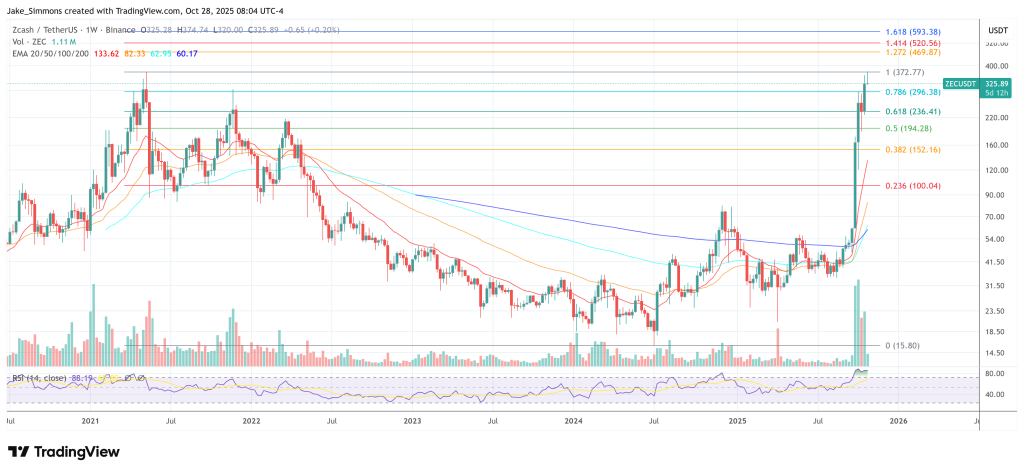
At press time, ZEC traded at $325.
Zcash price
Market Opportunity
Clash Logo
Clash Price(CLASH)
$0.047016
$0.047016$0.047016
+19.18%
USD
Clash (CLASH) Live Price Chart
Disclaimer: The articles reposted on this site are sourced from public platforms and are provided for informational purposes only. They do not necessarily reflect the views of MEXC. All rights remain with the original authors. If you believe any content infringes on third-party rights, please contact service@support.mexc.com for removal. MEXC makes no guarantees regarding the accuracy, completeness, or timeliness of the content and is not responsible for any actions taken based on the information provided. The content does not constitute financial, legal, or other professional advice, nor should it be considered a recommendation or endorsement by MEXC.

You May Also Like

XRP Price Prediction: $DSNT Could Outperform Ripple Once the Token Goes Live on Multiple Rumored CEXs at the End of January

XRP Price Prediction: $DSNT Could Outperform Ripple Once the Token Goes Live on Multiple Rumored CEXs at the End of January

Galaxy Digital’s $75 million tokenized loan deal shows how fast institutions are pushing traditional finance on-chain.  But while firms focus on private credit
Share
Coinstats2026/01/17 22:00
Crypto Market Cap Edges Up 2% as Bitcoin Approaches $118K After Fed Rate Trim

Crypto Market Cap Edges Up 2% as Bitcoin Approaches $118K After Fed Rate Trim

The global crypto market cap rose 2% to $4.2 trillion on Thursday, lifted by Bitcoin’s steady climb toward $118,000 after the Fed delivered its first interest rate cut of the year. Gains were measured, however, as investors weighed the central bank’s cautious tone on future policy moves. Bitcoin last traded 1% higher at $117,426. Ether rose 2.8% to $4,609. XRP also gained, rising 2.9% to $3.10. Fed Chair Jerome Powell described Wednesday’s quarter-point reduction as a risk-management step, stressing that policymakers were in no hurry to speed up the easing cycle. His comments dampened expectations of more aggressive cuts, limiting enthusiasm across risk assets. Traders Anticipated Fed Rate Trim, Leaving Little Room for Surprise Rally The Federal Open Market Committee voted 11-to-1 to lower the benchmark lending rate to a range of 4.00% to 4.25%. The sole dissent came from newly appointed governor Stephen Miran, who pushed for a half-point cut. Traders were largely prepared for the move. Futures markets tracked by the CME FedWatch tool had assigned a 96% probability to a 25 basis point cut, making the decision widely anticipated. That advance positioning meant much of the potential boost was already priced in, creating what analysts described as a “buy the rumour, sell the news” environment. Fed Rate Decision Creates Conditions for Crypto, But Traders Still Hold Back Andrew Forson, president of DeFi Technologies, said lower borrowing costs would eventually steer more money toward digital assets. “A lower cost of capital indicates more capital flows into the digital assets space because the risk hurdle rate for money is lower,” he noted. He added that staking products and blockchain projects could become attractive alternatives to traditional bonds, offering both yield and appreciation. Despite the cut, crypto markets remained calm. Open interest in Bitcoin futures held steady and no major liquidation cascades followed the Fed’s decision. Analysts pointed to Powell’s language and upcoming economic data as the key factors for traders before building larger positions. Powell’s Caution Tempers Immediate Impact of Fed Rate Move on Crypto Markets History also suggests crypto rallies after rate cuts often take time. When the Fed eased in Dec. 2024, Bitcoin briefly surged 5% cent before consolidating, with sustained gains arriving only weeks later. This time, market watchers are bracing for a similar pattern. Powell’s insistence on caution, combined with uncertainty around inflation and growth, has kept short-term volatility muted even as sentiment for risk assets improves. BitMine’s Tom Lee this week predicted that Bitcoin and Ether could deliver “monster gains” in the next three months if the Fed continues on an easing path. His view echoes broader expectations that liquidity-sensitive assets will outperform once the cycle gathers pace. For now, the crypto sector has digested the Fed’s move with restraint. Traders remain focused on signals from the central bank’s October meeting to determine whether Wednesday’s step marks the beginning of a broader policy shift or just a one-off adjustment
Share
CryptoNews2025/09/18 13:14
‘The White Lotus’ Season 4 Officially Casts Its Next Two Actors

‘The White Lotus’ Season 4 Officially Casts Its Next Two Actors

The post ‘The White Lotus’ Season 4 Officially Casts Its Next Two Actors appeared on BitcoinEthereumNews.com. With filming on the near horizon, The White Lotus
Share
BitcoinEthereumNews2026/01/17 22:35