

Bitcoin Poised To Top $1.5 Million, Says Ex-PayPal President
In a wide-ranging Coin Stories interview published October 21, David Marcus—co-founder and CEO of Lightspark, former president of PayPal and co-creator of Diem, the cryptocurrency project initiated by Facebook—laid out a thesis that Bitcoin will ultimately surpass gold in value and evolve from a purely “store-of-value” asset into the invisible, neutral settlement layer of the internet for money.
How Bitcoin Could Reach $1.5 Million
“I think Bitcoin will be more valuable than gold,” Marcus told host Natalie Brunell. “At today’s gold price, it’s, you know, $1.3 million a bitcoin that [it] will have a higher market cap than gold.” He emphasized he is “decent at directional predictions” but “terrible at timing,” framing the trajectory as inevitable over a five-to-ten-year horizon rather than a near-dated call. The implication of outgrowing gold’s market capitalization places Bitcoin’s potential value well north of $1.3 million per coin and, at Gold’s recent ATH at $4,381.58/oz, above $1.53 million.
Marcus’s price view is inseparable from his broader contention that BTC must progress beyond a narrow “digital gold” narrative. Echoing a line from analyst Matt Pines that Brunell cited—“if Bitcoin is only a store of value, it has failed”—Marcus agreed “fully,” but added a critical caveat: the savings-asset phase was a necessary precondition for utility.
“We believe that the store-of-value phase is absolutely essential for us to be able to actually build a utility phase of Bitcoin on top of it,” he said, arguing that institutional adoption, ETFs and nation-state accumulation conferred enough legitimacy to begin scaling real-world payments. “Now that every institution… whether it’s BlackRock, Fidelity or others, are actually supporting Bitcoin… we can actually really start building payment utility on top of it.”
That utility vision hinges on using Bitcoin more like TCP/IP—an invisible settlement substrate—than as a volatile unit of account for everyday spending. Marcus was blunt about behavioral and economic constraints: “People don’t want to use Bitcoin for everyday purchases because it’s volatile and people want to actually benefit from appreciation… they don’t want to be the Bitcoin pizza guy.”
Lightspark’s approach is to move fiat end-to-end while using BTC in the middle. “You can send dollars from a US bank account to someone in Mexico receiving Mexican peso… the settlement asset is Bitcoin in between. So you have dollars, Bitcoin, Mexican peso and it’s invisible to people using it.”
Technically, Lightspark is pushing beyond Lightning’s channel model while remaining backward-compatible. Marcus lauded Lightning’s trust model and speed, but highlighted its liquidity and self-custody frictions when scaled to “billions of endpoints.”
The company’s newly launched “Spark” is described as a Lightning-compatible, non-channel payment system that enables spinning up “billions of wallets” with “minimal new trust assumptions.” Crucially, he said, it preserves safety valves: “It’s not as trustless as Lightning, but we believe it’s trustless enough and has unilateral exits to Layer 1… you can pull a rip cord and no one can prevent you from recovering your funds on L1.”
Stablecoins And Adoption
Marcus also argued that stablecoins—despite their centralized issuer model—are an unavoidable component of global payments, and that anchoring them to BTC’s settlement layer enhances resilience. He described a personal “schizophrenic journey” with stablecoins, disliking the “single throat to choke,” yet accepting their ubiquity and attempting to minimize trust by avoiding separate gas tokens and preserving unilateral exits to Bitcoin L1.
On adoption, Marcus pointed to shifting institutional sentiment. Recounting a panel in New York “put together by Citadel Securities,” he said a “majority” of a roughly 450-person room of large traditional-finance investors indicated they own BTC, versus far fewer holding ETH, stablecoins, or any token. “This is a room that traditionally would have been very resistant to Bitcoin… now the times have changed so profoundly.” Yet he still framed retail penetration as early, estimating “low hundreds of millions” of unique holders globally and significant headroom from there.
Overall, Marcus’ thesis returns to first principles: BTC as neutral, scarce, programmable collateral and a credibly decentralized settlement layer. Dismissing critiques that it lacks “intrinsic value,” he argued, “Underlying scarcity of Bitcoin secured by code is the intrinsic value… this is the only thing that’s deflationary by nature.”
That, he contends, is why Bitcoin should outcompete gold over time: “When the first gold ETFs were launched, they started mining more gold. You can’t do that with Bitcoin.” If and when that market-cap crossover arrives, it would validate the structural call embedded in his remarks—and, by extension, the headline-grabbing notion that BTC’s fair value is not just above seven figures, but ultimately “more valuable than gold,” which today maps to $1.5 million.
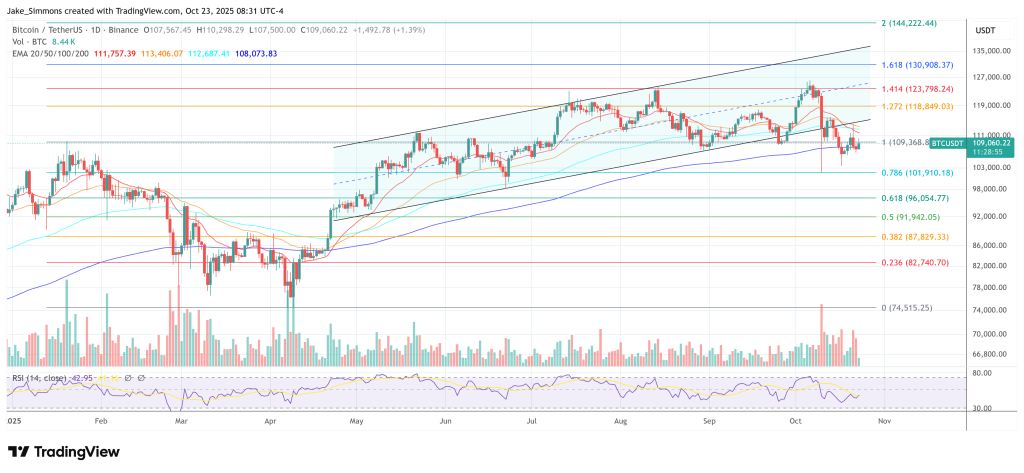
At press time, BTC traded at $109,060.


You May Also Like

Taiko ERC20 Vault Exploit Leads to Estimated $1 Million Loss, Blockaid Reports

Bitcoin Prediction From February Comes Back Into Focus As BTC Trades Near $65K Zone

Yamal opens World Cup account in style as Spain thrash Saudi Arabia 4-0 to top group



