Pioneers are now allowed to use PI as collateral, borrow stablecoins, or lend to earn yields.Pioneers are now allowed to use PI as collateral, borrow stablecoins, or lend to earn yields.

Major Pi Network Update: Will This Be the Turning Point for PI?

2025/10/23 18:21

The developments surrounding the controversial crypto project Pi Network are quite frequent, and in the following lines, we will focus on the latest one.

We will also examine the price performance of the native token PI and assess its potential for a short-term resurgence.

‘Turn Your PI Into Power’

PiBridge, a project related to Pi Network that specializes in offering exclusive services to the community, such as an exchange platform, recently unveiled P2P lending. This means that people can now use their PI holdings as collateral, borrow stablecoins, or lend to earn yields.

The team revealed that this initiative marks the next step toward the launch of the PiBridge Neobank.

Another recent development surrounding Pi Network is the upgrade of the AI-powered platform Pi App Studio. In mid-October, the team launched new updates “to make app creation more accessible and customizable, and integrated within the ecosystem.”

Pi App Studio saw the light of day on June 28, a date known across the PI community as Pi2Day, with the primary goal of enabling users to create decentralized applications (dApps) without any programming skills.

Meanwhile, in August, the team unveiled the Pi Hackathon 2025: an event that encourages developers to build real-world applications that expand the utility of the PI coin. While it was supposed to run until October 14, Pi Network has not yet given details about its end.

PI Price Outlook

Several hours ago, the price of Pi Network’s native cryptocurrency plummeted to $0.19, but shortly after, it followed the resurgence of the entire crypto market and is now trading above $0.20.
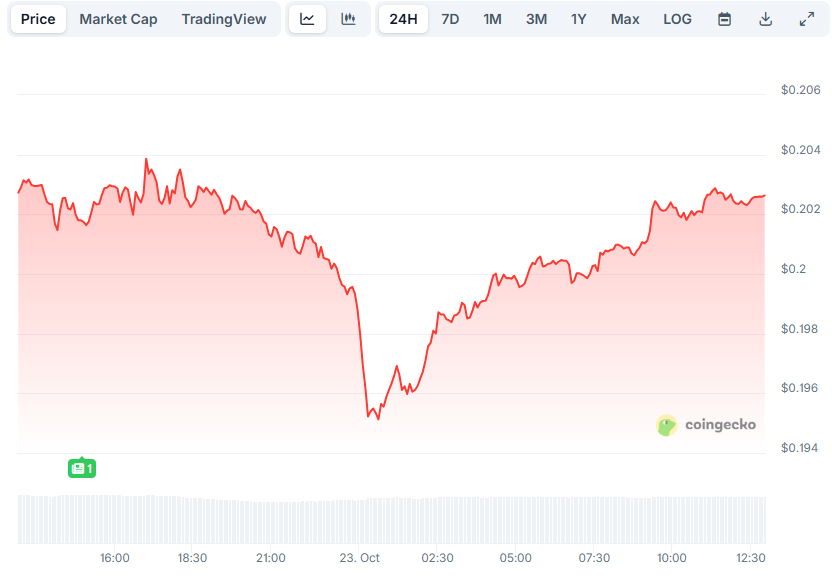
PI PricePI Price, Source: CoinGecko

However, this level remains quite disappointing for the bulls since it represents a 26% decline on a monthly scale and a staggering 93% crash since the all-time high of $3 witnessed at the start of the year.

Two essential factors signal that PI’s valuation may experience a more substantial rebound in the near future. First, the amount of tokens stored on crypto exchanges has decreased significantly: over one million coins have left centralized platforms in the past 24 hours alone, suggesting investors have shifted towards self-custody methods, thus reducing selling pressure.

Second, PI’s Relative Strength Index (RSI), which continues hovering around 30. The technical analysis tool measures the speed and magnitude of recent price changes to give traders a possible idea of reversal points. Ratios below 30 indicate the asset is oversold and due for a potential rally, while anything above 70 is interpreted as a bearish signal.

PI RSIPI RSI, Source: TradingView

The post Major Pi Network Update: Will This Be the Turning Point for PI? appeared first on CryptoPotato.


Disclaimer: The articles reposted on this site are sourced from public platforms and are provided for informational purposes only. They do not necessarily reflect the views of MEXC. All rights remain with the original authors. If you believe any content infringes on third-party rights, please contact service@support.mexc.com for removal. MEXC makes no guarantees regarding the accuracy, completeness, or timeliness of the content and is not responsible for any actions taken based on the information provided. The content does not constitute financial, legal, or other professional advice, nor should it be considered a recommendation or endorsement by MEXC.

You May Also Like

South Korea Revisits Crypto Exchange Liability Amid Hacking Risks

South Korea Revisits Crypto Exchange Liability Amid Hacking Risks

The post South Korea Revisits Crypto Exchange Liability Amid Hacking Risks appeared on BitcoinEthereumNews.com. Key Points: South Korea considers no-fault liability for virtual asset exchanges. Legislation aims to enhance operator accountability in cyber attacks. Pending fines could reach 3% of sales for hacking cases. South Korea’s Financial Services Commission is contemplating imposing no-fault liability on virtual asset operators for hacking-related damages, according to a Yonhap News Agency report on December 7. This potential legislation aligns virtual asset operators with financial institutions, impacting regulatory dynamics and market stability in South Korea’s evolving crypto sector. South Korea Targets Crypto Exchanges with 3% Sales Fines The Financial Services Commission (FSC) of South Korea is considering adding a clause to its draft legislation, imposing no-fault liability on virtual asset operators. This move follows a series of 20 computer incidents on top Korean won exchanges, emphasizing the need for enhanced security measures. The FSC aims to align virtual asset exchange liabilities with those of financial companies. South Korean lawmakers are debating stricter penalties, with proposed fines reaching 3% of sales revenue, paralleling measures in the Electronic Financial Transactions Act. Current maximum fines are capped at 5 billion won. This legislative shift reflects the government’s commitment to improving user protection and response strategies in the crypto sector. Industry reactions have been mixed. While there has been no official statement from major exchanges like Upbit and Bithumb, stakeholders are closely monitoring developments. Discussions on cryptocurrency forums and social media emphasize the potential impact on exchange compliance efforts and security enhancements. No-Fault Liability: Potential Game-Changer for Crypto Compliance Did you know? The concept of no-fault liability is already applied to South Korean banks for voice phishing cases, setting a precedent for proposed crypto exchange regulations. According to CoinMarketCap, Bitcoin (BTC), as of 06:31 UTC on December 7, 2025, has a market cap of $1.79 trillion. The 24-hour trading volume declined by 41.05%…
Share
BitcoinEthereumNews2025/12/07 14:37