Japan to Combat Crypto Insider Trading with New Regulations: Report
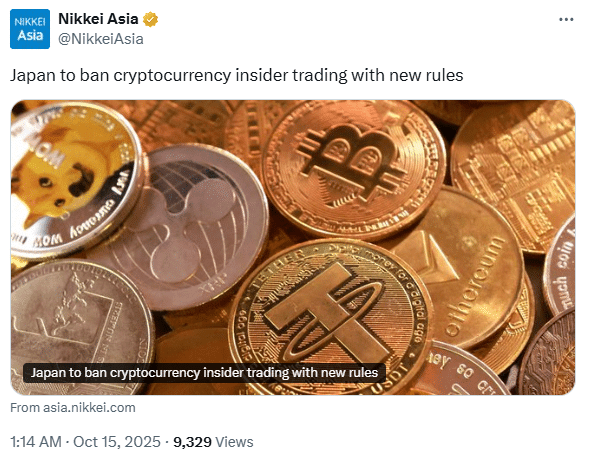
Japan plans new regulations to stamp out crypto insider trading. A law enforcement agency in the country, the Securities and Exchange Surveillance Commission (SESC), is to have new powers of crypto trading investigation.
Currently, no laws apply to crypto insider trading in FIEA. This void left the space open for regulation.
Japan’s Crypto Regulation
The Japan Virtual and Crypto Assets Exchange Association (JVCEA), which self-regulates crypto exchanges, lacks the tools to detect insider trading. This is why the government is taking steps to tighten the rules.
The Financial Services Agency (FSA), which oversees the SESC, will form a working group to discuss a new regulatory framework. They aim to submit an amendment to the FIEA by next year, bringing cryptocurrencies under the same rules as stocks and bonds.
Source: X
Insider Trading in Crypto: A Growing Concern
The rise of cryptocurrency in Japan has sparked an urgent need for clear regulations. As of August 2025, Japan has 7.88 million active cryptocurrency accounts, an increase of 400% over the past five years.
Also Read: Japan to Secure Cryptocurrencies as Legal Financial Products
Crypto insider trading poses unique challenges. Many tokens lack identifiable issuers, making it hard to define who qualifies as an insider. This makes detecting and penalizing insider trading in the crypto market more difficult compared to traditional stock trading.
Proposed Regulatory Changes to Address Crypto Insider Trading
The SESC is aiming to modify the Financial Instruments and Exchange Act to make room for crypto in insider trading laws. The new rule would be the first time the regulation expressly applies to insider trading on nondisclosed information.
Under the recommendations, the FSA would be able to provide specific guidance on what amounts to insider dealing. Such regulations would help prevent the problem of crypto insider trading in a digital age and make it clearer for crypto investors.
Challenges in Regulating Crypto Insider Trading
As opposed to traditional financial instruments, crypto assets are frequently decentralized. It’s hard to figure out what insider trading looks like when there isn’t a clear issuer for a lot of these tokens.
Japan’s regulatory agency is still coming to grips with insider trading in the crypto sector. The country certainly has lots of experience monitoring stock markets, but it is far less clear about crypto: The market remains something of the Wild West.
FSA’s Push to Reclassify Crypto Assets
New crypto insider trading rules are set to be introduced, along with the possibility of Japan’s Financial Services Agency classifying cryptocurrencies as financial products. This change would put crypto subject to the FIEA, similar to how stocks and bonds are regulated.

Reclassifying crypto could reduce to a maximum of 20% the capital gains tax digital assets are subject to, down from as much as 55%, Holger Zschaepitz explains. It would benefit crypto by making it more appealing to investors, and bring Japan’s tax policy in line with international norms.
Political Momentum for Crypto Regulation
A supporter is rising Key political figure Sanae Takaichi could bring new momentum to the regulation of the crypto asset industry in Japan. The former has openly called for technology sovereignty to be a high government priority.
She is also supportive of lower interest rates and tax cuts, moves that might see yet more capital pour into Japan’s crypto sphere. The policies of Takaichi could aid in solidifying Japan as the world’s capital for cryptocurrency regulation.
Benefits of Strengthening Crypto Oversight
There are a number of persistent problems in the cryptocurrency space that the new regulatory structure would be designed to tackle. These are misleading statements, unregistered activity, and security issues.
Policies that are transparent can help investors trade the crypto market with more assurance. Exchanges would also have to abide by tighter rules to prevent fraud and market manipulation.
Conclusion
Japan is making significant strides in regulating its crypto market. The country’s approach to crypto insider trading will likely set a precedent for other nations looking to address similar issues.
In associating crypto with traditional investment vehicles, Japan is demonstrating its resolve to create a safe and transparent marketplace. This is also an attempt to ensure a fair and transparent crypto ecosystem.
Also Read: Ripple Funds Japan’s Web3 Future: $200K Grants Aim to Ignite XRP Ledger
Summary
Japan to combat crypto insider trading with new regulation, aiming for digital currency to be on par with traditional securities. The SESC will receive renewed authority to investigate and sanction violations, with the goal of promoting greater market transparency and safety.
The FSA is also said to weigh the recategorization of cryptocurrencies under the Financial Instruments and Exchange Act, meaning they would become subject to lower capital gains taxes in exchange for better protection of investors.
Appendix: Glossary of Key Terms
Crypto Insider Trading: Illegal practice of trading cryptocurrencies based on non-public information.
Financial Instruments and Exchange Act (FIEA): Japanese law governing securities and financial markets.
Securities and Exchange Surveillance Commission (SESC): Regulatory body responsible for overseeing financial markets in Japan.
Financial Services Agency (FSA): Government agency responsible for overseeing Japan’s financial market regulations.
Capital Gains Tax: Tax on profits from the sale of assets like crypto.
Japan Virtual and Crypto Assets Exchange Association (JVCEA): Self-regulatory body overseeing crypto exchanges in Japan.
Frequently Asked Questions Crypto Insider Trading
1: What is Japan’s stance on crypto insider trading?
Japan is set to introduce regulations to ban and penalize insider trading in the crypto market, bringing it in line with traditional stock market rules.
2: How will the new regulations impact investors?
The new rules aim to protect investors by creating a more transparent and secure crypto market. Insider trading will be punished, making it safer for people to invest.
3: What changes are proposed for crypto taxation in Japan?
The FSA plans to reclassify cryptocurrencies as financial products under the FIEA. This could lower the capital gains tax on crypto to a maximum of 20%.
4: How does insider trading in crypto differ from stock trading?
Insider trading in crypto is harder to detect because many tokens lack identifiable issuers. This makes it more challenging to define who qualifies as an insider.
Read More: Japan to Combat Crypto Insider Trading with New Regulations: Report">Japan to Combat Crypto Insider Trading with New Regulations: Report
You May Also Like

France’s Macron says UN snapback sanctions on Iran coming in a week
This is Trump's tell that all isn't well