What to Know: Stripe’s stablecoin arm, Bridge, has applied for a US national trust bank charter under the GENIUS Act, joining Circle, Ripple, Paxos, and Coinbase. The GENIUS Act introduces federal oversight for stablecoin issuers, requiring 100% cash or Treasury reserves and monthly public disclosures. This could mark the start of ‘Stablecoin Season,’ as regulated issuers bridge the gap between banks and blockchain payments. Best Wallet ($BEST) stands to benefit, offering users secure custody, presale access, and up to 80% APY staking rewards. Stablecoins are going legit, and pretty fast. Stripe’s stablecoin arm, Bridge, just filed an application with the US Office of the Comptroller of the Currency (OCC) to form a national trust bank under the newly enacted GENIUS Act. It’s the latest move in what’s shaping up to be ‘Stablecoin Season’: a full-blown regulatory sprint to bring digital dollars under federal oversight. If approved, Bridge’s charter would let Stripe issue, redeem, and custody stablecoins directly under the OCC, instead of juggling dozens of state-level money-transmitter licenses. That means its entire stablecoin business would sit under on federal framework, complete with 100% cash or Treasury-backed reserves and monthly public disclosures, as required by the GENIUS Act. Bridge now joins Circle ($USDC), Ripple ($RLUSD), Paxos ($USDP), and Coinbase ($COIN) in chasing national trust licenses – a race that marks a historic pivot for the US digital asset market. Together, these firms are positioning stablecoins as the regulated backbone of global payments, rather than gray-zone fintech experiments. The timing makes sense. Stablecoins already account for over $315B in circulating value, and Standard Chartered analysts estimate they could pull $1T in deposits away from traditional banks over the next three years. For users and merchants, that shift would make stablecoins the default settlement rail of the internet. They’re faster, cheaper, and now, finally, compliant. For Striple, Bridge isn’t just about compliance; it’s also an infrastructure play. The company recently unveiled Open Issuance, a service that helps apps launch their own stablecoins using Bridge’s back-end. Wallets like Phantom ($CASH), MetaMask ($mUSD), and Hyperliquid ($USDH) already rely on Bridge as their issuance partner. All signs point to a regulated on-chain economy, where digital dollars move under federal supervision and mainstream adoption finally takes hold. So the real question for investors becomes: if stablecoins are about to become the rails of this new system, which tokens will capture user flow at the edge? That’s where Best Wallet Token ($BEST) enters the picture, powering one of the fastest-growing Web3 wallets built to bridge the gap between regulated stablecoins and everyday users. From Stablecoins to Wallet Wars – the New On-Ramp Race The race for federal trust charters isn’t just about who prints the next digital dollar; it’s about who controls the gateway to it. Stripe, Circle, Ripple, and Coinbase are fighting for issuance and compliance. But at the user level, a different war is breaking out… the battle for wallets. Under the new GENIUS framework, stablecoins can finally plug into traditional finance with clear oversight from the OCC. That unlocks direct settlement with banks, cross-chain interoperability, and compliant collateral for lending protocols. This is the pipeline for a regulated DeFi economy. And this is where crypto wallets come in. They’re no longer just storage apps. They’ve become super apps. MetaMask now offers staking, Phantom integrates stablecoin rails, and new players like Best Wallet are going further by blending payments, presales, and rewards inside one secure, Fireblocks-powered interface. Best Wallet Token ($BEST) – The Token Fueling a Web3 Super App Built for the Stablecoin Era As stablecoins edge closer to federal recognition, wallet ecosystems are becoming the frontlines of adoption. Best Wallet is positioning itself at that intersection as a non-custodial wallet app that merges security, yield, and discovery into one seamless platform. Built on Fireblocks’ MPC-CMP framework, the same institutional-grade tech used by major custodians, Best Wallet offers users secure on-chain control without sacrificing usability. It’s a place to store tokens, buy into new crypto presales, stake assets, and soon, spend crypto cash through the Best Card. That card will deliver cashback and fee discounts to anyone staking the native $BEST token. And that token is what powers the entire ecosystem. Holding $BEST unlocks reduced transaction fees, higher staking rewards, and early access to new token launches through the in-app ‘Upcoming Tokens’ feature. Discover how to buy Best Wallet Token in our step-by-step walkthrough. The project has drawn over 57K followers on X and raised $16.5M so far in the presale. Tokens are priced at $0.025795, and with ambitions to capture 40% of the crypto-wallet market by the end of 2026, you can see why we a Best Wallet Token price prediction of $0.05106175 is not unreasonable. As stablecoins come under the OCC’s watch, wallets integrating compliant rails and institutional security will stand out. Best Wallet is built precisely for that world, connecting regulated stablecoin infrastructure with DeFi native opportunities. In that sense, the GENIUS Act sets the stage for wallets like Best Wallet to become the banks of the future, Join the $BEST presale and stake now for up to 80% APY. This article does not constitute financial advice. Crypto carries inherent risks, so please do your own research (DYOR) and never invest more than you are willing to lose. Authored by X, NewsBTC — www.newsbtc.com/news/stablecoin-season-stripe-bridge-impact-best-wallet-tokenWhat to Know: Stripe’s stablecoin arm, Bridge, has applied for a US national trust bank charter under the GENIUS Act, joining Circle, Ripple, Paxos, and Coinbase. The GENIUS Act introduces federal oversight for stablecoin issuers, requiring 100% cash or Treasury reserves and monthly public disclosures. This could mark the start of ‘Stablecoin Season,’ as regulated issuers bridge the gap between banks and blockchain payments. Best Wallet ($BEST) stands to benefit, offering users secure custody, presale access, and up to 80% APY staking rewards. Stablecoins are going legit, and pretty fast. Stripe’s stablecoin arm, Bridge, just filed an application with the US Office of the Comptroller of the Currency (OCC) to form a national trust bank under the newly enacted GENIUS Act. It’s the latest move in what’s shaping up to be ‘Stablecoin Season’: a full-blown regulatory sprint to bring digital dollars under federal oversight. If approved, Bridge’s charter would let Stripe issue, redeem, and custody stablecoins directly under the OCC, instead of juggling dozens of state-level money-transmitter licenses. That means its entire stablecoin business would sit under on federal framework, complete with 100% cash or Treasury-backed reserves and monthly public disclosures, as required by the GENIUS Act. Bridge now joins Circle ($USDC), Ripple ($RLUSD), Paxos ($USDP), and Coinbase ($COIN) in chasing national trust licenses – a race that marks a historic pivot for the US digital asset market. Together, these firms are positioning stablecoins as the regulated backbone of global payments, rather than gray-zone fintech experiments. The timing makes sense. Stablecoins already account for over $315B in circulating value, and Standard Chartered analysts estimate they could pull $1T in deposits away from traditional banks over the next three years. For users and merchants, that shift would make stablecoins the default settlement rail of the internet. They’re faster, cheaper, and now, finally, compliant. For Striple, Bridge isn’t just about compliance; it’s also an infrastructure play. The company recently unveiled Open Issuance, a service that helps apps launch their own stablecoins using Bridge’s back-end. Wallets like Phantom ($CASH), MetaMask ($mUSD), and Hyperliquid ($USDH) already rely on Bridge as their issuance partner. All signs point to a regulated on-chain economy, where digital dollars move under federal supervision and mainstream adoption finally takes hold. So the real question for investors becomes: if stablecoins are about to become the rails of this new system, which tokens will capture user flow at the edge? That’s where Best Wallet Token ($BEST) enters the picture, powering one of the fastest-growing Web3 wallets built to bridge the gap between regulated stablecoins and everyday users. From Stablecoins to Wallet Wars – the New On-Ramp Race The race for federal trust charters isn’t just about who prints the next digital dollar; it’s about who controls the gateway to it. Stripe, Circle, Ripple, and Coinbase are fighting for issuance and compliance. But at the user level, a different war is breaking out… the battle for wallets. Under the new GENIUS framework, stablecoins can finally plug into traditional finance with clear oversight from the OCC. That unlocks direct settlement with banks, cross-chain interoperability, and compliant collateral for lending protocols. This is the pipeline for a regulated DeFi economy. And this is where crypto wallets come in. They’re no longer just storage apps. They’ve become super apps. MetaMask now offers staking, Phantom integrates stablecoin rails, and new players like Best Wallet are going further by blending payments, presales, and rewards inside one secure, Fireblocks-powered interface. Best Wallet Token ($BEST) – The Token Fueling a Web3 Super App Built for the Stablecoin Era As stablecoins edge closer to federal recognition, wallet ecosystems are becoming the frontlines of adoption. Best Wallet is positioning itself at that intersection as a non-custodial wallet app that merges security, yield, and discovery into one seamless platform. Built on Fireblocks’ MPC-CMP framework, the same institutional-grade tech used by major custodians, Best Wallet offers users secure on-chain control without sacrificing usability. It’s a place to store tokens, buy into new crypto presales, stake assets, and soon, spend crypto cash through the Best Card. That card will deliver cashback and fee discounts to anyone staking the native $BEST token. And that token is what powers the entire ecosystem. Holding $BEST unlocks reduced transaction fees, higher staking rewards, and early access to new token launches through the in-app ‘Upcoming Tokens’ feature. Discover how to buy Best Wallet Token in our step-by-step walkthrough. The project has drawn over 57K followers on X and raised $16.5M so far in the presale. Tokens are priced at $0.025795, and with ambitions to capture 40% of the crypto-wallet market by the end of 2026, you can see why we a Best Wallet Token price prediction of $0.05106175 is not unreasonable. As stablecoins come under the OCC’s watch, wallets integrating compliant rails and institutional security will stand out. Best Wallet is built precisely for that world, connecting regulated stablecoin infrastructure with DeFi native opportunities. In that sense, the GENIUS Act sets the stage for wallets like Best Wallet to become the banks of the future, Join the $BEST presale and stake now for up to 80% APY. This article does not constitute financial advice. Crypto carries inherent risks, so please do your own research (DYOR) and never invest more than you are willing to lose. Authored by X, NewsBTC — www.newsbtc.com/news/stablecoin-season-stripe-bridge-impact-best-wallet-token

Stripe’s Bridge Leads the Stablecoin Season, and Could Boost Best Wallet Token

2025/10/15 21:26

What to Know:

  • Stripe’s stablecoin arm, Bridge, has applied for a US national trust bank charter under the GENIUS Act, joining Circle, Ripple, Paxos, and Coinbase.
  • The GENIUS Act introduces federal oversight for stablecoin issuers, requiring 100% cash or Treasury reserves and monthly public disclosures.
  • This could mark the start of ‘Stablecoin Season,’ as regulated issuers bridge the gap between banks and blockchain payments.
  • Best Wallet ($BEST) stands to benefit, offering users secure custody, presale access, and up to 80% APY staking rewards.

Stablecoins are going legit, and pretty fast.

Stripe’s stablecoin arm, Bridge, just filed an application with the US Office of the Comptroller of the Currency (OCC) to form a national trust bank under the newly enacted GENIUS Act.
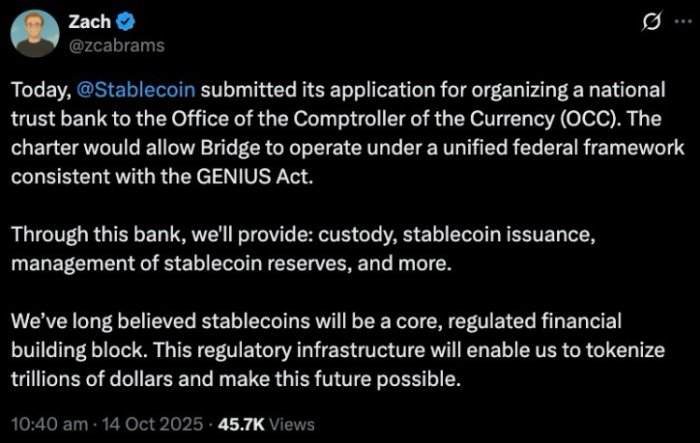
Bridge application to OCC announcement.

It’s the latest move in what’s shaping up to be ‘Stablecoin Season’: a full-blown regulatory sprint to bring digital dollars under federal oversight.

If approved, Bridge’s charter would let Stripe issue, redeem, and custody stablecoins directly under the OCC, instead of juggling dozens of state-level money-transmitter licenses.

That means its entire stablecoin business would sit under on federal framework, complete with 100% cash or Treasury-backed reserves and monthly public disclosures, as required by the GENIUS Act.

Bridge now joins Circle ($USDC), Ripple ($RLUSD), Paxos ($USDP), and Coinbase ($COIN) in chasing national trust licenses – a race that marks a historic pivot for the US digital asset market.

Together, these firms are positioning stablecoins as the regulated backbone of global payments, rather than gray-zone fintech experiments.

The timing makes sense. Stablecoins already account for over $315B in circulating value, and Standard Chartered analysts estimate they could pull $1T in deposits away from traditional banks over the next three years.
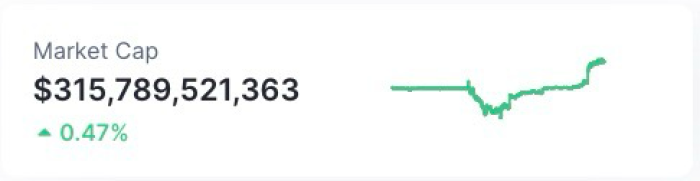
Stablecoins market cap.

For users and merchants, that shift would make stablecoins the default settlement rail of the internet. They’re faster, cheaper, and now, finally, compliant.

For Striple, Bridge isn’t just about compliance; it’s also an infrastructure play.

The company recently unveiled Open Issuance, a service that helps apps launch their own stablecoins using Bridge’s back-end. Wallets like Phantom ($CASH), MetaMask ($mUSD), and Hyperliquid ($USDH) already rely on Bridge as their issuance partner.

All signs point to a regulated on-chain economy, where digital dollars move under federal supervision and mainstream adoption finally takes hold.

So the real question for investors becomes: if stablecoins are about to become the rails of this new system, which tokens will capture user flow at the edge?

That’s where Best Wallet Token ($BEST) enters the picture, powering one of the fastest-growing Web3 wallets built to bridge the gap between regulated stablecoins and everyday users.

From Stablecoins to Wallet Wars – the New On-Ramp Race

The race for federal trust charters isn’t just about who prints the next digital dollar; it’s about who controls the gateway to it. Stripe, Circle, Ripple, and Coinbase are fighting for issuance and compliance. But at the user level, a different war is breaking out… the battle for wallets.

Under the new GENIUS framework, stablecoins can finally plug into traditional finance with clear oversight from the OCC. That unlocks direct settlement with banks, cross-chain interoperability, and compliant collateral for lending protocols. This is the pipeline for a regulated DeFi economy.

And this is where crypto wallets come in. They’re no longer just storage apps. They’ve become super apps.

MetaMask now offers staking, Phantom integrates stablecoin rails, and new players like Best Wallet are going further by blending payments, presales, and rewards inside one secure, Fireblocks-powered interface.

Best Wallet Token ($BEST) – The Token Fueling a Web3 Super App Built for the Stablecoin Era

As stablecoins edge closer to federal recognition, wallet ecosystems are becoming the frontlines of adoption. Best Wallet is positioning itself at that intersection as a non-custodial wallet app that merges security, yield, and discovery into one seamless platform.

Built on Fireblocks’ MPC-CMP framework, the same institutional-grade tech used by major custodians, Best Wallet offers users secure on-chain control without sacrificing usability.

It’s a place to store tokens, buy into new crypto presales, stake assets, and soon, spend crypto cash through the Best Card. That card will deliver cashback and fee discounts to anyone staking the native $BEST token.
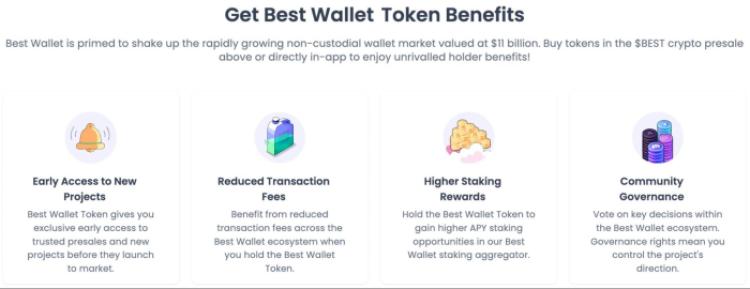
Best Wallet Token ($BEST) benefits for holders.

And that token is what powers the entire ecosystem. Holding $BEST unlocks reduced transaction fees, higher staking rewards, and early access to new token launches through the in-app ‘Upcoming Tokens’ feature.

Discover how to buy Best Wallet Token in our step-by-step walkthrough.

The project has drawn over 57K followers on X and raised $16.5M so far in the presale. Tokens are priced at $0.025795, and with ambitions to capture 40% of the crypto-wallet market by the end of 2026, you can see why we a Best Wallet Token price prediction of $0.05106175 is not unreasonable.

As stablecoins come under the OCC’s watch, wallets integrating compliant rails and institutional security will stand out. Best Wallet is built precisely for that world, connecting regulated stablecoin infrastructure with DeFi native opportunities.

In that sense, the GENIUS Act sets the stage for wallets like Best Wallet to become the banks of the future,

Join the $BEST presale and stake now for up to 80% APY.

This article does not constitute financial advice. Crypto carries inherent risks, so please do your own research (DYOR) and never invest more than you are willing to lose.

Authored by X, NewsBTC — www.newsbtc.com/news/stablecoin-season-stripe-bridge-impact-best-wallet-token

Market Opportunity
Hyperbridge Logo
Hyperbridge Price(BRIDGE)
$0.01988
$0.01988$0.01988
0.00%
USD
Hyperbridge (BRIDGE) Live Price Chart
Disclaimer: The articles reposted on this site are sourced from public platforms and are provided for informational purposes only. They do not necessarily reflect the views of MEXC. All rights remain with the original authors. If you believe any content infringes on third-party rights, please contact service@support.mexc.com for removal. MEXC makes no guarantees regarding the accuracy, completeness, or timeliness of the content and is not responsible for any actions taken based on the information provided. The content does not constitute financial, legal, or other professional advice, nor should it be considered a recommendation or endorsement by MEXC.

You May Also Like

LMAX Group Deepens Ripple Partnership With RLUSD Collateral Rollout

LMAX Group Deepens Ripple Partnership With RLUSD Collateral Rollout

LMAX Group has revealed a multi-year partnership with Ripple to integrate traditional finance with digital asset markets. As part of the agreement, LMAX will introduce
Share
Tronweekly2026/01/16 23:00
Bitcoin 8% Gains Already Make September 2025 Its Second Best

Bitcoin 8% Gains Already Make September 2025 Its Second Best

The post Bitcoin 8% Gains Already Make September 2025 Its Second Best appeared on BitcoinEthereumNews.com. Key points: Bitcoin is bucking seasonality trends by adding 8%, making this September its best since 2012. September 2025 would need to see 20% upside to become Bitcoin’s strongest ever. BTC price volatility is at levels rarely seen before in an unusual bull cycle. Bitcoin (BTC) has gained more this September than any year since 2012, a new bull market record. Historical price data from CoinGlass and BiTBO confirms that at 8%, Bitcoin’s September 2025 upside is its second-best ever. Bitcoin avoiding “Rektember” with 8% gains September is traditionally Bitcoin’s weakest month, with average losses of around 8%. BTC/USD monthly returns (screenshot). Source: CoinGlass This year, the stakes are high for BTC price seasonality, as historical patterns demand the next bull market peak and other risk assets set repeated new all-time highs. While both gold and the S&P 500 are in price discovery, BTC/USD has coiled throughout September after setting new highs of its own the month prior. Even at “just” 8%, however, this September’s performance is currently enough to make it Bitcoin’s strongest in 13 years. The only time that the ninth month of the year was more profitable for Bitcoin bulls was in 2012, when BTC/USD gained about 19.8%. Last year, upside topped out at 7.3%. BTC/USD monthly returns. Source: BiTBO BTC price volatility vanishes The figures underscore a highly unusual bull market peak year for Bitcoin. Related: BTC ‘pricing in’ what’s coming: 5 things to know in Bitcoin this week Unlike previous bull markets, BTC price volatility has died off in 2025, against the expectations of longtime market participants based on prior performance. CoinGlass data shows volatility dropping to levels not seen in over a decade, with a particularly sharp drop from April onward. Bitcoin historical volatility (screenshot). Source: CoinGlass Onchain analytics firm Glassnode, meanwhile, highlights the…
Share
BitcoinEthereumNews2025/09/18 11:09
Fed rate decision September 2025

Fed rate decision September 2025

The post Fed rate decision September 2025 appeared on BitcoinEthereumNews.com. WASHINGTON – The Federal Reserve on Wednesday approved a widely anticipated rate cut and signaled that two more are on the way before the end of the year as concerns intensified over the U.S. labor market. In an 11-to-1 vote signaling less dissent than Wall Street had anticipated, the Federal Open Market Committee lowered its benchmark overnight lending rate by a quarter percentage point. The decision puts the overnight funds rate in a range between 4.00%-4.25%. Newly-installed Governor Stephen Miran was the only policymaker voting against the quarter-point move, instead advocating for a half-point cut. Governors Michelle Bowman and Christopher Waller, looked at for possible additional dissents, both voted for the 25-basis point reduction. All were appointed by President Donald Trump, who has badgered the Fed all summer to cut not merely in its traditional quarter-point moves but to lower the fed funds rate quickly and aggressively. In the post-meeting statement, the committee again characterized economic activity as having “moderated” but added language saying that “job gains have slowed” and noted that inflation “has moved up and remains somewhat elevated.” Lower job growth and higher inflation are in conflict with the Fed’s twin goals of stable prices and full employment.  “Uncertainty about the economic outlook remains elevated” the Fed statement said. “The Committee is attentive to the risks to both sides of its dual mandate and judges that downside risks to employment have risen.” Markets showed mixed reaction to the developments, with the Dow Jones Industrial Average up more than 300 points but the S&P 500 and Nasdaq Composite posting losses. Treasury yields were modestly lower. At his post-meeting news conference, Fed Chair Jerome Powell echoed the concerns about the labor market. “The marked slowing in both the supply of and demand for workers is unusual in this less dynamic…
Share
BitcoinEthereumNews2025/09/18 02:44